11/05/2026
  982 views
Break-even point – A seemingly simple concept, yet it is the key to helping businesses balance costs and optimize profits. Accurately determining the break-even point not only helps managers understand the financial health of the business but also assists them in making better strategic decisions. In this article, 1Office will help you understand what the break-even point is, how to calculate it accurately, and its practical applications for improving business efficiency.
Mục lục
- 1. What is the break-even point?
- 2. Break-Even Point Formula
- 4. What factors increase and decrease the break-even point?
- 5. What is the significance of the break-even point in business?
- 6. Comparison and classification of break-even points
- 6. Key Considerations in Break-Even Analysis
- 7. Applying the Break-Even Point in Business
- 8. Frequently Asked Questions about the Break-Even Point
- 9. Conclusion
1. What is the break-even point?
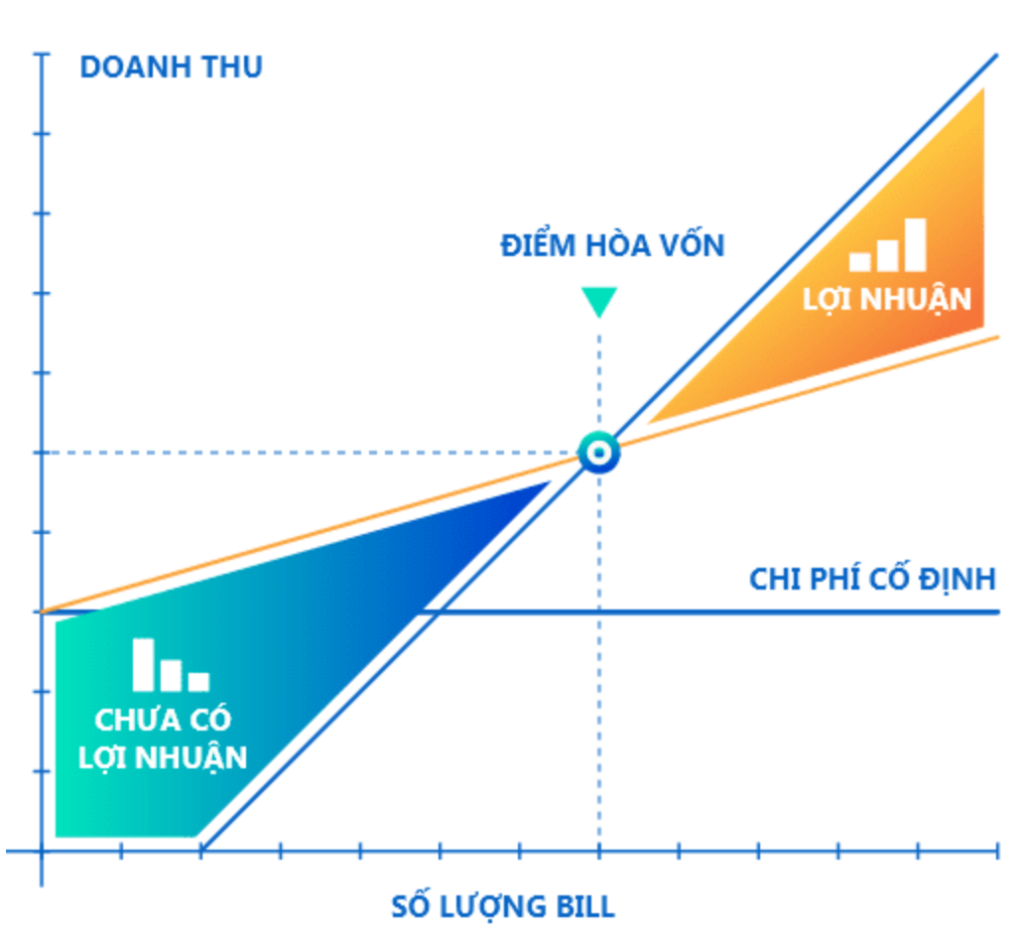
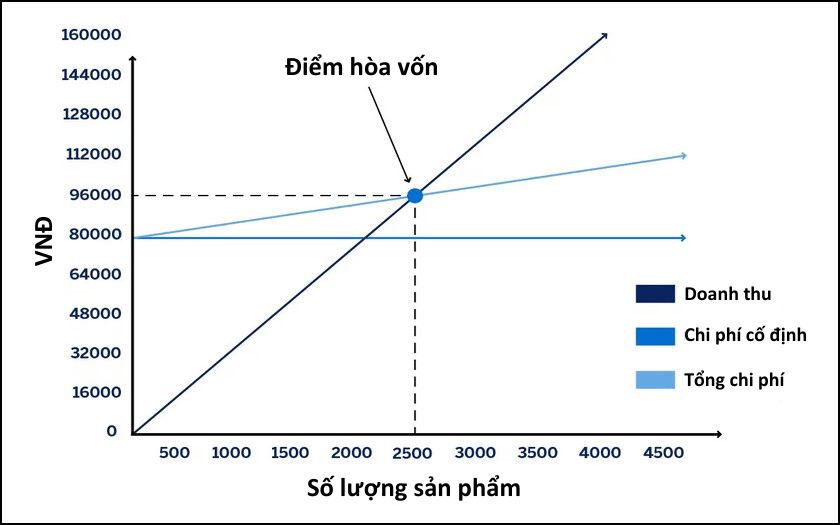
The break-even point (BEP) is a concept in finance and accounting used to determine the level of revenue or output at which total revenue equals total costs (including both fixed and variable costs). At this point, the business experiences no profit or loss, meaning it has reached a state of financial equilibrium.

For any new business, this is a crucial calculation in the business plan. Potential investors not only want to know the potential return on their investment but also when they can expect to see that return. This is especially important because some businesses may take years to become profitable, often operating at a loss in the initial months or years before reaching the break-even point. For this reason, the break-even point is an essential component of any business plan presented to investors.
For other businesses, the break-even point is a useful tool not only for analyzing costs and evaluating profitability at different sales levels but also for demonstrating the company’s potential for recovery after difficult situations.
2. Break-Even Point Formula
The break-even point is where total revenue equals total costs, and the business makes neither a profit nor a loss. Depending on the calculation method, the specific formulas are as follows:
3.1. By Units (Break-Even Point in Units)
Formula:
Q= FC/(P – VC)
- Q: Break-even quantity (the number of units that need to be sold)
- FC: Fixed Costs
- P: Price per Unit
- VC: Variable Cost per Unit
Analysis:
- Profit when: Revenue > Total Variable Costs + Total Fixed Costs
- Break-even when: Revenue = Total Variable Costs + Total Fixed Costs
- Loss when: Revenue < Total Variable Costs + Total Fixed Costs
Example:
A company has fixed costs of 100 million VND, a selling price of 200,000 VND per product, and a variable cost of 120,000 VND per product.
Q = 100,000,000/(200,000-120,000) = 1,250
=> The company needs to sell 1,250 products to reach the break-even point.
>> Read more: What is Contribution Margin? Formula and Application of Contribution Margin
3.2. By Revenue (Break-Even Point in Revenue)
Formula:
R = FC/ (1 – VC/P)
- FC: Fixed Costs
- R: Revenue at the break-even point
- 1 – VC/P: Contribution Margin Ratio
Example:
Fixed costs are 100 million VND, the selling price per product is 200,000 VND, and the variable cost is 120,000 VND per product.
R = 100,000,000/ (1 – 120,000/200,000) = 250,000,000
=> The break-even revenue is 250 million VND.
3.3. By Operating Capacity Percentage (Break-Even Point in Capacity Percentage)
Formula:
Break-even capacity % = Q/Qmax x 100
- Q: Break-even point in units (calculated from the formula above).
- Qmax: The business’s maximum capacity.
Example:
If a company has a break-even point of 1,250 units and a maximum capacity of 2,000 units, then:
Break-even capacity % = 1,250/2,000 x 100 = 62.5%
=> The business needs to operate at 62.5% capacity to break even.
3.4. By Target Profit (Target Profit Analysis)
Formula:
Q = (FC + Target Profit)/(P – VC)
- Target Profit: Target Profit
- Q: Break-even point in units
- FC: Fixed Costs
- P: Price per Unit
- VC: Variable Cost per Unit
Example:
The business wants to achieve a target profit of 50 million VND. Based on the previous example, we have:
Q = (100,000,000 + 50,000,000)/(200,000 – 120,000) = 1,875
=> The business needs to sell 1,875 units to achieve the target profit.
3.5. For Multiple Products (Break-Even Point for Multiple Products)
Formula:
Q = FC/Weighted Average Contribution Margin
- Weighted Average Contribution Margin: Weighted average contribution margin (based on the sales mix of each product).
- Q: Break-even point in units
- FC: Fixed Costs.
Example:
If the business sells two products, A and B:
- A accounts for 60%, with a contribution margin of 100,000 VND/unit.
- B accounts for 40%, with a contribution margin of 80,000 VND/unit.
Weighted Average Contribution Margin= (100,000 x 0.6) + (80,000 x 0.4) = 92,000
Q = 100,000,000/92,000 = 1,087 units
4. What factors increase and decrease the break-even point?
The break-even point will increase when the business increases fixed costs (premises, machinery), variable costs (raw materials, labor), or reduces product selling prices. Conversely, the break-even point will decrease when the business optimizes its production process, cuts operating costs, or increases selling prices to achieve a higher profit margin per unit.
4.1. Factors that increase the break-even point
Increase in Sales Volume
When sales volume and product demand increase, the business needs to ramp up production. This leads to higher production costs, raising the break-even point to cover the additional expenses.
Example: A company needs to expand its production line to meet a large order, leading to an increase in both fixed and variable costs.
Increase in production costs
When the price of raw materials, labor, or other variable costs rises while the selling price remains unchanged, the break-even point will increase to offset these costs.
Example: A sudden increase in the price of raw materials makes each product more expensive to produce, reducing the contribution margin ratio.
Equipment repair costs
Production equipment that breaks down or stops operating leads to reduced output, increased operating costs, or repair expenses. This also contributes to a higher break-even point.
Example: A main production line breaks down, forcing the business to incur additional outsourcing costs to complete an order.
4.2. Factors that decrease the break-even point
Increase in product selling price
When the product’s selling price increases, the contribution margin ratio goes up, allowing the business to break even at a lower sales volume or revenue.
Example: A company increases its product price by 10% without losing customers.
Adopting more efficient production methods
Optimizing the production process or adopting new technology can help reduce variable and fixed costs, thereby lowering the break-even point.
Example: Using automated machinery helps reduce labor and operating costs.
Outsourcing
Outsourcing production or logistics processes helps reduce production costs, especially as the business scales. This lowers the total costs that need to be covered, thus reducing the break-even point.
Example: A company outsources its product packaging at a lower cost than handling it in-house.
Reducing fixed costs
Cutting fixed costs such as office or factory rent, or restructuring the organization, can help lower the break-even point.
Example: A company transitions to a remote work model, reducing office rental costs.
5. What is the significance of the break-even point in business?
The break-even point is the basis for determining the minimum revenue needed to cover costs, helping managers make accurate decisions about selling prices, control costs, and measure financial safety. It is also a key indicator for assessing project feasibility and persuading investors.
Assess the financial performance of the business
The break-even point allows a business to determine the minimum revenue or output required to avoid losses. This is particularly useful for assessing the feasibility of a new business project or production plan.
Example: A manufacturing company needs to know the minimum output to cover fixed costs like employee salaries and rent. From there, they can decide whether to continue or adjust their business strategy.
Support pricing decisions and cost control
The break-even point helps managers understand the impact of selling price, variable costs, and fixed costs on profit. If costs increase (e.g., rising raw material prices), the business can use the break-even point to adjust selling prices or cut costs in other areas.
Practical applications:
- Pricing decisions: If the break-even point is high, the business should consider increasing product prices.
- Cost control: Cut unnecessary expenses to lower the revenue needed to break even.
Financial planning and business scenario analysis
By analyzing the break-even point, businesses can create financial plans, forecast cash flow, and assess profitability. Managers need to calculate the break-even point for different scenarios, such as when raw material prices fluctuate or sales decline.
Example: During difficult economic times, a business can calculate the break-even point at a lower sales level to prepare appropriate business scenarios.
Measure the Margin of Safety
The break-even point is the basis for determining the margin of safety – the amount by which revenue exceeds the break-even point. A high margin of safety means the business has a greater ability to withstand unexpected market fluctuations.
Example: If current revenue is 20% higher than the break-even point, the business can be more confident about sustaining its operations.
Help persuade investors
When presenting a business plan, the break-even point is a factor that helps investors assess the project’s feasibility and potential profitability. Investors typically want to know when the project will start generating profit and its margin of safety.
Example: A startup presents that it needs to sell 1,000 products in the first 6 months to break even, thereby demonstrating the project’s potential for a quick return on investment.
Guide long-term development strategy
Based on the break-even point, a business can create business plans, strategies for production expansion, product diversification, or optimization of current operations.
Example: A company that reaches its break-even point early can reinvest in research and development (R&D) to create new products and increase its competitive advantage.
6. Comparison and classification of break-even points
| Criteria | Accounting Break-Even Point | Financial Break-Even Point | Economic Break-Even Point |
| Definition | The level of revenue or output needed for total revenue to equal total costs (fixed and variable). | The level of revenue needed to cover all costs, including interest expenses and the cost of equity. | The level of revenue needed to cover all opportunity costs, including potential lost profits. |
| Purpose of Use | Determines the minimum level to ensure the business does not incur a loss. | Determines the ability to meet long-term and short-term financial commitments. | Evaluates the overall economic efficiency of the business, including opportunity costs. |
| Cost Components | Includes fixed costs and variable costs. | Includes accounting costs, interest expenses, and the cost of equity. | Includes all accounting costs, capital costs, and opportunity costs. |
| Scope of Application | Common in cost management and managerial accounting. | Often used in financial analysis, solvency assessment, and financial planning. | Used in long-term strategic analysis and assessing the sustainability of the business. |
| Profit at Break-Even Point | No profit, only enough to cover fixed and variable costs. | No actual net profit, but enough to meet financial requirements and debt payments. | No economic profit, meaning the business does not create added value beyond its opportunity costs. |
| Advantages | Simple, easy to calculate, and applicable for short-term decisions. | Helps assess the financial capability, liquidity, and risk level of the business. | Provides a comprehensive view of operational efficiency and the long-term development potential of the business. |
| Disadvantages | Does not account for financial costs and opportunity costs. | Can be complex as it requires calculating additional capital costs and interest expenses. | Difficult to calculate as it requires accurately estimating opportunity costs and potential lost profits. |
| Example | A business needs a minimum revenue of 500 million VND to cover production costs (fixed and variable). | The business needs to achieve a revenue of 600 million VND to cover all costs, including interest and capital costs. | If opportunity costs are included (e.g., investing capital elsewhere could yield higher returns), the business needs to achieve a revenue of 700 million VND to reach the economic break-even point. |
6. Key Considerations in Break-Even Analysis
Here are some key considerations for managers when conducting a break-even analysis for business operations:

- Accurate Cost Classification: Clearly separate fixed costs (rent, depreciation) and variable costs (raw materials, commissions) to avoid calculation errors.
- Calculate by Product Category: If you sell multiple products, calculate the break-even point for each type separately or use the contribution margin ratio method for a more realistic view.
- Be Cautious with Assumptions: Sales prices and costs constantly fluctuate with the market; therefore, assumptions about revenue and costs should be updated regularly rather than treated as constants.
- Consider Time and Scale: New businesses need a financial buffer for the pre-break-even period. Simultaneously, leverage economies of scale to reduce marginal costs, but ensure you can sell the output.
- Assess Opportunity Costs and External Risks: Include opportunity costs in your calculations for a comprehensive economic efficiency assessment and develop contingency plans for fluctuations in interest rates and policies.
- Use Support Tools: Prioritize using visual charts and management software like 1Office to automate data, helping managers make quick decisions on pricing and resource allocation.
7. Applying the Break-Even Point in Business
7.1. Using the break-even point to determine the minimum selling price
The break-even point provides a basis for businesses to calculate the minimum selling price to avoid losses. If the selling price is lower than this, the business cannot cover its fixed and variable costs.
Method:
- Calculate the total fixed and variable costs per product.
- Calculate the break-even point in units.
- Divide the total cost by the production volume to determine the minimum selling price.
Example:
- Fixed costs: 200 million VND/month.
- Variable costs: 100,000 VND/product.
- Target production volume: 5,000 products/month.
- Minimum selling price = (200,000,000 + 100,000 × 5,000) ÷ 5,000 = 140,000 VND.
Result: If the product is sold for less than 140,000 VND, the business will definitely incur a loss.
7.2. Using the break-even point for production and revenue planning
By knowing the break-even volume, a business can easily determine the number of products it needs to sell each month to avoid losses and set a reasonable revenue target.
Method:
- Calculate BEP in units = Fixed Costs ÷ (Selling Price – Variable Costs).
- From the BEP in units, calculate BEP in revenue = BEP in units × Selling Price.
- Compare with actual production capacity.
Example:
- Selling price: 200,000 VND/product.
- Variable costs: 120,000 VND/product.
- Fixed costs: 400 million VND.
- BEP in units = 400,000,000 ÷ (200,000 – 120,000) = 5,000 products.
- Break-even revenue = 5,000 × 200,000 = 1 billion VND.
Result: The business must sell a minimum of 5,000 products per month or achieve 1 billion VND in revenue to avoid losses.
7.2. Using the break-even point to analyze marketing and sales campaigns
Not every campaign with high revenue is profitable. The break-even point helps businesses determine if a campaign has truly become profitable or just has “good-looking revenue figures.”
Method:
- Record the revenue and costs for each campaign.
- Calculate the BEP based on the marketing costs incurred.
- Compare sales results with the BEP.
Example:
- Campaign A: Revenue 1.2 billion VND, marketing costs 600 million VND, variable costs 400 million VND → Net profit = 200 million VND.
- Campaign B: Revenue 2 billion VND, marketing costs 1.5 billion VND, variable costs 400 million VND → Net profit = 100 million VND.
Result: Although it has lower revenue, Campaign A is more effective because it exceeded its BEP by a larger margin and generated a higher profit.
7.3. Applying the break-even point to make investment and expansion decisions
Before expanding a factory, branch, or launching a new product, businesses can use the BEP to forecast profitability.
How to do it:
- Estimate the fixed and variable costs for the new project.
- Calculate the BEP in units/revenue.
- Compare with market purchasing power or projected revenue.
Illustrative example:
- Branch expansion project: Fixed costs of 2 billion VND/year, variable costs of 150,000 VND/product, selling price of 250,000 VND/product.
- BEP = 2,000,000,000 ÷ (250,000 – 150,000) = 20,000 products/year.
- The market is expected to consume 25,000 products.
Result: The project is feasible because the projected output > BEP → profitable.
Besides determining the BEP index, for effective financial analysis and cash flow management, businesses can refer to the 1Office CRM sales management software.
- Supports setting up various types of revenue and expenditure, standardizing approval processes for effective cash flow management.
- Track real-time cash flow across internal company accounts, anytime, anywhere, right on your mobile device.
- Provides a visual statistical reporting dashboard for a comprehensive overview of revenue and expenditure fluctuations during the period and to forecast costs for the next period.
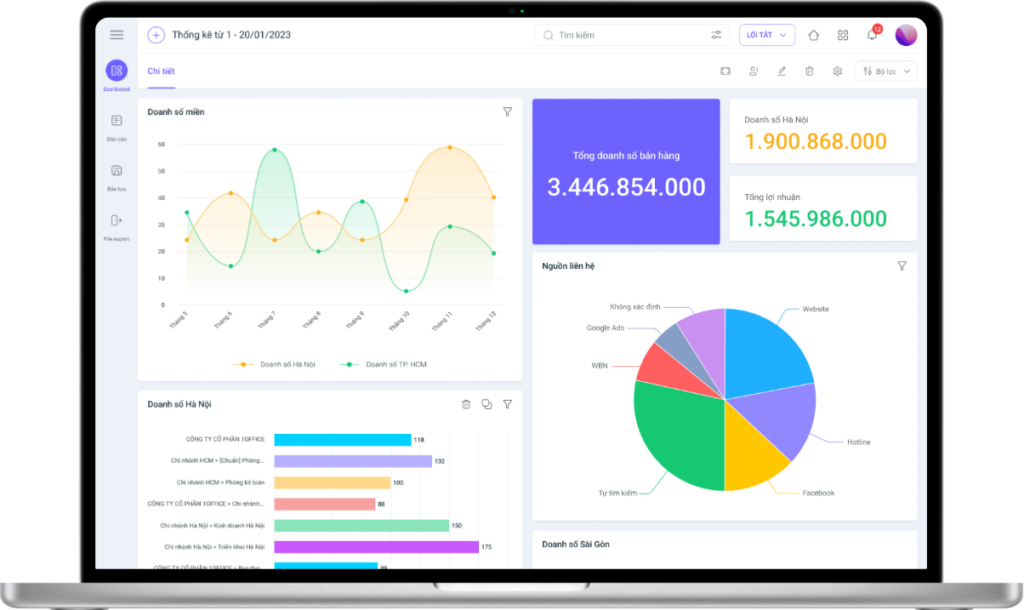
1Office CRM – Proud to be a powerful assistant, providing managers with a comprehensive view of the company’s financial situation.
8. Frequently Asked Questions about the Break-Even Point
Is a low or high break-even point better for a business?
The lower the break-even point, the better. When the break-even point is low, a business only needs to sell a small quantity of goods to cover costs and start making a profit, thereby minimizing financial risk and increasing competitiveness.
Is a business safe just by reaching the break-even revenue?
Not necessarily. Reaching the break-even point only helps a business “not lose money.” To be truly safe, you need to achieve a Margin of Safety – meaning the actual revenue must be significantly higher than the break-even point to buffer against adverse market fluctuations.
Why does the break-even point change even if the sales volume remains the same?
Because the break-even point depends on costs and selling price, not just on volume. If the price of raw materials increases (variable costs increase) or rent increases (fixed costs increase) while the selling price remains unchanged, the break-even point will be pushed higher.
How do you calculate the break-even point for a business with multiple products?
You cannot calculate it collectively; instead, you should use the weighted average contribution margin method. This method is based on the sales mix of each product type to determine an overall break-even point for the entire store or business.
How can you lower the break-even point without increasing the selling price?
You can focus on cost optimization. Specifically, cut unnecessary fixed costs (outsourcing, remote work) or improve production processes to reduce waste of raw materials and labor (reducing variable costs).
Cost control becomes simpler and more accurate with technology. With modules like 1Work and 1CRM on the 1Office platform, businesses can track cash flow and performance in real-time, quickly identify waste for optimization, thereby lowering the break-even point and maintaining a sustainable profit margin.
9. Conclusion
Above is all the information about the break-even point that 1Office wants to share with you. We hope your business can apply it to make effective production and business decisions.
Instead of losing control with scattered and inaccurate manual spreadsheets, businesses can use the 1Office platform to automate break-even point tracking. The system connects cost and sales data, helping you instantly identify financial fluctuations to optimize a sustainable path to profitability.