09/05/2026
  2249 views
Incident reports – an important tool, but one where mistakes are easily made if you don’t know how to write them correctly. From violations of internal regulations and workplace accidents to property loss, a standard report will serve as solid evidence to help you resolve issues quickly. Let’s explore our detailed guide and the latest set of incident report templates, available for free download to use today!”
Mục lục
- What is an incident report?
- Structure and Guide to Writing an Accurate Incident Report
- General Principles for Creating an Incident Report
- Key Components of an Incident Report (Standard Structure)
- Incident Statement Report Template
- Incident Confirmation Report Template
- Company Internal Regulation Violation Report
- Property Damage Incident Report
- Workplace Accident Incident Report Template
- Asset Loss Report Template
- Violation Warning Report
- Meeting Minutes for Recording Opinions
- 4. Important Notes When Creating an Incident Report
- 5. Quick Q&A on Incident Reports
What is an incident report?
An incident report is a very common type of administrative document in daily life, work, and state management in Vietnam. It is a document created to record, objectively, truthfully, and in detail, an event or incident that has occurred or is occurring at a specific time and place.
In simple terms: An incident report is like an “official account” of the event, co-signed by all involved parties (witnesses, participants, the report creator) to serve as evidence later.
Differentiating incident reports from other types of reports
| Type of Record | Main Purpose | Key Content Recorded | Typical Examples | Is it directly enforceable? |
| Incident Report | To objectively record the developments and information of an event that occurred | Event developments, scene, cause, consequences, opinions of all parties | Workplace accidents, disputes, internal regulation violations, asset inventory | No |
| Meeting Minutes | To record the discussion content, opinions, and decisions made during a meeting | Agenda, spoken opinions, conclusions, assigned tasks | Cell meetings, board of directors meetings, council meetings | No (serves only as a reference) |
| Violation Record | To record a legal/administrative violation as a basis for imposing penalties | Specific violation, violator, evidence, aggravating/mitigating circumstances | Traffic violations, administrative labor violations | Has high legal value, serves as a direct basis for issuing a penalty decision |
→ An incident report serves as a general record; it is not specialized like a violation report (which has a standard form under administrative sanctions law) or meeting minutes (which focus on discussions and conclusions).
Purpose of an Incident Report
An incident report is created for the following main purposes:
- Timely and objective information recording: Ensures the incident’s details are recorded as they happen, preventing memory lapses or changes in testimony later.
- To serve as a basis and evidence for future resolution: Used as grounds for disciplinary action, resolving complaints, denunciations, civil or labor disputes, compensation for damages, and even for court proceedings.
- To archive records and proof of the event: It is an official document in the management files of an agency or business, facilitating lookups when needed.

Legal Value of an Incident Report
- It is not a legally enforceable document for direct execution (it cannot be used to compel immediate action like an administrative decision).
- However, it holds significant legal value as evidence (proof) in the process of resolving the matter.
- If prepared correctly (with signatures from all involved parties and witnesses), the report will be considered highly reliable evidence by courts and state agencies.
- In some cases (workplace accidents, contract disputes, etc.), an incident report is a mandatory document required as a basis for resolution.
Common Cases Requiring an Incident Report
Below are some common situations in daily life, work, and administration that require an incident report:
- Violation of labor regulations (e.g., an employee is repeatedly late, takes unauthorized leave, causes loss of company property)
- Workplace accidents (e.g., an employee is injured, machinery is damaged during work)
- Disputes between parties (e.g., contract disputes, land disputes, conflicts between departments)
- Incidents, unexpected events (e.g., fire, theft of property, information leaks, damaged goods)
- Handover of assets or work (e.g., shift handover, asset handover upon resignation, asset inventory during liquidation)
- Inspection, supervision, verification (e.g., surprise warehouse inspections, verification of complaint or denunciation information)
- Incidents in community living (e.g., fights, public disorder, damage to condominium property)
- Damage compensation agreements (e.g., civil traffic accidents, damage to another person’s property)
In summary, an incident report is a simple yet crucial tool that ensures transparency, objectivity, and provides a solid legal basis whenever an event needs to be officially recorded.
Structure and Guide to Writing an Accurate Incident Report
Creating an incident report requires adherence to fundamental principles to ensure its legality, objectivity, and highest evidentiary value. Below is a detailed guide, updated according to current administrative practices in Vietnam (2025).
General Principles for Creating an Incident Report
- Objective, truthful, and complete information: Record only what actually happened, without additions, omissions, speculation, or personal comments.
- Timely and on-site: Create the report immediately when the incident occurs or is discovered, at the relevant location, to ensure the highest accuracy.
- Clear, concise, and understandable language: Use short, precise sentences, avoiding vague, emotional, or subjective terms (do not use words like “very serious,” “intentional,” etc.).
- Adherence to administrative document format (if applicable): Use the standard national emblem and motto, present neatly with standard margins (usually Times New Roman font, size 13-14).
- Signed confirmation: All involved parties must sign voluntarily. If someone refuses to sign, the reason must be clearly stated.
Key Components of an Incident Report (Standard Structure)
Below is a common structure widely used in businesses, state agencies, and civil situations:
National Emblem and Motto
SOCIALIST REPUBLIC OF VIETNAM
Independence – Freedom – Happiness
Title
INCIDENT REPORT
(Regarding ……………………)
- Example: Regarding a workplace accident / loss of property / violation of labor regulations / dispute over goods delivery…
- Time and Place
- At … hours … minutes, on … (date) … (month) … (year) …
- Location: ………………………………………………… (specify the exact location, e.g., Meeting Room, 3rd Floor, ABC Company, 123 XYZ Street, District 1, Ho Chi Minh City)
- Participants
- Report creator: Full name, position, department/unit
- Involved parties: Full name, position/title/residential address, ID card number (if necessary for identity verification)
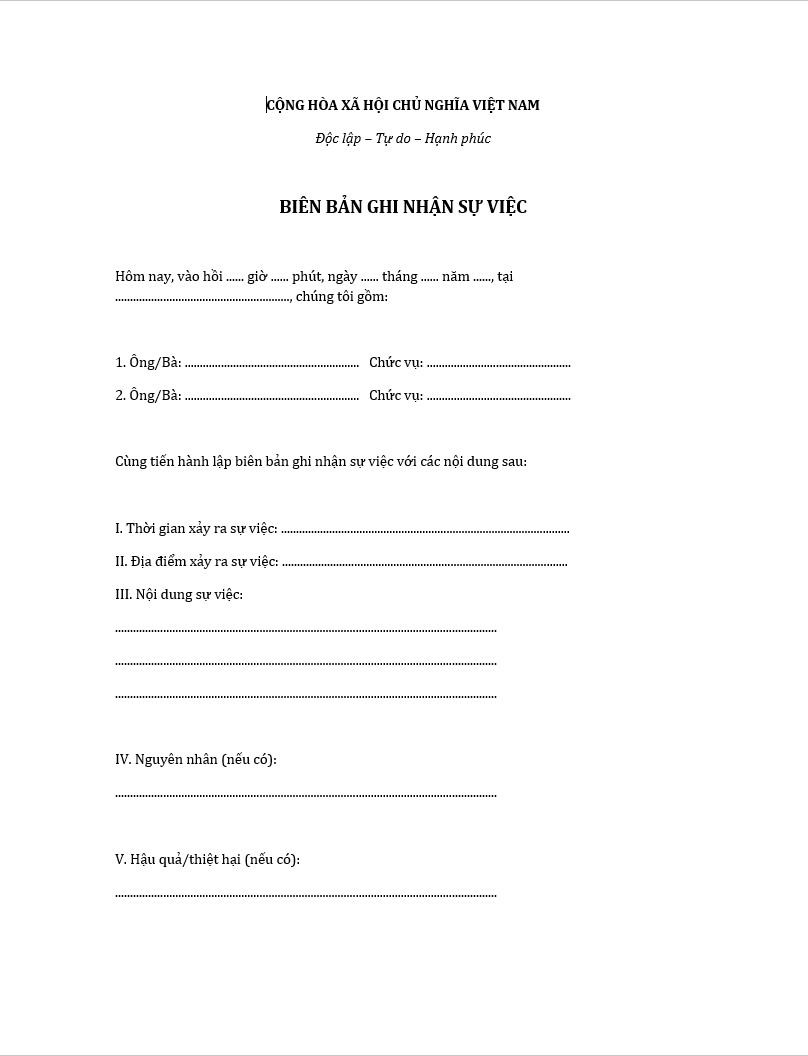
- Witnesses (if any): Full name, position/address,This is the most flexible report template, used to record any unexpected event (incidents, conflicts, surprise inspections, etc.). This template clearly states the time, location, objective developments, opinions of all parties, and confirmation signatures, serving as evidence for any non-specific situation, which is very common in businesses and administrative agencies.

Incident Report Template Download the Incident Report Template Now
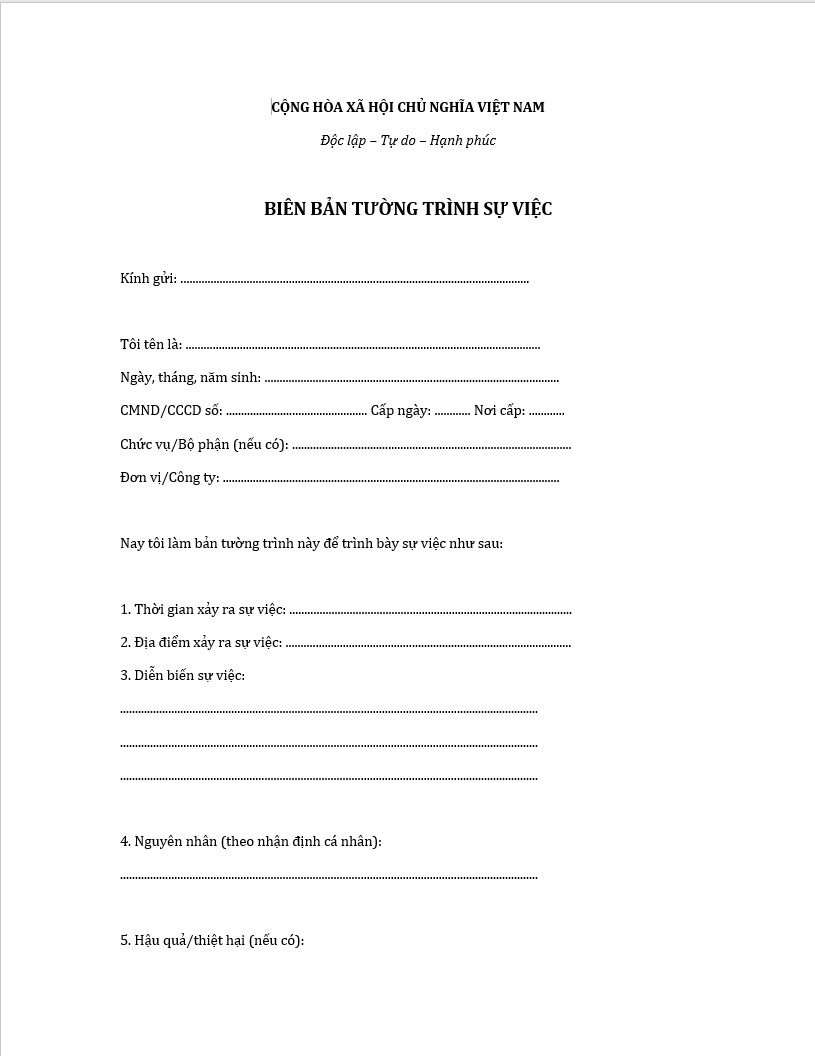
Incident Statement Report Template
A report prepared by the involved individual (usually the violator or a witness) to detail the developments, causes, and their level of responsibility. This template is often used to explain violations of internal regulations or personal incidents, helping management review and handle the matter fairly and objectively.

Incident Statement Report Template Download the Incident Statement Report Template Now
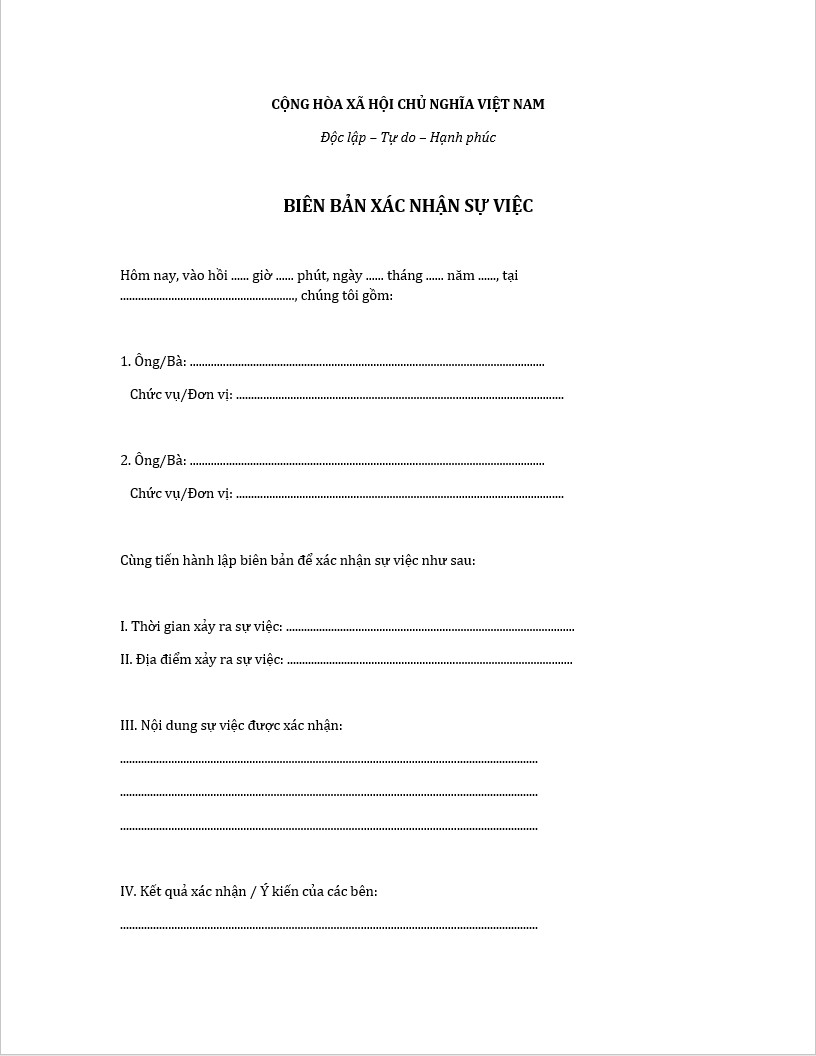
Incident Confirmation Report Template
Used to verify and acknowledge an event that has occurred, with the participation of the preparer, involved parties, and witnesses. The template emphasizes accuracy and objectivity, often applied in minor disputes, damage confirmation, or internal events, holding high evidentiary value for future resolution.

Incident Confirmation Report Template Download the Incident Confirmation Report Template Now
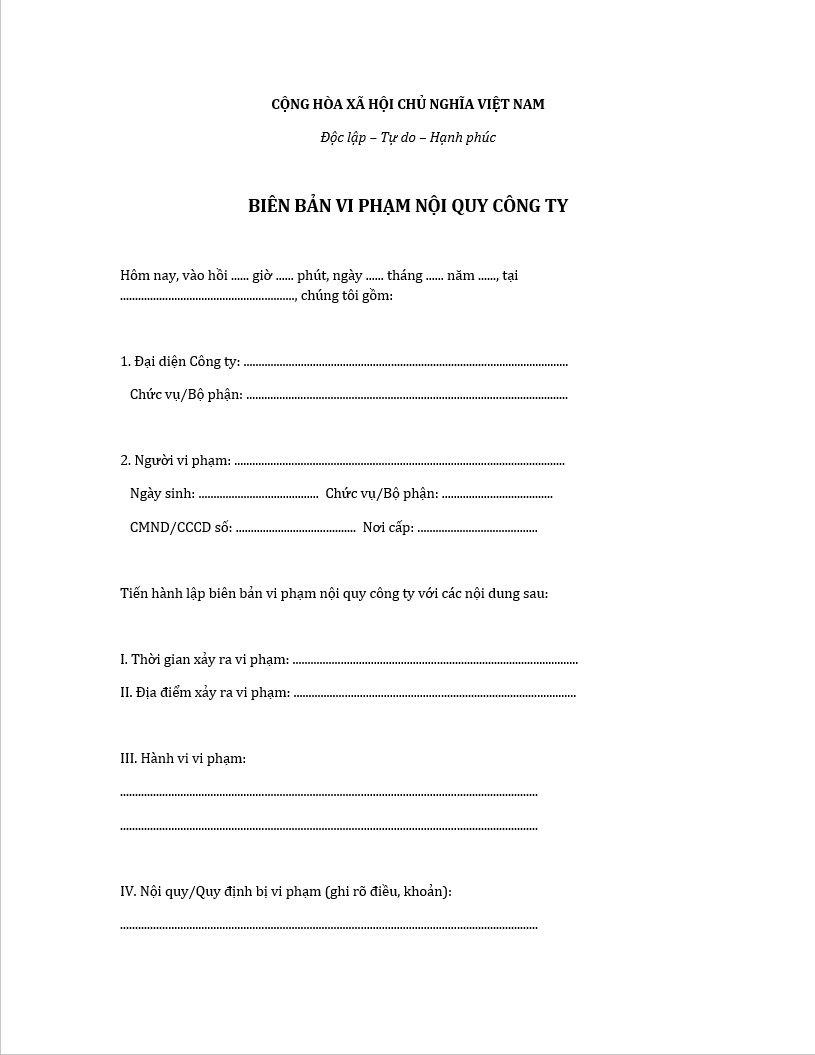
Company Internal Regulation Violation Report
A document prepared by management or the HR department when an employee violates labor regulations (tardiness, unexcused absence, non-compliance with procedures, etc.). The template clearly records the violation, time, consequences, and the violator’s statement, serving as a basis for disciplinary action according to the Labor Code.

Company Internal Regulation Violation Report Template Download the Company Internal Regulation Violation Report Template Now
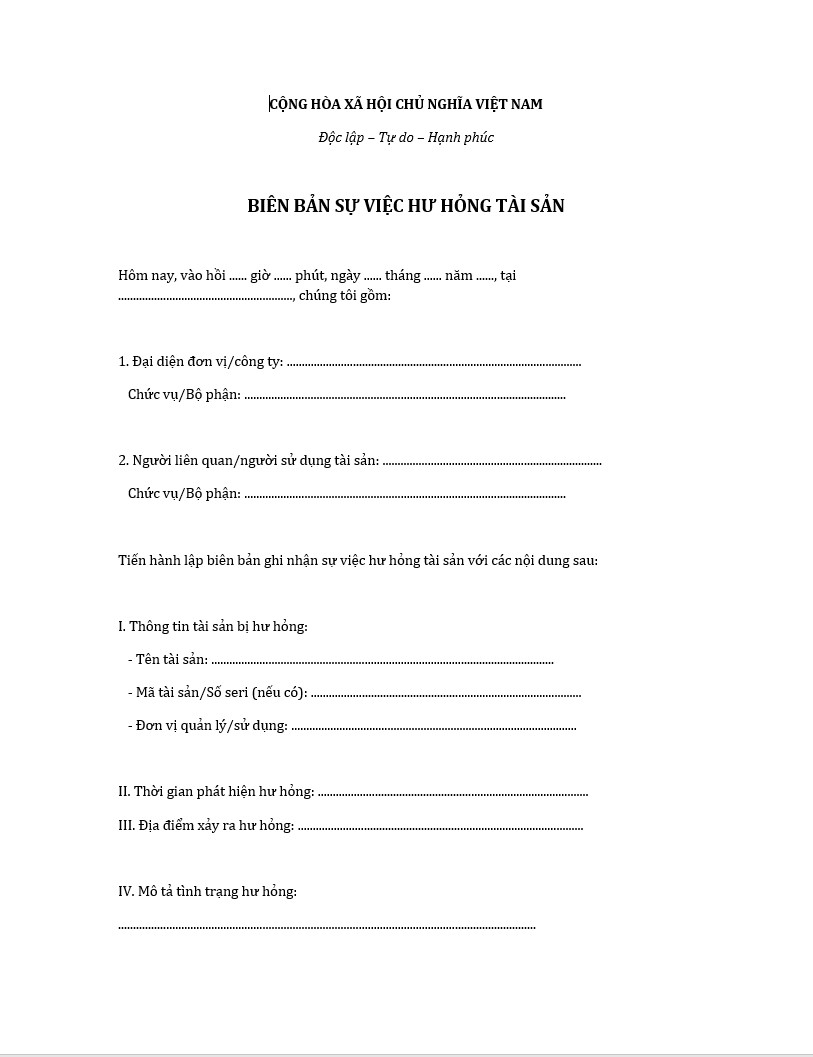
Property Damage Incident Report
Used to record the condition, cause, and extent of damage to assets (machinery, equipment, goods, etc.) due to an incident or personal error. The template provides a detailed description of the scene, includes photos if available, and serves as a basis for compensation, repairs, or assigning responsibility within the company.

Property Damage Incident Report Template Download the Property Damage Incident Report Template Now
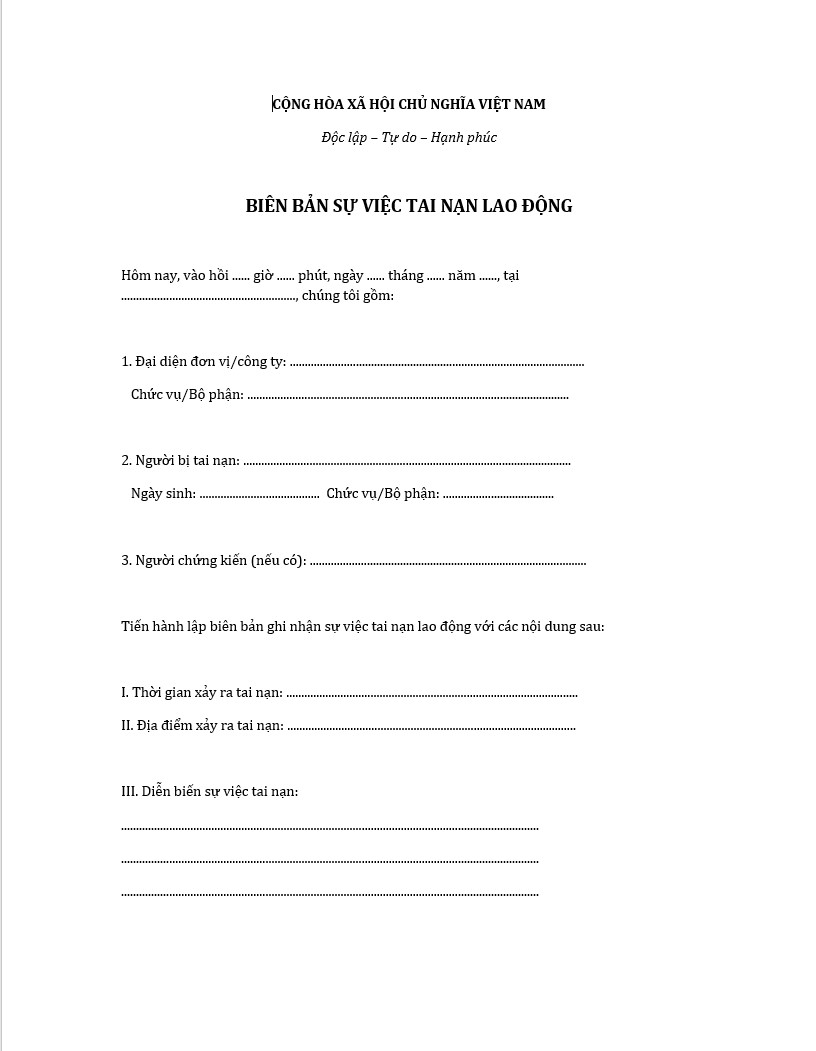
Workplace Accident Incident Report Template
A mandatory report for when a workplace accident occurs (injury or death during work), recording the scene, initial cause, consequences, and first-aid measures. This template is a crucial document for reporting to state agencies, Social Insurance, and for investigation according to Decree 39/2016/ND-CP.

Workplace Accident Incident Report Template Download the Workplace Accident Incident Report Template Now
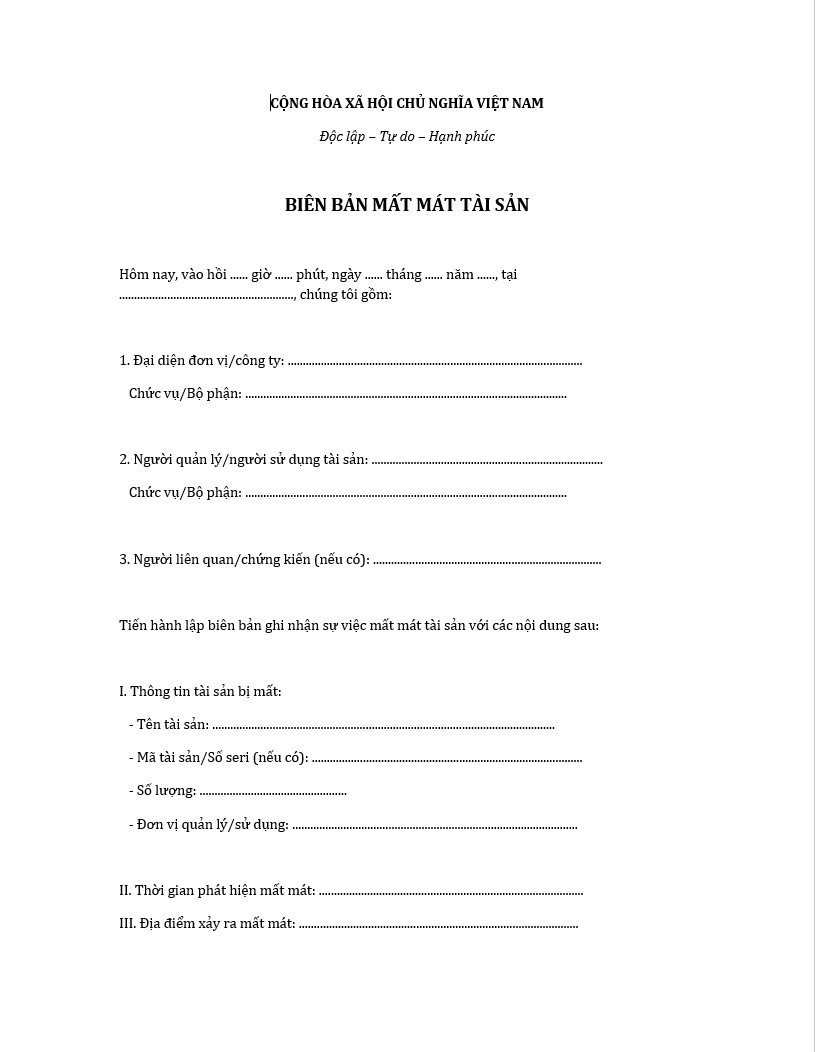
Asset Loss Report Template
Used when loss or theft of company assets (money, goods, equipment, etc.) is discovered. The template describes the quantity, value, time of discovery, involved parties, and initial handling measures, serving as evidence for investigation, compensation, and internal/official reporting.

Asset Loss Report Template Download the Asset Loss Report Template Now
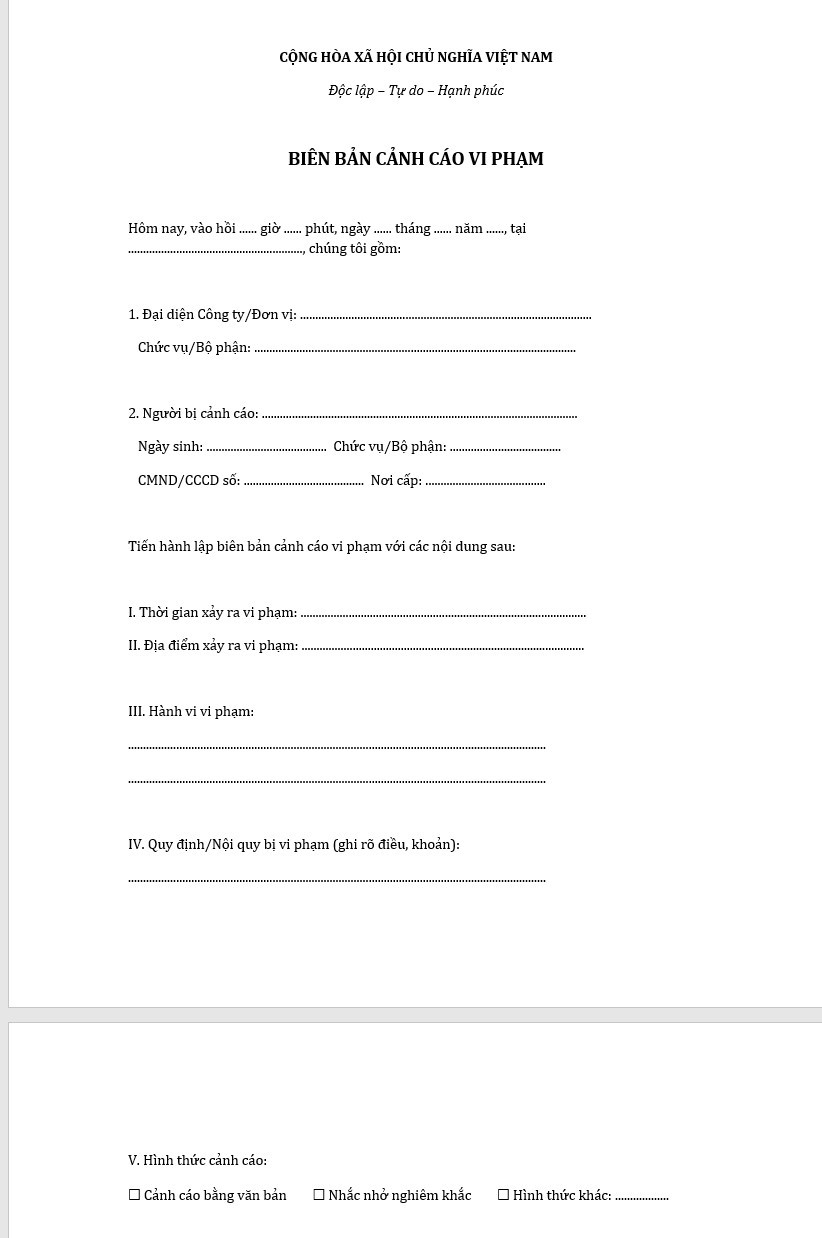
Violation Warning Report
A document to record and warn an employee for a minor disciplinary violation (a stern reminder), typically used for a first-time offense or one that has not caused serious consequences. The template specifies the violation, potential consequences, and a commitment to not repeat the offense, helping to improve behavior without severe disciplinary action.

Violation Warning Report Template Download the Violation Warning Report Template Now
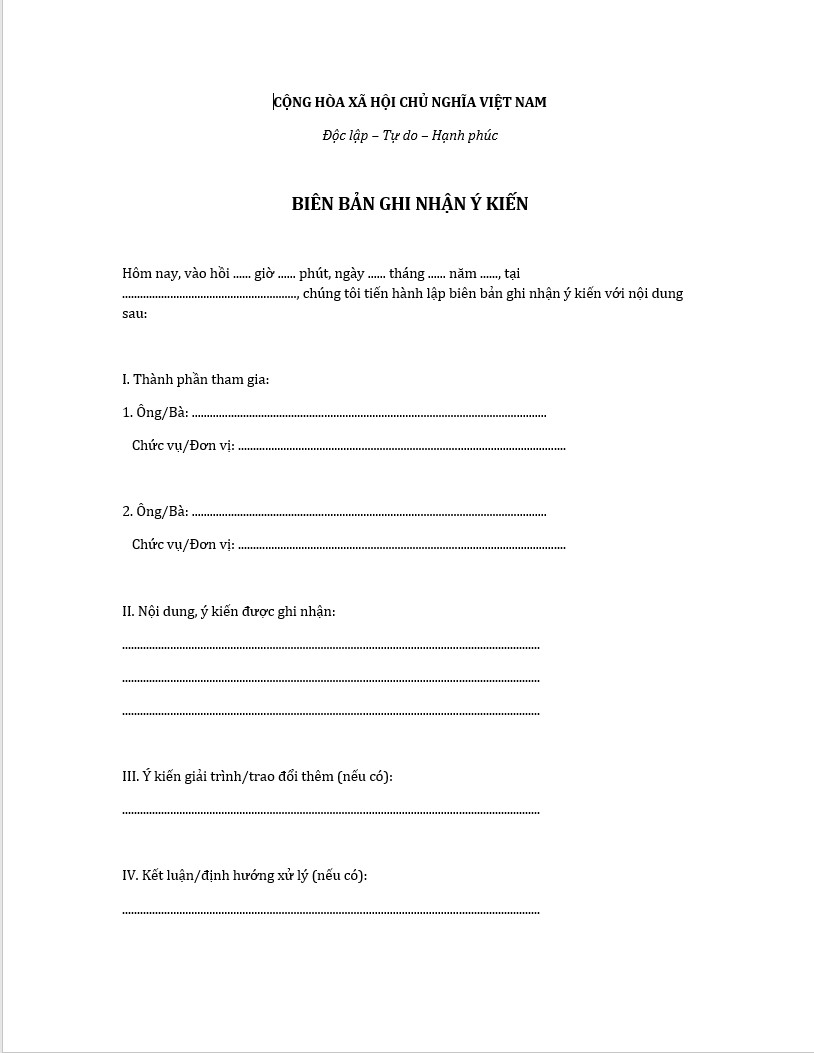
Meeting Minutes for Recording Opinions
Used in meetings and discussions to compile and fully record the contributions of all participants (internal meetings, incident handling, feedback sessions, etc.). The template ensures a democratic and objective process, serving as a reference for final decisions or for record-keeping.

Meeting Minutes for Recording Opinions Template Download the Meeting Minutes for Recording Opinions Template Now
4. Important Notes When Creating an Incident Report
Creating an incident report may seem simple, but even a small mistake can severely diminish its legal value or even cause it to be dismissed as evidence. Below are common mistakes and practical tips to help you create a professional, thorough, and highly effective report.
Common Mistakes
- Omitting basic information
- Not recording the exact time (only the date).
- Vague location (e.g., writing only “at the company” instead of “5th floor, warehouse A, XYZ Co., Ltd., 123 ABC Street, Ward 5, Go Vap District, HCMC”).
- Missing complete identity information of participants (only writing names without titles, departments, or ID numbers).
- Using subjective language or personal commentary
- Incorrect: “Mr. A intentionally damaged the machine,” “The behavior was very serious,” “It was clearly Party B’s fault.”
- Correct: “Mr. A performed action X, which resulted in damage to part Y of the machine.”
- Describing events unclearly, inconsistently, or out of chronological order
- Writing in a disorganized manner, jumping between events.
- Contradictory information between sections (e.g., conflicting timelines).
- Lacking complete confirmation signatures from all involved parties
- Only the preparer’s signature is present, missing the signature of the violator/affected person.
- An involved party signs but does not write their full name or title.
- Failing to attach supplementary documents and evidence
- Not taking photos of the scene, not listing physical evidence, not attaching inventory reports, videos, images, or related documents.
- When needed as evidence later, the report is “empty” of physical proof.
Tips for a Professional and Highly Effective Report
- Review thoroughly before signing
- Read the entire report aloud for all parties to hear.
- Ask if there are any additional comments or corrections → clearly write “No other comments” or record the additional comments verbatim if there are any.
- Double-check: Are the time, location, identities, and sequence of events logical?
- Take photos and videos of the scene (if permitted)
- Capture multiple angles: overall view, close-ups of evidence, and damage.
- Note in the report: “Attached are 5 photos of the scene taken
- Create multiple copies with equal legal validity
- Typically: Create 03 copies (each party keeps 01 copy, the remaining copy is filed by the agency/company).
- Clearly state: “This report is made in 03 copies of equal legal validity, each party shall keep 01 copy.”
- Store carefully and systematically
- Scan the original in color, save as a PDF file with a digital signature (if the company has one).
- Number and categorize by year/month/incident for easy retrieval.
- Store for at least 5–10 years depending on the nature of the incident (workplace accidents, property disputes may need to be stored longer).
Handling situations where parties refuse to sign the report
- This is a very common situation. The standard procedure, recognized by law and practice, is as follows:
- Step 1: Clearly state the reason for refusal directly in the report. For example: “Mr. Nguyen Van B refuses to sign the report, stating that the content is inaccurate / disagrees with the recorded events.”
- Step 2: Invite a third-party witness (a union representative, a representative from another department, or ideally, a representative from the commune/ward People’s Committee if the incident is serious). This witness signs to confirm the creation of the report and the refusal to sign by the involved party.
- Step 3: Add a line: “The report was read aloud to Mr. Nguyen Van B, who still refused to sign. The report was created in the presence of Ms. Tran Thi C – representative of the People’s Committee of Ward X.”
- Step 4: Proceed with creating the report as usual. This report still holds high evidentiary value if it is prepared correctly and has a witness.
In summary: A good incident report does not need to be lengthy, but it must be complete, objective, fully signed, and accompanied by physical evidence. By following these guidelines, the report will become solid evidence in any future dispute resolution, disciplinary action, or legal proceedings.

Important notes when creating an incident report 5. Quick Q&A on Incident Reports
Below are concise answers based on current Vietnamese law (as of 2025), focusing on the practical aspects of incident reports (not administrative violation reports or notarized reports).
Does an incident report need to be notarized?
No, it does not.
An incident report is an administrative document that records a factual event. It serves as evidence in future dispute resolutions, disciplinary actions, or legal proceedings, and is not a civil transaction document that requires notarization (like a land transfer contract). It only needs the signatures of the involved parties and witnesses (if any) to ensure objectivity. Notarization is only required when mandated by law (e.g., for power of attorney contracts, wills, etc.), not for a standard incident report.
Can an incident report be created electronically?
Yes, especially in corporate and government environments.
According to regulations on electronic transactions and documents (Decree 30/2020/ND-CP and related documents), an incident report can be created in an electronic format (PDF, Word, etc.) if:
- It is signed with a valid digital signature (an electronic signature with a certificate).
- It ensures integrity, authenticity, and can be retrieved. In practice, many businesses have adopted electronic reports (scanned originals + digital signatures) for internal storage and use. However, for serious incidents (severe workplace accidents, major disputes), it is still advisable to have a paper copy with handwritten signatures to increase its persuasiveness in court or before government agencies.
How to correct errors in a report?
Do not make corrections directly on the original document (erasing or crossing out will invalidate it as evidence).
The standard procedure is:
- Create a new report (a supplementary or replacement report) that clearly states the error in the old report, and attach the old report as an appendix.
- Alternatively, create an appendix to be attached to the original report, detailing the correction, which all parties must sign to confirm.
- Clearly state the reason for the error, the time it was discovered, and include the signatures of the creator and all involved parties. For example: If the time or sequence of events is incorrect, create an appendix titled “Supplement/Correction to the Incident Report dated…”. This method is widely accepted in legal practice.
What is the retention period for an incident report?
There is no fixed universal period (unlike accounting documents or notarized records).
The retention period depends on:
- The nature of the incident:
- Minor incidents (minor rule violations, small issues): Store for at least 5–10 years (statute of limitations for labor complaints, civil disputes).
- Workplace accidents, major property disputes, incidents involving severe disciplinary action: Store permanently or for at least 20–70 years (according to Circular 10/2022/TT-BNV on document archiving for state agencies/enterprises).
- Internal regulations: Companies/agencies often stipulate a retention period of at least 10 years (in accordance with the Law on Accounting, Law on Archives).
- In practice: It is advisable to store for at least 10 years (the general statute of limitations for civil lawsuits), scan in color, and save as an electronic file for easy retrieval.
Who has the right to request the creation of an incident report?
Anyone involved or with authority has the right to request or initiate one.
Specifically:
- Creator of the report: Usually someone with authority (department manager, shift leader, office staff, security guard, union representative, etc.).
- Requestor: The affected person (employee, customer), a witness, unit leader, or a competent authority (if necessary).
- In a business: Anyone who discovers an incident (violation, accident, loss, etc.) has the right to request a report to protect their interests.
- In administration: Citizens or related organizations have the right to request a state agency to create a report when an event needs to be recorded (dispute, incident, etc.). No one is prohibited from creating a report if the incident occurs on-site and requires objective documentation.
If you have a specific situation related to any of the FAQs above, please provide more details so I can offer more in-depth advice!
- Omitting basic information