


 10/05/2026
  6915 views
An authorization letter for receiving money template is used when an individual or organization wants to authorize another person to receive a sum of money on their behalf within an agreed-upon scope. A clear document must fully state the information of the authorizer, the authorized person, the amount of money, the reason for receiving the money, the duration, and related responsibilities. The article below provides the latest authorization letter for receiving money template, along with instructions on how to write it and important notes for its use.
Mục lục
- 1. What is an authorization letter for receiving money?
- 2. When is it necessary to create an authorization letter for receiving money?
- 3. Rights and obligations of the authorizer and the authorized person
- 4. Term and termination of the power of attorney to receive money
- 5. Latest updated power of attorney to receive money templates (general templates)
- 6. Power of attorney to receive money templates for specific cases
- 7. Guide to Writing a Payment Authorization Letter
- 8. Important Notes When Using a Payment Authorization Letter
- 9. Frequently Asked Questions about Power of Attorney Forms for Receiving Money
An authorization letter for receiving money is a legal document in which an individual or organization (called the authorizer) allows another individual or organization (called the authorized person) to receive money from a third party on their behalf, based on the agreement and acceptance of both parties.
An authorization letter for receiving money template is often used in situations such as: receiving salaries, allowances, insurance payments, contract payments, or other funds that the authorizer cannot receive personally due to personal, work, or health reasons.

According to Article 138 of the 2015 Civil Code regarding Representation by authorization:
“An individual or legal entity may authorize another person to establish and perform civil transactions.” “The authorization can be made verbally or in writing. If required by law, the authorization must be made in writing, notarized, or authenticated.”
According to the 2015 Civil Code (Articles 562-566), authorization is an agreement between the authorizer and the authorized party, which can be established through a simple written document or an authorization contract. Regulations for an authorization letter for receiving money do not require notarization/authentication in most cases, except when:
- It involves the transfer of ownership of assets or real estate (which must be notarized according to the 2014 Law on Notarization).
- There is a specific requirement from the paying agency (such as a bank or Social Insurance) which often requires signature authentication to avoid disputes.
Is it necessary to notarize an authorization letter for receiving money? It is not mandatory under general law, but notarization/authentication at the commune/ward People’s Committee or a notary office is recommended to enhance its legal validity, especially for large sums of money or for authorizing the receipt of money from abroad. The notarization fee for an authorization letter for receiving money is approximately 50,000 – 200,000 VND, depending on the transaction value and location (according to Circular 257/2016/TT-BTC, updated 2025).
For authorizing the receipt of money at a bank, banks often require an authorization letter with an authenticated signature.
In cases where an authorization letter is related to receiving money from public organizations such as social insurance, banks, or state agencies, the regulations on notarization and authentication of the authorization letter must also comply with the guidelines in the 2014 Law on Notarization and Decree 23/2015/ND-CP on the issuance of copies from master registers, authentication of copies from originals, authentication of signatures, and authentication of contracts and transactions.
Therefore, this is not just a document expressing the will of an individual or organization, but it must also comply with legal regulations to ensure the rights and responsibilities of all parties involved.
An authorization letter for receiving money is created when the person entitled to the money cannot receive it directly and wants to legally authorize someone else to act on their behalf.
Cases where an authorization letter should be created:
- Receiving salary, bonuses, or allowances when the beneficiary is on a business trip, maternity leave, sick, or unable to be present in person.
- Receiving pensions, social insurance benefits, or unemployment benefits when the beneficiary is elderly, has mobility issues, is abroad, or faces other objective reasons.
- Receiving funds in civil transactions such as deposits, contract payments, compensation, refunds, inheritance distribution, etc., when the principal cannot participate directly.
- Carrying out procedures at banks, insurance companies, or paying organizations when the account/fund holder cannot be present, and the entity requires a written authorization.
Conditions for a valid authorization letter:
- The authorizer and the authorized party must have full civil act capacity; the content of the authorization must be lawful and within the rights of the authorizer.
- It must clearly state the information of both parties, the purpose, scope, duration of authorization, and signatures; if notarized, it must have confirmation from a notary organization or a competent People’s Committee.
- The situation must be described in detail (what money is being received, where, and which agency requires it) to determine whether notarization is needed or if a simple authorization letter is sufficient.
Notarization/Authentication of a Power of Attorney to Receive Money: When and Where Is It Required?
Notarizing or authenticating a power of attorney to receive money is necessary for large-value transactions or those involving banks, insurance companies, post offices, or state agencies to ensure legal validity, avoid disputes, and gain recognition from all parties.
When notarization/authentication is required:
- Mandatory or recommended: Withdrawing money from a bank, receiving insurance payouts, collecting pensions through the post office, making large contract payments (e.g., over 200 million VND), or when the paying party requires it to verify legality and civil capacity.
- Not mandatory: Internal transactions within a small company (like collecting a colleague’s salary) or low-value personal payments if the paying party accepts a simple signature; however, authentication is still recommended for security.
According to the 2015 Civil Code and the 2014 Law on Notarization, financial authorization transactions typically require notarization/authentication if stipulated by law or the involved parties.
| Type | Place of Execution | Advantages |
| Notarization | State-licensed notary offices, usually near the place of residence | High legal validity, accepted nationwide, confirms the full content and signature. |
| Authentication | People’s Committee of the commune/ward where the authorizer resides | Quick procedure, low cost, suitable for small transactions; only confirms the signature and voluntary will. |
The process consists of 4 basic steps, applicable to most cases (banks, social insurance, compensation, inheritance, etc.):
| Step | Action to be taken | Location | Cost (estimated 2025) |
|---|---|---|---|
| 1 | Draft the power of attorney to receive money (using a standard template) | At home or download from reputable sources | Free |
| 2 | The authorizer and the authorized person sign by hand, writing their full names clearly | At home | Free |
| 3 | Signature authentication (mandatory for banks, social insurance, and large sums of money) | – Commune/Ward People’s Committee (for signature authentication) – Notary Office | – People’s Committee: 10,000 – 20,000 VND – Notarization: 50,000 – 200,000 VND |
| 4 | Submit the power of attorney + photocopies of ID cards/Citizen ID cards of both parties to the paying agency | Bank, Social Insurance, compensation agency, etc. | Free |
According to the 2015 Civil Code, the authorized person has the following rights and obligations:
Rights of the authorized person:
- Act on behalf of the authorizer: Represent to receive money from agencies, organizations, or individuals according to the content of the power of attorney.
- Sign for receipt, make a record, or confirm the receipt of money within the scope of authorization.
- Work with relevant parties (banks, companies, insurance agencies, etc.) to carry out the task of receiving money
- Request the provision of necessary information and documents from the authorizer or a third party to facilitate the receipt of money (e.g., original contract, transaction code, etc.).
- Be reimbursed for reasonable expenses and receive remuneration (if agreed upon) after completing the task, for example: travel expenses, notarization fees, or remuneration for receiving compensation.
Obligations of the authorized person:
- Act strictly within the scope of authorization: Only receive money and perform tasks according to the content stated in the power of attorney, not for personal purposes.
- Notify and report the results: Fully report to the authorizer on the amount of money, time, method, and related documents.
- Preserve and transfer assets: Safeguard the received assets and promptly transfer them to the authorizer with confirmation documents.
- Compensate for damages in case of violation: Be responsible for compensation when exceeding the scope of authorization, acting dishonestly, or causing damage to the authorizer or a third party.
Rights and obligations of the authorizer and the authorized person
4. Term and termination of the power of attorney to receive money
The term of authorization is usually agreed upon by the parties; if not specified, according to the 2015 Civil Code, the default term is 01 year from the date of issuance. The power of attorney can specify a period (from date… to date…) or until the specific amount of money is received, and the paying agency will rely on this for acceptance. In some special cases such as pensions, allowances, or social insurance, the paying agency may stipulate a shorter term to update the beneficiary’s status.
Cases for termination of the power of attorney:
- Expiration of the term: When the end date stated in the document is reached or after 01 year from the date of issuance without any other agreement.
- Completion of the authorized task: For example, the money has been received and handed over.
- Unilateral early termination: The authorizer or the authorized person has the right to terminate according to Article 569 of the Civil Code, and must notify the other party and third parties (banks, paying agencies).
- Legal events related to personal status: The power of attorney terminates when one party dies, loses civil act capacity, is declared missing, etc., unless otherwise provided by law.
When wishing to cancel or change the authorization before its term, one should create a cancellation/revocation document or a new power of attorney and notify/re-register with the paying agency to ensure that only the valid document is accepted.
5. Latest updated power of attorney to receive money templates (general templates)
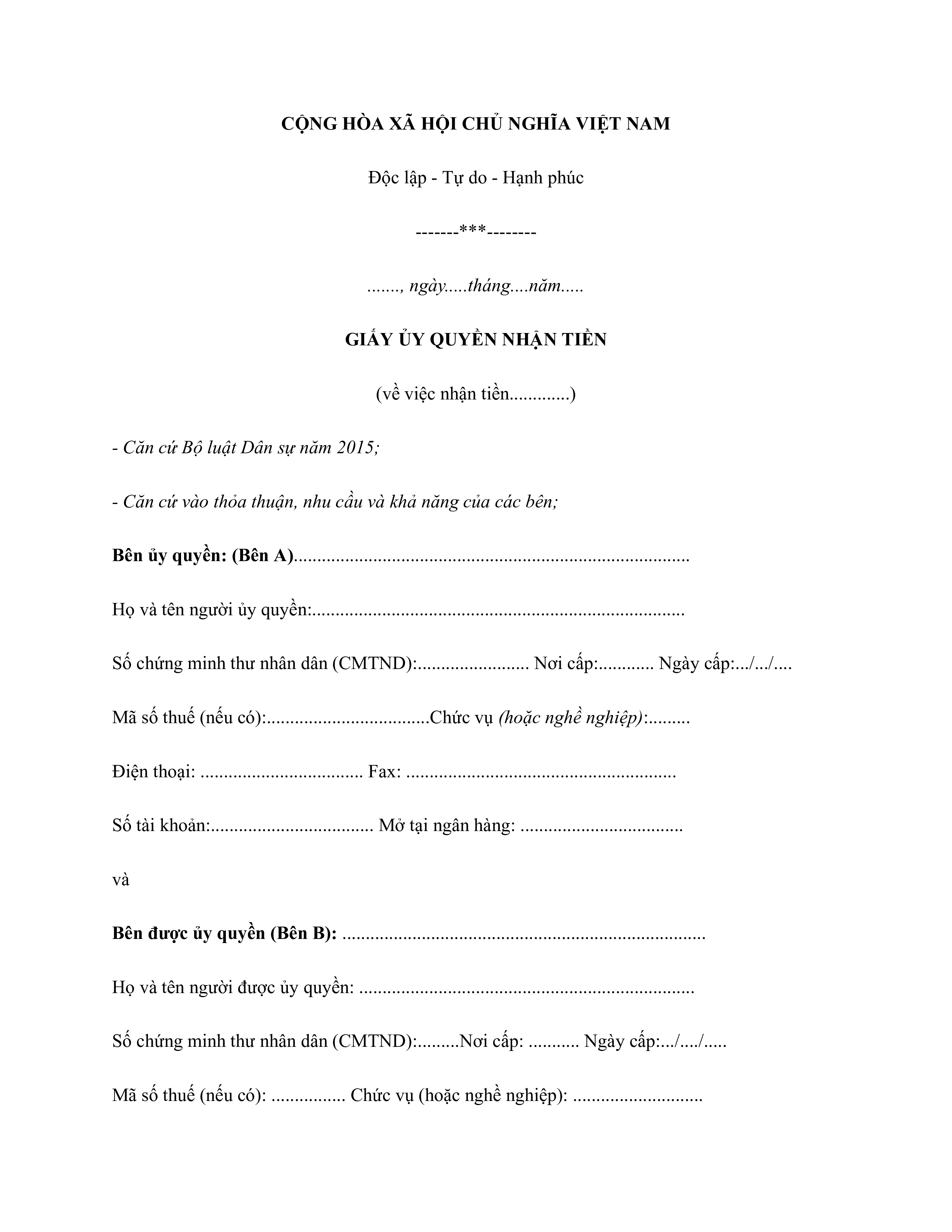
5.1. Template 1
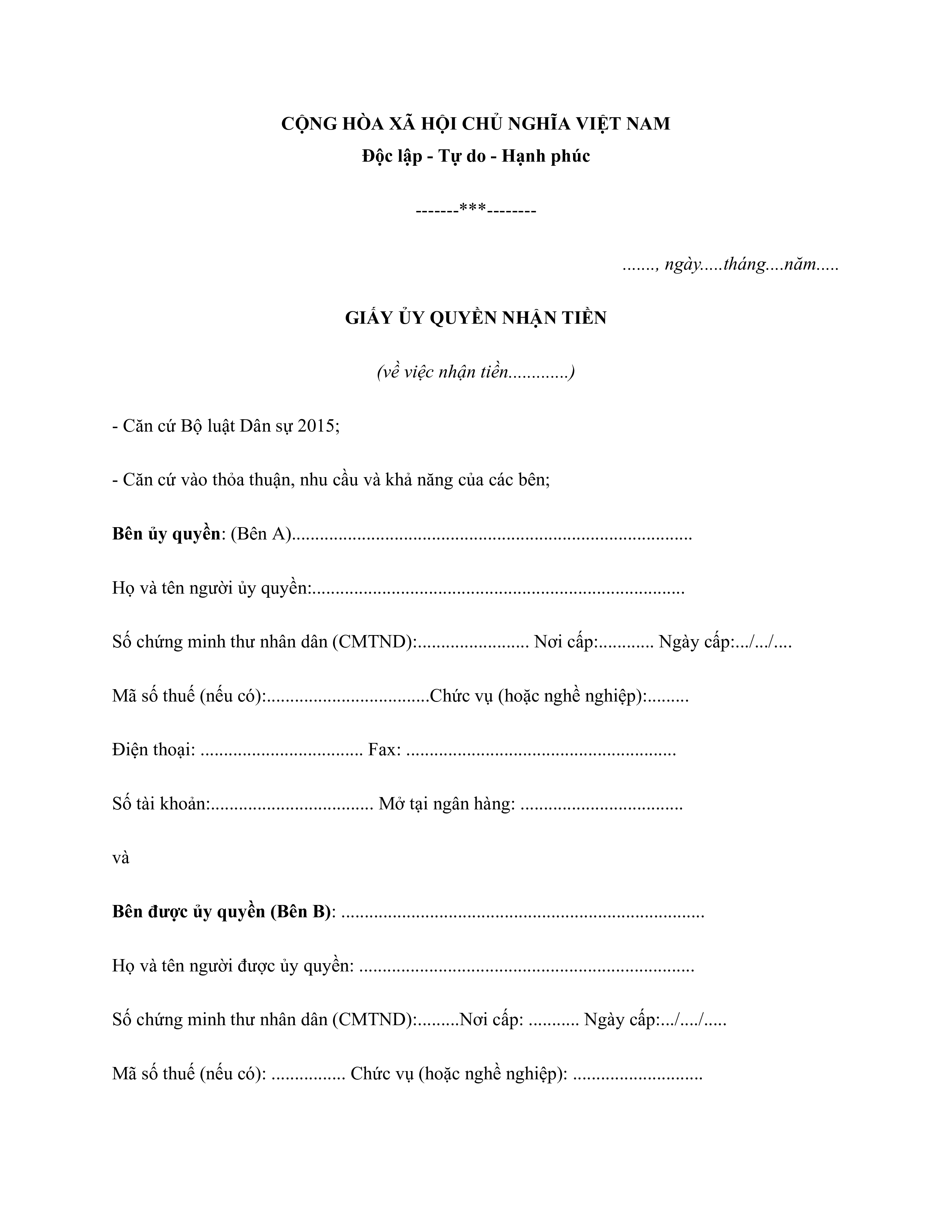
5.2. Template 2
6. Power of attorney to receive money templates for specific cases
6.1. Power of attorney to receive a deposit template
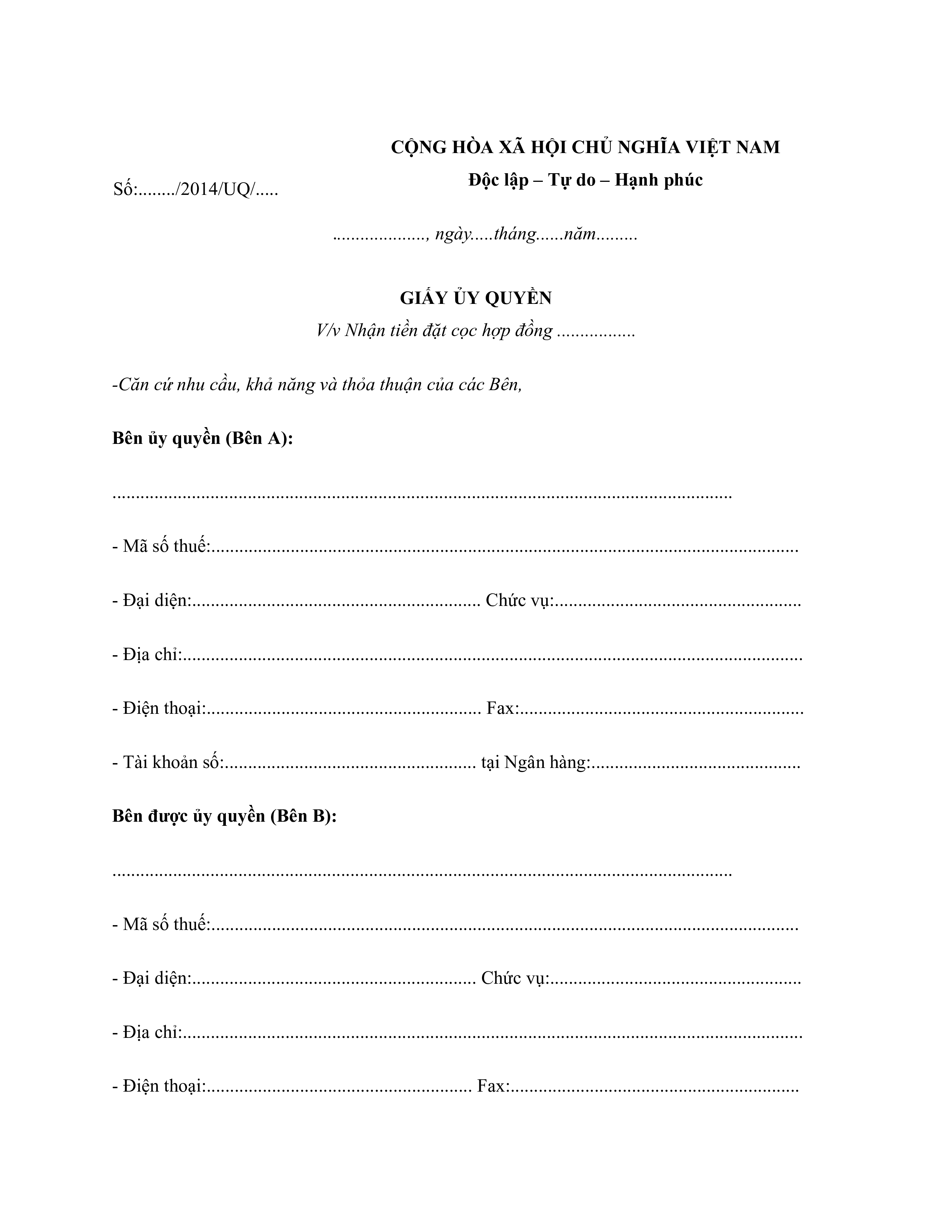
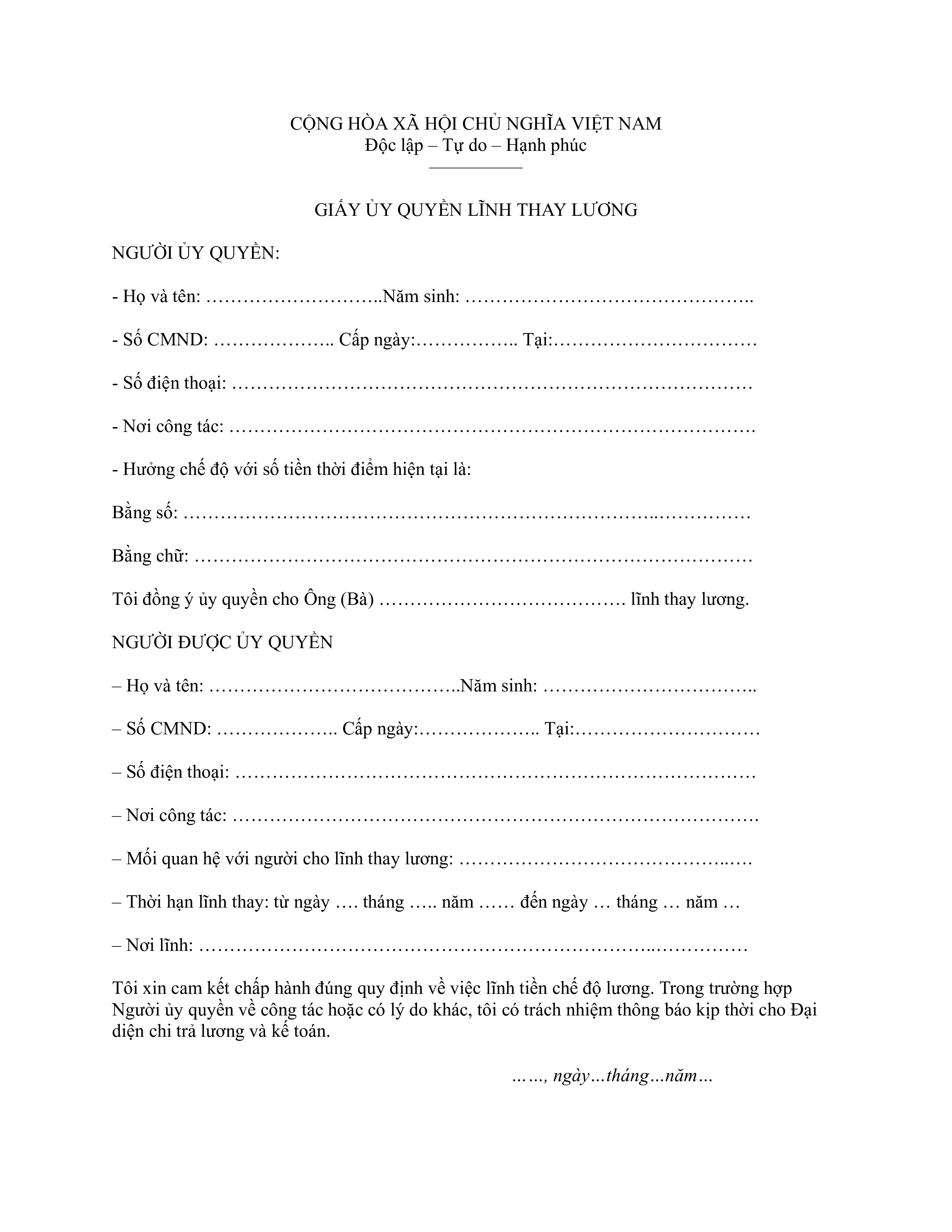
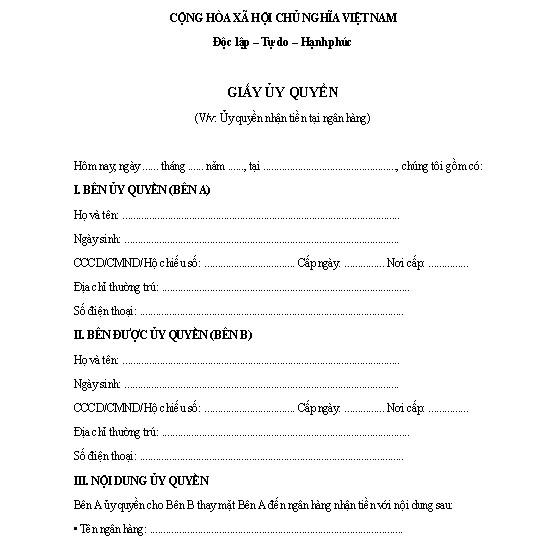
Download now: Bank Authorization Letter Template (.docx)
According to the regulations in Decree 30/2020/ND-CP on clerical work, below are the required sections for a payment authorization letter to ensure its legality and compliance with current standards:
– National Emblem and Motto
– Name of the issuing agency or organization: This section is not required for personal authorization. If issued by an organization or business, you must clearly state the organization/company name.
– Document number and symbol: The document number and symbol must be clearly stated, for example: No.: 01/2024/GUQ
– Place and date of issuance: Clearly state the place where the authorization letter was created and the date, month, and year.
– Document type and subject: For example: AUTHORIZATION LETTER – Regarding the collection of payment on behalf of another
– Authorizer’s information: Full name, date of birth, ID/Citizen ID/Passport number, address, phone number, Tax ID, etc.
– Authorized person’s information: Full name, date of birth, ID/Citizen ID/Passport number, address, phone number, Tax ID, bank account information, etc.
– Content of Authorization:
- Scope of authorization: Receive money from which organization/individual, reason for receiving the money (salary, insurance, contract payment, allowance, etc.), and the specific amount.
- Purpose of authorization: For example: “To receive the sum of money from… on my behalf.”
- Agreement on remuneration (if any).
- Specify the responsibilities and rights of the authorized person in receiving the money.
– Term of Authorization
- Clearly state the start and end date of the authorization.
- If there is no specific term, you must clearly state the conditions for termination of the authorization.
– Signatures and confirmation of the parties
– Seal, digital signature of the agency, organization (if any)
– Recipients: List the recipients of the authorization letter (relevant agencies, organizations, individuals).
* Notes when drafting a payment authorization letter:
- Accurate information: Both the authorizer and the authorized person must provide complete and accurate personal information. Especially the ID/Citizen ID number and permanent address to ensure legality.
- Clear authorization content: The writer must clearly state the amount of money authorized to be received and the source of the money (salary, insurance, contract payment, etc.), as well as the specific location and time.
- Term of authorization: Clearly state the start and end time of the authorization. If there is no specific time, you need to clearly note the conditions for termination of the authorization.
- Signature and notarization: The authorization letter must have the signatures of both parties (the authorizer and the person authorized to receive the money). Depending on the requirements of the paying agency or the law, the document may need to be notarized or authenticated by a competent state authority.
A payment authorization letter is a convenient legal document but must be used correctly to avoid risks of disputes, financial loss, or invalidity. Below are the main points to remember when creating and using an authorization letter (updated according to Vietnamese law for 2025):
- Authorization to receive money from abroad: The power of attorney must be consular legalized at the Vietnamese Embassy/Consulate abroad (or vice versa if authorizing from Vietnam to a foreign country). Additionally, the document must be notarized and translated into Vietnamese (if the original is in a foreign language). Failure to complete this step will render the power of attorney legally invalid in Vietnam, especially when receiving international wire transfers or inheritance from abroad.
- Power of attorney form for receiving compensation: Must clearly state the compensation amount (in numbers and words), the source of compensation (contract, court/state agency decision), and the paying agency (full name, address). It is advisable to attach the compensation agreement minutes or related decisions to increase transparency and avoid future disputes.
- If the amount is large, notarization is recommended to avoid disputes: Although the law does not require notarization for a regular power of attorney to receive money, for large amounts (usually from several hundred million VND upwards) or high-risk situations (inheritance, damage compensation), you should have it notarized at a notary office. This gives the power of attorney strong evidentiary value in court and protects the interests of both parties.
- The authorized party is responsible for transferring the full amount to the authorizing party: According to the 2015 Civil Code, the authorized party must correctly perform the authorized tasks and is liable for damages if losses occur (e.g., misappropriating funds, delaying transfer). You should clearly state this commitment in the power of attorney: “The authorized party commits to transferring the entire amount received to the authorizing party within … days from the date of receipt.” You can request the authorized party to sign a money handover record after receiving it.
Additional notes for better security
- Authorization period: Clearly state the start and end dates to prevent misuse.
- Do not authorize individuals under 18 years of age or those who lack civil act capacity.
- Keep a copy of the power of attorney and payment receipts as evidence.
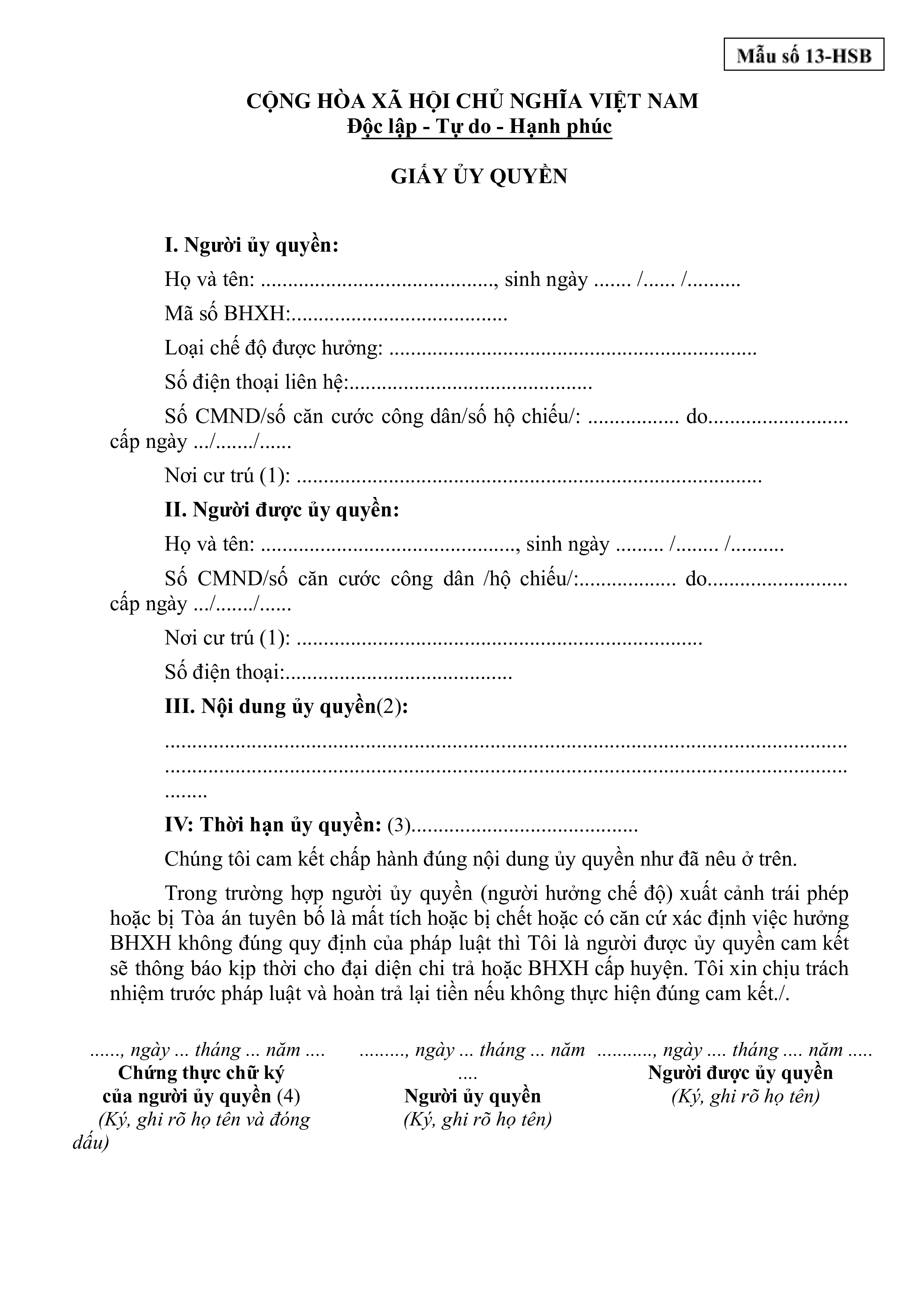
- For authorizing receipt of pension/social insurance: You must use the standard form 13-HSB and submit it directly to the social insurance agency.
- If a dispute is anticipated, you can create an authorization contract with remuneration to increase legal liability.
Adhering to the notes above will help ensure the power of attorney for receiving money is effective, protects your rights, and avoids unnecessary risks. If the amount is large or the situation is complex, consult a lawyer or notary office before signing!
See More: 8+ Latest Updated Power of Attorney Forms for Relatives
9. Frequently Asked Questions about Power of Attorney Forms for Receiving Money
Is a handwritten power of attorney for receiving money valid without notarization?
It is legally valid if it contains all necessary information and signatures of the parties. However, organizations like banks or insurance companies often reject this document if it lacks signature authentication from a competent authority.
Do spouses need a power of attorney to receive money on each other’s behalf?
Yes. Even for family members, the paying agency still requires a valid power of attorney (often requiring authentication) to ensure transparency and avoid disputes over separate property in a marriage.
Can a copy of the national ID card (CCCD) be used for the procedure of authorizing money receipt?
No. When carrying out the procedure to receive money at agencies, the authorized person must present their original national ID card (CCCD) and a copy (or the original, depending on the place) of the authorizer’s ID for verification.
How is a power of attorney created if the authorizer is abroad?
The authorizer must go to the Vietnamese Embassy or Consulate in the host country to create and authenticate the power of attorney, then send the original document to Vietnam for the authorized person to use.
Can a power of attorney for receiving money be used to withdraw savings at a bank?
Yes, but bank regulations are very strict. The power of attorney must be created using the bank’s specific form or must have clear notarization/authentication regarding the content that permits withdrawal from a specific savings account number.
How long is a power of attorney for receiving money valid?
The validity period is agreed upon by the parties. If not specified, the power of attorney is valid until the task is completed or terminated according to legal regulations.
Is it necessary to notarize a power of attorney for receiving money?
It is not mandatory in all cases. Notarization/authentication is only required when mandated by law or the receiving entity (such as a bank or state agency).
Can the authorized person re-authorize another person?
Re-authorization is only permitted with the consent of the original authorizer or as allowed by law.
















