10/05/2026
  211 views
Product pricing is one of the crucial steps that determines a business’s success and operational efficiency. Determining a reasonable product price not only helps increase profits but also enhances the business’s competitiveness in the market. However, not every business knows how to price products effectively and optimally. The following article by 1Office will provide you with popular and optimal product pricing methods and strategies, helping you determine the most suitable strategy for your business.
Mục lục
- 1. What is product pricing?
- 2. Why is product pricing necessary?
- 3. The right time for product pricing
- 4. Effective and popular product pricing methods today
- Price Skimming (Skimming Pricing)
- Penetration Pricing
- Value-based Pricing
- Cost-plus Pricing
- Competitive Pricing
- Psychological Pricing
- Segmented Pricing
- Bundle Pricing
- Discount Pricing
- Geographical Pricing
- Dynamic Pricing
- Target Pricing
- Product Lifecycle Pricing
- Loss Leader Pricing
- Premium Pricing Strategy
- Freemium Pricing Strategy
- 5. Steps to Price a Product
- 6. Notes on Applying Product Pricing Methods
- 7. Factors Affecting Product Pricing Strategy
- Costs
- Customer’s Perceived Value
- Demand and Price Elasticity
- Competition and Market Strategy
- Business Objectives and Strategy
- Product Life Cycle
- Distribution Channels and Sales Models
- Legal, Tax, and Non-Economic Cost Factors
- Consumer Psychology and Marketing Factors
- Seasonality and Consumption Cycles
- Operational Capacity and Scale
- Innovation and Replicability
- 8. Conclusion
1. What is product pricing?
Product pricing is the process where a business analyzes, researches, and determines a specific selling price for a product or service based on various factors, aiming to achieve profit goals, market share growth, and maintain competitiveness. During the pricing process, a business not only relies on production costs but also needs to consider market demand/orientation, consumer behavior, competition levels, and the value the product brings to customers.

To price a product accurately and optimally, a business will need to consider and calculate many different costs. Some types of costs that make up the product price include:
- Direct material costs: the main raw materials needed to produce the product.
- Direct labor costs: basic salary, benefits, etc.
- Manufacturing overhead costs: costs incurred during the production process, such as electricity, water, machinery, maintenance, rent, etc.
- Administrative and operating costs: costs arising from management activities: salaries, bonuses, administrative expenses.
- Shipping and distribution costs: warehousing, loading/unloading, logistics activities, etc.
- Marketing and sales costs: advertising costs, commissions, etc.
- Taxes and legal fees: various related taxes and legal fees, etc.
- Financing costs (loan interest)
- Expected profit: the desired profit margin from each product
2. Why is product pricing necessary?
Product pricing is one of the most important steps a business must take because this process directly affects its profitability, competitiveness, and long-term development strategy. Effective and optimal product pricing will allow a business to:
Optimize profitability
The selling price of a product directly determines the level of profit a business can achieve. If a business prices too high, the product may not attract customer interest. Conversely, if priced too low, the business may not generate enough profit to sustain operations and grow. Accurate pricing is the key to helping a business optimize profitability without losing potential customers.
>>> See more: What is Net Profit? Formula & Effective Optimization Methods
Maintain and enhance competitiveness
In the market, product price is a factor that helps a business compete with its rivals. With a reasonable price, the product can compete more easily, especially when the business faces many competitors in the same industry with similar products.
Shape brand value
The price of a product also reflects its value in the eyes of consumers. For example, high-priced products are often associated with a premium image, high quality, and excellent service. Conversely, with low-priced products, consumers tend to associate them with an image of savings, suitable for customers with average incomes. Therefore, pricing not only reflects the product’s value but also helps build the brand image in the minds of customers.
Influence purchasing behavior
Product price has a huge impact on consumers’ purchasing decisions. A price that matches their ability to pay and perceived value will encourage customers to make a purchase decision more quickly. Reasonable pricing can make customers feel the product is worthwhile and provide a positive experience.

Manage costs and cash flow
Correct product pricing helps businesses control costs and cash flow more effectively. Pricing that aligns with production and operating costs helps the business maintain stable and sustainable profits. At the same time, when a business has an effective pricing strategy, it can more easily plan for long-term investment and development.
3. The right time for product pricing
The right time to apply product pricing strategies depends on many factors, both internal to the business and from market impacts. Below are important times and situations when a business should consider adjusting its pricing strategy to optimize business efficiency:
Launching a new product line or an upgraded version
When a business launches a new product or an upgraded version of an existing product, it is a crucial time to review the pricing strategy. For new products, businesses can apply strategies such as: skimming strategy (high price), penetration strategy (low price), etc.
For example: When Apple launches new product lines like the iPhone or Macbook, they often apply a skimming strategy – setting the highest possible price to maximize the product’s appeal.
When production and investment costs change
A business will need to adjust and re-price its products when there is a significant change in production costs or raw material input costs. If costs increase, the selling price also needs to be adjusted to maintain profitability. Conversely, if costs decrease, the business can consider lowering the product price to attract more customers and increase market share.
When entering a new market
Each market has its own characteristics regarding consumer behavior, income, and competition. Therefore, when expanding into a new market, a business needs to adjust its pricing strategy to suit specific conditions and requirements:
For example:
- For high-income markets, businesses can apply a higher pricing strategy, emphasizing product value.
- For markets with high competition or low income, businesses can use a low pricing or penetration pricing strategy to attract customers.
When competitors change their pricing strategy
In an increasingly competitive market, a competitor’s price adjustment can directly affect your business. If a competitor lowers prices or launches product lines with more attractive prices, the business needs to analyze and consider adjusting its prices or adding value to its products to maintain competitiveness.
For example, in the retail industry, famous brands like Walmart and Target often adjust their prices continuously to respond to each other’s discount policies.
When the economy faces difficulties or inflation
When the general economy is facing difficulties such as high inflation or a recession, customer purchasing power may decrease, leading to changes in shopping behavior. In this situation, businesses need to consider adjusting selling prices or offering promotions and discounts to stimulate demand and retain customers.
When the business strategy changes
A business may change its strategy from focusing on short-term profits to building long-term market share, or from offering mass-market products to premium products. Each change in business strategy requires the business to readjust its product prices to align with the new direction.
For example, a fashion brand that initially sold affordable products might later decide to move into the premium market to match its new image.
When the product reaches the end of its life cycle
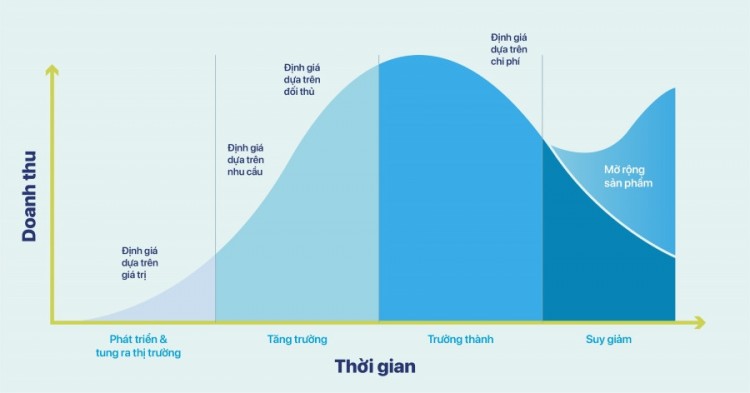
At the end of the product life cycle, businesses typically have to reduce product prices to boost consumption and clear inventory, maximizing revenue from the old product in preparation for launching a new one.
For example, phone companies often discount older models before launching a new version to boost sales and attract consumers to buy the remaining products.
4. Effective and popular product pricing methods today
There is no one-size-fits-all formula for every product — each pricing strategy is suitable for different stages and goals. Let’s explore the most effective product pricing methods today, from cost-based and value-based pricing to customer psychology, to choose the most suitable direction for your business.
Price Skimming (Skimming Pricing)
The price skimming strategy involves a business setting the highest possible selling price when a new product is launched, especially for innovative, unique, or technologically advanced products. The business typically targets customer groups willing to pay a high price to own the product early, then lowers the price over time as competition increases and demand from other segments emerges.
For example: When Apple releases a new iPhone line, the price is usually set high. After a few months or when a newer version is launched, the price of older models drops significantly to reach more customers.
Penetration Pricing
With this strategy, businesses often set prices lower than the market to attract customers and quickly gain market share. The goal is to build a large customer base from the beginning, then increase prices once customers are familiar with the product.
Example: Netflix applied this strategy when it first launched, offering its streaming service at a lower price than its competitors. Thanks to this strategy, they quickly became a leading entertainment service provider.
Value-based Pricing
Value-based pricing is pricing based on the customer’s perception of the product, rather than the cost of production. Businesses will need to understand customer needs and wants, then set a price that corresponds to the level of benefit the customer perceives.
Example: Starbucks sells its coffee at a much higher price than regular coffee brands, but customers are still willing to pay more because they perceive value from the experience, product quality, etc.
Cost-plus Pricing
With this strategy, a business determines the price by adding a desired profit margin to the total production cost. This is a simple and common approach but does not consider market factors or the value customers receive.
Example: A furniture manufacturer calculates the total production cost of a table to be 1 million and adds a 30% profit margin to set the selling price at 1.3 million.
Competitive Pricing
Competitive Pricing is a strategy where businesses base their prices on observing and reacting to competitors’ prices. The business sets its price equal to or lower than competitors to attract customers from them.
Example: In the mobile phone industry, Samsung and Xiaomi frequently adjust their product prices based on competitors’ discount events to retain and attract customers.
Psychological Pricing
Psychological pricing often targets customers’ emotions and behaviors by using prices like 99,000 instead of 100,000 to create the impression of a lower price. This takes advantage of how customers perceive value numerically.
Example: Supermarkets often price products at 99,000 or 199,000 instead of rounding up to 100,000 or 200,000.
Segmented Pricing
Segmented Pricing is when a business applies different prices for the same product, depending on the customer segment or geographical area. This can be based on ability to pay, needs, or market conditions and the target audience.
Example: Airlines like Vietnam Airlines offer different ticket prices for different seating classes such as business class, premium economy, and economy class.
Bundle Pricing
Businesses can combine multiple products or services into a bundle and sell it at a lower price than the total value of the products if purchased separately. With this strategy, businesses can encourage customers to buy more products.
Example: Microsoft Office sells products like Word, Excel, and PowerPoint in a bundle, at a lower price than buying each application individually.
Discount Pricing
With this strategy, businesses will offer direct price reductions or promotions to increase short-term purchasing demand. This method is often used to stimulate demand or clear out inventory.
Example: Brands often use Black Friday and Cyber Monday as events to offer major discounts and boost sales.

Discount Pricing
Geographical Pricing
A business’s product prices can vary by geographical area, due to different shipping costs, taxes, and economic conditions in each region.
Example: Gasoline prices in different provinces vary due to different transportation costs and local tax rates.
Dynamic Pricing
With Dynamic Pricing, product prices can change over time based on demand and supply. This is a flexible strategy and is often adjusted in real-time.
Example: Airline booking platforms like Vietnam Airlines, Vietjet, etc., often change ticket prices based on booking time, demand, and remaining seat availability.
Target Pricing

A business first determines its desired profit, then adjusts production costs and selling price to achieve that goal.
Example: Toyota might set a target price for a new car model, and from there, the car company adjusts production costs and product pricing to ensure a certain profit level is achieved.
Product Lifecycle Pricing
Product pricing can change according to the stages of the product life cycle (introduction, growth, maturity, decline). Initially, the price may be high, but it gradually decreases as the product enters the decline stage.
Example: When smartphones are first launched, they often have a high price, but it gradually decreases as new models are released or when the technology becomes outdated.
Loss Leader Pricing
Businesses will set a price lower than or equal to the production cost to attract potential customers. Profit is made from related products or subsequent transactions,
Example: Supermarkets often sell items like eggs and milk at very low prices to draw customers into the store, where they will then buy other products.
Premium pricing is a strategy of setting a product’s price higher than the market average to create a perception of superior value and quality. Customers will need to pay more for an exclusive product or service.
Example: Rolex is a luxury watch brand with very high prices. Customers pay this price not just for the functionality but also for the brand and the social value the product brings.
Freemium Pricing Strategy
This strategy is a combination of “Free” and “Premium,” where a business offers a free version of a product or service with basic features and charges for more advanced and comprehensive features. The goal of this strategy is to attract users with the free version and then encourage them to upgrade to the paid version.
Example: Spotify offers a free music streaming service with ads and some limited features. Users need to pay to upgrade to a Premium account to remove ads and use advanced features.
5. Steps to Price a Product
Step 1: Determine the Cost Price (Production Cost)
In this step, the business needs to determine the total cost to produce the product, including costs such as: raw material costs, direct labor costs, general production costs, etc.
Formula: Product Cost = Beginning Work-in-Progress + Total Production Cost – Ending Work-in-Progress
Example: If the raw material cost is 100 million VND, labor cost is 50 million VND, and general production costs are 60 million VND, the cost per product will be calculated by dividing the total costs by the number of completed products.
Step 2: Research the Market and Target Customers

After determining the product’s cost price, the business will need to identify customer demand and the price they are willing to pay. At the same time, the business must identify market trends, purchasing habits, and the financial capacity of each target customer segment. This helps you adjust the price to match customers’ desires and abilities.
Step 3: Research Competitors
This is an important step that helps businesses understand and analyze competitors’ selling prices to determine the market price range. Consider factors such as quality, features, and after-sales service that competitors offer, from which you can set a competitive or differentiated price.
Step 4: Determine the Desired Profit Margin
The business needs to determine the desired profit margin for each product. Typically, the profit margin is calculated as a percentage of the cost price.
Formula:
- Profit = Selling Price – Production Cost
- Profit Margin (%) = (Profit / Selling Price) * 100
Step 5: Determine the Retail Price
The retail price usually includes production costs, marketing costs, operating costs, and the desired profit margin.
Formula: Retail Price = Cost Price + (Cost Price * Desired Profit Margin)
Example: If the cost price is 1,000,000 VND and you want a 30% profit, the retail price will be 1,000,000 + (1,000,000 * 30%) = 1,300,000 VND.
Step 6: Determine the Wholesale Price
The wholesale price is usually lower than the retail price because businesses need to offer discounts to encourage distributors to buy in large quantities. The wholesale price depends on the quantity purchased and any accompanying incentives or discounts.
Formula: Wholesale Price = Retail Price – Volume Discount
Example: If you want to offer a 10% discount for large orders, the wholesale price will be 1,300,000 – (1,300,000 * 10%) = 1,170,000 VND.
See more: How to Calculate Percentage Discounts to Ensure Business Profitability
6. Notes on Applying Product Pricing Methods
When pricing products, businesses need to consider several important factors to ensure their pricing strategy is reasonable, effective, and optimal:
Consider all types of costs
To avoid losses, businesses must accurately and fully calculate all costs related to production and operations, such as: fixed costs, variable costs, marketing and distribution costs, etc.
Overlooking costs can lead to underpricing, which affects the company’s profitability. Therefore, businesses should not only calculate current costs but also forecast and budget for future expenses like raw material costs or inflation.
Balance price, quality, and service

Besides the product price, businesses also need to balance it with quality and customer service. A high-priced product that offers high value to customers (good quality, support services, long-term warranty) can be accepted. Conversely, if the price does not match the quality or the service is poor, customers will quickly leave.
Don’t be too rigid in your pricing strategy
The selling price should not be a fixed element that remains unchanged over time. Factors like the market, competitors, and consumer trends are always changing, so businesses need to be flexible in adjusting prices. For example, when production costs decrease or market demand changes, a business can consider lowering prices to attract more customers or maintain market share.
Integrate added value
Discounting is not always the optimal solution. Instead, businesses can provide additional value without reducing the price, such as free delivery, longer warranties, or bundled products. This helps customers feel they are receiving more value for their money without reducing the company’s profit.
Test and adjust prices
The market is constantly changing, and no single price is suitable forever. Therefore, businesses need to continuously test different price points to optimize profits. Businesses can experiment with different customer segments to find the most suitable price and adjust it according to market trends and customer feedback.
7. Factors Affecting Product Pricing Strategy
Pricing is not a random number—it’s a strategic decision influenced by many internal and external factors. Understanding these components helps businesses choose a suitable pricing model that both ensures profitability and aligns with the market and business goals.
Costs
Costs are the most fundamental basis of pricing. They include:
-
Direct variable costs (raw materials, direct labor).
-
Allocated fixed costs (depreciation, rent, management).
-
Indirect costs incurred when deploying sales channels (commissions, e-commerce platform fees, logistics).
Application: At a minimum, you must know the “total cost per unit” to determine the floor price (break-even price). For example: if the total cost of a product is 50,000đ, setting the price at 45,000đ is a deliberate “cash burn” strategy; setting the price at 60,000đ is a strategy with a 20% profit margin.
Customer’s Perceived Value
Price often reflects the value customers are willing to pay rather than the production cost. Value is formed from brand, quality, purchasing experience, after-sales service, and scarcity.
Application: Analyze personas—for the same cost, you can set a high price for customer groups that prioritize experience, and a lower price for price-sensitive groups.
Demand and Price Elasticity
The degree to which demand changes when the price changes determines the strategy:
-
Goods with inelastic demand: the price can be increased without a significant drop in sales volume (e.g., essential goods, strong brands).
-
Highly elastic goods: lowering prices to stimulate demand can significantly increase sales.
Application: calculate elasticity using historical data; run small A/B price tests to identify sensitivity points.
Competition and Market Strategy
The competitive environment shapes the pricing range:
-
Perfectly competitive market → price depends heavily on competitors.
-
Monopoly/oligopoly market → ability to set higher prices.
Application: analyze competitors (competitor benchmarking), find “price space” for positioning (lower price for penetration, or higher price for premium positioning).
Business Objectives and Strategy
Different objectives lead to different prices:
-
Maximizing market share → often uses penetration pricing.
-
Maximizing short-term profit → skimming pricing.
-
Maintaining a premium brand position → premium pricing.
Application: each strategy needs corresponding KPIs (market share, margin, LTV/CAC).
Product Life Cycle
The introduction, growth, maturity, and decline stages affect pricing: at launch, you can use high (skimming) or low (penetration) prices; at maturity, promotions are needed; during decline, you might reduce prices or change packages.
Distribution Channels and Sales Models
Channels affect the final price: selling directly (direct-to-consumer) allows for better price control; selling through agents/distributors requires margin sharing; selling on e-commerce platforms incurs platform fees, vouchers, and promotional programs. Application: calculate the price structure for each channel to ensure profitability per channel.
Legal, Tax, and Non-Economic Cost Factors
VAT, import taxes, government price ceilings/floors, competition regulations, or environmental compliance costs may force price adjustments. Always check local regulations before setting prices.
Consumer Psychology and Marketing Factors
Psychological pricing techniques (9.99, 199k instead of 200k), limited-time promotions, and anchoring (placing a high price next to a sale price to increase perceived value) all affect conversion rates. Application: combine communication strategies with pricing levels to maximize acceptance rates.
Seasonality and Consumption Cycles
Seasonal products (fashion, food) require seasonal pricing strategies; goods in high demand during holidays may have temporary price increases (seasonal dynamic pricing).
Operational Capacity and Scale
Large-scale businesses with optimized logistics have lower costs, thus creating competitive pressure on prices. Small businesses may not compete on price but can compete on service, niche, or personalization.
Innovation and Replicability
Unique, patented, or hard-to-replicate products allow for higher prices; easily replicated products need to account for competitive reactions.
8. Conclusion
Mastering pricing strategies and methods will help you optimize profits, enhance brand value, and strengthen your competitiveness in the market. We hope that through this article, you can choose a suitable product pricing strategy, contributing to a solid foundation for the long-term development of your business