


 10/05/2026
  169 views
The complaint handling process is one of the key factors that helps businesses maintain customer satisfaction and build brand reputation. Handling complaints effectively not only helps businesses resolve issues quickly but also helps improve customer relationships and retain them long-term. Therefore, in this article, we will provide you with details on the steps in the complaint handling process, from receiving, analyzing, and resolving to providing feedback, along with other important notes.
Mục lục
- 1. What is a complaint handling process?
- 2. Why is a customer complaint handling process necessary?
- 3. A simple and effective 6-step customer complaint handling process
- 4. Common Complaint Scenarios and How to Handle Them
- 5. Things to Avoid During the Customer Complaint Handling Process
- 6. How to Measure and Improve the Complaint Handling Process
- 7. 1CRM: The Comprehensive Customer Management and Customer Service Toolkit
- Frequently Asked Questions about the Complaint Handling Process
1. What is a complaint handling process?
A complaint handling process is a series of steps a business takes to receive, analyze, and resolve customer complaints professionally and effectively. This process includes listening to customer feedback, identifying the root cause of the problem, and providing a suitable solution, ensuring all complaints are handled promptly to enhance satisfaction and retain customers. A well-structured, professional complaint handling process will help a business improve its reputation and build strong trust with customers.

1.1. Departments involved in the complaint handling process
The departments involved in handling complaints within a business typically include:
- Customer Service Department: This is the first department to receive customer complaints, listen to feedback, and resolve basic issues or forward them to the relevant departments for handling.
- Sales Department: When a customer has a complaint related to a product/service, the sales department provides information and assists in resolving the issue from the customer’s perspective.
- Technical Support Department: For complaints related to technical errors, this department will investigate and provide technical solutions to fix the problem.
- Quality Control Department: If the complaint is related to product/service quality, this department will inspect, evaluate, identify the cause, and determine corrective measures.
- Legal Department: In cases involving legal issues, rights, or disputes, the legal department will participate to ensure the handling process complies with legal regulations.
- Management: For complex complaints that have a significant impact on the business, management may intervene to make decisions on the final handling and resolution.
1.2. Principles for handling customer complaints
The principles for handling customer complaints are guidelines that businesses need to follow to ensure the process of resolving customer complaints or requests is effective and professional. Some basic principles include:

- Listen to the customer: Always respect, be willing, and listen attentively to the customer’s opinions to fully understand the issue and gather comprehensive information before making a decision.
- Respond quickly: Ensure timely responses so customers do not feel ignored.
- Resolve fairly: Provide a reasonable, satisfactory, and fair solution for both parties.
- Maintain a professional attitude: Always remain calm, polite, and respectful to the customer in any situation. You should not try to explain or advise customers when they are angry.
- Follow up and check: After resolution, the business needs to follow up to ensure the issue has been fully addressed and the customer is satisfied and accepts the solution.
Adhering to these principles will help the business maintain good customer relationships and build its reputation.
>>> See more: What is Customer Care (CSKH)? Role, tasks, and effective CSKH process
2. Why is a customer complaint handling process necessary?
Establishing a complaint handling process helps businesses turn negative feedback into opportunities for quality improvement, thereby protecting brand reputation and building lasting customer loyalty.
Here are the key values that a professional handling process provides:
- Enhance customer satisfaction and retention: When customers encounter a problem, they often evaluate the business by how it handles complaints. A professional process helps resolve issues quickly and transparently, increasing customer satisfaction.
- Improve the business’s image and reputation: A business that handles complaints professionally will build trust and credibility in the eyes of its customers. This helps enhance its reputation, build trust, and attract potential new customers.
- Prevent risks and legal disputes: Poor complaint handling can lead to disputes and even legal action, causing a loss of time and money and negatively impacting the business.
- Create opportunities to improve services and products: Through complaints, businesses can gather feedback from customers and identify areas for improvement in their processes, products, or services.
- Optimize internal operational efficiency: A clearly defined complaint handling process helps to better assign responsibilities and control work quality, thereby improving efficiency and minimizing errors during processing.
- Build long-term relationships with customers: A business that listens and satisfactorily resolves complaints makes customers feel respected, which helps build long-term relationships based on trust. .
It can be said that a professional complaint handling process not only helps a business maintain and grow its existing customer base but also creates favorable conditions for sustainable development, contributing to improved business efficiency.
3. A simple and effective 6-step customer complaint handling process
| Stage | Person/Department in Charge | Task to be Done | SLA | Output Result |
| 1. Receiving Complaint Information | Complaint Handling Department
Customer Service (CS) Staff |
Receive complaints or requests from customers through various channels | Within 1-2 hours | Confirm, receive the request, and provide feedback to the customer |
| 2. Classifying the Complaint/Request | Head of Customer Service Department
Complaint Handling Department |
Determine the severity level and type of request or complaint | Within 4 hours | Correctly classify the request to the corresponding groups/departments (e.g., service, technical, etc.) |
| 3. Handling the Complaint | Complaint Handling Department
Related Department |
Resolve and provide a solution according to the department’s internal process | Within 24 hours | Complete the resolution or provide a temporary solution to the customer |
| 4. Reviewing the Solution/Resolution Plan | Head of CS Department/Complaint Handling Department | Department head reviews the solution | Within 4 hours | Assess the suitability of the solution |
| 5. Communicating the Result | CS Department Complaint Handling Department |
Inform the customer of the resolution result | Within 2 hours after the resolution is complete | The customer receives a full response regarding the solution and the results that have been implemented |
| 6. Follow-up and Evaluation | CS Department | Monitor and evaluate the situation after handling the complaint and assess the customer’s satisfaction level | Within 3 days | Assess satisfaction level, record additional feedback if any. |
Here is an effective 6-step complaint handling process that you can apply at your business:
Step 1: Receive complaint information
In the first step, customer service staff will receive complaints or requests from customers through channels such as phone, email, or social media. The information will be recorded and confirmed to the customer as soon as possible (usually within 2 hours). This ensures that customers know their issue has been acknowledged and will be resolved soon.
Step 2: Classify the complaint/request
After receiving the complaint information, the head of the customer service department will review and classify the customer’s request to forward it to the appropriate handling department. This ensures that customer issues are resolved by the right people with the right expertise.
Step 3: Resolve the issue
Depending on the type of request, relevant departments such as technical, finance, or service will proceed to resolve it within the specified timeframe (usually 24 hours). If the issue is complex and requires more time to handle, this department will provide a temporary solution for the customer.
Step 4: Review the solution/complaint handling approach
After a resolution approach is proposed, the director or head of the complaint handling/customer service department needs to review the solution to ensure its consistency, accuracy, and appropriateness.

Step 5: Respond with the result
After resolution, the customer service department will contact the customer again to inform them of the outcome. This helps customers feel cared for and receive an accurate and timely response.
Step 6: Follow up and evaluate
Finally, the customer service department will monitor the situation after the issue is resolved and assess the customer’s satisfaction level. This allows the business to measure the effectiveness of the process and improve the service if necessary.
Read more:
4. Common Complaint Scenarios and How to Handle Them
Customers may complain for various reasons—from the product and service to the interaction experience. Each situation requires a suitable approach and resolution, ensuring the issue is thoroughly addressed while maintaining a respectful and professional attitude. Early identification of common scenarios helps businesses proactively build response scripts and train employees to handle any situation flexibly.
Complaints about the product
Cause: Typically, the reasons for customer complaints about a product are that it does not match the description, is faulty, damaged, or does not meet expectations.
How to handle: In this case, the business should ask the customer to provide detailed information with photos of the faulty product, confirm the fault, and offer a sincere apology to the customer. At the same time, the business should propose and offer suitable solutions such as a refund, a new product exchange, a repair, or a gift as compensation.
Complaints about service attitude
Cause: During the purchasing process, customers need advice and support from sales staff or related departments. However, if the employee interacting with the customer is unenthusiastic or has an unprofessional attitude, the customer will likely be dissatisfied and complain to the business.
How to handle: The business or person in charge needs to listen to both sides: the customer and the employee. Then, apologize to the customer and ensure service attitude improves. Additionally, the business should have regular training programs on professional skills, expertise, and employee attitude. You can refer to what should a business do when employees respond slowly to customers? here.
Complaints about the payment process
Cause: Nowadays, there are various payment methods (e-wallets, credit cards, QR codes, etc.). If a business does not update its payment methods or the payment system encounters an error, customers will have complaints related to the payment process and procedures during their purchase.
How to handle: Apologize to the customer for the inconvenience and, at the same time, update to new payment methods to meet the diverse needs of customers.
Complaints about service quality
Cause: The reason for complaints about service quality can stem from the quality of delivery, consultation, or customer support not meeting requirements.
How to handle: Investigate the issue and determine responsibility. Then, the business should propose solutions for improvement, such as training employees, changing the person in charge, or offering incentives to satisfy the customer.
Complaints about pricing or policies
Cause: The product price is too high or not commensurate with its quality, and related policies are unclear.
Solution: In this situation, the business needs to listen to customer feedback and provide a transparent explanation of the pricing or policies. If the fault lies with the business, a reasonable compensation plan should be offered.
Read more: What is Product Pricing? 15+ Effective Strategies with Examples
Complaints Due to Rejected Requests
Cause: The customer is dissatisfied because their request was not accepted.
Solution: The business needs to transparently explain the reason for the rejection and provide a more suitable solution that aligns with the company’s policies and protects the customer’s interests.
Complaints About Shipping Issues

Cause: Late delivery, lost items, or damage during product shipment.
Solution: Quickly verify the incident and inform the customer. The business should offer a compensation plan: a refund, a new product, or a discount on future purchases.
5. Things to Avoid During the Customer Complaint Handling Process
An effective complaint handling process depends not only on communication skills but also on avoiding common mistakes when interacting with customers. A confrontational attitude, lack of listening, or delayed responses can escalate the situation and damage the company’s image. Therefore, identifying and eliminating inappropriate behaviors is crucial to maintaining professional service standards.
Arguing with Customers
Customers who complain are often in a negative and agitated state. Therefore, if an employee tries to argue, the situation will become more tense. The handling department should not try to prove the customer wrong or be overly defensive. At the same time, it’s necessary to limit the use of critical language and tone.
Instead, always remain calm, listen sincerely, and explain with a courteous attitude.
Not Listening to Customers
When a business fails to listen, ignores, or interrupts, customers will feel neglected and disrespected. Therefore, you should try to put yourself in the customer’s shoes, fully record their feedback, and confirm that you have correctly understood the issue before proposing a solution
Delays in Handling Complaints
Delays, unfulfilled promises, or resolutions that exceed the committed timeframe will make customers impatient and give them a negative impression of the brand. The business needs to ensure the fastest possible resolution time and continuously update the customer on the status of their complaint.
Missing Complaints
Not closely monitoring complaint channels and failing to respond to complaints indicates that your business has a weak customer management and care system, which can easily lead to a loss of customer trust. Therefore, businesses need to establish a clear customer information management and care system with automated notification channels and conduct regular, periodic checks to avoid missing anything.
A Complicated and Cumbersome Complaint Handling Process
One of the common mistakes businesses make is having an overly complex complaint handling process that requires customers to interact with multiple departments, prolonging the resolution time. Instead, businesses should build simple, clear processes with a single point of contact responsible for handling and communication.
Unprofessional Attitude
Customers will have a low opinion of the business if employees cannot maintain a polite and professional attitude while receiving and handling issues. Businesses need to have training programs to teach employees how to maintain a professional, positive, and respectful attitude toward customers, even in difficult situations.
6. How to Measure and Improve the Complaint Handling Process
Handling complaints is not just about “resolving an issue”; it is a continuous process of evaluating and improving the customer experience. Businesses need to track both quantitative and qualitative metrics to comprehensively assess handling effectiveness, from response speed to final satisfaction levels.
6.1 Metrics for Measuring the Effectiveness of the Complaint Handling Process
To ensure the complaint handling process truly delivers results, businesses need to apply specific performance metrics. Indicators such as average response time, successful resolution rate, or post-resolution satisfaction levels help accurately assess team performance and the potential for process improvement. This also serves as a basis for businesses to continuously optimize the customer experience and enhance service quality.
Average Complaint Response Time (SLA – Service Level Agreement)
-
Measures the time from when a customer submits a complaint to when they receive the first response.
-
The lower this metric, the higher the customer retention rate.
Suggested target: respond within 24 hours for online complaints, or within the same work shift for in-person complaints.
First Contact Resolution (FCR) Rate
-
Reflects the capability and authority of the customer care team.
-
When employees have enough information and authority to resolve the issue on the first contact, customers feel respected and save time.
Formula: (Number of complaints resolved on the first contact / Total number of complaints) × 100%.
Customer Satisfaction Score (CSAT) After Resolution
- Assesses the customer’s sentiment after the resolution process is complete.
- Can be collected through a quick survey:
“How would you rate your satisfaction with our resolution on a scale of 1–5 stars?” - The results help businesses understand the level of acceptance and customer trust after a crisis.
Repeat Complaint Rate by Issue Category
- Helps identify root causes that have not been fully resolved, such as process errors, product quality issues, or inadequate employee training.
- From this data, businesses can adjust policies, internal processes, or organize retraining sessions.
6.2. How to Continuously Monitor and Improve the Process
- Periodic statistics: Compile data monthly or quarterly, categorized by product group, branch, or employee group.
- Comparison over time: Measure trends – whether the complaint rate is decreasing or increasing, and if response speed has improved.
- Organize review meetings: After each period, hold a “case review” session to share resolution experiences and update internal guidelines.
- Update the process: When recurring issues or outdated regulations arise, update the guideline documents directly to ensure consistency.
Businesses can present these metrics in customer care KPI reports or service quality assessment summaries, helping management easily track trends and make improvement decisions.

7. 1CRM: The Comprehensive Customer Management and Customer Service Toolkit
Building a customer care system and handling customer complaints is always a challenging problem for many businesses. The 1CRM customer management and care toolkit from 1Office is a comprehensive solution that helps businesses improve efficiency in customer care and sales. With powerful integration capabilities and high security, 1CRM is suitable for any business in today’s digital transformation era:
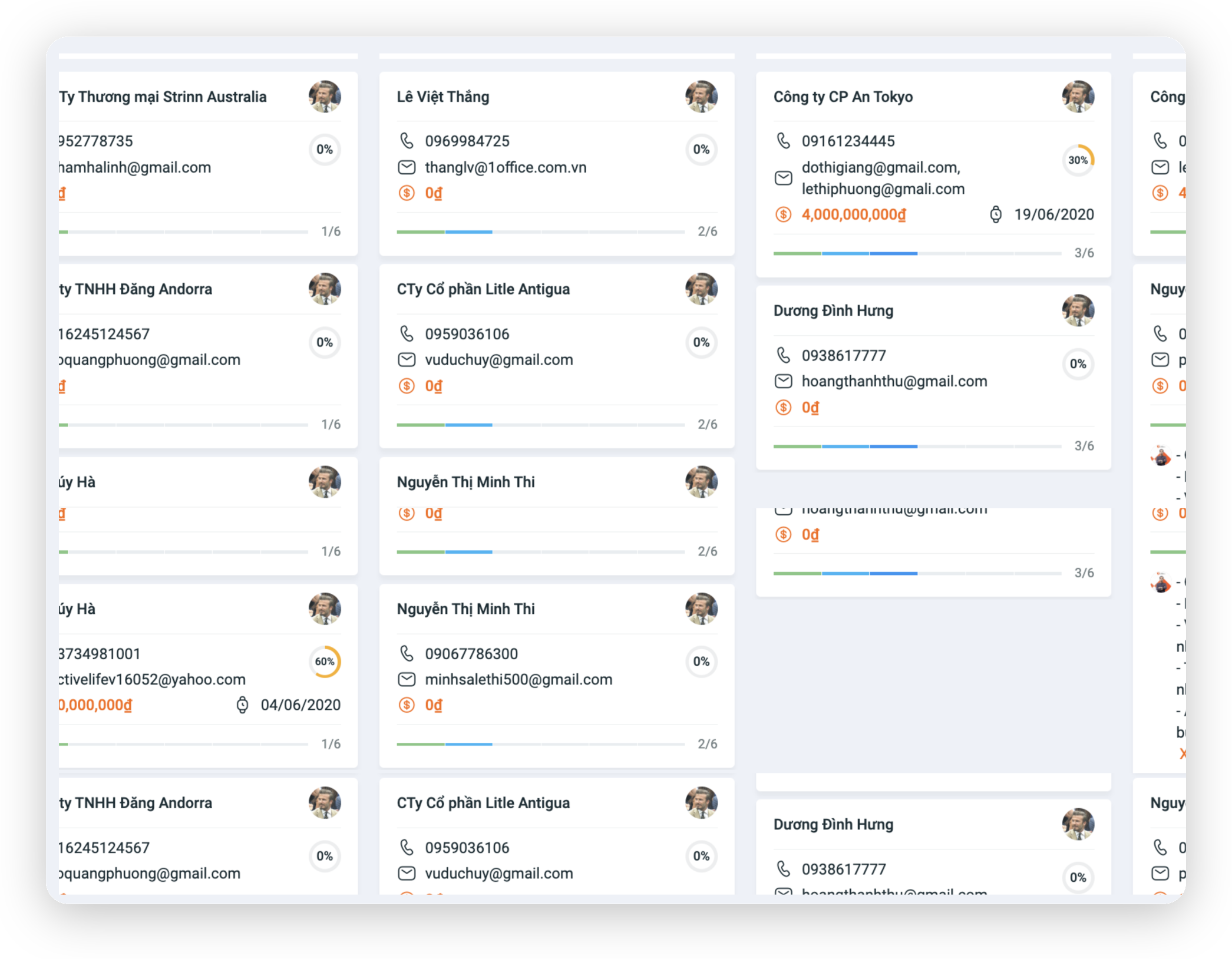
- Automatically classify and build customer care plans by group.
- Record care history and send automatic reminders, helping to optimize employee tasks.
- Digitize and centralize customer data storage, preventing loss and inconsistency among employees.
- Strictly delegate management permissions by individual, department, and position.
- The system’s automatic alerts help employees remember to care for and interact with customers—a valuable data source that the company spends significant resources to collect.
- Alerts allow for diverse customization of customer care scenarios such as reminders, birthdays, and more.
Register for a free feature Demo!
Frequently Asked Questions about the Complaint Handling Process
What is the optimal time to respond to an initial complaint?
Typically, it’s within 2 business hours of receipt. A quick response helps customers feel respected and prevents them from sharing negative experiences on social media.
What should a business do if a customer’s complaint is false?
It’s important to remain calm and tactfully provide complete evidence (images, transaction history, recordings) for verification. Absolutely avoid heated arguments; instead, explain based on the published policy.
Should the complaint handling process be made public on social media?
No. You should respond publicly with an apology and suggest moving to a private messaging channel (like email or direct message) to protect customer information and avoid negative public debate. To manage and respond quickly across all channels, you can refer to the 1CRM customer management tool from 1Office.
How should you handle a complaint when the fault lies with a third party (like a shipping carrier)?
The business should take responsibility for resolving the issue with the customer first (by exchanging the item or issuing a refund), and then work independently with the shipping partner to seek compensation. Customers are only concerned with the commitment from the party they paid.
When should a business offer compensation gifts to customers?
This should be done when the error causes direct harm to the customer’s time, health, or finances (e.g., delivery delayed by several days, a faulty product causing work disruptions). Gifts (discount codes, physical items) help convert customers from a state of anger to one of loyalty.
















