


 11/05/2026
  138 views
Management skills are one of the mandatory requirements for becoming a talented manager. For the same amount of work, a smart leader will improve work efficiency and enhance the quality of the results received without having to strictly supervise their subordinates. Therefore, in this article, let’s explore the 7 important management skills that a manager must have.
Mục lục
- I. What are management skills?
- II. The difference between management skills and leadership skills
- III. 7 Important management skills every business manager must have
- IV. Management Skill Development Roadmap for Young Managers
- V. How to improve management skills?
- 1. Understand your team well
- 2. Build trust by creating a friendly work environment
- 3. Set clear goals and share the company’s big picture
- 4. Regularly hold meetings to maintain relationships and evaluate work performance
- 5. Avoid micromanagement
- 6. Acknowledge mistakes and provide solutions
- 7. Demonstrate flexibility at work
- VI. Frequently Asked Questions about Management Skills
- VII. Conclusion
I. What are management skills?
Management skills are the abilities a manager needs to perform their job within an organization. They include the skills to manage subordinate resources: human resources, assets, etc. In addition, a manager with good management skills must be able to solve problems that arise during the work process.

Typically, a manager’s skills are developed through two main methods: self-study and practical work. To become a manager in an organization, you will certainly have to go through lower-level positions. Therefore, through hands-on experience, employees will gain the necessary experience to serve their work process.
II. The difference between management skills and leadership skills
Many people often confuse management skills and leadership skills, but these are two groups of competencies that are complementary yet distinct:
-
Management skills focus on operations: establishing processes, assigning tasks, monitoring progress, and ensuring results are completed on time and to the required quality. A good manager is often someone who knows how to organize resources, control costs, and maintain stability.
-
Leadership skills, on the other hand, lean towards the ability to inspire, set a vision, and motivate the team. A great leader not only manages tasks but also fosters proactivity, creativity, and a sense of unity within the team.
In other words, management helps in “doing things right,” while leadership helps in “doing the right things.” A successful manager in the modern era needs to balance both: having the ability to manage operations effectively and the leadership skills to guide the team through challenges.
III. 7 Important management skills every business manager must have
In this section, we will explore the important management skills that every manager needs to achieve career success.
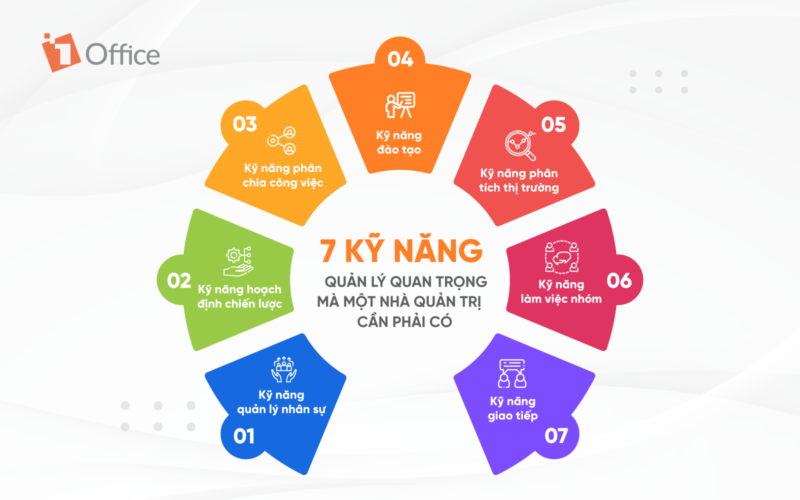
1. Human resource management skills
Building relationships between individuals within a team is an essential task for a manager. To lead a team, you need the respect of its members. Therefore, the problem a manager needs to solve is how to earn the respect and trust of their employees.
A smart leader can leverage the unique characteristics and personalities of each team member to increase employee engagement, foster a positive work environment, and build trust. Therefore, it is necessary to spend time getting to know each individual in an organization through social activities or team-building training.
Criteria to be achieved:
- Public speaking skills
- Ability to control situations
- Supervision
- Individual performance evaluation
- Ability to convey information
See more: 15 essential human resource management skills for businesses
2. Communication skills
As a manager representing a group of people in an organization, communication is an indispensable element. Common communication skill issues faced by managers include:
- Inability to convey ideas and information for employees to understand (due to ideas often being large-scale, abstract, or grand) because of poor communication skills or lack of experience in presenting and expressing their thoughts.
- Not interacting or talking with employees regularly, leading to communication difficulties when proposing or discussing issues

To improve communication, managers must build trust with their subordinates, so cutting off contact is not an option. You need to always be active and available when your team members have questions or need advice.
Required criteria:
- Critical thinking
- Identifying stakeholder interests
- Strategic thinking
- Planning
- Communication framework for specific audiences
3. Task Delegation Skills
As a manager, you will need to manage your own workload, supervise the work of other employees, attend meetings and training sessions, etc.Typically, the difficulties a manager faces often revolve around: Not knowing how to plan, assigning tasks to the wrong person, setting incorrect completion times…
To reduce the workload, managers need to delegate tasks to their subordinates. For delegation to be effective, you must clearly identify each person’s strengths/weaknesses and their ability to complete the work.
To have good management leadership skills, a manager must meet the following criteria:
- Analytical skills
- Identifying factors affecting performance
- Logical thinking
- Time management
- Communication framework for specific audiences
- Time management skills
Readers are also interested in: WHAT IS THE “ART” OF DELEGATION FOR MANAGERS?
4. Strategic Planning Skills
A manager’s job is to think about the big picture, so as well as focusing on today’s tasks and responsibilities, you also need to plan for the future. During the strategic planning process, common problems managers face include not knowing how to build a strategy, setting the wrong goals leading to incorrect resource planning, and creating an unfeasible strategy.
To have an accurate strategy, the first thing a manager needs to do is to clearly define their goals. Build your goals based on the SMART rule. Besides, you can also learn more about strategy map to help managers work more effectively.
Required criteria:
- Analyzing business issues
- Critical thinking
- Research and qualitative skills
- Project management
- Using planning software
5. Teamwork Skills
The way to increase productivity is to have an effective team that works without envy or jealousy. Therefore, the problem that managers must solve is how to gain the agreement and trust of their subordinates.
To have a successful team, the manager must start with the smallest things, which are the individuals within it. When leaders focus on cohesion, they are also giving employees the opportunity to achieve higher performance in their roles.
Criteria to achieve for successful teamwork skills:
- Situational adaptability
- Decisiveness in problem-solving
- Conflict resolution skills
- Task delegation
- Awareness of the organization’s mission and goals
- Understanding of the company’s field of operation
- Understanding of the political and social factors affecting the business
- Identifying all the strengths and weaknesses of competitors
- Communication and presentation skills
- Coaching
-
Time and task management: Get accustomed to setting priorities, allocating time reasonably, and performing basic management tasks.
-
Effective communication: Practice clear expression, know how to listen, and provide constructive feedback to build trust with staff.
-
Observation and learning: Proactively observe senior managers to learn their management styles, how they handle situations, and apply it to your own work.
-
Managing small teams: Focus on honing skills in planning, setting goals, and tracking KPIs to ensure work efficiency.
-
Conflict resolution: Learn how to handle conflicts within the team, balance individual interests, and maintain cohesion.
-
Investing in learning: Participate in short-term courses on project management, human resource management, or leadership skills to enhance professional knowledge.
-
Building a vision: Not just managing operations, but also setting long-term strategic direction for the organization.
-
Coaching and mentoring: Know how to develop the next generation of leaders through training, inspiration, and supporting subordinates’ growth.
-
Applying technology and data: Utilize digital platforms, management software, and data analysis to optimize management efficiency.
- Hotline: 083 483 8888
- Fanpage: https://www.facebook.com/1officevn/
- YouTube: https://www.youtube.com/channel/Nềntảngquảnlýtổngthể1Office
<li style="font-weight:
6. Market Analysis Skills
Understanding the market in which the business operates and what makes it successful is extremely necessary. The problems that managers often face are: inability to determine market size, competitive advantages, and market trends.
Solution: To become skilled in market analysis, you need to achieve the following:
7. Training Skills
Training subordinates often presents many challenges in Vietnamese businesses. Most companies’ training programs often lack a clear roadmap and system. Additionally, personnel training is not given enough importance, leading to low budgets and ineffective training processes.
To have effective training skills, the one thing you need is extensive experience, knowledge, and skills. Your task is then to convey and share this knowledge with your subordinates.
Criteria to achieve:
After mastering the 7 essential management skills for leaders, let’s explore how to improve your skills to make management increasingly more effective.
| Reference: What is leadership style? 8 popular leadership styles today |
IV. Management Skill Development Roadmap for Young Managers
For young managers, building a management skill development roadmap is a key factor for advancing in their careers. Here are some specific suggestions that can be applied:
For young managers, building a clear management skill development roadmap not only helps enhance personal capabilities but also creates a solid foundation for career advancement. This roadmap can be divided into three main stages:
1. The Beginning Stage (0–2 years of experience)
In the early stage of entering a management role, the most important thing is to build a foundation:
2. The Development Stage (3–5 years of experience)
Once a foundation is established, young managers begin to take on more responsibilities:
3. The Maturity Stage (over 5 years of experience)
This is the stage where managers begin to establish their personal mark and build influence:
This roadmap is not absolutely binding, but it serves as a guide for young managers to shape their careers. Persistently developing each skill in each stage will help them accumulate practical experience while building a sustainable development path in their management role.

V. How to improve management skills?
To improve management skills, leaders need to balance strategic thinking with people management capabilities, focusing on building trust, optimizing resources based on individual strengths, and maintaining flexibility in the face of any organizational changes.
Below are methods to help managers optimize their leadership capabilities:
1. Understand your team well
An individual may not be the most cheerful person to be around, but they are the most diligent worker you have. Additionally, they are very good at attracting customers. Therefore, it can be affirmed that understanding the work team well will help a manager clearly identify strengths and weaknesses to improve management skills and build better strategies.
If you are a new manager taking over an organization from someone else, ask them for specific information before you start. This will provide you with useful information about both the team and the department’s working style, as it has been influenced by the previous manager.
2. Build trust by creating a friendly work environment
A friendly environment will increase collaboration, motivation, and enhance effective problem-solving abilities.
For example: If a principal maintains an open-door policy and his teachers feel comfortable sharing their insights, he will be able to implement their innovations throughout the school and improve his business operations. If there are any issues with students or conflicts with teachers, he will also recognize them early on.
Clearly establishing a system of business objectives helps managers make more accurate decisions. Typically, goal setting is based on the SMART principle mentioned above so that team members have no confusion about what they are doing and what the team needs to achieve. In addition, it is easier to allocate time and resources to a goal if it is clear and targeted, and your team is also more likely to succeed.
4. Regularly hold meetings to maintain relationships and evaluate work performance
Holding regular meetings will help managers understand the work situation, maintain relationships, and enhance monitoring capabilities. In addition, holding regular meetings will help employees express their constructive thoughts about the project, making them feel more motivated and engaged in their work.
5. Avoid micromanagement
Micromanagement is the act of monitoring employees’ work under a microscope, or what can be called “scrutinizing” others. In the past, this behavior might have been useful, but in today’s open-policy era, it is not highly regarded.

Becoming a micromanager will affect the trust between leaders and subordinates. Managers must start trusting that others can do the job as well as you would. If you allow employees to make their own decisions and show your faith in what they do, it will make them feel more confident and engaged.
6. Acknowledge mistakes and provide solutions
As a manager, you will make some mistakes while performing your job. Therefore, know how to admit your mistakes. Learn from what you did wrong and draw experience to share with your subordinates so that mistakes will happen less often.
More importantly, instead of focusing on mistakes, be solution-oriented. Transparency in your communication with your team helps create a work environment built on trust.
7. Demonstrate flexibility at work
In business, not everything goes according to plan. It is important to be agile in your approach and change direction when necessary. Showing flexibility towards your employees also contributes to a better work environment.
A manager with a growth mindset often likes to try new ways of working with their team and challenge the status quo. You see opportunities and challenges as ways to learn new things and grow.
VI. Frequently Asked Questions about Management Skills
What is the core difference between management skills and leadership skills?
Management focuses on maintaining processes, assigning tasks, and controlling to keep work “on schedule”. Leadership is more about inspiring, setting a vision, and motivating the team to “do the right things”.
How can I delegate effectively without micromanaging?
Managers need to build trust, set goals according to the SMART principle, and focus on outcomes rather than scrutinizing the process. Empowerment helps employees become more confident and increases their personal responsibility.
What are the most important management skills for a young manager?
Human resource management and communication skills are top priorities. Understanding the strengths and weaknesses of each team member helps a young manager allocate resources accurately and build respect from the team right from the beginning.
What should a manager do when conflict arises within the team?
It’s necessary to maintain critical thinking and multi-faceted listening skills to identify the root cause. Instead of avoiding it, organize transparent dialogues focused on a common solution to harmonize interests and unite the team.
How can one make accurate management decisions in a volatile environment?
It is necessary to combine strategic planning skills with the application of data technology. Using comprehensive management platforms gives leaders a clear view of the workflow, allowing them to make decisions based on real data rather than intuition.
VII. Conclusion
The article above has provided a more specific look at business management skills. Understanding these important management skills and how to improve them will help you become a successful manager.
For more detailed information, please see:
















