


What is Design Thinking? The Effective Design Thinking Process


Design Thinking is a method that helps businesses solve problems with a human-centered approach to find more creative solutions. But what is Design Thinking, why are more and more businesses applying it, and what are the steps in its implementation process? This article will help you understand everything from the concept and examples to practical application.
Mục lục
1. What is Design Thinking?
Design Thinking is a model created to help people design solutions for a specific problem. It allows us to comprehensively review the problem and think appropriately to find an optimal solution. This method is extremely useful in handling complex problems that are ambiguous or undefined.
Whether the problem is simple or complex, especially abstract and unpredictable ones, design thinking can still help you solve it. By deeply understanding human-related issues, taking a practical approach with visual thinking, and using testing methods.
-

What is Design Thinking?
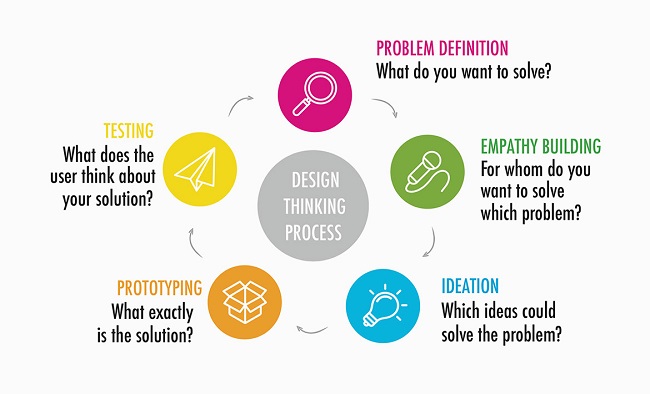
2. Examples of Design Thinking
A classic example of a “Design Thinker” is the scientist Thomas Edison. Everyone knows he created the electric light bulb. But few people know that he also developed the power generation and transmission grid system. We can clearly see that without those two things, the light bulb would be useless.
What made Edison special was his ability to clearly envision what users wanted, needed, and how they would use his inventions. Therefore, he built everything around those needs, solving the specific problems users faced with an entire system, not just with single, fragmented, or piecemeal inventions.
Edison’s approach is a prime example of what we now call “Design Thinking”. If we consider design thinking a method, it emphasizes innovation and designing human-centered products.
See more: Lateral Thinking – A Thinking Method to Keep You Creative!
3. Why is the Design Thinking method important?
Design thinking is particularly effective when applied to solving “wicked problems”. These are the types of problems that you don’t fully understand and for which there is no specific solution.
Design Thinking is very helpful for the work of businesses and non-governmental organizations, where the need for new ideas, solutions, and features is an indispensable part of the organization’s operations.

- With design thinking, you can find new ways to better meet user needs
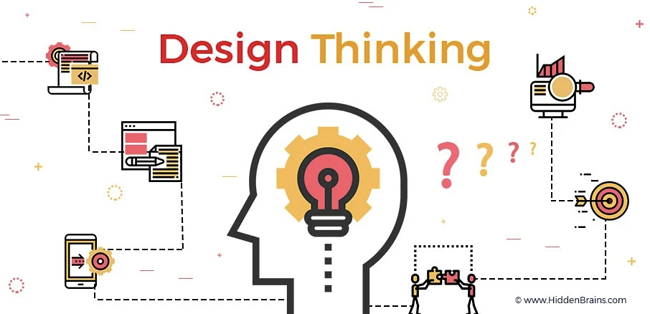
With design thinking, you can conduct UX research, create prototypes, and test to find new ways to better meet user needs.
Most Vietnamese businesses today still lack a true product development process. Design Thinking will help make product development a more professional and systematic process. This will greatly help businesses improve in introducing new innovations for their products.
| Read more: Valuable business lessons from the world’s top CEOs! |
4. An Effective Design Thinking Process for Businesses
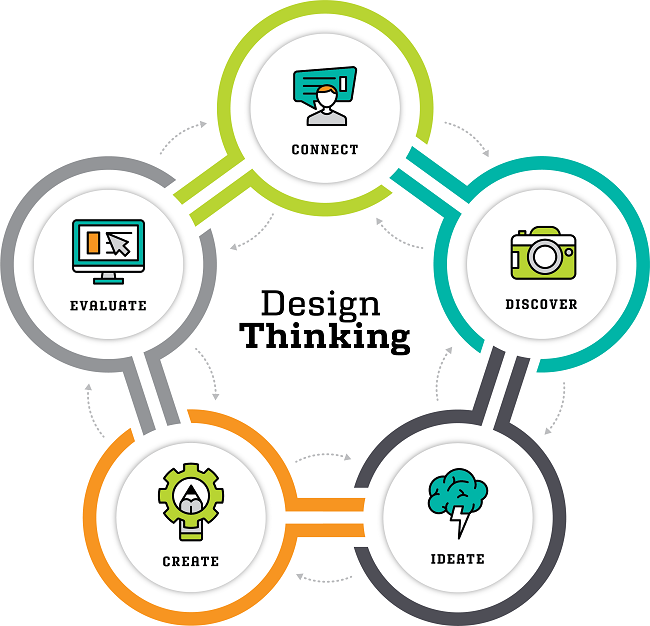
4.1. Empathize
This step requires you to learn about your target customers—the people whose problems you are trying to solve—to achieve empathy with them.
-

Empathy is a crucial element of human-centered design thinking

This requires leaders to learn more about their industry through market research data.
Additionally, by observing and experiencing the customer’s situation firsthand, you can gain deeper insights and think more logically. This helps you understand the customer’s difficulties with the problem.
Empathy is a crucial element of human-centered design thinking; it allows leaders to set aside their own assumptions to gain insight into users and their needs.
4.2. Define the Problem
In this step, the data and information collected in the “Empathize” stage are synthesized and connected to analyze and identify the core of the problem. You should define your problem and formulate a human-centered problem statement.
The Define stage will help you gather great ideas to establish the features, functions, and any other elements that will allow you to solve the problem.
Additionally, you can use a Fishbone Diagram—a variation of a mind map—which is very useful for problem-solving to complete this step.
4.3. Ideate
In the third step of the Design Thinking process, your mindset is ready to generate creative ideas. The goal of this step is to brainstorm and find solutions to the problem.
With the foundation of information and empathy gained from the Empathize and Define stages, business owners can start to “think outside the box” to discover new and creative solutions to the problem.
-

Ideate
There are many ideation techniques such as Brainstorming, Brainwriting, Worst Possible Idea, and SCAMPER that you can easily search for on Google.
What’s important in the early part of the Ideate stage is to generate as many ideas and solutions as possible. Don’t limit yourself with ideas you think are unsuitable. Be as creative as you can!
Read more: 7 Effective Business Management Methods in the 4.0 Era
4.4. Prototype
This is the step where you will implement your ideas through models or sample products, allowing you to research and find the best solutions for each problem identified in the previous three Design Thinking steps.
The key objective of the prototyping process in Design Thinking is to help you eliminate unfeasible or impractical solutions and focus on promising ideas.
-

Prototype

Through research, testing, and development based on customer experience and needs, the business gradually eliminates unsatisfactory products.
In this step, the business will become more aware of the product’s limitations and existing issues, leading to continuous product improvement.
4.5. Test
This is the final step of the 5-step Design Thinking process. However, in practice, this step is often repeated. Throughout this stage, it’s necessary to continuously test and gather feedback from users to keep improving the product or service.
Feedback is the most critical factor for developing and perfecting the solution. A solution that is suitable today may become unsuitable tomorrow.
Therefore, business owners need to stay grounded in reality and ensure appropriate changes are made. This leads to creating truly high-quality products that solve customer problems.
| Read more: 4 Managerial Thinking Skills – The Qualities That Make an Excellent Leader |
5. Important Considerations in the Design Thinking Process
5.1. The 5 stages of Design Thinking do not follow a specific order
It’s important to note that these five stages are not always sequential. They don’t have to follow any specific order and can often occur in parallel and be repeated.
Therefore, you shouldn’t understand the stages as a hierarchical or step-by-step process. Instead, you should view it as an overview of the modes or phases that contribute to a creative project, rather than sequential steps.
Anyone who understands these five stages of design thinking will be able to apply the Design Thinking method to solve complex problems around us.
5.2. Helps solve problems that are not clearly defined
The design thinking model is extremely useful in solving ill-defined or unknown problems by reframing the problem in a human-centric way, generating many ideas in brainstorming sessions, and applying a hands-on approach in testing and prototyping.
-

Design thinking is extremely useful in solving ill-defined problems
Currently, not many businesses in Vietnam apply this model in their work processes. The design thinking process is mainly popular in developed countries.
This is a very popular method worldwide. It fosters human-to-human connection, has a high degree of unity, and is highly practical. It encourages each individual to think continuously and positively, and to come up with new ideas.
What you need to remember is that no idea is a bad idea. All ideas are respected, and everyone works together to choose the best one. Each individual will develop positively and enhance their work performance and problem-solving abilities.
6. Conclusion
You have probably grasped some methods for finding ideas in work in general and in other aspects of life. However, if you still need more detailed, clear, and specific ideas about business management, you can refer to 1Office, the leading business management platform in Vietnam today. Click the registration button below to receive a free consultation.
For all inquiries, please contact:
- Hotline: 083 483 8888
- Website: https://1office.vn/
- Fanpage: https://www.facebook.com/1officevn/
- Youtube: https://www.youtube.com/channel/UCeTIRNqxaTwk0_kcTw6SxmA




