


 13/05/2026
  282 views
Timekeeping and payroll calculation is a daily activity for employees in every business. The timesheet is the basis for calculating salaries and evaluating employee work frequency. So, what information does a timesheet need? How should it be designed for easy application and tracking? Let’s explore the latest types of timesheets for businesses in 2022 with 1Office.
Mục lục
I. The Importance of Standardizing Timesheets for Businesses
Timesheets play a crucial role in tracking and evaluating employee work frequency. A scientific and highly accurate timesheet is easy to implement on a daily basis. However, if a timesheet is not set up reasonably, errors can easily occur, leading to incorrect salary payments, employee dissatisfaction, and disputes.
Standardizing timesheets brings the following benefits to businesses in general and HR in particular:
1. Improve Employee Management Efficiency
Standard timesheets will accurately provide the number of working hours as well as the work results of employees. A business’s timekeeping and timesheet template creation process always needs to be seamless, continuous, and effective.
If a business applies a standardized timekeeping process, it will minimize costs, time, and resources for managing employee working hours. This simplifies reporting and data extraction, optimizing the payroll process.
Check out a popular solution: Most popular mobile timekeeping app in 2026
2. Professionalize the Resource Management System
A standard employee timesheet creation process helps the company establish reasonable timekeeping regulations and policies. This helps establish a consistent HR time management planning process, enhancing the professionalism of the management team in general and all employees in particular.

Usually, at the end of each month, HR will compile employee data to calculate salaries based on timesheets. However, if the timesheet and payroll calculation templates are not standardized, it will lead to shortcomings and risks, resulting in related consequences and wasted time for resolution.
3. Avoid Errors
Calculation and tracking are not always 100% accurate, so standardizing timesheets and the employee timesheet creation process is the solution for businesses to end the headache-inducing problem of incorrect timekeeping and payroll.
Instead of wasting time handling errors, with standardized timesheets in hand, HR can easily address non-transparent timekeeping issues and avoid risks in personnel management.
4. Basis for Accurate Employee Salary Calculation
Based on timesheets, HR can accurately determine the working hours of each employee, thereby calculating the correct salary, along with the corresponding bonus and penalty system.
When timesheets are built in the form of standardized templates, they will produce clear and transparent reports. Therefore, businesses can manage employees effectively and build a solid human resource management system.
Employee timesheet templates and the timekeeping process play such an important role, but not every business currently has a standardized and easy-to-use timesheet. So, let’s move on to the next section to explore the latest types of timesheets in 2022.
II. A Compilation of the Latest Types of Timesheets for Businesses in 2022
1. Full-Time Timesheet
This is the employee timesheet template with the simplest structure among all types of timesheets. A full-time timesheet usually requires employees to commit to working 40-44 hours per week.
The full-time timesheet requires employees to work a full 8 hours a day, with the most common full-time work schedule being from 8:00 AM to 5:30 PM, with a 1.5-hour lunch break.
Because of the long required working hours, businesses often arrange for employees to be eligible for additional benefits such as sick days, health insurance, or short-term vacations.
2. Part-Time Timesheet
A part-time employee timesheet helps the HR department track the work process of employees who are not present at the company during standard business hours. This group of employees will have a more flexible benefits and compensation package compared to full-time employees, with a separate calculation method depending on the nature of the job.
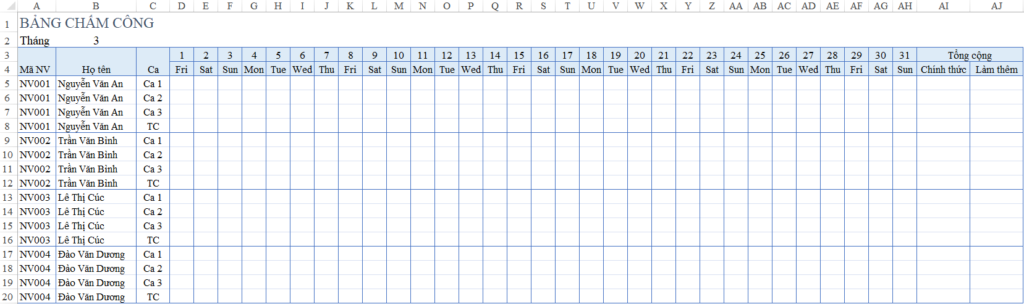
Adding the day of the week and the date to a part-time timesheet will make it easier to manage working time. You can also fill in the day manually by typing it, but Excel has a function to automatically update the day corresponding to the date, helping you simplify the task of timekeeping and calculating salaries for employees.
You can refer to the structure of a part-time timesheet in the table below:
3. Shift-Based Timesheet
A shift-based timesheet divides work shifts by hours for employees and HR to track. This is the timesheet for employees who work in shifts, which can change monthly according to the job requirements at the company.
Corresponding to the shift-based timesheet is a benefits package with a fixed policy to ensure employee rights, accompanied by a schedule that usually includes the same number of hours and working days each week.
The shift-based timesheet is considered the most objective and effective among all types of timesheets. If technology is integrated for timekeeping, the time tracking process, accuracy, and efficiency will be optimized to the highest level.
You can download the shift-based timesheet: Here
4. Flexible Employee Timesheet
This is often a timesheet with a low level of commitment, suitable for groups of collaborators working short-term for the business.
For a flexible hourly timesheet, the company’s policy will stipulate the minimum number of hours an employee must work within a specific period.
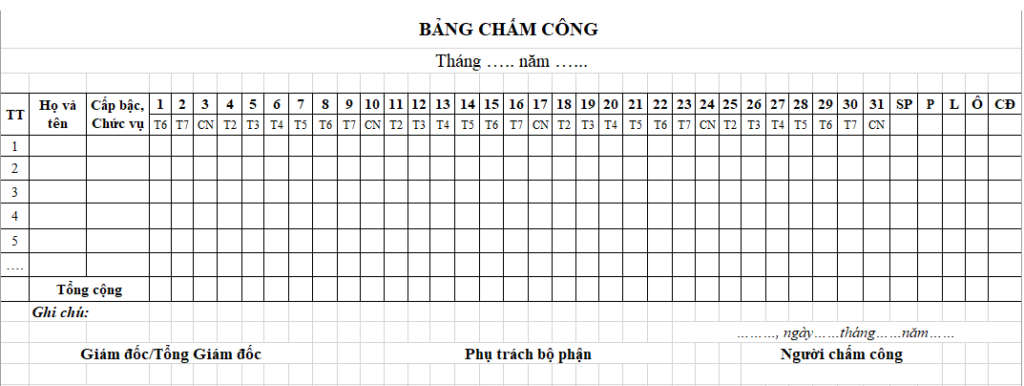
In particular, when arranging this timesheet, shifts need to be allocated appropriately to meet the needs of the employer as well as the employees’ availability.
5. Rotating timesheet
For many employees, changing schedules can cause significant difficulties, especially when daily routines are irregular, making it hard to maintain balance. That is why some businesses use rotating timesheets to improve employee work efficiency.
With this timesheet, the rotating work schedule for employees will usually change between day, swing, and night shifts, and is especially common in industries like services, construction, military, power plants, or 24/7 healthcare services.
This kind of shift rotation helps to balance all work shifts and brings high efficiency, so that no one gets stuck in less desirable shifts such as night shifts, midday shifts, or very early shifts. Hours can rotate between the day shift (7:00 AM to 3:00 PM), swing shift (1:00 PM to 9:00 PM), weekends, night shifts, and overnight shifts.
6. Timesheet according to Circular 133
The timesheet template according to Circular 133 is form No. 01a-LDTL, issued with Circular 133/2016/TT-BTC, and applies to:
- Small and medium-sized enterprises (including micro-enterprises) in all fields and economic sectors, as stipulated by the law on supporting small and medium-sized enterprises, excluding state-owned enterprises.
- Small and medium-sized enterprises in specific sectors such as electricity, oil and gas, insurance, securities, etc., for which the Ministry of Finance has issued or approved the application of a specific accounting regime.
Download the timesheet template according to Circular 133 HERE.
7. Timesheet template according to Circular 107
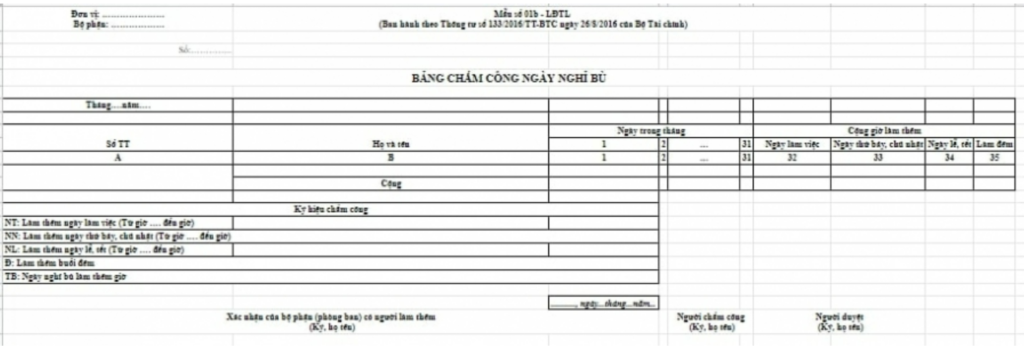
This is a timesheet template prepared according to Circular 107/2017/TT-BTC dated October 10, 2017, on the Accounting Regime for Administrative and Public Service Units, for the purpose of tracking actual overtime workdays to provide a basis for calculating compensatory time off or making payments to employees within the unit.
Download the timesheet template according to Circular 107 HERE.
8. Compensatory leave timesheet
Compensatory time off is essentially a form where employees work overtime without being paid for it. Instead, they receive time off in lieu, and their regular salary is paid for that time.
| See more: Standardize the payroll process in your business with 7 simple steps |
III. Guide to Creating a Simple and Effective Timesheet
Creating a timesheet is not difficult. Businesses can choose to download existing timesheet templates or create their own by following simple, detailed instructions.
Information required in a timesheet:
- No.
- Employee ID
- Employee’s full name
- Position
- Department
- Monthly workdays timesheet (Including Saturdays and Sundays)
- Clock-in, Clock-out times (To calculate late arrivals and early departures)
- Type of leave, remaining leave days
Once you have the timesheet, you will need to link it to payroll documents to create an accurate payroll sheet based on the employee’s salary scale. This ensures you avoid errors and issues when performing timekeeping and payroll consolidation tasks.
| Read more: A simple, easy-to-understand guide to creating timesheets in Excel |
IV. The Timekeeping and Payroll Process in a Business
Once the timesheet is standardized, businesses typically perform timekeeping and payroll calculations following these basic steps:
1. Create and save employee profiles
Completing employee profiles with all personal data (name, position, department, etc.), details about the salary structure, notes on salary and bonuses, or other necessary related information is the first step for managers to proceed with employee timekeeping and payroll calculation.
2. Perform Timekeeping
The number of workdays and work hours for each employee will be compiled by the HR department from traditional timekeeping logbooks or extracted from timekeeping management software, based on data from the organization’s internal facial recognition and fingerprint time clocks.
3. Compile, Reconcile, and Confirm Timekeeping Data
HR will compile data from timesheets and related documents to compare, reconcile, and confirm the accuracy of the timekeeping data. Afterward, the HR department is responsible for completing and reporting the specific figures to the accounting department for payroll preparation.
4. Prepare the Payroll
Based on the available employee work data and data from employee timesheet templates, the accounting department will calculate salaries based on the number of workdays and record the total salary calculation and salary details for each employee. The next step is to forward the report to the chief accountant.
From here, the chief accountant will approve and calculate the final salary for each company employee.
| See more: Download now: 5+ most popular employee salary templates for 2022 |
From the information above, it’s clear that there are many types of timesheets, each suited to different businesses with varying work schedules and employee distributions. This inadvertently creates significant challenges for HR in managing timekeeping and calculating payroll.
The issues of timekeeping and payroll become even more difficult and problematic when a business has a large number of employees, multiple branches, or shift-based work schedules. In such cases, a smart, modern online timekeeping software is an excellent solution, allowing employees to easily clock in and out, and making it convenient for HR to track working hours.
The 1Office HRM module, with its automated timekeeping and payroll features, is the perfect choice for any business. The 1Office timekeeping and payroll software acts as a virtual assistant, resolving all the difficulties of manual timekeeping with a range of modern features. For more detailed information about this tool, please contact:
- Hotline: 083 483 8888
- Fanpage: https://www.facebook.com/1officevn/
- Youtube: https://www.youtube.com/channel/UCeTIRNqxaTwk0_kcTw6SxmA
















