


 13/05/2026
  359 views
In the current digital age, the competition among businesses is extremely fierce, not only among large companies but also with the emergence of numerous startups in the market. Therefore, every business needs an effective project management model to increase labor productivity and boost revenue. So, in this article, let’s explore what a project management model is and the popular project management models today, such as: the Agile model, the Kanban method, the Scrum model, etc.
Mục lục
- I- What is a project management model?
- II- Popular project management models
- 1. Agile Model (Agile Software Development)
- 2. Scrum Project Management Model
- 3. The Kanban Model
- 4. The Waterfall Model
- 5. The Six Sigma Model
- 6. The CPM (Critical Path Method) Project Management Method
- 7. Gantt Chart
- 9. RUP (Rational Unified Process) Model
- 10. Crystal Method Model
- 11. Spiral Model Project Management
- 12. PERT Project Management Model (PERT network diagram)
- III- Steps to Determine the Right Project Management Model
- IV- Effective project management with 1Office
I- What is a project management model?
To clearly understand the content below, let’s first explore the concept of a Project Management Model.
According to PMI, the definition is as follows: “It is a methodology of a system of practices, techniques, procedures, and rules used by individuals working together in a field.” Based on this understanding, we can affirm that: A project management model is simply the way a business executes its projects.
II- Popular project management models
Regardless of the industry your business operates in, applying a project management model to your operational processes will generally help improve returns and enhance the company’s labor productivity. In this section, we will explore the 12 most popular project management models today.
1. Agile Model (Agile Software Development)
The Agile model is a flexible software development method based on the principles of interaction and integration to deliver the product to users as quickly as possible. Initially, Agile was created to support software development. But over the years, with its flexible development, the Agile model has contributed to changing the way of working, managing, and producing in many aspects of the economy: Manufacturing, services, sales, marketing, education, etc.
In general, this is a model created with a working method based on iterative and incremental principles: breaking down the project into cycles called sprints, and at the end of each cycle, the product is delivered to the customer for easy evaluation. Based on feedback and reviews, employees can promptly make changes that align with market trends.
Read more: Project management process according to ISO: 5 international standard stages
2. Scrum Project Management Model
The Scrum project management model is a variation of the Agile model. It can be said that Scrum is more of a framework than a methodology. Scrum is also a way of executing projects based on the Sprint cycle by breaking down tasks and completing sub-tasks to make them easier to implement and handle. A key feature of Scrum is the Scrum Master (the ability to delegate responsibility) who tracks progress and supports employees in a project when issues arise.
| >>> Read more: The key positions and principles of the Scrum model |
3. The Kanban Model
Kanban is a model created and widely used in Japan. It focuses mainly on the process and progress of a project. When using Kanban for project management, individuals will enhance their ability to self-manage tasks and improve work efficiency.
When applying Kanban to project management, you just need to “start with what you have now” without “disrupting what already exists.” The improvements are always small changes, as large changes are not encouraged because they can create a sense of uncertainty.

By using columns and cards—where columns represent steps in the process and cards are work items—your business can save costs and resources, and avoid redundant activities because work cards are always actively “pulled.”
| Learn more: What is Kanban? How to apply Kanban in work management |
4. The Waterfall Model
The Waterfall Model – often called SDLC (Software Development Life Cycle). True to its name, this is a simple method with the main idea of planning robustly and accurately, and then executing it as efficiently as possible.
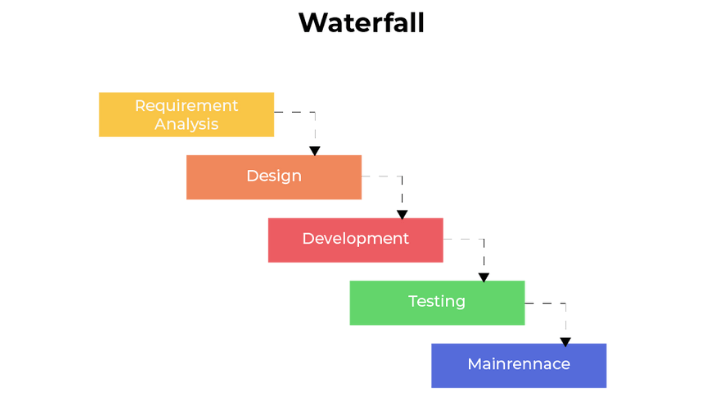
Unlike the Kanban method or the Agile model, Waterfall is carried out by laying out tasks in a sequence, and activities are performed exactly according to the pre-established plan.
This is one of the first project management models to be developed, so “classic” is a fitting term for it. With its goal-oriented approach to work, applying it today can be quite rigid and lacks flexibility.
5. The Six Sigma Model
Initially, Six Sigma was a solution to support the manufacturing process and has been improved to be applied in many fields, especially for businesses in the commercial and manufacturing sectors. The model’s operating principle: instead of focusing on fixing defective products, businesses will invest in improving operational processes to minimize errors, thereby creating stability in production and business. Let’s learn about Lean Six Sigma – similar to the Kanban method, Lean Six Sigma is a project management model improved by Toyota from the original Six Sigma model to minimize errors that arise in a project.
This method applies a statistical formula to count the number of errors that arise in a process, thereby finding ways to fix them to focus on saving time, costs, and human resources for the company.
6. The CPM (Critical Path Method) Project Management Method
The CPM project management method, also known as the Critical Path method, is one of the oldest and most reliable models in the history of project management.
This method operates based on the manager creating a plan, listing tasks, and then estimating the time to complete each task. This detailed planning helps everyone visualize the project and the tasks to be performed more clearly, thereby helping the manager to control the progress more easily.
Besides its advantages, this model is quite limited because it is only applicable to large, stable projects where tasks have been planned and completion times have been determined in detail. In addition, creating such a task time frame also leads to a lack of flexibility, because if one task is delayed, it will affect the subsequent tasks.
7. Gantt Chart
Gantt is one of the most commonly used project management models today. While the Kanban method uses boards and cards to divide tasks, Gantt uses the vertical axis for task names and the horizontal axis to represent the project timeline and milestones.

When using a Gantt chart, you can also identify who is responsible for the task, the start time and the project completion deadline, and the relationship of that task to the overall project progress.
From a manager’s perspective, using a Gantt chart for project management in a business will help you manage and allocate available human resources effectively. Not only that, but monitoring a Gantt chart also helps managers supervise the progress of all departments at any time, thereby determining when to move work to the next stage.
Besides its achievements, the Gantt chart also has limitations:
- Because it tracks progress along a timeline, this model is suitable for small projects. For large projects with hundreds of tasks, it is very difficult to get an overview of the project on a computer screen.
- Cost, scope, and time are three important criteria for evaluating a project. But if you use a Gantt chart for project management, cost and scope cannot be described fully and accurately.
| Read now: What is a Gantt Chart? Applying Gantt Charts in Project and Task Management |
8. RAD (Rapid Application Development) Model
RAD – Rapid Application Development is a widely used method for creating mobile applications. The principle of this model is to break down the project into components, develop those components in parallel within a specific timeframe, and deliver and assemble the components based on an existing prototype.
Developing components based on customer experiences allows for continuous product quality improvement. This helps your company reduce product development time and increase the reusability of components, as new product updates are continuous and frequent.
Conversely, with its continuous product improvement, RAD is not an ideal model for projects with low budgets. Moreover, based on the principle of parallel component development, this method is highly dependent on team performance, making it difficult to track progress and issues.
9. RUP (Rational Unified Process) Model
Perhaps this term is quite unfamiliar compared to the project management models mentioned above, but its operating principle is quite flexible because it helps the project develop and customize according to the business’s needs. RUP supports iterative software development projects based on the principle of dividing work among project members and breaking it down into different phases.
Basically, when applying RUP to project management, it divides the project into 4 small phases:
The operating mechanism of the RUP model
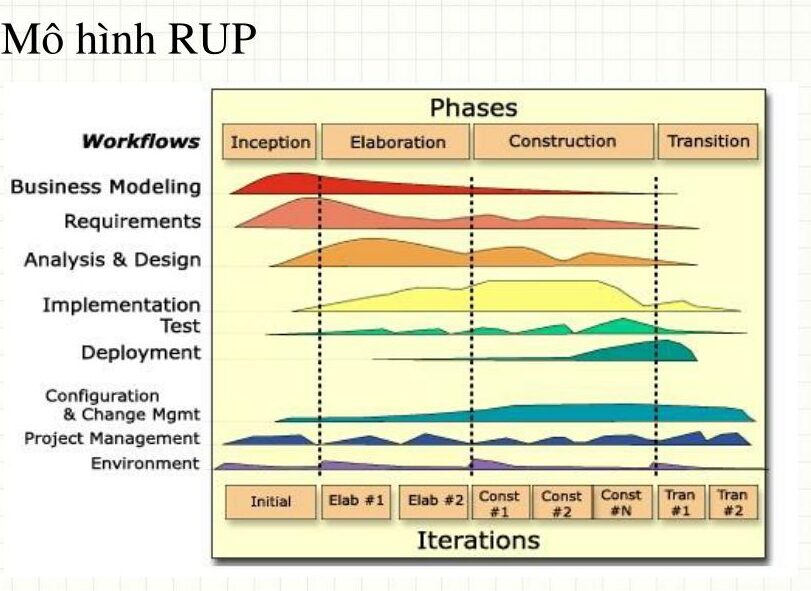
- Inception: Establishing the tasks in a project
- Elaboration: Researching the project’s domain and system architecture to enable project execution
- Construction: Designing the system and planning framework to execute the project.
- Transition: Deploying and implementing the project.
When applying the RUP model to project management in software development, unifying the entire process helps you use resources effectively because the components within a project are maintained, inheritable, and reusable.
In addition, frequent project improvements also help enhance control and risk management.
However, to apply the RUP model to project management, you may face the following difficulties: The model’s process can be too complex to implement, leading your business to need an expert to clearly understand and navigate this process.
10. Crystal Method Model
In contrast to the Kanban method, the purpose of the Crystal Method is to provide the best software development process, which is why the ‘People’ factor is at the core of this method. Additionally, it focuses on other factors such as Interaction, Community, Skills, Talent, and Communication to enhance mutual support among individuals participating in the project.
When applying the Crystal model to projects, you can determine it based on the rules below:
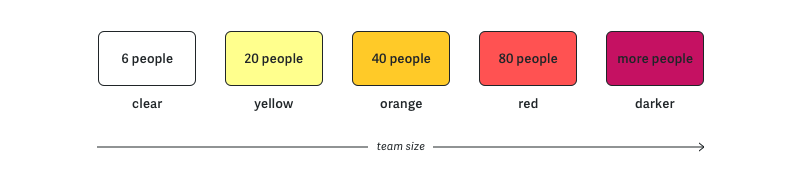
- Crystal Clear: up to 8 people
- Crystal Yellow: from 10-20 people
- Crystal Orange: 21 to 40 people
- Crystal Red: 40 to 80 people
- Crystal Maroon: 80 to 200 people
- Crystal Diamond & Sapphire: Usually applied to critical projects, in case incidents occur that could directly affect the health of workers.
In general, when applying the Crystal Method to project management, managers often aim to enhance teamwork capabilities, thereby creating interaction, understanding, and achieving the best results for the project.
11. Spiral Model Project Management
This is a model developed based on the Waterfall Model (Waterfall Method) with a “risk-oriented” approach to software development for businesses. Each loop in the spiral consists of content items: planning, analysis, risk development, system representation, and improvement, corresponding to each phase of the project.
It can be said that the spiral model describes software development through stages that go from general to specific. All project activities using the spiral model must be carried out in the prescribed order. This method is quite effective for large projects because the steps in each project phase are meticulously and thoroughly planned. It also ensures that the business always has time to wait for customer feedback on the product.
Additionally, because there is no limit to the number of spirals in the model, the project’s time and cost can be substantial, making it suitable only for a company’s critical projects.
12. PERT Project Management Model (PERT network diagram)
The PERT project management model describes the completion process of a project. In practice, this model is often used by many businesses in combination with the Critical Path Method (CPM).
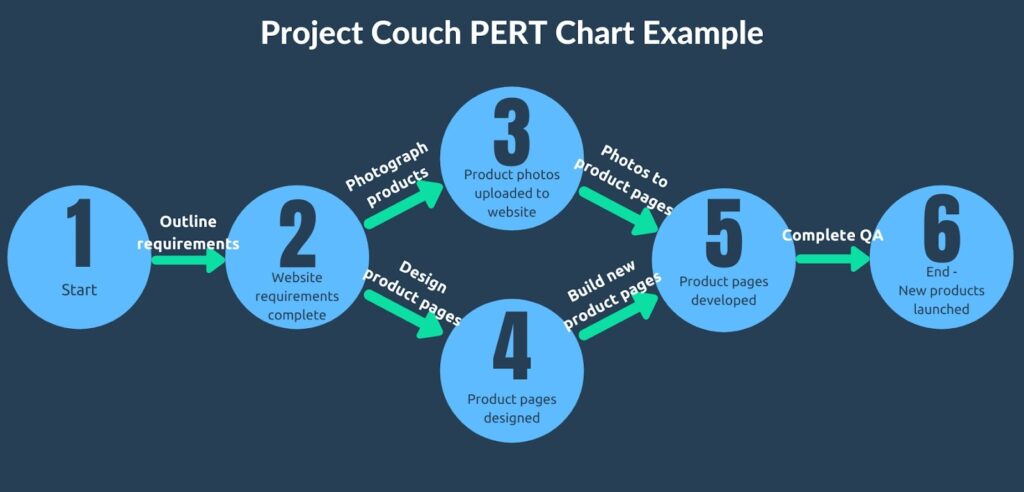
To apply the model, managers need to clearly define several factors: There is only one single start point and one single end point in a project; Each task is represented by a directional arrow. Applying PERT helps managers control and track the workflow, project completion time, and the cost of each activity more easily.
However, the time estimation in this model is subjective and can lead to inaccuracies. And with the use of such a diagram, large and complex projects can have hundreds of thousands of tasks and dependencies, making it difficult for managers to track.
Above are the 12 most popular project management models trusted by many Fortune 500 companies worldwide. However, to determine which model is suitable for your business, let’s explore the next section.
III- Steps to Determine the Right Project Management Model
Academically, there are many project management methods for a business. But determining which model is right for your company depends heavily on business characteristics, project scale, and many other factors. Therefore, to evaluate which management model to choose for a project, managers must consider factors from multiple perspectives as quickly and completely as possible.
You can refer to the steps below to evaluate a management model suitable for your project.
Step 1: Identify the key factors to consider.
Some important factors you can consider include:
- Strategic goals and core values
- The company’s business orientation
- Project scale and cost
- Constraints
- Stakeholders: Capital ownership relationships among shareholders, partners, etc.
- Risks
Note: These factors should be arranged in order of priority, from simple to complex.
Step 2: After identifying the factors, consider the project’s flexibility.
If your work environment and project are dynamic and flexible, models like Agile, the Kanban method, the Scrum model, etc., will be your choice. Conversely, if you work in an environment with a fixed time and budget that is difficult to change, you should choose the Waterfall model.
Step 3: Evaluate which method brings the most value and has the least negative impact on your project.
Management models are created to be general and cannot perfectly fit any real-world project. Therefore, this evaluation will help you determine what will be gained and what will be affected when applying the model to the project management process.
Step 4: Define the project’s objectives.
When a project has specific objectives, it helps you clearly visualize the direction and find a suitable project management model. A method is considered good if it helps you achieve your set goals faster.
Step 5: Agree on and build a suitable management model
With so many project management models on the market, agreeing with individuals within the same project on work methods and how to apply a model that best fits your current reality will help everyone better understand the workflow, increase flexibility, and thereby boost work efficiency.
Above are the steps to help you identify a suitable project model for your business. However, applying it in practice is a process that requires managers to spend a lot of time on consideration and calculation. Therefore, you can consider using software applications in your management activities.
Read more: 10 Best Project Management Software for Progress Tracking in 2026
IV- Effective project management with 1Office
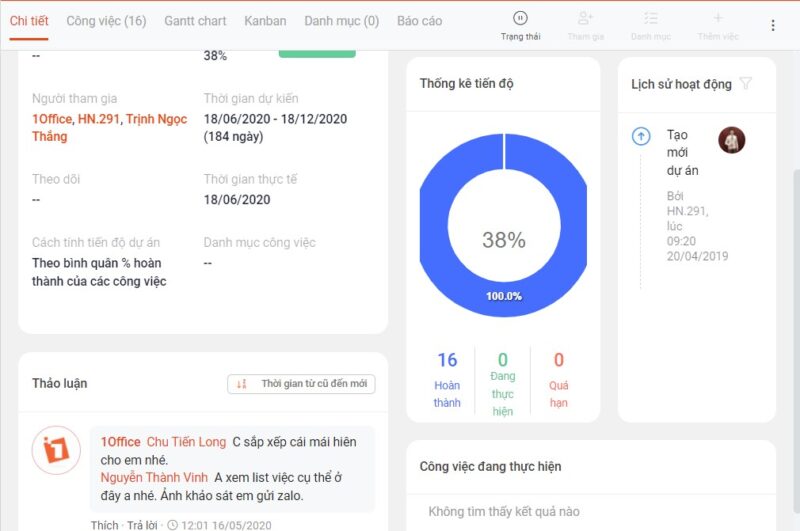
In today’s digital age, with the built-in integration of project management models on 1Office’s project management software, you won’t have to worry about which model to choose or how to apply it to best suit your project. Here are some of the software’s main functions:
- Create projects and allocate resources by helping users create detailed plans for each individual and department. Not only that, but you can also duplicate the work structure from an old project and then modify it into a new one.
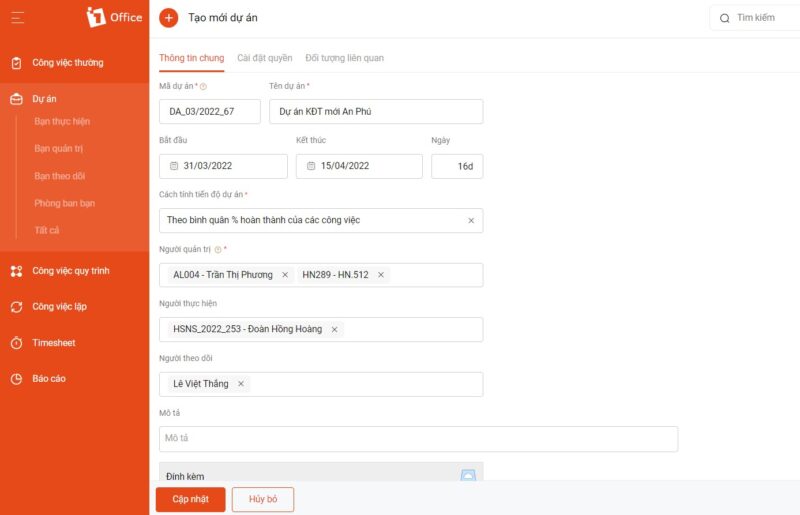
- Manage and monitor projects: Applying two methods, Kanban and Gantt Chart, to project monitoring helps you easily update work status, track every issue that arises in the project in detail and continuously to stay on top of the progress
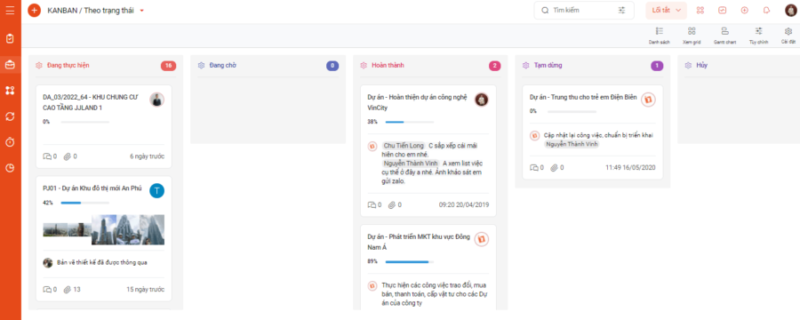
- Report project progress: Reporting project progress in 1Office’s software not only gives you specific numbers but also formats them in various models and charts, such as: Kanban, Gantt Chart, Grid view, etc.
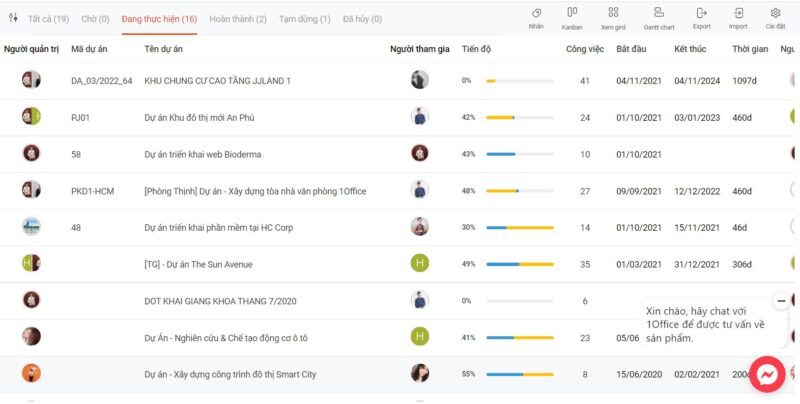
- Interact within the project: When assigning tasks in a project using 1Office, the tasks will be synchronized with each person’s individual work, helping project members exchange documents and information with each other.
Thus, the article above has given readers a general overview of project management models and a better understanding of the popular models used in businesses today. It can be said that applying theory to practice is a whole process. And applying technology to business management is a new trend that helps managers easily track the progress, capacity, and work efficiency of a specific individual or an entire project team.
If you need more information or have questions that need consultation and answers about project management models, you can contact the hotline: 083 483 8888 or the 1Office fanpage for support.
For more detailed information, please see:
Fanpage: https://www.facebook.com/1officevn/
Youtube: https://www.youtube.com/channel/UCeTIRNqxaTwk0_kcTw6SxmA
















