


 10/05/2026
  42407 views
A power of attorney form is used when an individual or organization wants to authorize another person to act on their behalf to perform a specific task, procedure, or transaction. A clear power of attorney must fully state the information of all parties, the scope of authorization, the duration, and related responsibilities to limit disputes during its use. The article below provides the latest power of attorney form templates, along with instructions on how to write one and important notes on notarization and authentication.
Mục lục
- 1. What is a power of attorney document?
- 2. What content does a power of attorney form include?
- 3. Instructions on how to fill out a power of attorney form
- 4. 10 power of attorney templates for individuals & companies
- 4.1. Simple power of attorney template
- 4.2. Power of Attorney Template from Company to Individual
- 4.3. Power of Attorney Template from Individual to Individual
- 4.4. Power of Attorney Template for a Relative
- 4.5. Power of Attorney Template for Work-related Matters
- 4.6. Power of Attorney Template for Receiving Money
- 4.7. Power of Attorney Template for Land Use
- 4.8. Power of Attorney Template with Local Authority Certification
- 4.9. Power of Attorney Template for Receiving a Graduation Diploma
- 5. Important Notes When Creating a Power of Attorney
- 6. Legal regulations on power of attorney
- 6.1. What is the form of a power of attorney?
- 6.2. Is notarization mandatory for a power of attorney?
- 6.3. How long is a power of attorney valid?
- 6.4. What is the difference between a power of attorney and an authorization contract?
- 6.5. In which cases can authorization be sub-delegated?
- 6.6. What are the obligations of the authorized party?
- 6.7. Is compensation required for unilateral termination of an authorization contract?
- 7. 1Office Centralized Document Management Software
- 8. Frequently Asked Questions about Power of Attorney Forms
1. What is a power of attorney document?

A power of attorney form is a legal document used to authorize another person to act on one’s behalf to perform one or more specific tasks. The power of attorney document must contain all necessary information, including:
- Information of the principal (authorizing party): Full name, date of birth, ID/Citizen ID card number, permanent address, etc.
- Information of the agent (authorized party): Full name, date of birth, ID/Citizen ID card number, permanent address, etc.
- Scope of authorization: The content of the tasks that the principal assigns to the agent to perform.
- Duration of authorization: The period during which the principal authorizes the agent to perform the tasks.
For a power of attorney document to be legally valid, it must be made in writing and signed by both the principal and the agent. In the case of a power of attorney between individuals, the signatures can be authenticated at the commune-level People’s Committee or a Notary Office.
| See more: |
2. What content does a power of attorney form include?
A standard power of attorney form typically includes the following groups of information:
Personal information of the authorizer
- Full name
- Date of birth
- ID/Citizen ID/Passport number, date of issue – place of issue
- Permanent/temporary address
- Contact phone number
Personal information of the authorized person
- Full name
- Date of birth
- ID/Citizen ID/Passport number
- Residential address
- Phone number
Scope of authorization
Clearly describe what the authorized person is permitted to do on behalf of the authorizer, for example:
- Sign administrative documents
- Submit and receive documents
- Perform banking procedures
- Handle tasks at state agencies
- Sign contracts on behalf of, etc.
Term of authorization
- Clearly state the start time
- End time
- Or the term for each specific case
Commitments of the parties
- Act strictly within the scope of authorization
- Be legally responsible
- No future disputes or complaints
- Provisions for termination of authorization
Signatures of both parties
- The authorizer signs and writes their full name
- The authorized person signs and writes their full name
Confirmation from a competent authority (if necessary)
- Confirmation from the People’s Committee of the commune/ward
- Notarization/authentication (Especially necessary for authorizations related to assets, real estate, banking, etc.)
3. Instructions on how to fill out a power of attorney form
Fill in the complete information for both parties
- Enter information correctly and ensure it matches the ID/Citizen ID card
- Do not use abbreviations, do not leave important sections blank
Clearly describe the scope of authorization
- The more detailed, the better to avoid misunderstandings
- Clearly state the permitted actions
- If there are limitations (e.g., only submitting documents, not signing on behalf), it must be clearly stated
Example:
“I authorize Mr./Ms. … to submit and receive the business license application on my behalf at the Department of Planning and Investment of Ho Chi Minh City. They are not permitted to sign any type of contract on my behalf.”
Clearly state the term of authorization
- If it is a one-time authorization, specify the exact date of execution
- If the authorization is for a specific period, clearly state from date… to date…
- If it is a long-term authorization, write “Until the work is completed…”
Check related legal information
- For high-value assets, notarization/authentication is required
- For simple procedures, the signatures of both parties are sufficient
Sign and confirm
- Both parties must sign by hand (do not use electronic signatures if the document requires authentication)
- If notarization is required, bring the original ID/Citizen ID card for verification
- For businesses, the authorizer must be the legal representative or have a letter of appointment
4. 10 power of attorney templates for individuals & companies
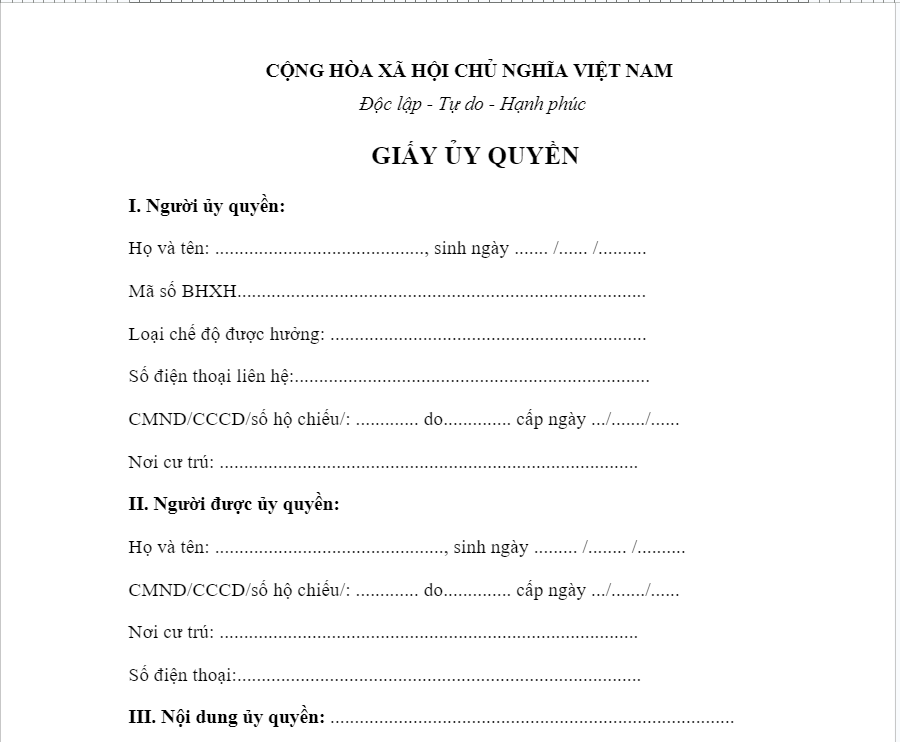
4.1. Simple power of attorney template
4.2. Power of Attorney Template from Company to Individual
Download: [1OFFICE] Power of Attorney Template from Company to Individual.docx
4.3. Power of Attorney Template from Individual to Individual
Download: [1OFFICE] Power of Attorney Template from Individual to Individual.docx
4.4. Power of Attorney Template for a Relative
Download: [1OFFICE] Power of Attorney Template for a Relative.docx
Download: [1OFFICE] Power of Attorney Template for Work-related Matters.docx
4.6. Power of Attorney Template for Receiving Money
Download: [1OFFICE] Power of Attorney Template for Receiving Money.docx
4.7. Power of Attorney Template for Land Use
Download: [1OFFICE] Power of Attorney Template for Land Use.docx
Download: [1OFFICE] Power of Attorney Template with Local Authority Certification.docx
4.9. Power of Attorney Template for Receiving a Graduation Diploma
Download: [1OFFICE] Power of Attorney for Receiving a Graduation Diploma.docx
5. Important Notes When Creating a Power of Attorney

To ensure legal validity and effectiveness when using a power of attorney form, the principal should note the following:
- The information of the principal and the agent must be recorded fully and accurately, including: full name, date of birth, gender, ID card/Citizen Identity Card number, place of issue, date of issue, permanent address, etc.
- The content of the authorization must be clearly and specifically stated, including the specific tasks that the principal assigns to the agent to perform.
- The authorization period can be specified or left unspecified. If no period is specified, the power of attorney is valid until revoked by the principal.
- The power of attorney should be made in two copies, with each party keeping one copy, and must be signed by both the principal and the agent.
- In the case of a power of attorney between individuals, the signatures can be authenticated at the Commune-level People’s Committee or a Notary Office.
- The power of attorney can be changed, supplemented, or revoked by agreement between the principal and the agent.
Notes when creating a power of attorney for an individual:
- For a power of attorney from an individual to another individual, it is necessary to clearly state the specific tasks that the principal assigns to the agent. For example: receiving money, signing contracts, handling administrative procedures, etc.
- For a power of attorney from an individual to an organization, it is necessary to clearly state the name of the organization that the principal authorizes to perform the work. For example: authorizing a bank to receive money, authorizing a law firm to sign contracts, etc.
Notes when creating a power of attorney for a company:
- For a power of attorney from a company to an individual, it is necessary to clearly state the position of the authorized person within the company. For example: Director, Deputy Director, Chief Accountant, etc.
- For a power of attorney from a company to another company, it is necessary to clearly state the name of the company that the principal authorizes to perform the work. For example: authorizing company A to sign a contract with company B, etc.
6. Legal regulations on power of attorney
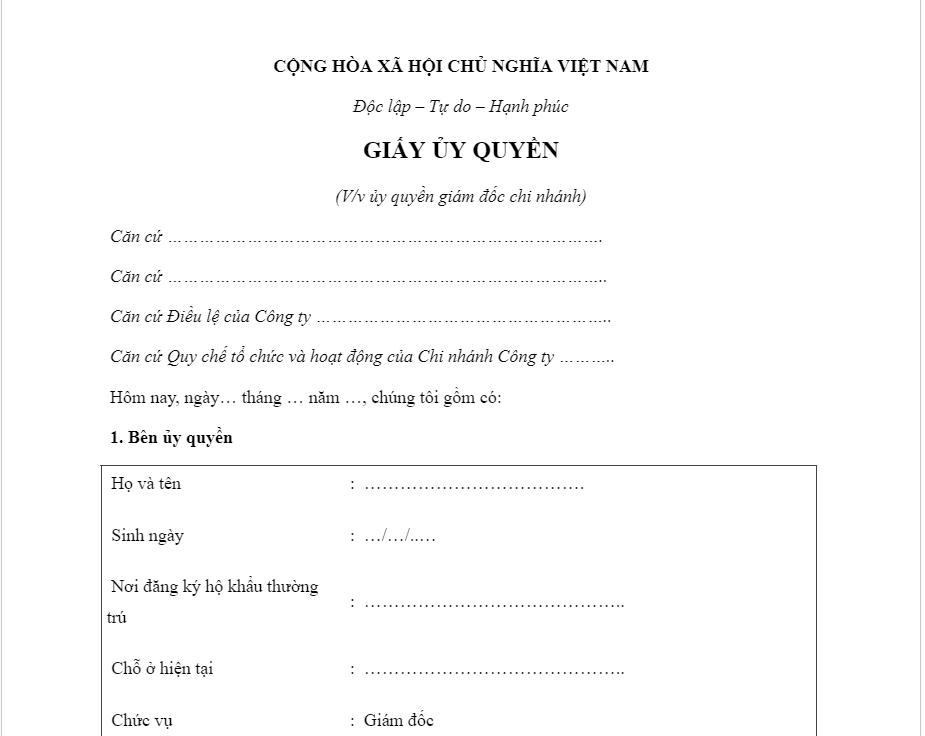
6.1. What is the form of a power of attorney?
According to the provisions of Article 562 of the Civil Code 2015, there are no mandatory regulations on the form of a power of attorney. However, to ensure legal validity, the power of attorney should be made in writing and agreed upon and signed by both the principal and the agent.
6.2. Is notarization mandatory for a power of attorney?
A power of attorney is not required to be notarized. However, in some cases, a power of attorney needs to be notarized to have legal validity, such as:
- A power of attorney related to the transfer, gift, or inheritance of property.
- A power of attorney related to the sale, transfer, lease, sublease, or capital contribution with land use rights.
- A power of attorney related to transactions of high-value assets or other assets of significant legal importance.
However, to have a solid legal basis for resolving future disputes, the parties signing the authorization contract can agree to notarize or authenticate it. In addition, businesses can ask a third party not related to the rights and interests in the authorization activity to act as a witness.
6.3. How long is a power of attorney valid?
The authorization period is as agreed by the parties. If there is no agreement, the authorization period is 1 year from the date the authorization is established.
Both a power of attorney and an authorization contract are legal documents used to authorize another person to act on one’s behalf to perform one or more specific tasks. However, these two types of documents have some differences as follows:
| Characteristics | Letter of Authorization | Authorization Contract |
| Form | Not required to be in writing | Must be in writing |
| Content | Only clearly and specifically states the tasks assigned by the authorizer to the authorized party | Clearly and specifically states the tasks assigned by the authorizer to the authorized party, as well as the rights and obligations of the parties |
| Legal Validity | Legally valid if made in writing and signed by the authorizer and the authorized party | Legally valid if made in writing and signed by the parties |
Comparison table of power of attorney and authorization contract
According to Article 564 of the 2015 Civil Code, the authorized party may sub-delegate to another person if the authorizing party agrees in writing.
Article 565 of the 2015 Civil Code stipulates the obligations of the authorized party as follows:
- Perform the authorized work according to the signed power of attorney document.
- Inform the authorizing party about the performance of the authorized work.
- Hand over to the authorizing party any assets or benefits obtained from performing the authorized work.
- Compensate the authorizing party for damages if the authorization obligations are violated.
If the authorizing party unilaterally terminates the authorization contract because the authorized party violates their obligations or is unable to perform the authorized work, no compensation is required for the authorized party. However, if the authorizing party unilaterally terminates the authorization contract without legal grounds, they must compensate the authorized party for damages.
In addition, the authorizing party must compensate the authorized party if the unilateral termination of the authorization contract causes damages to the authorized party.
7. 1Office Centralized Document Management Software
Managing documents, especially power of attorney forms, is one of the important tasks for a business. Effective document management helps businesses avoid loss and difficulty in searching, while also improving work efficiency.

Today, with the development of technology, document management software is becoming an effective solution to help businesses digitize and manage documents scientifically. It replaces traditional storage methods and creates a digital office for businesses.
1Office is a document management software trusted by many businesses. This software can store, manage, and share documents easily, securely, and effectively. To date, 1Office has been used by over 5,000 businesses with more than 14 million documents stored.
Get a free demo of the document management feature today!
8. Frequently Asked Questions about Power of Attorney Forms
Is notarization mandatory for a power of attorney form?
Not all types of power of attorney require notarization.
- Notarization/authentication is mandatory for authorizations related to: real estate, assets, banking, insurance, and important legal documents.
- It is not mandatory for simple tasks such as: receiving documents, submitting applications, or handling internal company procedures.
Is a handwritten power of attorney form valid?
Yes. A handwritten power of attorney is still legally valid if:
- It contains the full information of both parties
- It has the signature (or fingerprint) of the authorizing party
- The content is clear
- It is notarized/authenticated if the procedure requires it
What is the difference between a power of attorney and an authorization contract?
- Power of attorney: usually applies to single tasks, short durations, and simple procedures.
- Authorization contract: is a document with higher legal standing, applied to complex tasks related to assets and finances, with binding responsibilities for both parties.
Can one person authorize multiple people at the same time?
Yes. The authorizing party is allowed to appoint multiple people to perform the work, but must:
- Clearly state the scope and responsibility of each person
- Avoid overlap or conflict in authority
How long is a power of attorney valid?
There is no fixed regulation. The duration depends on:
- Type of procedure
- Agreement of the parties
- Requirement of the receiving authority
Typically, a power of attorney is valid from one day to several months, depending on the nature of the work.
Can you sign on someone’s behalf with only a power of attorney?
Yes, if the scope of authorization allows for signing on behalf.
If the document does not explicitly state the right to sign, the authority may reject it.
Can a power of attorney be re-delegated to a third party?
Re-delegation is only permitted if the power of attorney states “re-delegation is allowed”.
Without this provision, any re-delegation is invalid.
Thus, creating an accurate power of attorney template that complies with legal regulations is essential for it to be valid for both parties. We hope that the 10 power of attorney templates introduced by 1Office above will be helpful for individuals and businesses in their authorization activities.
If your business has any further questions, please contact us via Hotline: 083 483 8888 for the fastest support.
















