


 11/05/2026
  591 views
As a new leader, have you figured out which working style suits you? Or what are the ways to improve your leadership style and management skills? In this article, let’s join 1Office to explore what a leadership style is and the factors a new manager needs to know to improve the organization’s leadership skills.
Mục lục
- 1. What is a leadership style?
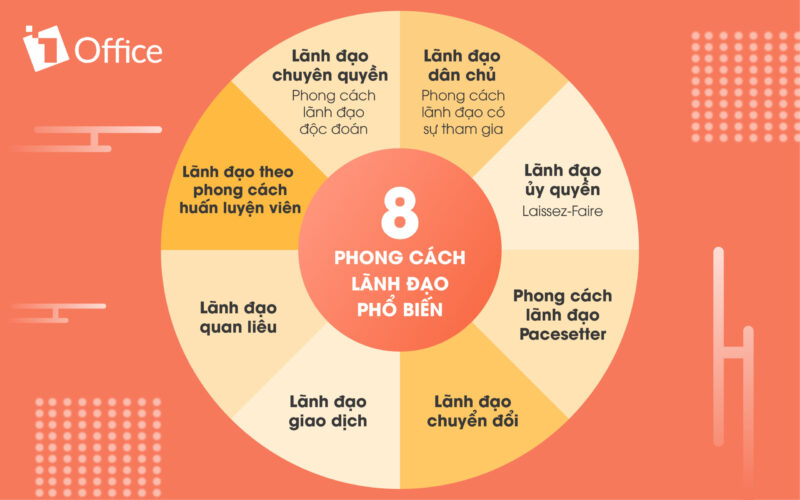
- 2. 8 Common Leadership Styles for Managers Today
- 2.1. Autocratic Leadership (Authoritarian Leadership Style)
- 2.2. Democratic Leadership Style
- 2.3. Delegative Leadership (Laissez-Faire)
- 2.4. Coaching Leadership Style
- 2.5. Transformational Leadership Style
- 2.6. Transactional Leadership Style
- 2.7. Bureaucratic Leadership Style
- 2.8. Pacesetter Leadership Style
- 3. The Importance of Leadership Styles
- 4. What Factors Influence Leadership Style?
- 5. How is a Suitable Leadership Style for a Manager Shaped?
- 6. Notable Leaders by Style
- 7. Frequently Asked Questions
- 8. Conclusion
1. What is a leadership style?
A leadership style is the behavior of a leader (or a group of leaders) used to approach and influence the management, direction, and guidance of a group of people or an organization.
A leadership style reflects how a leader communicates, makes decisions, inspires, or solves problems. Each leadership style has its own unique characteristics, suitable for different circumstances, environments, and the personalities of both the leader and the team.
2. 8 Common Leadership Styles for Managers Today
After understanding the concept of leadership style and its importance, in the next section, let’s explore 8 management leadership styles that help promote comprehensive development for a business. However, no single business leadership style is all-encompassing. Each style has its own advantages and limitations:
The autocratic leadership style is implemented by managers who typically make decisions on their own without seeking input from subordinates or anyone else. Therefore, employees are not considered or allowed to voice their opinions before carrying out tasks assigned by their superiors.
It can be seen that this is an effective style when applied in a business environment where the majority of workers need a lot of supervision and have little or no experience. However, this supervision can stifle creativity and make employees feel constrained, leading to low employee retention rates and a short employee lifecycle.
Pros and cons of the autocratic leadership style:
- Advantage: Helps businesses boost productivity through clear and specific task delegation.
- Limitation: Lacks flexibility, does not accept input from others, and therefore is unpopular with subordinates,…
2.2. Democratic Leadership Style
Democratic leadership is considered the most effective leadership style according to Lewin’s research. In theory, leaders using this style often encourage team members to provide input, but still retain the final say in decision-making.
Pros and cons of the democratic leadership style:
- Advantage: Employees feel respected, and satisfaction with leadership increases. Less supervision from managers is needed because workers are satisfied with the final decision made.
- Limitation: It takes a lot of time to organize large group discussions, gather opinions and feedback, discuss possible outcomes, and communicate decisions.
Example of democratic leadership style:
A manager applying the democratic leadership method might present the team with several options related to a project they have to undertake and then open a discussion about each option. After the discussion, this leader might consider the board’s thoughts and feedback, or they might make the decision through a vote.
2.3. Delegative Leadership (Laissez-Faire)
This is a management leadership style that focuses on delegating tasks to members and does not require much supervision from the manager, as the employee’s performance is judged solely on the final result.

It can be seen that the delegative leadership style is useful in a work environment with experts and specialists who have high experience and professional skills, but it can also lead to a lack of motivation among employees.
Note: The delegative leadership style should be applied when subordinates are experienced, well-trained, and require little supervision. But with such freedom and lack of strict supervision, it can lead to a drop in productivity if employees are confused about the leader’s expectations.
Pros and cons:
- Advantage: A sense of responsibility, freedom in creating new content, and a work environment without excessive supervision help increase employee retention rates.
- Challenge: This style is not effective for new employees because they lack experience, do not yet understand the company’s culture and work style, and in some cases, employees may not feel adequately supported.
Example of delegative leadership style:
When welcoming new employees, Keisha explains that her engineers can set and maintain their own work schedules as long as they can track and achieve the set goals for themselves and for the entire team. They are also free to learn about and participate in projects outside of their team.
| Read more: What is Micromanagement? Should You Apply Micromanagement in Your Business? |
2.4. Coaching Leadership Style
This leadership style often focuses on nurturing the strengths of each individual. Additionally, the manager also concentrates on specific strategies and plans to increase the work team’s productivity.
It shares similarities with the Democratic Leadership Style but places a stronger emphasis on the development and success of individual employees. Therefore, this management style can help members set personal goals and drive project growth.
Pros and cons of the coaching leadership method:
- Benefits: Promotes the development of new skills, free thinking, evaluates company goals, and nurtures corporate culture during the “Digital Transformation” era. Leaders with a coaching style are often seen as valuable mentors.
- Challenges: Managers will spend a lot of time on training and identifying the strengths of each individual.
2.5. Transformational Leadership Style
This style can be said to be quite similar to the coaching leadership style, but instead of putting most of their energy into the personal goals of each employee, transformational leaders are driven by a commitment to the organization’s goals.
When applying this leadership style, the manager will spend a lot of time on general objectives, so it is best suited for teams that can handle many assigned tasks without constant supervision.
How to implement:
All employees receive a list of goals to be achieved, as well as deadlines to achieve them. And over time, this list of goals may change depending on the overall objectives of the organization.
Pros and cons:
- Benefits: Values personal relationships with their team, which helps boost morale and company retention. It emphasizes business ethics rather than focusing 100% of energy on achieving the organization’s overall goals.
- Drawbacks: Because transformational leaders focus on individuals, the results of the team or company may be overlooked.
Example of transformational leadership style:
Person A is hired to lead the Marketing Department. The CEO asks Person A to set new goals and assign work teams to achieve them. Therefore, Person A needs time to analyze the market, identify market trends, etc. After three months, Person A has set clear goals for each team reporting to them and asked individuals to set their own goals that align with those of the teams.
See more: What is the Laissez-Faire Leadership Style? Pros and Cons of the Laissez-Faire Leadership Style
2.6. Transactional Leadership Style
Under this leadership style, the manager will establish policies to boost productivity, rewarding employees when they achieve the set KPIs and taking disciplinary action if targets are not met.
Suitable model:
Organizations or teams tasked with achieving specific goals, such as sales and revenue.
Pros and cons of the transactional leadership method:
- Benefits: Facilitates the achievement of goals through short-term objectives.
- Challenges: Hinders creativity and fails to motivate employees who are not encouraged by rewards.
Example of transactional leadership style:
A bank branch manager meets with each team member every two weeks to discuss how they can meet and exceed the company’s monthly targets to receive a bonus. Each of the top 10 performing members in the district will receive a cash reward. However, teams like Marketing—who do not directly generate sales for the business—may become discouraged because they are not eligible for the company’s reward policy.
2.7. Bureaucratic Leadership Style
Listening to and considering employee input is a prominent feature of this style. But a bureaucratic leader may reject input if it contradicts company policy or past practices.
Suitable model for applying the bureaucratic management style:
Most effective in highly regulated industries or departments such as finance, healthcare, or government.
Pros and cons of the bureaucratic leadership style:
- Benefits: Each person in the team/company has a clearly defined role. The manager should separate work from relationships to avoid obscuring the team’s ability to achieve its goals.
- Challenges: It does not promote creativity and can feel restrictive to some employees. This leadership style is also slow to change and does not thrive in an environment that requires dynamism.
2.8. Pacesetter Leadership Style
Pacesetter leaders primarily focus on employee performance, setting specific standards and then holding their team members accountable for achieving their goals.
- Benefits: Motivates employees to achieve goals and meet the company’s overall business objectives. Builds a dynamic work environment and culture with a high quality of work completion.
- Challenges: Can cause stress for employees as they constantly strive to meet goals or deadlines. The fast-paced work environment can also lead to misinformation and a lower quality of work completion.

| Learn more: 7 essential management skills for managers and 7 ways to improve your management skills |
3. The Importance of Leadership Styles
A study by Daniel Coleman in a Harvard Business Review article examined and analyzed over 3,000 mid-level managers to identify specific leadership behaviors and their impact on profitability. The results showed that a manager’s leadership style is responsible for 30% of a company’s bottom-line profit.
Additionally, when you clearly understand the similarities and differences between leadership styles, you can identify their strengths, weaknesses, and suitability—allowing you to work in a way that best fits your personality.
In the next section, we will explore what leadership styles are, and 1Office will share which leadership style is the most optimal.
4. What Factors Influence Leadership Style?
Leadership style is not formed randomly; it is influenced by many different factors. From personal personality, organizational culture, and business context to qualifications and experience, all contribute to shaping how a leader directs, inspires, and manages their team.
4.1. The Leader’s Personality and Personal Values
Personality is a crucial foundation that determines how a leader behaves and makes decisions. A decisive, strong leader often tends to choose an autocratic or transactional leadership style to ensure discipline. Meanwhile, an emotionally intelligent leader who knows how to listen is more suited to a democratic or servant leadership style.
-
Personal values (honesty, integrity, responsibility) also act as a “guiding star” for leadership style. If a person values innovation, they will lean towards transformational leadership.
4.2. Organizational Culture and Work Environment
Every business has its own “DNA”—its corporate culture. This culture strongly influences leadership style:
-
Creative startups → often require an open, vision-oriented leadership style.
-
Traditional manufacturing companies → prioritize transactional or autocratic leadership to ensure processes.
Additionally, the work environment (on-site, hybrid, remote) also has an impact. In the digital age, leadership styles need to be flexible to lead remote teams.
4.3. Business Context and Industry
Leadership style is not fixed; it changes depending on the context:
-
During a crisis: a leader must be decisive and make quick decisions.
-
During a growth phase: democratic leadership is needed to encourage creativity and breakthroughs.
-
In volatile industries (technology, AI, finance): transformational and vision-oriented styles will create a competitive advantage.
4.4. Qualifications, Experience, and Training
A leader with formal management knowledge who has experienced various work environments often develops a situational leadership style—knowing when to be firm and when to be flexible.
Training in soft skills, emotional intelligence (EQ), and communication skills helps leaders refine their style and avoid extremes.
5. How is a Suitable Leadership Style for a Manager Shaped?
To become an effective leader, understanding yourself and knowing how to shape a suitable leadership style are key factors. It’s not just about choosing a management style; leaders also need to continuously train and improve their skills to adapt to change and guide their team toward common goals.
5.1. Determining a Suitable Leadership Style
After learning about the most optimal management styles, in this next section, let’s explore how to choose the most suitable leadership style for each manager. To build a leadership style that suits you, managers can consider the following questions:
- What do you value more? Goals or relationships?
- Do you prefer working towards predetermined goals or having the freedom to choose?
- Do you want to make decisions alone or based on the team’s opinions?
- Do you and your business want to focus on long-term or short-term goals?
5.2. How to Improve Management Skills
To develop and improve your leadership skills, consider the following methods:
- Develop situational awareness
A good leader is someone who can see the big picture and anticipate problems before they happen. This is a crucial and highly valued skill when handling complex projects. The ability to foresee and make suggestions to avoid potential issues is invaluable for a leader. This ability also helps you recognize opportunities that others miss, which will surely earn you recognition.
- Ability to Inspire
The ability to motivate and inspire will give subordinates more strength and love for their work, enabling them to collaborate as effectively as possible. When a team member needs encouragement or guidance, offer and provide advice that helps the organization. Sometimes, all a person needs is someone to listen and empathize.
- Conflict Resolution
Instead of ignoring and neglecting conflicts between individuals within the same team, handle them by speaking privately with those involved. Additionally, you can reassign team members if the conflict cannot be resolved. Resolving all conflicts will help the team work more effectively, increase the organization’s productivity, and strengthen team spirit.
- Be a discerning listener
Depending on each manager’s working style, there will be different ways to solve problems. However, an important characteristic of a good leader is the ability to listen to suggestions, ideas, and feedback from others and build upon them.
- Master the Art of Delegating to Your Employees
In addition to understanding what leadership styles are, to apply these methods effectively, a successful leader will not micromanage. Instead, they will know how to use their human resources to help the business achieve its set short-term and long-term goals. Delegate tasks to your employees and let them feel empowered. If you can do this, they will feel more involved and have more opportunities to develop new skills. Delegation will allow you to focus on the goals you need to achieve yourself.
6. Notable Leaders by Style
Leadership styles don’t just exist in theory; they are also clearly demonstrated by prominent leaders around the world. Each individual, with their own personality and vision, has left their mark by inspiring others, changing corporate culture, and achieving outstanding accomplishments.
Elon Musk
Elon Musk is considered a model of visionary leadership. He not only saw the potential of electric cars and space exploration but was also willing to take risks to turn his ideas into reality.
-
Key Actions: Musk set the goal of mass-producing affordable electric cars—something many major companies considered “fantastical”. He also founded SpaceX with the ambition of sending humans to Mars.
-
Impact on Employees: Elon Musk is known for his extremely high standards, once stating, “If a task takes 6 months to complete, I want the team to finish it in 3 months.” This creates pressure but also fosters creativity and a never-give-up spirit.
-
Results: Tesla became the world’s largest electric car company, with its market capitalization at one point exceeding $1 trillion. SpaceX succeeded with reusable rockets—something NASA once considered “impossible”.
Satya Nadella (Microsoft)
Before Nadella became CEO in 2014, Microsoft was seen as cumbersome, conservative, and having a culture of “internal infighting”. Nadella brought about a major turning point:
-
Key Actions: He focused on a “culture of empathy”, encouraging employees to learn and collaborate. He also pushed the cloud division (Azure) instead of relying too heavily on Windows.
-
Impact on Employees: Shifting from a “know-it-all” to a “learn-it-all” culture, which helped reduce internal competition and boost team spirit.
-
Results: Microsoft’s revenue grew from ~$87 billion (2014) to over $211 billion (2023). Its market capitalization surpassed $2.5 trillion, making Microsoft the world’s most valuable company at various times.
Howard Schultz (Starbucks)
Howard Schultz built Starbucks on the philosophy of “happy employees → happy customers”.
-
Key Actions: Schultz provided healthcare benefits even for part-time employees and shared equity through the “Bean Stock” program.
-
Impact on Employees: He created a “partner” culture (where employees are called partners), helping them feel like an important part of the brand’s development.
-
Result: Starbucks grew from a small store in Seattle (in 1982 when Schultz joined) into a global coffee chain with over 35,000 stores and revenue exceeding $35 billion (2022).

7. Frequently Asked Questions
Which leadership style is suitable for new employees?
For new employees, an autocratic or coaching style is often more suitable in the initial stage because this group needs clear goals, specific assignments, and a higher level of supervision to get up to speed.
Which leadership style is suitable for an experienced team?
For a team with expertise and good autonomy, a delegative style is often more suitable as it allows them to proactively handle tasks and utilize their abilities.
When should the democratic leadership style not be used?
It should not be used when the business needs to make very quick decisions, in emergency situations, or for issues unsuitable for prolonged discussion. The major drawback of the democratic style is that it takes a lot of time for discussion and gathering opinions.
Which leadership style is better for employee retention?
Usually, democratic, coaching, and delegative styles. These styles help employees feel heard, developed, and have more autonomy in their work, making them more likely to stay with the company long-term.
Is delegative leadership the same as lax management?
No. Delegation is about entrusting autonomy to capable individuals, but it still requires clear goals and monitoring of the final results.
8. Conclusion
Through the article above, 1Office believes that readers now have the most specific and clear understanding of what leadership style is and how to choose and shape the most suitable leadership style for managers. Additionally, you can also start reshaping your personnel management approach through specialized software that helps boost productivity and build a strong workforce. The HRM software from 1Office is an excellent choice for businesses that are shaping a suitable leadership style and building an effective HR organizational structure.
If you have any further questions that need consultation and answers, please contact us for a free consultation.
For more detailed information, please see:
- Hotline: 083 483 8888
- Fanpage: https://www.facebook.com/1officevn/
- Youtube: https://www.youtube.com/channel/UCeTIRNqxaTwk0_kcTw6SxmA
















