


 11/05/2026
  388 views
The technological revolution and the wave of digital transformation have completely redefined how businesses organize and manage work. Documents, paperwork, and manual work methods have now given way to advanced work management systems. More and more businesses have started implementing technology into their operational processes to optimize productivity and improve work quality. So, what is a work management system? What should be noted in the process of implementing an effective work management system to optimize productivity for businesses? 1Office will answer all these questions in the following article.
Mục lục
- 1. What is a work management system?
- 2. Why do businesses need to implement a Work Management System?
- 3. Key Functions of a Work Management System
- 4. What Should a Business Do to Build an Effective Work Management System?
- 5. 1Office – Intelligent Work Management System with AI Assistant and Low-code Platform
1. What is a work management system?
A work management system is a software platform that helps organize and manage all work processes centrally on a digital platform.
A work management system helps digitize and automate every stage of an employee’s workflow, clearly outlining directions and goals for effective work execution. At the same time, it is also a tool for managers to control, track progress, and evaluate employee performance.

LEARN MORE ABOUT THE LEADING WORK MANAGEMENT SOFTWARE 1OFFICE
2. Why do businesses need to implement a Work Management System?
The current situation of companies worldwide and various studies have shown that: Traditional work management is a productivity pain point for every business. Manual methods of organizing and executing work make business operations convoluted and fragmented, leading to wasted resources and hindering the organization’s growth. Let’s look at a survey conducted by 1Office on 300 businesses to get a clearer perspective on this issue:
- 90% of employees report feeling exhausted and demoralized when facing repetitive tasks
- 1000 working hours/year is the amount of time wasted on cumbersome, manual work processes
- 500 is the number of tasks delayed or behind schedule due to the lack of tools to support task allocation and progress management
- 55% of personnel make mistakes or forget tasks because there is no reminder tool
The numbers above highlight the alarming situation of businesses that lack support tools and do not apply technology to their work management process. Therefore, implementing a work management system not only helps solve bottlenecks in the business’s productivity problem but also contributes to building resilience in the operational apparatus, helping to optimize the work management process by:
- Standardizing and digitizing the organization’s entire work process.
- Centralizing management data for easy retrieval of task-related information.
- Assigning tasks and managing employee work progress anytime, anywhere.
- Providing automatic, visual reports on work execution status.
- Deploying and organizing work on a single platform, ensuring a seamless and interconnected workflow between departments.
>> Read now: Top 25+ best and most effective work management software in 2023
3. Key Functions of a Work Management System
3.1. Planning Support
Work planning is one of the core features of a work management system. Work management software allows users to build detailed and systematic work plans with criteria such as: Task type (regular/process/recurring), Execution time, Person in charge, Output KPIs, etc.
Based on the plan in the system, personnel will clearly understand their tasks and scope of responsibility to meet the set objectives. At the same time, this also serves as a basis for managers to monitor effective work management and continuously evaluate employee performance throughout the work execution process.
3.2. Work Progress Tracking
Time is a critical factor that must be ensured in business operations. A single task behind schedule can cause the entire project to be delayed and impacted. Therefore, how to control execution time and ensure work progress is a key concern. Previously, managers had to manually track work progress reports and measure completion rates. Now, with a work progress management system, this process has become simpler and faster than ever.
With the 1AI Dashboard, managers can track overall work progress in real-time, without waiting for traditional reports.
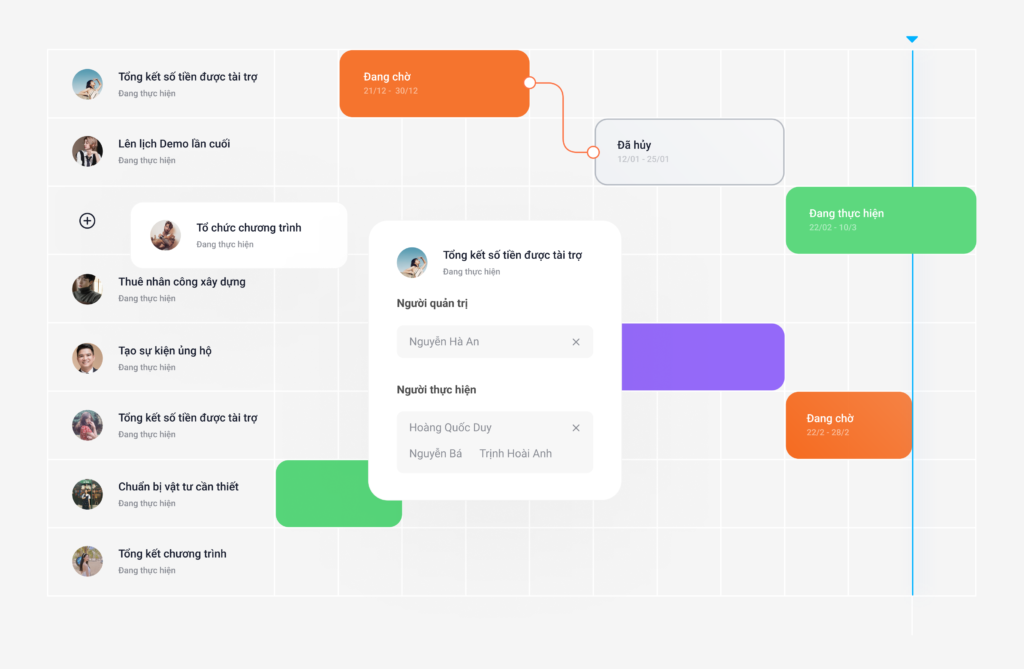
The system provides ready-made metrics to measure the progress of tasks and projects visually in formats like timelines, Gantt charts, etc. This helps managers closely control the work execution status by evaluating indicators such as the number of execution days, percentage of work completed, number of remaining tasks, etc., allowing for timely adjustments and promotion.
3.3. Evaluate work performance
A work management system helps create a fair and transparent digital work environment by evaluating employee performance. By tracking and analyzing performance evaluation criteria such as KPIs, task completion rates, etc., managers can accurately assess the productivity of each employee.
Additionally, work management software provides an automated reporting system in the form of a dashboard, helping managers easily evaluate work results visually without spending time compiling and processing data. Modern systems like 1AI Performance not only help measure with KPIs but also detect declining productivity trends and propose timely solutions.
3.4. Standardize workflows
Any project or task needs to go through multiple stages to reach its final result. With traditional work methods, many tasks and processes within a business lacked specific documented instructions and were only implicitly understood and agreed upon by employees. This easily leads to situations where errors occur, the source cannot be traced, and departments blame each other. Management also cannot control which stage the process is at or its progress to provide timely direction.
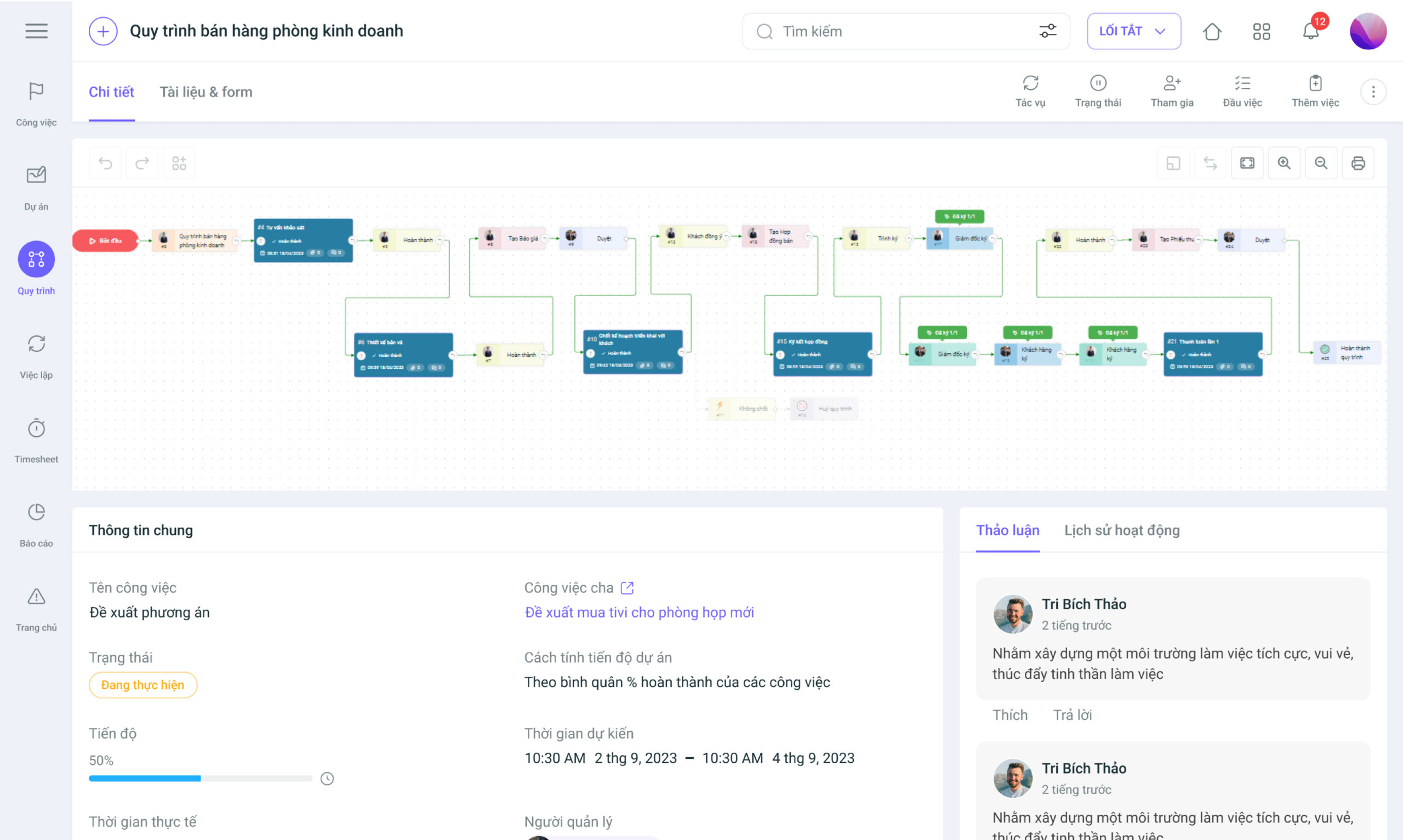
The advent of work management systems has established a new order for business operations management, organizing workflows according to proper standards and norms. Work management software systems help build, design, and digitize entire workflows and bring them onto the platform in the clearest, most transparent way.
A standardized process on the software will have detailed information about the number of steps, the person responsible, the execution time, etc. When an employee processes a task and completes a step in the process, the software will automatically update and move to the next stage. This allows all members to clearly understand their scope of responsibility as well as the project’s progress.
The AI Process and Low-code tools in 1Office help businesses build standard processes without needing technicians, ensuring flexibility, personalization, and easy updates.”
3.5. Internal work communication
The work management system establishes an internal communication channel for personnel to discuss and coordinate on tasks. This helps create a seamless digital work experience for employees, preventing them from being interrupted or distracted by having to communicate and connect through multiple messaging apps and emails as before.
With 4.0 work software, members can discuss directly on the workflow or edit and contribute ideas in the comment section. This way, all personnel can easily grasp the content of the ongoing discussion without messages getting lost or missed.
See more: Top 8 Task Assignment Software for Employees, effective Online work management
In the context of ever-evolving technology, a modern work management system must go beyond just planning, tracking, and evaluating – it needs to automate, personalize, and optimize the entire system’s operation.
Advanced solutions today, like 1Office, have integrated AI Agent and a Low-code platform, bringing a leap forward for businesses:
- AI helps analyze real-time data, automatically assigns tasks to the right person, warns about slow progress, and suggests solutions.
- AI Performance tracks the performance of each individual and team, thereby providing fair, transparent evaluations and proposing development roadmaps.
- AI Dashboard provides a real-time overview, helping leaders make quick decisions without waiting for summary reports.
- Low-code allows businesses to design their own processes, forms, and dashboards with simple drag-and-drop actions, no coding required – suitable even for non-tech department heads.
With the support of these technologies, the work management system is no longer just an operational support tool, but becomes a true “brain” that helps businesses control, optimize, and accelerate their entire work machinery.
4. What Should a Business Do to Build an Effective Work Management System?
4.1. Develop a methodical strategy
A work management system can only be truly effective when there is a clear direction and a methodical implementation strategy. This strategy will help clarify the purpose of use as well as the scope of system deployment to suit the needs and characteristics of the organizational structure.
The strategy needs to clarify:
- Implementation objectives: What operational problems will implementing a work management system solve for the business?
- Implementation scope: Will the system be implemented for a specific project, a specific department, or the entire enterprise system?
- Implementation resources: All members who will use the work management software.
4.2. Digitize documents and work processes
To implement the work management system, the business needs to build a database for the system. Resources that need to be digitized include task information, detailed work processes, and work-related documents.
Additionally, the business needs to issue regulations, policies, and guidelines related to the application of the work management system to ensure all personnel clearly understand how the system operates.
4.3. Establish metrics to monitor and evaluate work performance
To track the effectiveness and progress of tasks, managers must establish a specific set of evaluation criteria. Some suggested metrics for managers to consider include:
- Task completion rate
- Workload completion rate
- Sub-task weight
- Task KPIs:
4.4. Choose a suitable work management software
The final and most crucial factor determining the success of a work management system for a business is choosing the right software for implementation. Currently, there are many companies on the market offering Industry 4.0 work management solutions with various features and characteristics. This can inadvertently lead to information overload and confusion for managers when selecting a suitable software. To find the optimal work management solution for your business, consider evaluating based on the following criteria:
- Suitability: Does the software meet the company’s personnel scale and work management needs?
- Implementation feasibility: Is the software compatible with the company’s existing infrastructure and data?
- Vendor support services: Does the company receive consulting support during the implementation and use of the work management software?
- Reasonable cost: Is the system implementation cost within the company’s financial capacity?
- User-friendliness and ease of use: Is the software easy to understand and operate? Does it require significant effort to train personnel to use it?
Businesses should prioritize choosing software that integrates AI for automatic task assignment and progress alerts, and a Low-code platform for easy expansion and customization according to operational realities.”
See the latest updates:
>> Latest Work Management Software Price List 2023
5. 1Office – Intelligent Work Management System with AI Assistant and Low-code Platform
Among the many work management software options on the market, 1Office stands out as a comprehensive management platform integrated with artificial intelligence (AI) and modern Low-code technology, helping businesses not only operate efficiently – but also automate and continuously improve in real-time.
With its powerful set of work management tools, the new version of 1Officedelivers:
- Intelligent Task Assignment: Thanks to the 1AI Process virtual assistant, the system automatically assigns tasks based on capability and role, helping to optimize resource allocation and prevent work bottlenecks.
- Real-time Progress Tracking: With the 1AI Dashboard, managers can grasp the work status of each department and project in just a few seconds, without waiting for reports.
- Automatic Alerts and Coordination: The AI continuously monitors progress, detects signs of overdue tasks or delays, and proactively issues alerts for early resolution.
- Performance Analysis – Efficiency Measurement: Thanks to 1AI Performance, the system accurately evaluates work productivity based on data, eliminating subjectivity in management.
- Flexible Process Customization with Low-code: Allows department heads and managers to design forms, create report templates, and set up work processes that fit the business model – without IT involvement.
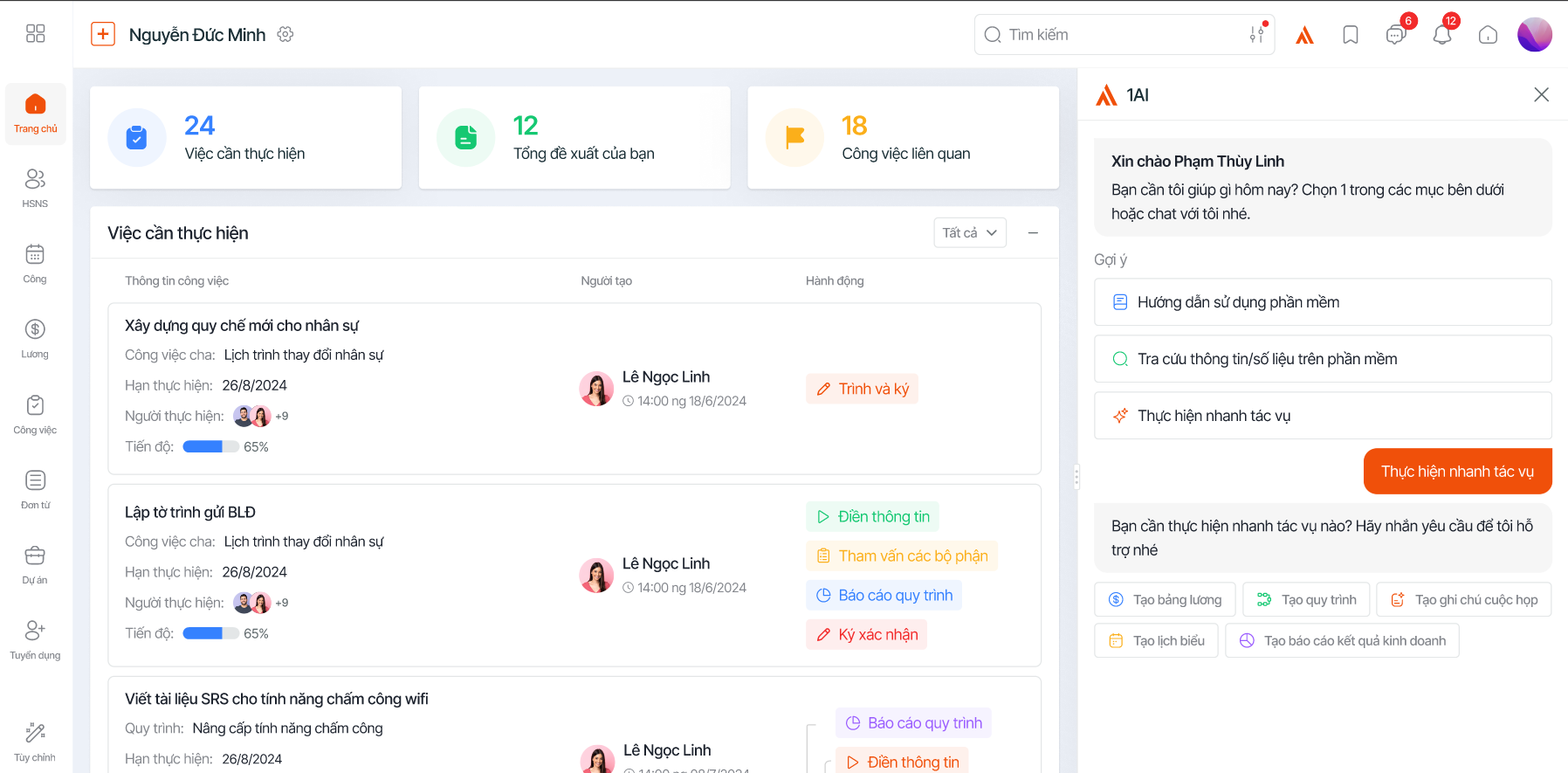
1Office is not just a work management system, but an intelligent operating platform that helps businesses transition from manual operations to operations driven by data and artificial intelligence – in line with the trend of digital transformation 4.0.
1Office is a work management solution researched and developed based on scientific, consistent thinking methods combined with a modern technology platform, ensuring uniformity, coherence, and comprehensiveness. The software provides all the necessary features to organize, implement, and manage work effectively. The actual numbers have proven 1Office’s capabilities on the digital transformation journey:
- Over 500,000 users from more than 6,000 Vietnamese businesses have chosen and trusted our solution
- Saves businesses 72 working hours per month
- Reduces manual work operations by 85%, replacing them with an automated system
- Automates 100% of the organization’s work processes
GET A DEMO AND USE THE SOFTWARE FOR FREE
Through the article above, 1Office provides readers with a comprehensive view of the work management system as well as a methodical and professional system implementation strategy. In the context of the current strong wave of digital transformation, implementing work management software is an ideal solution to help businesses optimize operational processes, saving time and effort in managing and monitoring employee work progress. 1Office is a technology solution that helps businesses solve the problem of effective work management and productivity optimization. For a free consultation and to experience a trial of the leading business management software today, please contact us using the following information:
- Hotline: 083 483 8888
- Fanpage: https://www.facebook.com/1officevn/
- Youtube: https://www.youtube.com/channel/UCeTIRNqxaTwk0_kcTw6SxmA
















