12/05/2026
  407 views
With the impact of digital transformation, the trend of applying automation technology is becoming more prevalent, and automated production lines are widely used in manufacturing. Human intervention in work has been significantly reduced. To achieve this, technology experts have worked diligently to find software solutions for automating business processes, and this article will help you better understand these solutions.
Mục lục
General Introduction to Automation Technology
What is Automation Technology?
Automation Technology is the application of advanced control devices and software to standardize processes, replacing repetitive manual tasks.

In the digital era, this concept has expanded to the office environment with workflow automation tools that help connect and operate workflows smoothly without constant human intervention.
In practice, these solutions are being applied across various industries such as manufacturing, transportation, healthcare, defense, and especially in smart business administration.
Benefits of Automation Technology
To give you a deeper insight into why modern businesses are racing to digitize, here are the core values that this technology brings:
- Increase productivity & operational flexibility: An automated workflow (automation workflow) helps the production line operate continuously, stably, quickly, and easily adapt to changes.
- Reduce costs & optimize resources: Automation helps streamline personnel, reduce hidden costs, optimize resources, and increase ROI.
- Enhance product quality: AI automation tools ensure consistency, increase accuracy, and maintain stable quality.
- Improve employee capabilities: Encourages employees to master AI-powered process automation tools, shifting from manual labor to technology management.
- Ensure workplace safety: Machines replace humans in hazardous environments, minimizing the risk of accidents.
- Increase competitive advantage: Creates high-quality products at optimal costs, helping businesses attract customers and establish their position in the market.
See more:
Notes on Business Automation – How to optimize processes operational
What is Automation? Practical Applications & Latest Trends for Leaders
Applying Control and Automation Technology for Businesses
Components of Industrial Automation Software
For an automation system to operate smoothly, it requires seamless coordination between hardware and software. Typical components include:

- Execution system: Industrial robots (ABB, Yaskawa, Universal…), actuators such as hydraulic valves, pneumatic cylinders.
- Control system: PLC (Programmable Logic Controller), inverters, and HMI screens that allow humans to interact with machines.
- Sensor system: Temperature and pressure sensors, image recognition cameras to collect real-world data.
- Management software layer: Systems integrated with artificial intelligence, acting as the “brain” to analyze and make decisions based on historical data.
Common Applications of Automation Technology Software
Currently, the intersection of the Internet of Things (IoT) and AI has created major breakthroughs. Not only in the manufacturing sector, but service businesses are also eagerly seeking workflow automation tools to optimize their office operations.
When a business lacks a centralized process management system, operations often become fragmented, uncontrolled, and inefficient. This not only affects productivity but also increases costs and risks during operation.
- Employees easily forget or miss tasks due to a lack of reminder and alert mechanisms.
- Coordination between departments is unsynchronized, making it difficult to control progress.
- Difficult to track job status and accurately measure performance.
- Manual approval and signing processes are time-consuming and prone to errors.
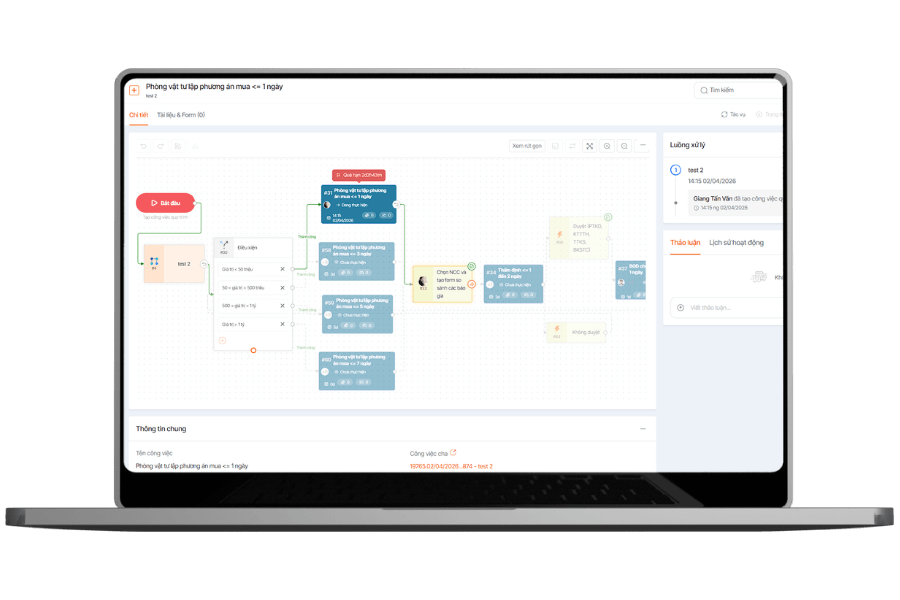
With a deep understanding of operational bottlenecks, 1Office has developed a BPA (Business Process Automation) solution – a process automation platform integrating No-code Platform and AI Agents, to help businesses digitize, operate intelligently, and comprehensively optimize their management systems.
1Office BPA – Process Automation (Workflow Automation)
- Standardize and digitize all business processes.
- Establish cross-departmental workflows with clear logic.
- Automatically route tasks based on rules and conditions.
- Customize flexibly with branching and multi-level approvals.
- Track, measure, and optimize process efficiency in real-time.
- Integrate digital signatures and forms directly into the workflow.
1Work (Work & Operations Management)
- Assign tasks, track progress, and send reminders to individuals.
- Manage a centralized task list to avoid missing work.
- Track processing status in real-time.
- Connect tasks arising from processes to the responsible individuals.
Register for a free feature demo!
Automation Software Implementation Strategy for Businesses
Choosing the Right Technology and a Reasonable Digitalization Roadmap
Businesses need to determine the right direction when investing in technology to standardize processes and enhance operational capacity. In the context of digital transformation, comprehensive management platforms like 1Office act as a central infrastructure, enabling the rapid processing of repetitive tasks, reducing reliance on manual operations, and focusing resources on value-creating activities.
For manufacturing businesses, it is necessary to select machinery and equipment from reputable suppliers, ensuring they are suitable for the scale and specific operational characteristics. Choosing the wrong technology can easily lead to production disruptions and unnecessary costs.
For service-based businesses, priority should be given to management platforms that can connect data, processes, and people on a single system. Solutions like 1Office, with its business process automation (BPA), work management, and human resources capabilities, allow businesses to build a systematic and synchronized digitalization roadmap from the outset, mitigating risks during implementation.
Track and optimize resources over time

Businesses need to establish a time tracking system for each plan on a daily, weekly, and monthly basis. This approach creates a foundation for monitoring progress, evaluating work efficiency, and allocating resources appropriately.
- Determine the time consumption for each activity
- Evaluate performance based on actual data
- Optimize processes to shorten processing time
- Ensure progress is accompanied by quality output
Streamline and optimize the process system
Leadership needs to fully understand the entire operational method to classify processes by importance and necessity, thereby guiding the effective implementation of automation technology. Redundant or non-value-adding processes should be eliminated or consolidated to optimize the operational system.
- Identify core operational processes
- Eliminate unnecessary intermediate steps
- Standardize processes before applying technology
- Ensure the process system is optimized before automation
Enhance employee experience and adoption capability
Technology is only effective when employees understand and proactively use it. Businesses need to build a clear training roadmap, creating conditions for employees to adapt and master the system.
- Organize systematic training in stages
- Clearly communicate the role of automation in business development
- Collect regular feedback to improve the system
- Create an environment that encourages the use of technology in daily work
When employees fully recognize the value of automation, the implementation process will be smooth and yield sustainable results.
Conclusion
Automation technology is becoming a crucial foundation for enhancing a business’s operational capacity and competitiveness. When processes are standardized and run on a digital platform, businesses can achieve better control, optimize resources, and grow sustainably.
Automation is no longer an experimental option, but a necessary direction for businesses to operate systematically and develop sustainably. Instead of struggling with fragmented processes, let 1Office help your business establish operational discipline and create breakthrough growth momentum.