


 13/05/2026
  337 views
The art of human resource management is one of the factors that contribute to a business’s success. Although this factor does not directly create products or services, it plays a significant role in improving the labor productivity and product quality of the organization. In this article, we will delve into the role and key techniques for applying the art of human resource management in a business!
Mục lục
- I. The Role of the Art of Human Resource Management
- II. 13 Arts of Human Resource Management Every Manager Should Know
- 1. Communicate with Employees
- 2. Know How to Listen and Empathize
- 3. Aligning employees with the company’s common goals
- 4. Taking responsibility
- 5. Always respect employees
- 6. Handling risks in personnel management
- 7. Knowing the strengths and weaknesses of personnel
- 8. Fair rewards and discipline
- 9. Evaluating and orienting employee capabilities
- 10. Motivate your personnel
- 11. Empower employees
- 12. Use human resource management software
- 13. Continuous Learning
I. The Role of the Art of Human Resource Management
Human resource administration plays a crucial role in business operations, and the art of human resource management is its core value. The art of human resource management is a balance of three elements: strategic management, business administration, and emotional analysis and understanding.
A talented manager is someone who can approach, analyze, and solve problems skillfully and subtly, and can execute all human resource management plans to bring about positive results. If you achieve these elements, you will win the favor of the entire company and be valued by higher-level leaders.
See more: What is a Human Resource Management System? Functions and Roles of HR Management
II. 13 Arts of Human Resource Management Every Manager Should Know
1. Communicate with Employees
A business’s work efficiency goes hand in hand with a healthy internal communication environment. It requires a comprehensive combination of factors such as clear direction, proper recognition, and questions that show close attention to employees. A good leader will care about building a strong connection with employees and establishing respect for their colleagues. Here are some methods you can consider:
- Offer specific praise, such as “I think you are very good at the following points:…”
- Interact with and show more respect for employees and their efforts
- Create opportunities for employees to express themselves and see their opinions acknowledged
- Continuously provide feedback and guidance to employees, creating a healthy and flexible environment
2. Know How to Listen and Empathize
Employees are feeling increasingly pressured and stressed. They feel undervalued and even disrespected. This is also one of the reasons for the recent wave of mass resignations globally. Listening and empathy from the highest levels of leadership help alleviate these issues, making employees less likely to quit, more engaged, and better able to perform their jobs.
Additionally, empathy helps leaders more objectively assess others’ emotional reactions to work-related issues, leading to more sensitive solutions.
This is not an entirely new skill in the art of human resource management, but its importance is becoming increasingly clear—empathy is the leadership capability that needs the most development both now and in the future of work.
| Read more: 5 HR Management Models effective for every HR professional to know |
3. Aligning employees with the company’s common goals
The next art of personnel management that leaders need is to orient employees to work for a common purpose. This is the best way for all members of the organization to collaborate effectively. Individuals who only focus on personal goals or departments confined to their professional goals can sometimes lead to self-isolation, lack of connection, and less cooperation.
To do this, leaders should take the time to discuss with employees their abilities and goals, in order to set appropriate common goals. During implementation, managers need to ensure their employees are on the right track with the set common goals, create action plans, and recognize their contributions after the goals are achieved.

4. Taking responsibility
“Taking responsibility” is considered a work culture and a necessary skill for everyone in their job, especially when you are in a leadership role. The core responsibilities of a leader include:
- Responsibility for strategic vision
- Responsibility for human resources
- Responsibility for building corporate culture
- Responsibility in making decisions
- Responsibility for ensuring performance
Furthermore, to organize and achieve the desired results from your team, you cannot just focus on criticizing an individual or a problem. What is necessary is to identify the issue and resolve it together with other members.
5. Always respect employees
Always respect all employees, from the lowest to the highest positions, and treat them fairly. This is one of the necessary conditions to retain talented people in the business. Because when leaders always show respect, behave professionally, and have good compensation policies for employees, they will be motivated to complete their work to the best of their ability. Respecting employees is also respecting your own management style towards them.
6. Handling risks in personnel management
Every business has had to face risks in personnel management. These can be cases of employees retiring or wanting to leave the company… causing serious impacts on the organization and related parties such as customers, suppliers…
To be able to handle risks in personnel management, leaders need the skills to research, analyze, and evaluate feasible options to overcome risks, while also limiting the recurrence of those risks in the future.
7. Knowing the strengths and weaknesses of personnel
A good leader has the ability to assign tasks to each employee reasonably and provide suitable solutions for each individual to help them improve in their work. To do this, the leader needs to identify the strengths and weaknesses of their subordinates.
8. Fair rewards and discipline
To be trusted and followed by employees, a leader must prioritize fairness and integrity. This is demonstrated through clear and impartial reward and punishment systems. For outstanding individuals who have contributed to the company’s achievements, commend them and provide deserving rewards. For underperforming employees, you must also implement thoughtful disciplinary measures.
9. Evaluating and orienting employee capabilities
According to a study by Linkedin, the most common reason people quit their jobs is that the company no longer provides enough opportunities for them to continue their personal development. If they stay, their career advancement will be hindered.
The way to overcome this situation is for leaders to have clear development path orientations through regular performance reviews and competency assessments. This is the most appropriate time to sit down with employees and propose necessary skills training courses.

10. Motivate your personnel
To motivate employees, leaders need to understand the Three R’s Principle of motivation, which includes:
Reward (Reward): Leaders should establish reward policies based on task completion to help the organization and work towards achieving its set goals.
Recognition (Recognition): Whenever an employee meets or exceeds job requirements or does something exceptional, the leader should acknowledge that employee’s efforts, both publicly and privately.
Reinforcement (Reinforcement): Reinforce behavior by telling employees that you appreciate what they have done. This makes people feel great about themselves and will encourage them to seek new opportunities to repeat that behavior.
11. Empower employees
Empowering employees means allowing them to participate in the management process, make decisions, take responsibility, share high-level information, and have their opinions heard. This method of empowerment helps reduce the workload for leaders and also provides an opportunity for employees to demonstrate their abilities, gain more knowledge, and develop their skills.
A study shows that a person who can empower others is someone who can create job autonomy for employees, promote the development of each individual, and lead the entire team to success.
12. Use human resource management software
Using HRM software is also an “art” that helps leaders manage their teams more professionally and effectively.
Currently, there are many software options on the market for leaders to choose from, depending on the needs and scale of their business. Using free human resource management software is often the top choice for small businesses. For businesses with hundreds to thousands of employees and complex organizational structures, a software with diverse features and integration between modules will be necessary.
1Office is a professional, easy-to-use online human resource management software suitable for all business sizes and types. With many outstanding features, the software is a perfect choice for astute managers.
Outstanding features of 1Office:
(1) Recruitment Management:
- Establish personnel headcount
- Manage recruitment proposals from all departments
- Integrate and sync CVs from recruitment sites
(2) Employee Management
- Manage and store all personnel information, work history, contracts, insurance, etc.
- Manage information on decisions regarding rewards, discipline, transfers, appointments, etc.
- Integrate digital signatures & eContracts directly within the software
(3) Timekeeping – Leave – Payroll Management
- 100% automated timesheet calculation
- Manage leave and compensatory time-off information for all personnel
- Automated salary payment via MB Bank
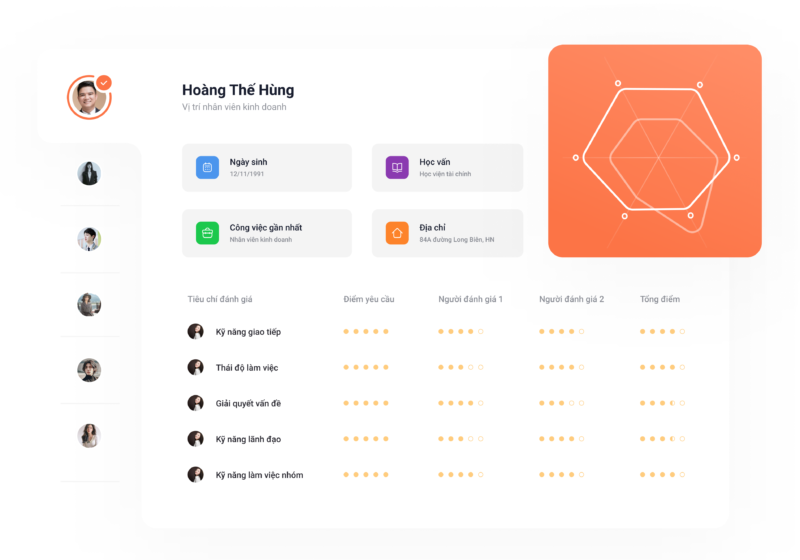
(4) Personnel Evaluation
- Manage training courses and the training results of participating employees
- Support competency framework assessment
- Build and evaluate employee KPIs, linking KPIs to the payroll
13. Continuous Learning
Continuous learning is the final leadership quality that 1Office wants to share. Individuals with leadership qualities are always learning, accumulating knowledge and experience to keep up with the changes of the times and the fierce competitive pressures of today.
Conclusion
Above are 1Office’s insights on the art of personnel management that leaders need to cultivate to earn the respect and admiration of their employees. Remember, the 1Office business management software will be a powerful support tool to help you advance faster on your journey to win people over. Contact us now for a free consultation on our leading personnel management solution!
















