12/05/2026
  378 views
For any business, human resources play a core role in determining the success or failure of the organization. Building a quality workforce helps a business execute all its established plans and strategies. Therefore, a well-structured HR plan is essential to help the organization achieve all its goals quickly and easily. So, what is an HR plan, and what are its benefits and the steps to create a human resource management plan? Let’s explore this in the content below.
Mục lục
Why do businesses need an HR plan?
According to a recent report by Mercer, 52% of high-growth companies state that one of the biggest risks to their workforce is taking too long to fill open positions. High-growth businesses know that it’s crucial to keep up with the pace of change. The Mercer report recommends that businesses should have a “long-term view of what people need to inform short-term decisions…
This can include moving people to higher-earning business areas, testing new technology, relocating offices closer to key talent pools, or investing in non-traditional talent by creating new pathways into skilled jobs.” Businesses can successfully implement this by building an HR plan in advance.
Let’s consider what it takes to develop an HR plan and why high-growth businesses like yours are using them to meet changing talent needs, business goals, and market trends, as well as to better inform their recruitment plans.
I – General Overview of HR Planning
1. What is an HR plan?
An HR plan is a strategic process undertaken by the HR department to assess and determine the organization’s personnel needs. In other words, a good human resource management plan helps you understand the number and type of employees your organization needs to achieve its goals.
Each business will develop a different HR plan, which can cover the entire company or be applied to smaller teams, departments, or even individual projects.
For example, if your company’s business goal is to expand the sales force next year, an HR plan can help prepare the sales department for that growth—to get the right people with the right skills into the right jobs at the right time.
2. Benefits of an HR plan for businesses
Creating a human resource plan not only helps companies recruit, hire, and develop employees effectively but also helps guide budgeting and financial decisions within the organization. Here are some key benefits of an HR plan that you should know.
Reduce personnel costs
The first benefit to mention is the reduction in personnel costs; you can save money with a clear HR plan. An HR plan template will give you an overview of the existing position structure, helping you find new roles for employees within your company. Additionally, a human resource plan will include internal training methods and strategies, as well as advanced training courses to enhance employee productivity and expertise.
Increase development opportunities
This is an extremely important benefit of employee planning because it helps you expand your current workforce and create a more effective structure. This, in turn, helps you increase development opportunities and create a framework for the future.

A more organized company structure
With a pre-established plan, you can create an organized structure for your business. This will help the company have a stronger, more professional workforce. If employees perform well, it can also help your team plan for promotions and propose salary increases more easily.
Stronger recruitment
In addition to the benefits mentioned above, recruitment software will help you have a better recruitment method. Once you have completed your needs analysis, you can quickly identify the skills you need in a candidate and which candidates meet those standards. This will make recruitment easier than ever.
With the benefits mentioned above, it’s clear that HR planning helps you prevent related issues that could delay growth or hinder the quality of your products and services. This increases recruitment efficiency and helps you quickly find the most qualified candidates.
Read more: Top 10 Most Comprehensive and Effective Recruitment Management Software
II- The Role of HR Planning
HR planning plays a crucial role in every industry and business production process, such as:
- It is a fundamental factor that drives the business to achieve its set goals and tasks.
- It serves as the basis for developing internal training programs and planning the development and enhancement of employee capabilities.
- HR planning helps businesses arrange, organize, and utilize labor reasonably, creating a foundation for employee compensation.
- Accurately determining the company’s workforce in terms of quantity, education level, gender, expertise, etc., to expand production scale and ensure uninterrupted processes.
- HR planning is the foundation for establishing a human resources information system to support HR management and production activities.
See more: Automated HR and Payroll Management Software – 1Office
III- The Most Effective Steps to Create an HR Plan for Your Business
Each organization and business will have a different human resources plan depending on its structure and scale. Below are 6 basic steps for an HR plan that you can reference and apply:
1. Define Business Objectives
First, you need to define your company’s business objectives, from general to specific. Using business objectives will give you a clear understanding of the company’s upcoming goals, allowing you to arrange personnel accordingly. Therefore, you need to carefully consider the company’s business results and direction to allocate human resources most appropriately.
For example, if the business plans to open a new location, you may need to move current employees around or hire new staff to fill those roles. The business plan will help inform these personnel decisions.
2. Assess Your Current HR Situation
To build a perfect HR plan, you need to clearly understand your current HR environment and have a suitable human resource management approach. To determine the number of employees and the current work situation, you should store this information on a single platform for easy searching and management.
Once you have consolidated the data, you can quickly assess the current HR environment and start gathering useful insights from the data.

Some criteria for assessing the company’s HR situation:
- Number of employees
- Employee distribution (team size and where people work)
- Skills and competencies in the workforce
- High performers and potential leaders
- Low performers or “flight risks” who might indicate turnover
- Employee age and tenure (to predict the number of retirements)
3. Forecast Future HR Needs
Once you have assessed the company’s current HR situation, you need to make some predictions about your future HR needs. To accurately assess future HR needs, you should consider several factors that influence decisions and HR opportunities, including:
- Business objectives
- Turnover rates and forecasts
- New product launches
- Changes in the economy
- Business investments (e.g., new technology)
- Competitors attracting key talent
- Labor costs in the industry
- Unemployment rates
All of these internal and external factors can affect your workforce and HR needs.
Although forecasting will always involve some guesswork, you can make confident, educated, and (more accurate) predictions using the following methods.
Trend Analysis
Trend analysis works effectively for established businesses with several years of operation. This means historical data is saved to inform future needs.
To perform a trend analysis, start by collecting historical data. Focus on gathering information from at least the last 5 years—but you may want to go back as far as 10 years. (Remember that the larger the sample size, the more accurate the results.)
Collect data on the following:
- Recruitment and retirement patterns
- Transfers and promotions
- Employee transfers
- Years of service
- Skills and qualifications
- Employee demographics
- Education
- Past work experience
Once you have collected the data, you can analyze it to understand turnover rates over time and discover trends or patterns between datasets.
Ratio Analysis
This is considered a dual-purpose forecasting method that both predicts personnel needs and compares the forecast results with industry standards. For young companies, this is a significant advantage that should be applied, helping the business gain deeper insights into future trends.
Here’s how it works
A ratio establishes a relationship between two things. A business can calculate the ratio between business factors such as future sales revenue forecasts and staffing requirements.
4. Complete a gap analysis
Next, you conduct a comparison between the current HR environment and future HR forecasts to understand where your employees currently stand and what their needs are. Here, you need to consider what skills your personnel need to meet business goals or what support you need from your staff to achieve the company’s objectives. Simply put, gaps in the workforce will include: expertise, number of people, and whether employees are in the right positions.
Note that you should view these gaps as opportunities to create an ideal state to achieve goals, not as weaknesses. Below are some factors you should consider:
- Whether the analysis helps you support company goals when comparing the future state with the current state
- Adjusting your current personnel
- Selecting employees with the right expertise
5. Create your HR plan
Once the analysis is complete, you can now create an HR plan. A human resource management plan will include:
- Proposals for a training program to teach current employees new skills
- Succession HR policies to streamline promotions or reassignments following employee retirement
- Including job titles, job descriptions, and a recruitment budget.
6. Evaluate and refine the plan
Finally, you take the step of evaluating and refining the plan. This serves as a method to help you streamline recruitment processes, identify outstanding talent within the organization, and achieve various business goals. Depending on the needs of the business, your plan can be flexible to accommodate business changes. Remember that your plan needs to be suitable for you, and consider alternatives if it doesn’t work as well as you expect.
See more: 10 effective HR management methods that businesses can’t do without!
IV- HR Plan Templates and Download Links
Most companies today conduct recruitment randomly without a specific plan. This has led to companies facing situations of overstaffing, understaffing, or being unable to recruit quality personnel, which affects the entire company structure.
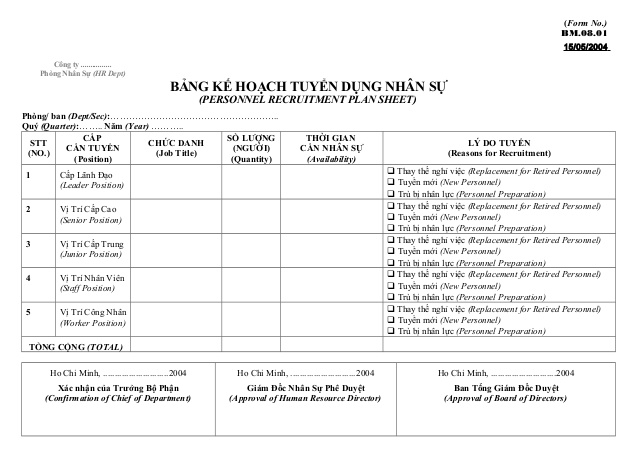
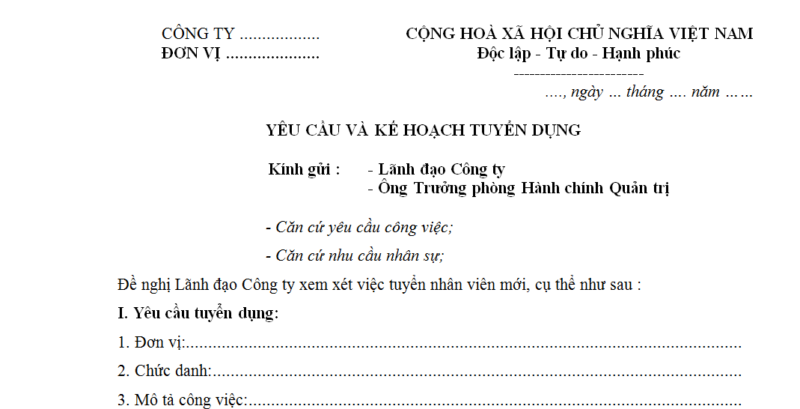
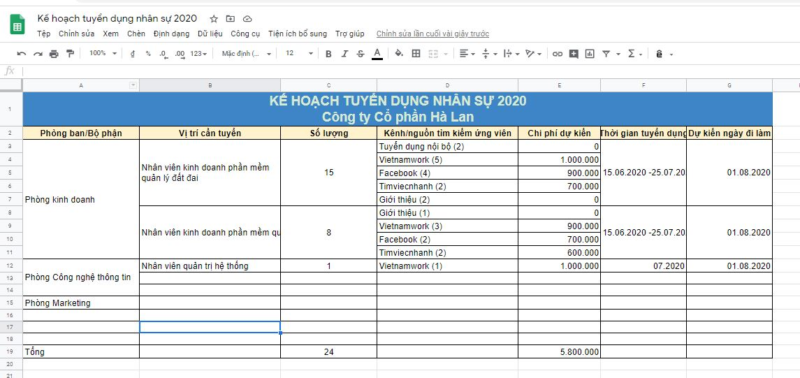
Therefore, an HR management plan template will help you solve that problem thoroughly. Below are some templates you can use.
>>>Free HR plan template download link https://docs.google.com/spreadsheets/d/1oWh3zdvfMcmmIJYkECX_bCyuAOhalkLHXL0klShnteM/
Strategy Template 1
Strategy Template 2
Template 3:
| >>> Read now: Personnel Requisition Form Template for Businesses |
V- Frequently Asked Questions about Human Resource Planning
Below are some of the most common questions employers ask about workforce planning:
Why is human resource planning important?
For each plan, you need to analyze, review, and strategize to help the company achieve its set goals. You can then align your recruitment plans to attract the right employees who fit the company’s needs. Additionally, human resource planning also helps with employee retention, as you can evaluate training and development ideas to help your team members acquire necessary skills.
What are the different types of human resource plans?
Depending on the industry and scale, there will be different human resource plans. Here are some common types of human resource plans:
- Short-term human resources: This type of human resource plan focuses on the immediate needs of the company
- Succession planning: This is an approach that allows you to anticipate the departure of managers and train internal candidates to step into those roles
- Long-term human resources: These are human resource plans that last for at least one year
- Strategic human resource planning: This approach includes a combination of short-term, long-term, and succession planning
What is human resource analysis?
This is a process of identifying trends among employees in the business, such as employee transfers, job satisfaction levels, and the staffing levels needed to manage the workload.
As you can see, building a human resource plan directly affects organizational leadership, the recruitment of managers, and HR leaders. Therefore, creating a workforce plan is the key to success in developing a plan that meets everyone’s needs and is suitable for any business.
For more detailed information, please contact us via:
Hotline: 083 483 8888
1Office Fanpage: https://www.facebook.com/1officevn
Youtube: https://www.youtube.com/c/1OfficeNềntảngquảnlýtổngthểDoanhNghiệp