


 12/05/2026
  354 views
Measuring business performance is always a crucial task, helping to increase efficiency and formulate more effective business strategies. One of the key metrics for this activity is the “Win rate”. In this article, let’s join 1Office to learn What is Win Rate? as well as the most effective ways to increase your win rate.
Mục lục
1. What is Win rate?
Win rate is understood as the “win rate” or also known as the “successful transaction rate”. This is the percentage of deals that a sales representative successfully closes, bringing in new customers for the business.
Understanding what win rate is and how to effectively use this metric will help managers and leadership grasp the state of business operations and the suitability of business strategies.
2. The importance of measuring win rate
As mentioned above, win rate is one of the key metrics for the business as a whole and the sales team in particular. Once a business understands what win rate is, it will need to clearly grasp the role this rate plays in driving business activities.
Most commonly, businesses use this measurement to determine which time periods and which sales representatives are performing most effectively and have a high closing rate.
Specifically, measuring the ability to increase the company’s market share plays the following roles:
- Helps managers grasp the effectiveness of business plans
Building a business plan helps a company lay a solid foundation for its business activities. A business plan acts as a guiding compass, directing the company towards future growth.
Win rate is extremely helpful for a business in the planning process. Based on whether the measured competitiveness against rivals is low or high, the business may need to review and adjust its business plan to be more suitable for successfully attracting and converting customers.
- Helps the business clearly identify target customers
To increase the win rate, a business needs to identify who its target customers are. A business can understand its customers better by answering various questions, for example:
What are the characteristics of our target customers?; What problems or pain points do they have that need solving?; What needs do target customers typically have?…
By determining the Win rate, the business can find ways to optimize it and more clearly define its target customer audience.
- Evaluates the performance of the sales team
For sales representatives with low win rates, the business needs to provide additional training on closing skills or product knowledge to help them consult and discuss with customers more confidently about the issues they face, and to present the product’s benefits and features more accurately.
On the other hand, for sales representatives with high closing rates, the business can consider rewards and praise to encourage them to continue performing well in the future.
Read more: What is a BCP? Strategy for building a business continuity plan for enterprises
3. The most accurate formula for calculating win rate
After understanding what win rate is and grasping the important role of this metric in business, let’s move on to the most accurate calculation method.
Basically, the main and most fundamental formula for measuring Win rate is as follows:
| Win rate = Number of successful deals / Total number of deals with customers |
-

Accurate win rate calculation formula
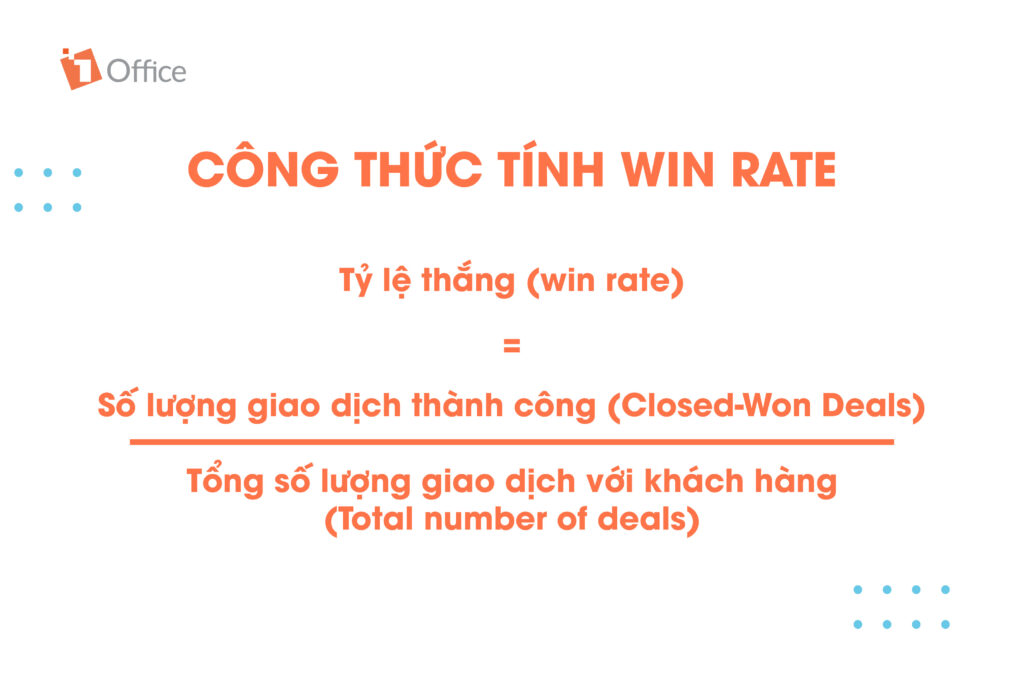
For example:
A software solutions business has 50 successful deals and a total of 200 deals with customers in Q3 of 2022.
=> The business’s competitive ability (Win rate) will be: 50/200 = 25%
By applying this formula, the business can easily calculate the sales team’s win rate to create suitable plans accordingly.
Read more: What is Profit Margin? The most accurate way to calculate 3 types of profit margins
4. 6 Steps to Effectively Increase Your Win Rate in Business
After understanding what a win rate is, its importance, and the calculation formula, businesses will likely ask how to improve this rate and maintain it at an optimal level.
Below are 6 steps businesses can apply to help increase business efficiency by up to 80% (based on the win rate):
4.1. Clearly define the win rate according to specific criteria
There are always criteria suitable for each business’s products/services. Clearly defining these criteria to calculate and measure the ability to increase market share plays a crucial role in improving this metric.
-
How to effectively increase your win rate in business
The sales team can bring in successful deals based on many different criteria. Some of the criteria that businesses can use to define and analyze the Win rate include:
- Features: The features of the business’s product or service have met the potential customer’s requirements.
- Price: The final offered price from the business is suitable for the price the customer is willing to pay.
- Competition: The potential customer decides to choose the product/service provided by the business instead of the competitor’s product/service.
- Benefits: The product/service provided by the business brings benefits to the customer, helping them solve their problems and meet their needs.
- Timing: The time when the salesperson introduces the product/service is suitable for the time when the customer is interested in that product/service.
4.2. Plan the stages in the sales funnel
Each customer in different stages of the sales funnel will have different needs. Therefore, clearly defining the steps in the sales funnel will help the sales staff better understand customer needs, thereby adopting a suitable approach and effectively increasing the competitive rate.
The 4 main stages of the sales funnel:
| Phase 1 | Awareness Stage | Target customers realize they have a problem that needs to be solved, and they are struggling to find a solution for their business. => Customers have many questions that need to be answered with useful information. |
| Phase 2 | Consideration Stage | Potential customers truly understand their problem and believe their questions will be answered by the useful information the business provides.
However, customers still need to learn more about the solution the business offers to see if it is a good fit. |
| Phase 3 | Decision Stage | Customers may be considering choosing between the business’s product and a competitor’s.
In this stage, customers are at the bottom of the purchasing funnel and know exactly what their problem is and what kind of solution they need for it. |
| Phase 4 | Action Stage | This is the stage that determines whether a potential customer officially becomes a customer of the business.
If the customer decides not to purchase, the business can still provide them with useful information and content to improve brand awareness and increase the likelihood that they will decide to purchase the next time they have a need. |
4.3. Develop detailed sales goals
To increase the win rate, setting clear and specific sales goals is crucial. In this step, management needs to provide the company’s sales team with a clear roadmap of what they need to do to help the company achieve its overall objectives.
To develop a sales plan with clear and specific goals, businesses can use the SMART model. This is a model for setting goals based on specific factors such as:
- Specific (S): Clearly explain the goal and the steps to achieve it
- Measurable (M): Ensure there are established metrics to measure goal completion
- Achievable (A): The goal must be realistic, but not so easy that it fails to motivate.
- Relevant (R): Ensure the goal aligns with the overall objectives and strategy of the business, as well as your team
- Time-Bound (T): Set a precise and clear timeframe for the goal
For example:
Company A, a technology business, needs to acquire more new potential customers each month. To create a plan, it needs to determine:
| S (Specific) | Gain 100 new customers each month and assign them to the sales staff. |
| M (Measurable) | How many new customers does each team member need to reach out to daily or weekly to achieve the goal? |
| A (Achievable) | There are 4 sales employees, so can each person bring in 25 customers a month? |
| R (Realistic) | Consider whether the number 100 is feasible. Is it possible to achieve? |
| T (Time-bound) | Set a goal to bring in 100 new customers each month. This way, the sales team will know there is a specific time limit for the set goal. |
4.4. Thoroughly research the market segment
Another effective way to increase the Win Rate is to thoroughly research the market. Only by understanding the market can a business better understand its customers, competitors, and target market.
To conduct effective market research, businesses can apply the following steps:
- Identify the target market
- Understand customers thoroughly
- Identify the specific customer group to survey
- Analyze competitors
- Choose a research method
- Design survey questions
- Summarize the collected data
| Reference: What is Market Segmentation? How to Segment the Market Effectively for Businesses |
4.5. Identify the target customer audience for the business
Besides market research, clearly understanding the target customer audience will help increase the win rate in customer transactions.
Clearly defining an ideal customer profile includes information such as: interests, behavioral characteristics, and the factors that influence their purchasing decisions.
-
Correctly identify the target audience to improve business efficiency

Customer audience information is built based on market research, actual data, and well-founded assumptions about potential and current customers.
By understanding its customers, a business can develop a strategy for allocating resources reasonably and plan a successful approach, thereby effectively increasing the Win rate.
4.6. Improve sales skills for handling customer rejections
Sales staff need to have communication measures to reassure customers when they have concerns about the products/services the business provides. Once these concerns are dispelled, negotiations will move in a positive direction.
In cases of customer rejection, many people argue or show an attitude, putting pressure on the customer. This creates a negative impression and tarnishes the brand image.
Common customer rejections can be classified into 5 main groups of reasons, including:
- Reasons related to price
- Reasons related to time
- Reasons related to competitors
- Reasons related to authority
- Reasons related to need and suitability
So how can you turn a customer’s negative thoughts into positive ones to increase the win rate? You should:
- Listen to the customer (which also creates an opportunity for the customer to speak)
- Acknowledge their concern (summarize the issue)
- Ask questions (to understand the underlying reason for the rejection)
- Address the customer’s concerns (provide a recommendation).
Thus, through the article above, your business should now have a clear understanding of what win rate is, its importance, the formula for calculating it, and how to effectively increase the win rate in business.
In today’s modern market, applying software solutions for business management and development is very common. And 1Office sales management software is among the top most popularly used tools for managing and improving business efficiency for many large enterprises.
For more detailed information, please contact:
- Hotline: 083 483 8888
- Fanpage: https://www.facebook.com/1officevn
- Youtube: https://www.youtube.com/c/1OfficeNềntảngquảnlýtổngthểDoanhNghiệp
















