


 12/05/2026
  243 views
Digital transformation is an essential activity that any business needs to promote to boost business efficiency. Many businesses have been and are looking to enhance their management and operational capabilities through digital transformation. However, not every business has a clear roadmap for digitizing operations, or more accurately, they don’t know where to start with digital transformation. 1Office will help businesses understand the digital transformation process for any enterprise, as well as provide some tips to optimize business digitization.
Mục lục
- Differentiating Digital Transformation from Digitization
- Benefits of Digital Transformation in Business Operations
- The Basic Digital Transformation Process for Businesses
- 5. Key considerations for sustainable business digitalization
- 1Office – The digital transformation solution to optimize business operations
Differentiating Digital Transformation from Digitization
Below is a table differentiating digital transformation from digitization based on specific criteria:
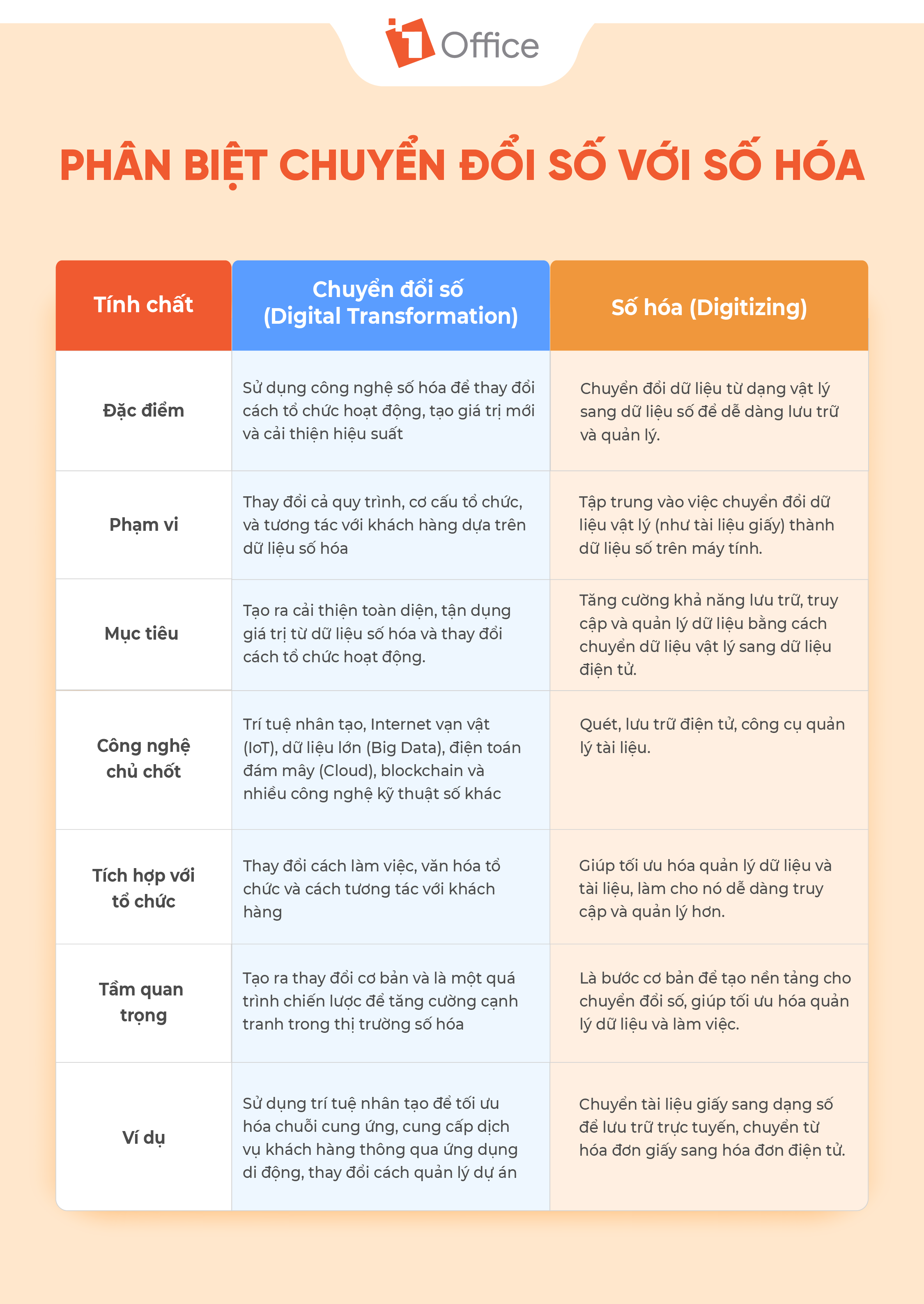
From this analysis, we can see that digital transformation is broader in scope than digitization, as it involves changing how an organization operates and creating new value through the interaction of technology and the organization. Meanwhile, digitization primarily focuses on converting data from a physical to a digital format to optimize management and access.
Benefits of Digital Transformation in Business Operations
Digital transformation plays a crucial role in the growth and success of modern businesses. It is not merely about adopting new technology but is a comprehensive process of changing how an organization operates, interacts with customers, and manages resources. The benefits of digital transformation in business operations are very clear, as follows:
- Saves operational costs for the business: Digital transformation helps minimize costs related to traditional operations and management. For example, switching from paper printing to online document storage and sharing reduces printing and paper purchase costs.
- Optimizes business operations: Digital transformation allows for the automation of business processes, improving accuracy and processing speed. For example, an automated system for inventory management and reordering helps prevent shortages and inventory waste.
- Manages information and utilizes resources more effectively: Businesses can use data to predict market demand and trends. For example, a retail store can analyze sales data to identify which products are in high demand and need to be restocked.
- Enhances customer experience: Digital transformation helps create a better shopping and customer interaction experience. For example, a mobile app allows customers to easily look up product information, place orders, and track their order status.
- Optimizes work performance: Employees can focus on creative tasks instead of repetitive work. For example, an automated system for processing employee leave requests saves time for both employees and the HR department.
- Increases opportunities and enhances competitiveness: Digital transformation opens up new opportunities through the adoption of new technology. For example, using artificial intelligence to analyze customer data can help businesses better understand their needs and develop new business strategies.
- Increases profit and sales revenue: Improving the customer experience and business processes leads to increased profits. For example, developing a user-friendly website that makes online shopping easy can boost sales.
- Builds corporate culture: Digital transformation can contribute to cultural change within the business. For example, using online tools to share knowledge and ideas among departments can foster a spirit of collaboration and innovation.
The Basic Digital Transformation Process for Businesses
Step 1: Define a Digital Strategy Aligned with the Business Strategy
To prepare for implementation, digital transformation must begin by clarifying the business’s unique strategy and objectives. This strategy needs to be developed by leadership, aligned with, and serve business goals. The priority must be placed on critical operational tasks to determine priorities in the digital transformation process and build a roadmap for subsequent work. Common digital transformation strategies include:
- Operational Optimization
- Building Customer Experience
- Business Model Transformation
One method to help businesses plan their digital transformation strategy is to use a Digital Strategy Map. This approach, often applied by FPT Digital when assisting businesses, involves a comprehensive analysis of 6 trends:
- Market Trends
- Customer Trends
- Competitor Trends
- Ecosystem Trends
- Startup Trends
- Technology Trends
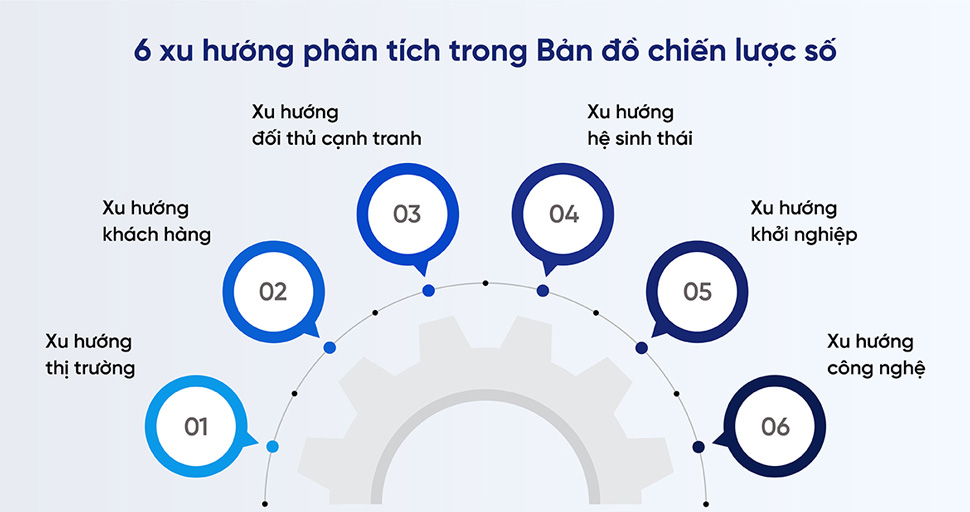
Based on this overview, businesses can analyze and combine it with their needs and goals to build a suitable digital strategy.
Step 2: Assess the business’s digital maturity level
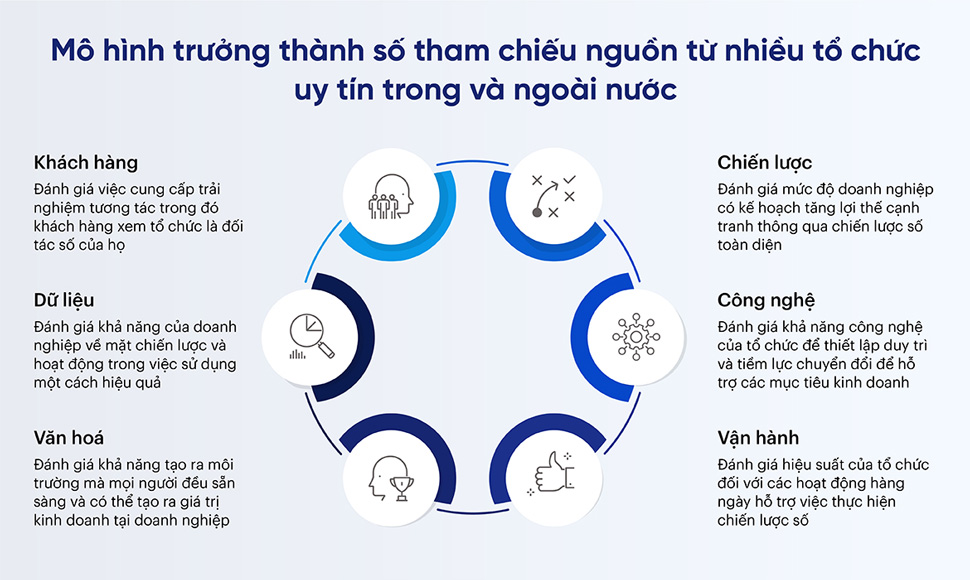
Digital transformation begins with defining a unique strategy. The next step is to assess the digital maturity level to guide the process. This step helps the business analyze and determine its current position, the “current situation” – the initial starting point.
The digital maturity assessment model is built on 6 key aspects of business operations:
Step 3: Build a digital transformation roadmap for the business
After defining the strategy and pinpointing the starting point of the digital transformation journey, building a roadmap is the next step to outline a comprehensive vision toward the target state of the transformation process. During the roadmap development, the business must analyze and select effective implementation methods. The goal is to minimize time, effort, and budget for implementation, as well as to identify potential risks in advance.
Without thorough analysis, businesses may make mistakes such as implementing disconnected technology solutions, which limits integration and leads to a waste of time, resources, and money, or causes them to stray from the original strategic goals.
The criteria for building a digital transformation strategy include:
- Suitability: Choose solutions that are suitable and closely aligned with the business strategy, digital transformation strategy, and focused priority tasks.
- Inheritance: The solutions in the roadmap must be inheritable to ensure long-term applicability and integration.
- Prudence: The roadmap requires careful consideration to establish each digital transformation task on a solid foundation.
- Unanimity: The roadmap requires unanimity, inspiration, and leadership from the management team, as well as approval, support, and adoption from the employees within the organization.
Step 4: Build a people transformation roadmap
The human factor plays a crucial role in the digital transformation process. To prepare for this, businesses need to build a personnel transformation roadmap focusing on engagement and digital skills. This roadmap includes 3 stages: “Incubation,” “Dissemination,” and “Maintenance.” In each digital transformation stage, the business will need to plan specific tasks to create engagement among the personnel involved in the transformation process.

Activities in the plan to build the personnel transformation roadmap include:
- Communication,
- Training,
- Building digital transformation governance models,
- Organizing workshops,
- Innovation contests, etc.
When every individual in the organization shares a common goal and understands the significance of digital transformation not only for the business but also for themselves, unanimity and commitment will be built, aiming for the company’s collective success. For future digital skills, the business will need to develop suitable training programs for each target group and link them closely with the digital transformation roadmap.
Additionally, coaching and consulting will be tools to support the workforce in enhancing their capabilities and personal development. As a result, work will be performed smarter, more optimally, and more coherently.
Step 5: Implement, Measure & Improve
The digital transformation process also requires careful monitoring to ensure the transformation proceeds according to the established roadmap. At the same time, the business needs to evaluate the effectiveness of the implementation process at each stage. These evaluations are based on reports from the implementation process, aiming to make necessary adjustments.
Furthermore, in the face of constant fluctuations from the market, technology, competitors, customers, and new business models, as well as potential values that can be created, businesses need to review and re-evaluate the feasibility of digital initiatives. From there, they can determine the technology solutions to be applied in the company’s roadmap.
5. Key considerations for sustainable business digitalization
Determine the business’s digital transformation desires
Faced with the rapid changes in modern technology, before considering the adoption of digital transformation, leaders must remain calm to identify the main issues of the business based on an understanding of business processes and the current market situation. In addition, customer psychology must be placed at the center to develop a suitable digital transformation roadmap, because ultimately, revenue is always the goal of every business.
Assess the business’s readiness
After outlining a clear plan for the digital transformation roadmap and determining priorities, the business needs to re-evaluate its readiness to restructure its operational processes. This is not an easy challenge as it requires the business to consider both factors: people and data.
In addition to checking and analyzing existing data within the organization, leaders also need to pay attention to data from their strategic partners. This is to create a comprehensive overview of the business’s Value Chain before starting the digital transformation process.
Change processes when necessary
Managers do not need to be technology experts, but they need to understand that combining business vision with the power of technology can bring significant achievements.
Specifically, after understanding the meaning of data for the business, leaders need to recognize the signs to assess the maturity of the business process. From there, the business can determine its current position and whether it is ready for digital transformation. The management can also take advantage of periods with less production and transaction activity (such as during the Covid-19 pandemic) to adjust the process structure to be suitable for digital transformation.
This is also an opportunity for the business to review its readiness for digital transformation. Which processes or work stages are not ready and how they need to be improved.
Find a suitable and optimal solution
When researching investment in digital transformation, businesses face two choices: develop an ERP system in-house based on internal processes, or leverage solution providers and connect them.
With the first option, the business needs to establish a department within the organization to develop the solution itself. For the second option, leaders need to focus on planning. The business should limit the use of temporary solutions to solve short-term problems.
Ultimately, the sustainability of digital transformation is an opportunity for new technology to advance. Skipping a platform can sometimes bring many benefits to the business in the future.
Nurture commitment to digital transformation from leadership and the entire enterprise
When technology becomes too common, it is often easy to overlook the most fundamental value: people. Building a culture that respects and values creativity and a love for learning is a crucial factor in the digital transformation process.
Instead of having employees work in separate rooms or narrow spaces, departments should be arranged in an open space and closer to each other. This will encourage creativity and a love for learning. People can work and discuss together, from which the business can develop a common voice. This environment not only brings work efficiency but also promotes the pace of absorbing new technology.
1Office – The digital transformation solution to optimize business operations
As one of the leading solutions in the field of digital transformation today, the comprehensive business management software 1Office helps businesses optimize their operations AUTOMATICALLY – QUICKLY – EFFICIENTLY. This software stands out with its 3 main modules:
- 1Work – A module that provides tools for employees to work and communicate internally.
- 1HRM – A module that provides tools to manage the company’s human resources.
- 1CRM – A module that provides tools to manage marketing, sales, and customer care.
With just the 1Office software, businesses can coordinate, track, and evaluate everything from the overall picture to the finest details of each activity and task of employees and departments. The data system is digitized and synchronized across the entire system.
——————————–
Thus, the article above has answered the question “Where does digital transformation start?” with a detailed 5-step process and notes to help managers optimize the effectiveness of their business’s digital transformation activities. Investing in digital transformation is an essential activity that businesses should promote. Among the options, applying a comprehensive business management solution – 1Office is a leading effective solution that businesses cannot overlook. Contact the 1Office team of experts now for more specific advice on the solution and to build a suitable digital transformation roadmap for your business!
Register for a consultation on the 1Office digital transformation solution!
















