10/05/2026
  11928 views
Evaluating and summarizing employee performance at the end of the year is a crucial activity for every business. However, for businesses with hundreds or thousands of employees, this evaluation process can be challenging. Understanding this, 1Office would like to share with managers information on the criteria, steps for an effective year-end employee review, and the most detailed, easy-to-apply employee evaluation form templates.
Mục lục
- I. What is the purpose of a year-end employee evaluation form?
- II. What are the criteria for a year-end employee evaluation?
- III. An Effective Year-End Employee Evaluation Process
- IV. How to Ensure Fairness and Transparency in Employee Evaluations
- V. A collection of 9 detailed, easy-to-use year-end employee evaluation forms
- 1. Year-end evaluation form for probationary employees
- 2. Year-end performance evaluation form for official employees
- 3. Employee evaluation form for teams
- 4. Year-end KPI-based evaluation form for sales staff
- 5. Year-end evaluation form for customer service staff
- 6. Year-end employee evaluation form for the Marketing department
- 7. Year-end employee evaluation form for HR
- 8. Year-end evaluation form for managers
- 9. Year-end employee evaluation form based on the training plan
- VI. Frequently Asked Questions
I. What is the purpose of a year-end employee evaluation form?
“If managers are not well-trained in how to conduct performance appraisals, the data from the evaluation system will be flawed, leading to poor decisions in compensation, business planning, and labor allocation” (Dick Grote, author of How to be Good at Performance Appraisals: Simple, Effective, Done Right).
After a year of diligent and hard work, every business needs to conduct an evaluation and summary to identify strengths and areas for improvement in work performance for the coming period.
Specifically, the purpose of creating a year-end employee evaluation form is:
- To help managers and leaders understand what employees are doing, their immediate needs, and to reinforce short-term motivation if necessary.
- To enable both managers and employees to summarize and exchange honest feedback from the past year.
- To discuss new strategies for the upcoming year of growth.
- To accurately assess employee performance in the past year based on pre-disclosed criteria.
- To help employees gain more clarity and understanding.
- To identify the individual career goals of each employee, thereby creating suitable promotion paths and motivating them to work more effectively in the future.
II. What are the criteria for a year-end employee evaluation?
1. Based on work attitude
Many leaders believe that attitude is more important than knowledge and would prefer to choose an employee with a good work attitude over a competent but arrogant and unprofessional one. An employee with a good work attitude will meet the following criteria:
- Honesty and integrity.
- Carefulness in all tasks.
- Proactive and eager to learn.
- Respect for colleagues and customers.
- Punctual and diligent in attendance.
Example: A good employee will always follow the company’s rules, work with a progressive attitude, and have a sense of responsibility. Regardless of the work results, an employee with a good work attitude deserves to be recognized as a role model.

2. Based on work competency
Typically, a year-end evaluation based on work competency will have three criteria: administrative objectives, job completion objectives, and development objectives.
- Evaluation based on administrative objectives
Based on the employee’s workload and work efficiency to serve as a basis for rewards, promotions, or dismissal.
- Evaluation based on development objectives
This is an evaluation criterion based on sample KPI templates and the employee’s short/long-term goals. Based on this criterion, managers will devise development strategies and support employees to achieve the best results in their work. In return, employees must also strive to help the company grow.
- Evaluation based on completion of assigned tasks
Managers will evaluate each employee’s performance based on the results of their assigned tasks. This allows them to identify capable employees and those who need additional training.
| Tip: 7 Effective, Easy-to-Apply Employee Evaluation Methods |
III. An Effective Year-End Employee Evaluation Process
For the year-end employee evaluation to be effective and ensure fairness for every employee, businesses should follow the 3 steps below:
1. Provide Evaluation Forms to Employees
An evaluation form is a document that HR will prepare in either hard copy or soft copy, containing information to be assessed regarding position, attitude, KPIs, etc. By providing evaluation forms to employees through an employee evaluation software or manually, businesses can optimize evaluation effectiveness by gathering feedback from various perspectives.
Depending on the specific situation of the department and different career levels, you can use various types of evaluation forms such as self-assessment, peer review, mid-level manager evaluation, team-based evaluation, etc.
For example:
For the sales team, who often work in teams or groups, providing a team-based evaluation form is essential.
2. Consolidate Evaluations from Forms and Prepare for the Review Meeting
After consolidating the results of self-assessments and peer reviews, the next task for the manager is to prepare the content for the direct evaluation meeting. Preparing the content in advance will help both the manager and the employee feel more comfortable discussing the work accomplished in the past year and the plans for the upcoming year.
Of course, there will be many topics in the year-end employee evaluation that a manager wants to cover as comprehensively as possible. However, to ensure the review meeting is most effective, the manager can ask questions based on key themes. Specifically:
- What achievements did you accomplish this past year?
- What goals are you setting for yourself to strive for next year?
- What skills do you feel you need to develop further next year?
- Do you have any suggestions regarding the company’s regulations and policies?
With these questions and the consolidation of opinions, the meeting will proceed smoothly, any issues will be resolved, and the direction for the coming year will be clearer and more reasonable. The year-end personnel evaluation also becomes easier.

3. Conduct the Review and Evaluation Meeting
You must always remember that a face-to-face meeting is a two-way discussion, not just a simple evaluation session. You should evaluate, discuss, and share the assessment results with the employee instead of just reading a list of achievements and mistakes from the past year.
During the meeting, managers and leaders should note the following to improve its quality:
- Clearly analyze the evaluations from the forms, from positive to negative aspects.
- Provide full evidence for any praise or criticism directed at the employee.
- Take notes on necessary information.
- Maintain a stable, calm, and constructive attitude during the meeting with the employee.
After the meeting concludes, the manager should summarize and publicly announce the year-end performance evaluation results to all employees. The results of the year-end employee review should be posted publicly on the internal website, sent via email to all employees, printed and posted on the bulletin board, or sent as a notification to each department.
See more: 5 Steps to Build a Career Path – Enhancing the Quality of Human Resource Management
IV. How to Ensure Fairness and Transparency in Employee Evaluations
Fairness and transparency are two key factors that determine the effectiveness of any employee evaluation process. If objectivity is lacking, the evaluation results can cause dissatisfaction, affecting morale and internal cohesion. Therefore, businesses need to build an evaluation system based on clear principles, supporting data, and consistent criteria across departments.
1. Establish a Unified Set of Criteria Across Departments
Each position has its own specific job characteristics, but the business should still maintain a core framework of evaluation criteria applicable to the entire organization – for example: attitude, professional competence, work efficiency, and teamwork spirit.
In parallel, departments can add specialized criteria suitable for their roles (such as KPIs for sales, creativity for marketing, etc.).
This unification helps ensure that all employees are evaluated by the same standards, avoiding favoritism or discrepancies between departments.
2. Combine Multiple Evaluation Perspectives
Instead of relying solely on a supervisor’s feedback, businesses should adopt a 360-degree evaluation model, which includes:
-
Employee self-assessment: helps each individual reflect on their strengths and areas for improvement.
-
Evaluation from the manager: reflects work efficiency and the extent to which goals are met.
-
Feedback from colleagues or internal partners: provides perspective on collaboration skills and work attitude.
This approach creates a more comprehensive picture of performance and professional behavior, while also helping employees perceive fairness in the evaluation process.
3. Clearly separate quantitative and qualitative assessments
To ensure objectivity, businesses should clearly divide the evaluation form into two parts:
-
Quantitative section: based on specific data (KPIs, OKRs, work completion rates, etc.).
-
Qualitative section: reflects attitude, creativity, sense of responsibility, adaptability, etc.
When these two factors are clearly separated, managers can evaluate more impartially, relying on both measurable data and considering the human element – the factor that builds the organization’s culture and sustainable values.

V. A collection of 9 detailed, easy-to-use year-end employee evaluation forms
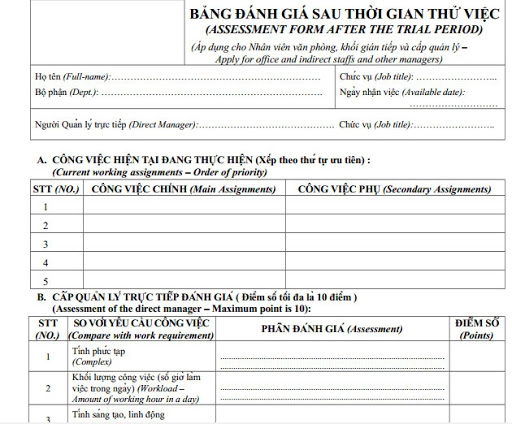
1. Year-end evaluation form for probationary employees
Evaluating probationary employees is a necessary step after the recruitment interview process. The new year-end employee evaluation form should be implemented during the employee’s 2-3 month probationary period.
Information required in the form:
- Goal system
- Tasks
- Employee behavior
- Achievements
- Existing limitations
This is accompanied by identifying the individual’s training needs. Evaluating a new employee’s performance will ensure high accuracy, and from the detailed evaluation sheet, the manager can devise clear plans and strategies. For example:
2. Year-end performance evaluation form for official employees
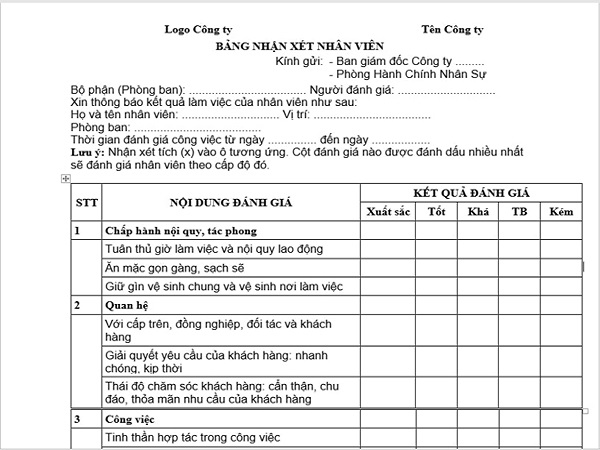
Of course, the team of official employees with long-term service requires a separate evaluation form with the following content:
- Skills
- Qualities, work attitude
- Goal system
- Work completion results
- Employee ranking for managers
Through this evaluation form, managers will have a general assessment of each employee’s work plan performance. From there, they can provide new directions and plans to help employees better develop their work capabilities. For example:
Download employee work efficiency evaluation forms:
3. Employee evaluation form for teams
As mentioned above, members working in a team (especially the sales team) also need to provide feedback for improvement. This allows managers to make more objective assessments.
This form of team evaluation will clarify the professional strengths and weaknesses of each individual. From there, the effectiveness of the entire team’s collective work results can be determined.

4. Year-end KPI-based evaluation form for sales staff
The KPI-based evaluation form for sales staff will be the clearest basis for assessing the performance of the sales team.
This form should clarify revenue, successful deal closing rate, the number of exchanges and returns within a specific period, work attitude, and customer service attitude during consultations…
DOWNLOAD THE YEAR-END KPI-BASED EVALUATION FORM FOR SALES STAFF HERE.
|
Read more: 6+ Most Complete and Detailed KPI Employee Evaluation Forms for All Departments in 2025 |
5. Year-end evaluation form for customer service staff
The information required in this evaluation form includes the requirements for providing proper and timely customer care. Specifically:
- Customer waiting time for calls and messages
- Ability to resolve customer issues
- Conversion rate from calls
- Customer retention rate
DOWNLOAD THE CUSTOMER SERVICE STAFF EVALUATION FORM HERE.
6. Year-end employee evaluation form for the Marketing department
Marketing staff are associated with personal development goals as well as achievements in promoting the company’s products and services. Therefore, the evaluation form should include information such as:
- Traffic to Lead conversion rate
- Lead to Customer conversion rate
- Post engagement and impressions
- Marketing revenue as a percentage of total revenue
- Costs incurred for marketing activities
Additionally, the form should include a section on the personal development goals of each employee and the team as a whole to further develop the company’s marketing activities.
DOWNLOAD THE YEAR-END MARKETING STAFF EVALUATION FORM HERE.
7. Year-end employee evaluation form for HR
For the HR department, there are two areas to evaluate: recruitment and training, and maintaining company culture and activities. The form should include information such as:
- Interviewed candidates / Total CVs ratio
- Hired candidates / Total CVs ratio
- Employee training costs
- Level of care for employees and the company
DOWNLOAD THE HR STAFF EVALUATION FORM HERE.
8. Year-end evaluation form for managers
In addition to year-end employee evaluations, businesses need to implement manager evaluation processes. This form should include all of the following elements:
- Ranking based on specific goals and behaviors
- Manager’s self-assessment
- Feedback from employees
- Feedback from senior leadership
Through manager evaluations, businesses can gain a comprehensive view of the capabilities, work results, and performance of potential key personnel.
9. Year-end employee evaluation form based on the training plan
Implementing an employee training plan, especially for new employees, requires a complete form to ensure the training process is as effective as possible. An employee training plan form should include:
- Specific timeline
- Training objectives
- Learning materials
- Training results
Thus, by applying the year-end employee evaluation templates above, businesses can more easily conduct year-end evaluations for all departments and divisions within their company.
The task of year-end employee evaluation has become much easier today with the support of quality software solutions. One of them is the effective employee evaluation software by 1Office, based on the ASK competency framework. With features that rely on established criteria, it provides the most objective and accurate comments and ratings.
VI. Frequently Asked Questions
For more details, please contact:
- Hotline: 083 483 8888
- 1Office Fanpage: https://www.facebook.com/1officevn
- Youtube Channel: https://www.youtube.com/c/1OfficeNềntảngquảnlýtổngthểDoanhNghiệp