


 10/05/2026
  12699 views
Time is the most valuable resource and can determine the success or failure of a project. How to effectively manage project time and ensure it stays on schedule is always a major challenge for managers. In reality, managing project implementation time is a complex process that needs to be specifically planned and adhered to through a strict procedure. So, what steps does this process include? What methods should be followed to ensure the quality and duration of the project? Let’s find out with 1Office in the following article.
Mục lục
- 1. What is the role of project time management in a business?
- 2. Effective Project Time and Schedule Management Process
- 3. What are the effective methods for project time management?
- 4. Why is time management important in business projects?
- 5. Factors affecting the efficiency of project time management
- 6. Achieve Superior Project Time Management with 1Office Software
- 7. Frequently Asked Questions about Project Time Management (FAQs)
- 8. Conclusion
1. What is the role of project time management in a business?
Project time management plays a key role as a crucial factor in coordinating resources and controlling budgets, helping businesses complete work according to the committed schedule. Maintaining a stable schedule not only ensures economic efficiency but also helps strengthen the trust of customers and partners in the organization.
Project time management is the process of planning, allocating, monitoring, and adjusting the time for project activities, with the goal of ensuring the project is completed on schedule and within the allowed resources.
If project time management is done well, it will help managers predict the time needed to complete tasks in each project phase and ensure that resources are used effectively. Additionally, effective time and schedule management helps the project team optimize the benefits derived from resources, improve work performance, and increase project flexibility.
Conversely, if the project management process is not properly executed at this stage, the project may face many problems such as delays, increased costs, or failure to complete on time. This can seriously affect the project’s outcome, leading to budget overruns, reduced commercial value, and sometimes sacrificing the organization’s profit and reputation.
>> Read the detailed REVIEW: Top 10 Project Management Software for the Most Effective Project Planning and Progress Monitoring
2. Effective Project Time and Schedule Management Process
Step 1. Define Project Activities
First, the manager needs to identify all the tasks required to complete the project using the Work Breakdown Structure (WBS). With WBS, the manager will assign specific content to each activity and determine the project’s milestones. The output of this process is an activity list, the specific content of each activity, and a list of milestones.
Activity List
- Identify specific activities and tasks in the project plan, including activity names, identification codes, and a brief description of the work.
Content of Each Activity
- Provide additional relevant detailed information;
- The content information for each activity needs to be updated regularly.
Project Milestones
- Marks that the project has reached a specific stage;
- Many activities must be completed to reach a milestone;
- A tool for defining objectives and evaluating project performance;
- Avoid setting too many milestones in a single project.
Step 2. Estimate the Time Required for Each Activity
Determine the time required to perform each activity and the sequential time-based relationships between activities. There are 3 types of relationships:
- Mandatory Dependency: This is an inherent relationship in the project, according to which tasks are carried out. It includes constraints and resource limitations, also known as hard logic.
- Discretionary Dependency: Determined by the project management team based on experience and knowledge of project-related fields. It is often used to adjust the relationships between tasks to suit each project, also known as soft logic.
- External Dependency: This is a relationship between a project activity and non-project activities or external factors.
One of the useful tools for arranging and representing the time relationships between activities is the network diagram.
Step 3. Develop the Project Schedule
Create a project schedule by combining the estimated time for each activity. The project schedule helps quantify activities and determine the start and end times for each one. Based on the project schedule, the manager will have a basis to:
- Track and monitor project implementation progress
- Serve as a basis for allocating resources for the project
- Detail tasks when creating the project plan, showing the project plan in detail
- Control and adjust the implementation process of a project.
Step 4. Resource Allocation
Identify the necessary resources for each project activity and allocate them according to the schedule. Project resource allocation helps ensure that resources are utilized effectively and minimizes resource conflicts. Note that while some resources can be used for multiple activities simultaneously, others can only be consumed sequentially and should therefore be assigned to high-priority tasks first.
| Read more: 4 Steps to Effective Project Human Resource Planning to Triple Management Efficiency |
Step 5. Monitor and adjust project progress
Track the progress of project activities to ensure the project is completed on time. If tasks fall behind schedule, it is necessary to adjust the timeline or reallocate resources.
The progress monitoring step is the one that most demands the management skills and practical experience of project managers. In addition, monitoring project progress is also closely related to risk management, which must have been identified in the project scheduling step.
>> See more: A compilation of 10+ effective construction project management skills to double productivity
3. What are the effective methods for project time management?
Project time management often relies on network diagram techniques and visual schedules to determine the sequence of tasks, calculate the critical path, and closely monitor actual progress against the established plan.
Businesses can choose one or a combination of the following methods depending on the project’s scale and nature:
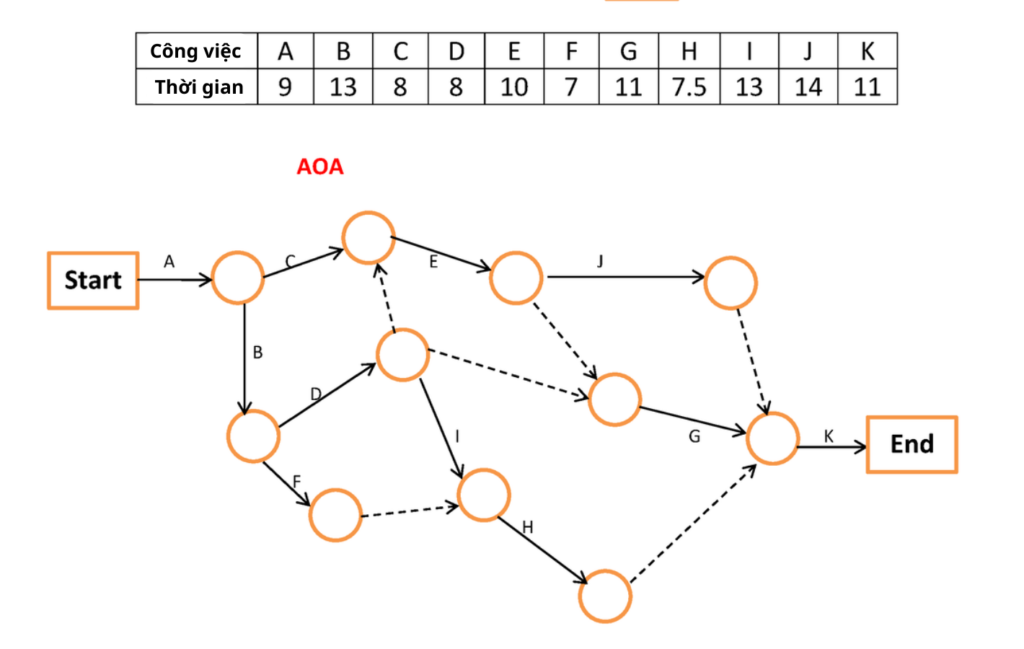
AOA Method
The AOA (Activity on Arrow) method is a network technique used in project management to represent and calculate the schedule of project activities. With the AOA method, tasks are represented on the arrows, with the nodes being events that describe the sequence of tasks. In an AOA diagram, the nodes are just transition points, marking the start or end of a task.
Example of an AOA diagram
Advantages:
- The AOA method has a simple and easy-to-understand structure, making it very suitable for small to medium-sized projects.
- The AOA diagram allows for finding the project’s critical path (the path of tasks with the longest duration), helping project managers and staff focus on the project’s key activities.
Limitations:
- It can only calculate the project completion time under ideal conditions, making it difficult to forecast the actual project progress.
- For large-scale projects, the AOA diagram can become very complex and difficult to manage.
| >> Read more: A guide to easily creating an online schedule and the 9+ best time management software today |
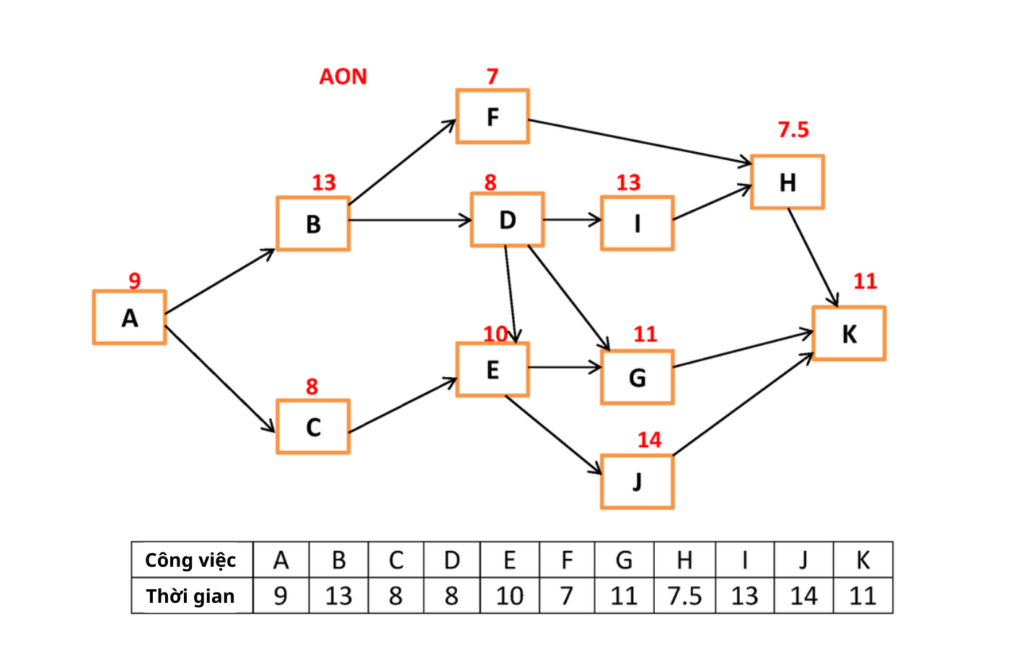
AON Method
The AON (Activity on Node) method is a technique for building a project network diagram where activities are represented by rectangular boxes with necessary information, and arrows purely define the sequence in which the activities are performed.
Example of an AON diagram
Advantages:
- The AON method allows for handling concurrent activities and delays between activities, helping project managers create more accurate plans.
- AON does not use the concept of events, which helps users stay focused directly on the project’s tasks without distraction.
Limitations:
- Complex and difficult to implement for large-scale projects with many tasks.
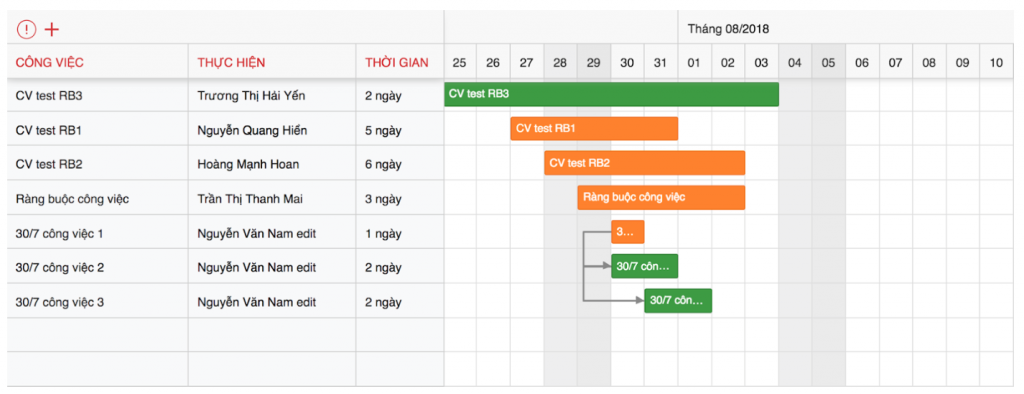
Project Schedule Management with GANTT Charts
Gantt chart is a project time management technique that displays project schedule information by listing tasks in sequence and showing their relationships, along with start and end time data (planned vs. actual) in a schedule format.
Example of a GANTT chart
Advantages:
- Useful for planning, scheduling, and allocating resources;
- Visually and detailedly track and evaluate progress.
Limitations:
- For complex projects, the representation can become difficult and cluttered;
- Does not clearly show relationships or dependencies between tasks.
4. Why is time management important in business projects?
Time management is the key to a project’s success. When a business effectively controls the schedule, costs, and resources, the project is not only completed on time but also ensures maximum quality and efficiency. Conversely, a lack of a clear time plan can cause the entire process to stagnate, become costly, and damage credibility with clients.
4.1. Time management helps ensure project schedules are met
In any business project, time is a critical factor. A clear time management plan helps team members understand deadlines, avoiding overlaps or delays.
For example, in a software implementation project for a client, if the development team does not follow the timeline, the entire testing and handover process will be backlogged, creating a “domino effect” that slows down the entire project.
4.2. Directly impacts costs and budget
Every day a project is delayed, costs for personnel, equipment, operations, etc., increase. Therefore, good time management means budget optimization.
Conversely, without a specific time plan, a project can easily exceed its projected costs—especially in projects involving subcontractors or third-party dependencies.
4.3. Increases team productivity and efficiency
When time is allocated reasonably, employees know the priority of tasks, avoiding wasted effort on low-value activities.
A transparent timeline also helps managers easily measure productivity, identify bottlenecks, and reassign tasks appropriately.
4.4. Reduces risks and improves project quality
Time management is not just about “meeting deadlines,” but also about controlling progress to make timely adjustments when risks arise. With a clear timeframe, the project team has enough “buffer time” to handle errors, perform quality checks, or accommodate changes in client requirements.
4.5. Affects the company’s reputation and competitiveness
A business that completes projects on time and to quality standards builds trust with clients and partners, thereby enhancing its brand image.
Conversely, schedule delays and missed deadlines can cause a business to lose contracts or be perceived as unprofessional.
5. Factors affecting the efficiency of project time management
5.1. Project Scope and Complexity
The more items and stakeholders involved, the harder it is to control time. Large projects often need to be broken down into smaller phases, each with its own timeline, to ensure overall control is not lost.
5.2. Competency of the Project Manager
A good Project Manager (PM) not only knows how to plan but also has the ability to predict risks, make quick decisions, and allocate time reasonably.
If the PM lacks leadership skills or assigns tasks ineffectively, the entire project can suffer from a “chain reaction” of delays.
5.3. Inter-departmental Coordination Skills
The effectiveness of time management largely depends on the level of collaboration between teams. If departments work in silos without a common communication system, tasks are prone to disruption or duplication.
5.4. Supporting Management Tools and Software
Using project management software like 1Office, Asana, Trello, or Jira helps businesses track progress in real-time and automatically sends alerts when there is a risk of missing deadlines. These tools also help store data, generate reports quickly, and ensure transparency among all parties.
5.5. Work Culture and Discipline of the Project Team
A team that is conscious of deadlines and has a professional work ethic will ensure more stable progress.
If employees frequently procrastinate and fail to update their progress, the project is likely to face bottlenecks or deviate from the plan.
6. Achieve Superior Project Time Management with 1Office Software
1Office’s project management solution is Vietnam’s leading superior solution, helping to resolve difficulties in managing project time and progress, optimizing resources, and ensuring project quality. The 1Office project management solution helps:
-
- Plan and schedule projects visually, quickly, and effectively; display details about time, resources, and project progress;
- Organize project execution better with various charts, presentations, and reports, featuring necessary data (progress and resources) tailored to specific management requirements;
- Adjust project plans and schedules proactively and update them according to the actual project implementation;
- With an intuitive interface, 1Office helps managers quickly identify issues or errors in planning and scheduling.
Register for a Free Feature Demo!
7. Frequently Asked Questions about Project Time Management (FAQs)
How to accurately estimate project time when the work is too complex?
Break down the project into smaller tasks (WBS) and apply an estimation formula based on 3 scenarios: Best-case, Most Likely, and Worst-case to get a realistic average.
What is the Critical Path and why is it important?
The Critical Path is the longest sequence of tasks in a project where a delay in any task will delay the entire project’s end date. Identifying the critical path helps you know which tasks “cannot be delayed” to prioritize and focus the most resources on.
What should be done when a project is at risk of falling behind schedule?
When a risk of delay is detected, you need to implement two tactics:
- Fast Tracking (running tasks that are normally sequential in parallel)
- Crashing (adding more personnel or budget to speed up progress).
Use the 1Office all-in-one management platform – operating on a single system, making it easy to detect “bottlenecks” early for timely adjustments.
Are Gantt charts or network diagrams (AOA/AON) more effective?
It depends on your needs: Gantt charts are better for tracking daily schedules and providing visual reports for leadership. Meanwhile, network diagrams are more powerful for analyzing complex dependencies between tasks.
How to manage time effectively when employees are working on multiple overlapping projects?
You need to use a Resource Allocation table to track the total workload of each individual, allowing you to set priorities and adjust tasks in a timely manner.
8. Conclusion
In the article above, 1Office has provided readers with an overview of effective project time management to ensure work progress, while also introducing a comprehensive project management software that helps optimize resources for businesses. For a consultation and a trial of the market-leading project management software, please contact us using the information below:
- Hotline: 083 483 8888
- 1Office Fanpage: https://www.facebook.com/1officevn
- Youtube Channel: https://www.youtube.com/c/1OfficeNềntảngquảnlýtổngthểDoanhNghiệp
















