13/05/2026
  290 views
The development of science and technology along with the 4.0 revolution has posed great challenges, requiring organizations to transform, step out of the traditional framework, and apply modern management methods to keep up with the world. So what must leaders do to lead a successful digital transformation for their organization? The following article will provide leaders with a comprehensive view of modern management, including the latest management trends, the modern management models being applied, and the skills needed to become a 4.0 leader.
Mục lục
- 1. What is Modern Management? Comparing Modern Management with Traditional Management
- 2. Modern Management Theories
- 3. The 3 Most Prominent Modern Business Management Models Today
- 4. Modern Management Trends 4.0
- 5. 8 Modern Management Skills Leaders Need
- 6. Optimizing the Modern Business Management Model with 1Office Software
1. What is Modern Management? Comparing Modern Management with Traditional Management
The term modern management emerged in the context of a rapidly changing business environment, which made traditional management methods no longer suitable and revealed many limitations. Modern organizational management focuses more on networks and collaboration, emphasizing the dynamic nature of communication and the importance of integrating individual interests with those of the organization.
The main differences between traditional and modern organizations are shown in the following aspects:
- Stability: Traditional organizations are often stable in their business activities and progress, while modernly managed businesses are more dynamic with various business strategies and processes to cope with constant changes.
- Flexibility: The structure of a traditional organization is often fixed, strategies are planned, and management is inflexible. In contrast, the modern business management model constantly improves workflows, updates to new market trends, and requires employees to develop new skills and knowledge to connect with the market and adapt to changes.
- Teamwork: The traditional business flow is highly hierarchical, focusing on individual responsibility and authority allocated from the top down. Meanwhile, the modern management trend is a flat hierarchy, focusing more on a teamwork style and emphasizing collaboration.
- Management Policies: In traditional business, management policies are conservative, often following traditional rules and regulations, focusing on creating a static workflow model to maintain business strategy and employee management systems. Conversely, the modern management model will continuously innovate in management policies and propose dynamic business strategies.
See more: 4 Management Functions You Need to Know When Running a Business
2. Modern Management Theories
2.1. Quantitative Management Theory
This is a theory that uses statistics and mathematical techniques to solve complex problems. This theory helps managers assess the risks, pros, and cons of hypotheses, thereby developing solutions to resolve or improve existing problems within the organization. This approach can help managers make objective decisions based on data and facts, rather than emotional ones.
This modern management theory includes 3 main branches:
- Management Science: Management science focuses on using mathematical and statistical methods to create effective business solutions, helping the organization achieve its set goals. Commonly used tools include Program Evaluation and Review Technique (PERT), Critical Path Method (CPM), and sampling methods. Managers can use these tools in project management, budget planning, and scheduling.
- Operations Management: In business operations management, managers implement quantitative methods to optimize the efficiency of production and business processes. Depending on the situation, managers can restructure or redesign their processes. Some tools used include forecasting, quality control methods, and project planning.
- Management Information Systems: A Management Information System (MIS) is an organization’s database. This system collects and stores real-time data, which is used to generate reports on areas such as finance, progress, human resources, and inventory. Managers will use this to evaluate performance and make improvements or develop solutions as needed.
2.2. Contingency Management Theory
Contingency management theory believes that to manage optimally, one must rely on the specific situation. Leaders who use this theory do not apply a single management style; instead, they identify and use different styles for different situations. Using diverse leadership styles can help managers be more flexible and better adapt to the work environment.
This theory presents the factors that influence organizational structure:
- The size of the organization
- The technology used
- Leadership style
An effective manager needs to have a clear understanding of these factors and how they can affect work performance. For example, a small organization can be more flexible and have less separation between departments, while a large organization can be more complex and fragmented. Managers in smaller organizations may have more control over processes due to their flexibility and can implement changes more easily.
2.3. Systems Management Theory
The systems approach to management states that organizations represent a complex set of different components that coordinate to achieve a common goal. An organization is made up of many subsystems, such as different departments.
Managers using this theory consider how these subsystems interact and influence each other, rather than analyzing them separately. Modern management theory, following the business management system approach, divides the organizational structure into different components, including:
- Inputs: Inputs represent the necessary factors to create goods and services. For example, inputs can include raw materials, capital, or information data.
- Transformation Process: The transformation processes represent the activities that convert the organization’s inputs into outputs. For example, these processes can include employee work tasks or operational activities.
- Outputs: Outputs represent the results produced by an organization. These outputs can include products, services, and financial results, such as profits.
- Feedback: Feedback represents information related to the organization’s results or outputs. Leaders can use this information to influence or make decisions regarding the organization’s inputs.
>> Read now: TOP 10 Best Business Management Software, ERP Solutions in 2022
3. The 3 Most Prominent Modern Business Management Models Today
3.1. McKinsey’s 7S Modern Management Model
The McKinsey 7S Model is a tool that analyzes organizational design by examining 7 key internal factors to determine if they are effectively aligned and allow the organization to achieve its goals.
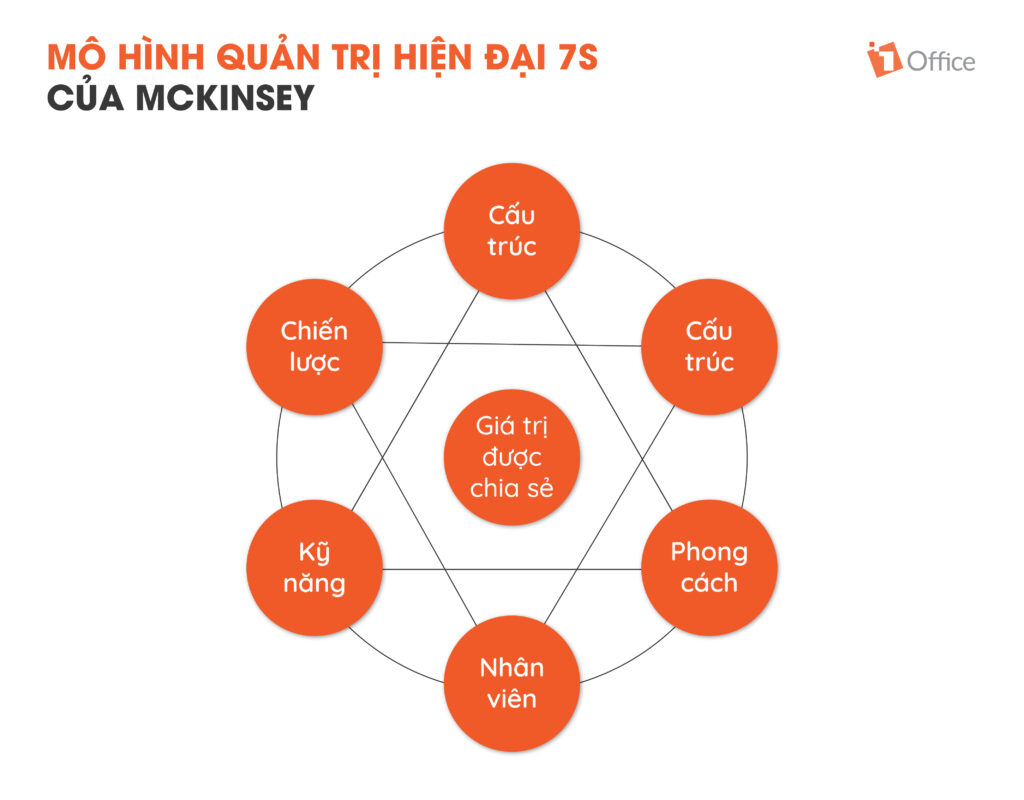
The 7 factors in the 7S model include:
- Structure: The chain of command and accountability relationships that form the organizational chart
- Strategy: The action plan to achieve a sustainable competitive advantage, reinforced by the company’s mission and values
- Systems: The systems include the technical and business infrastructure
- Skills: The capabilities and competencies to achieve set goals
- Style: The way leaders establish a code of conduct through interaction and decision-making.
- Staff: Relates to human resource management tasks such as training, recruitment, and reward systems
- Shared Values: The mission, goals, and values that form the foundation of the organization
3.2. The Holacracy Modern Management Model
The Holacracy modern management model is a self-management system that does not follow a traditional hierarchical organizational structure. With this approach, the hierarchical model is eliminated in favor of a flexible organizational structure where employees have the ability to make important decisions within their own scope of authority.
The Holacracy model replaces the rigidity of a traditional command structure with a system of flexible roles, each with broad authority in their specific area of responsibility. Instead of the traditional pyramid structure, the organization is structured as a series of nested circles, each representing a team with different functions and roles.
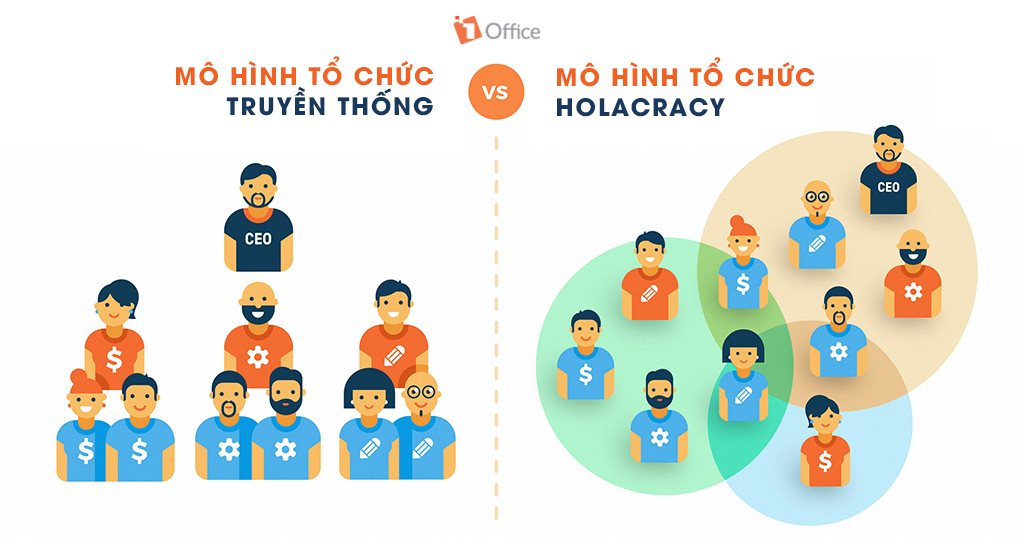
Instead of having fixed job responsibilities, individuals operating within a team can take on multiple roles, each with a specific purpose. Since each individual holds multiple roles, an executive can take on a leadership role in one team and a subordinate role in another. Any conflicts that arise are resolved in regular governance meetings.
3.3. Kotter’s 8-Step Change Management Model
Kotter’s 8-Step Change Model is a popular modern management model that helps manage change within an organization. This model plays a role in motivating all personnel and the organizational culture, thereby promoting improvement and innovation in operational processes and resource allocation methods. An organization’s innovation process goes through 8 steps:
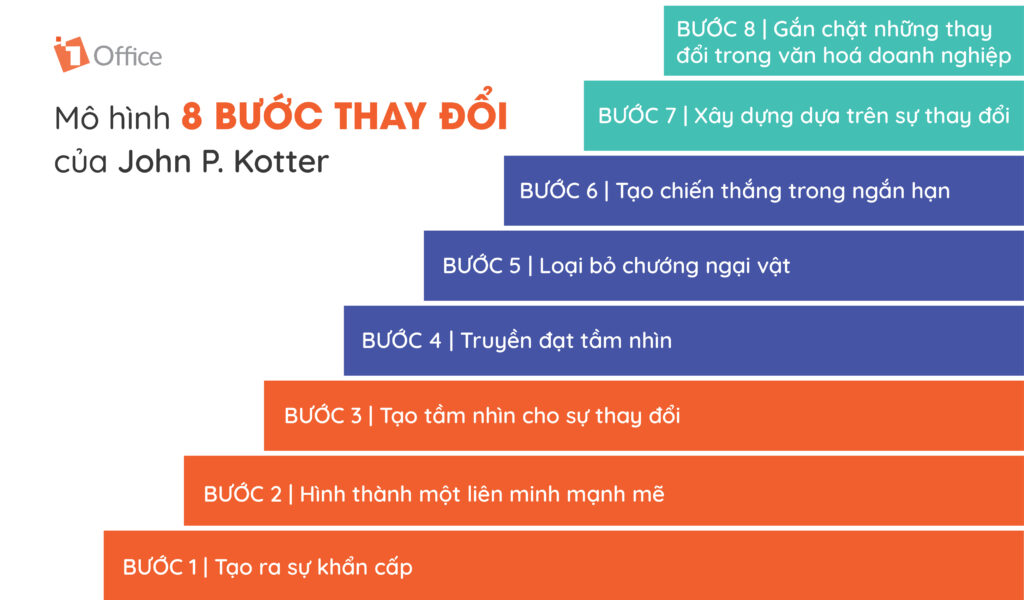
Step 1. Create a Sense of Urgency
The first step is to make the entire organization aware of the necessity and urgency of the change by convincing employees of the importance of taking action. This can be done by talking to them about potential threats or discussing feasible solutions.
Step 2. Build a Guiding Coalition
Form a project team to undertake the changes the organization wants to implement. This team is responsible for encouraging everyone in the organization to cooperate and for outlining the strategic direction for the change. This coalition is made up of individuals from various jobs and positions.
Step 3. Form a Strategic Vision
Develop a clear vision to help everyone understand what the organization is trying to achieve. The vision will make the changes more concrete and create the support needed to help employees reach their goals.
Step 4. Communicate the Vision
Generate support and acceptance among employees by disseminating the new vision and seriously considering their opinions, interests, and concerns. This new vision must be unified and fully implemented throughout the entire organization.
Step 5. Remove Obstacles
Inappropriate processes, employee resistance to change, lax management, organizational rules and structures, etc., are potential obstacles during the change process. At this stage, the guiding coalition and senior management should focus on removing any obstacles that slow the organization’s progress toward its change goals.
Step 6. Create Short-Term Wins
Create short-term goals so that employees have a clear view of what is happening. When goals are achieved, employees will be motivated to adjust and expand the change. Recognizing and rewarding participating employees is a useful measure to promote the change process.
Step 7. Consolidate Improvements
This step aims to sustain the change by ensuring that teams are working hard to achieve the change vision and by monitoring their progress.
Step 8. Anchor the Changes in Corporate Culture
A change will only become an integral part when it has become the core culture of the organization. This includes adjusting the organization’s norms and values, procedures, reward systems, and other components to ensure that everything aligns with the new strategy.
| Read more: What is OGSM? Tips for applying the OGSM model for business planning |
4. Modern Management Trends 4.0
4.1. Multicultural Management
The context of integration and globalization requires more interaction between people from different cultures, beliefs, and backgrounds. Therefore, organizations are gradually diversifying their workforce to become more creative and open to change.
Managing diversity in the workplace has become a critical issue for today’s leadership. An effective manager must manage a diverse workforce with differences in culture, religion, beliefs, and orientations. This requires managers to develop an “open” work environment where everyone can find common ground while retaining their individual uniqueness to foster a united, strong, and creative organization.
4.2. Conflict Management
Conflict refers to opposing or antagonistic interactions between individuals or groups. It exists due to differences in opinions, attitudes, and approaches to the same issue.
The manager’s task is to identify the reasons for the conflict and resolve them through mediation, voting, or careful consideration of different proposals.
4.3. Organizational Restructuring
Organizational restructuring is a popular modern management trend adopted by many businesses today. This trend indicates that the way work is done must be innovated and reformed to improve efficiency and increase profits.
Restructuring involves redefining and redesigning processes to eliminate manual, redundant operations and streamline implementation steps to optimize time and resources.
4.4. Employee Empowerment
Employee empowerment means allowing subordinates to participate in the decision-making process. Senior managers and their subordinates will discuss and exchange ideas to find the best solutions. This helps increase the value of employees and enhances their engagement with the organization by highlighting their roles.
>> Read more: Digital Transformation Roadmap – Understand the Digital Transformation Process for SMEs
5. 8 Modern Management Skills Leaders Need
In the digital technology era, what modern management skills do managers need to equip themselves with to lead their organizations to success? The shift from traditional management methods to modern corporate governance models has changed the role of a leader from concentrating power to empowering others. In addition, good managers in the 4.0 era are those who can adapt quickly to the environment and always have innovative, breakthrough ideas.
To become a 4.0 leader, equipping yourself with the following modern management competencies is essential:
Consulting Skills
In a modern organization that promotes empowerment, a leader is no longer a commander but acts as a consultant to guide members on what they need to do. Consulting skills not only support individuals in making their own decisions but also help leaders solve organizational problems effectively. To practice this modern management skill, a leader needs to:
- Know how to approach and face problems
- Be able to show empathy for others
- Have the skill to help others find their own solutions
- Follow up on action plans
Motivational Skills
A “living” organization is a place where people constantly learn and develop to move the organization forward. Creating conditions and motivation to encourage members to develop themselves is a core skill of modern management. Some factors a leader needs to equip themselves with to have the ability to motivate/inspire others include:
- Understand employees’ strengths and assign them suitable tasks to leverage their abilities
- Build a career path and provide clear development orientation for employees
- Use rewards to motivate employees
Thinking Skills
Modern human resource management thinking skills are the key to leading a successful organizational innovation. To achieve this skill, a manager needs to:
- Know how to control their own thoughts
- Have a good memory, good concentration, and a good imagination
- Be able to come up with creative, breakthrough ideas
To learn more about this skill, read the article now:
4 Thinking Skills of a Manager – Qualities that Make an Excellent Leader
6. Optimizing the Modern Business Management Model with 1Office Software
Applying technology is an essential solution in modern management to optimize an organization’s operational processes. To do this, leaders need to consider choosing suitable business management software that meets the organization’s needs.
As a pioneering management solution in digital transformation, 1Office aims to build a platform with a full range of useful yet simple and accessible features for Vietnamese businesses. 1Office can effectively solve all problems in modern management with a powerful toolkit of 4 modules: HRM (Human Resource Management), CRM (Customer Relationship Management), WORKPLACE (Work Management), and ADVANCE (Advanced toolkit, automation).
It can be said that 1Office is a modern management software that provides the most in-depth toolkit for managers to confidently manage their businesses effectively, helping to save time and minimize operational costs.
Through the article above, 1Office has brought readers the most comprehensive perspective on modern management and introduced the most superior management software to help leaders effectively implement modern management models. For a free consultation and a trial experience of the leading business management software today, please contact us using the information below:
- Hotline: 083 483 8888
- Fanpage: https://www.facebook.com/1officevn/
- Youtube: https://www.youtube.com/channel/UCeTIRNqxaTwk0_kcTw6SxmA