


 12/05/2026
  190 views
Employee salary management is one of the top priorities in any business. It is also a complex task that requires meticulousness and absolute accuracy to ensure employee benefits and the company’s reputation. How to build a scientific, systematic salary management system that ensures fairness and transparency is a concern for many HR managers and business owners. Join 1Office to learn how to optimize the employee salary management process in the following article.
See more related articles:
Mục lục
- 1. The importance of employee salary management
- 2. Common employee salary management methods
- 3. 6 steps to standardize the employee payroll management system implementation process
- 4. Solutions to Optimize the Employee Payroll Management Process in a Business
- 5. 1Office – The market-leading employee salary management software
1. The importance of employee salary management
Employee salary management is a crucial part of human resource management in every business. Salary management operations include a series of activities revolving around employee salaries, bonuses, and compensation, such as: developing policies, calculating salary based on coefficients, and salary regulations; building salary scales and grades; calculating employee salaries; finalizing taxes and various types of insurance; managing personnel information, and more.
Employee salary management plays an important role in building the workforce of every business, contributing to many significant benefits for the business, such as:
- Attracting and retaining talent
- Ensuring fair and equal compensation policies for all employees
- Boosting productivity and improving labor quality
- Building and maintaining a strong relationship between the business and its employees
- Stabilizing the workforce, creating a solid foundation for the business to grow and thrive
In particular, salary management has a significant impact on the business’s productivity as it determines the level of contribution, attitude, and morale of employees.
If employees feel that the salary they receive is not commensurate with their abilities and qualifications, they will tend to reduce their work performance, show dissatisfaction, be uncooperative, or even leave the organization to seek better opportunities.
Therefore, if the employee salary management process is not carried out systematically and rigorously, it could very well become a barrier to business and production activities.
2. Common employee salary management methods
Manual salary management using spreadsheets
This is the most commonly used salary management method in businesses, with the main tool being Excel spreadsheets. With this method, HR professionals will update information such as salary coefficients, allowances, timekeeping, etc., and build the payroll by performing manual operations on the spreadsheet.
This salary management method helps save significant costs while ensuring information security for the business by using internal human resources. However, this method also carries many potential risks as errors can easily occur during the process of compiling salary data. It also consumes a lot of time and effort from the HR and accounting departments due to handling a large volume of data, paperwork, preparing tax and social insurance reports, and ensuring timely payments.
Outsourcing
For businesses with limited resources or those that want to focus on their core business operations, outsourcing employee salary management services is a reasonable solution. Companies that provide payroll and salary management services handle all stages of employee salary management, such as creating payrolls, registering for health insurance, declaring and finalizing personal income tax for employees, etc., while also advising the business on regulations, salary policies, taxes, and labor contracts.
However, many businesses are still hesitant to adopt this method due to barriers related to cost and security.
Salary management software
With the current trend of technological development, more and more businesses are adopting software-based employee salary management systems to improve implementation efficiency. Employee payroll software is a superior solution that balances the benefits and drawbacks of the two aforementioned salary management methods.
Salary management software helps save time and reduces the administrative burden for the HR department by automating manual tasks. The software allows businesses to accurately calculate gross salary, deductions, and net salary, while also enabling businesses to proactively control the entire employee salary management process and data. Furthermore, this is also a long-term beneficial investment for the business as it only requires an initial cost for system installation and implementation.
3. 6 steps to standardize the employee payroll management system implementation process
1. Establish a salary policy
A salary policy is a document that stipulates the mechanism and method of paying salaries, developed and issued internally by the business based on legal regulations. The salary policy clearly and transparently defines issues related to employee salaries such as bonus levels, allowances, and equivalent payments, thereby serving as the basis for calculating monthly salaries for employees.
To build a well-structured and compliant salary policy, businesses must constantly monitor and update new labor law regulations, while also basing any amendments and improvements on their operational situation.
2. Develop a salary scale
A salary scale is a system of salary groups, grades, and tiers developed to serve as the basis for paying employees. It is the foundation for businesses to calculate monthly salaries, alongside factors such as job position, job specifics, competency, and employee performance.
Developing a salary scale is a mandatory task to provide a legal basis for paying employees and to ensure transparency and fairness in salary management. At the same time, the salary scale also serves as a reference for employees to know their actual income level and motivates them to strive for their desired salary within the scale.
Businesses should note that when developing a salary scale, it is necessary to clearly understand the legal regulations on regional minimum wages, as well as consult with the trade union and the company’s HR team.
3. Timekeeping Management
Timekeeping management is the process of tracking and recording employees’ actual working hours to serve as a basis for calculating salaries. Currently, there are many diverse forms of employee timekeeping and timekeeping management to serve the various needs and job characteristics of businesses, such as:
- Timekeeping with paper cards or magnetic cards
- Fingerprint scanning timekeeping
- Timekeeping with FaceID (facial recognition)
- Timekeeping with GPS tracking
In addition to monitoring daily employee timekeeping, HR also needs to closely manage requests arising during the month, such as leave requests, unpaid leave, and timekeeping adjustment requests, to ensure employee benefits and accurate salary calculations.
4. Salary Calculation
To calculate employee salaries, HR needs to collect complete data that constitutes the employee’s salary, including: actual workdays, salary coefficients, KPI targets, etc.
Each business will have a different method of calculating salaries depending on the characteristics of its salary system and the nature of the job positions. However, all businesses must ensure compliance with the following requirements:
- Ensure calculations are correct, complete, and accurate
- Calculate salaries promptly and on schedule
>> Learn more: 7 steps to implement a payroll process in your business
5. Salary Payment
After the payslip is generated and confirmed by relevant parties, HR will proceed with paying salaries to employees according to the specified deadline. There are currently many forms of salary payment that help businesses optimize this process, such as
- Paying salaries in cash directly to employees
- Creating a payment voucher and giving it to a representative to receive; this method is suitable for businesses and companies that operate in teams or on projects
- Transferring employee salaries via bank accounts
- Authorizing salary payments through a bank’s payroll service

6. Tax Finalization and Insurance Contributions
Finalizing Personal Income Tax (PIT) and making insurance contributions for employees are mandatory obligations for all organizations and businesses. Therefore, this process must be carried out seriously and ensure compliance with legal deadlines.
4. Solutions to Optimize the Employee Payroll Management Process in a Business
Regularly Update Salary Regulations
Labor law policies and regulations regarding salaries are constantly changing and improving over time. Therefore, businesses need to continuously update and stay informed to make appropriate adjustments, ensuring compliance with current legal standards and protecting employee rights.
Build a clear and transparent salary policy
Ensuring fairness and transparency in salary management is a top priority as it helps build trust among employees and safeguards the company’s reputation. Regulations, policies, mechanisms, and salary structures must be publicly disclosed within the company in clear, accessible language so that all employees can understand their benefits.
Receive employee feedback and suggestions
Employees are the core of the organization and the main focus of salary administration. Therefore, managers should proactively gather feedback and contributions from employees to identify shortcomings in salary management and implement timely improvements and revisions. Listening to employee opinions also helps the company minimize risks related to internal conflicts.
Automate the salary management system
To standardize the employee salary management system and optimize benefits for both the company and employees, implementing a tool to automate the payroll process is essential.
Salary management software helps digitize the entire employee salary management process on a single platform, automating data consolidation, salary calculation, and request approvals for HR. This contributes to saving up to 60% of the HR department’s working time while ensuring accuracy.
5. 1Office – The market-leading employee salary management software
1Office is one of the most superior HR salary management software on the market today. 1Office provides a set of in-depth tools to help businesses resolve all challenges in the employee salary management process, such as:
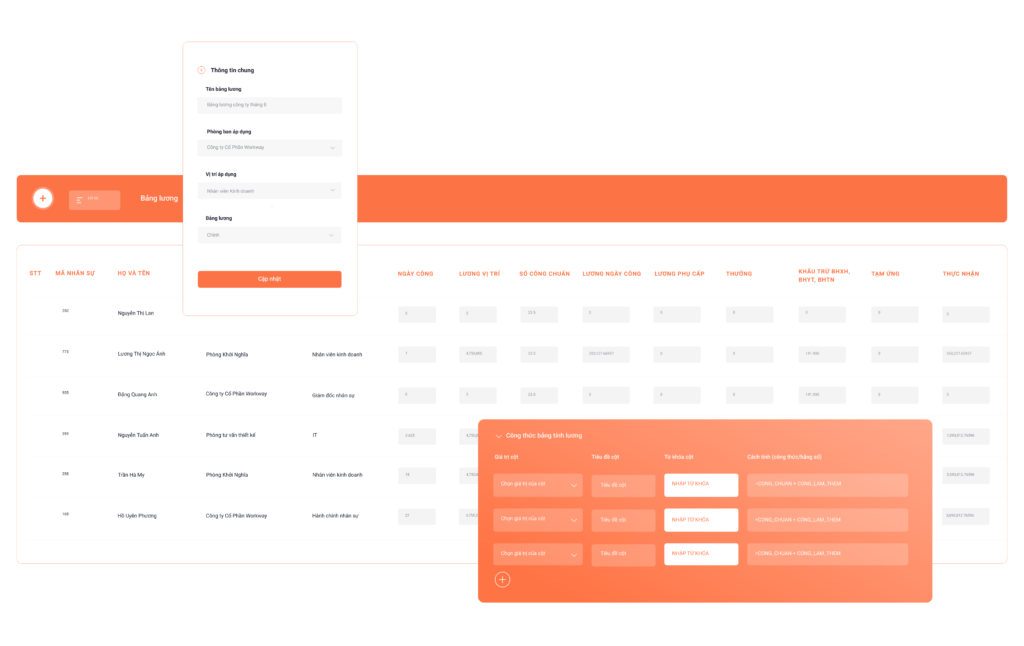
- Build customizable payrolls based on the company’s salary structure, allowing for the setup of multiple salary mechanisms suitable for each department
- Synchronize data for salary management, such as KPIs, sales figures, timekeeping, etc.
- Automatically calculate payroll and sync it with employee profile data
- Employees can proactively track their payslips on the software, ensuring transparent information
- Supports direct salary disbursement on the software 24/7 via MBbank
- A flexible salary management system that can adapt to continuous changes in the company’s salary and bonus policies
Get a free consultation and trial
1Office is proud to accompany over 500,000 businesses on their journey to create digital work experiences for employees and enhance labor quality. The capabilities of 1Office’s market-leading HR salary management solution have been proven through the following figures:
- 29,123 – Total Payrolls
- 55,827,817 – Total Fingerprint Scans
- 4,227,836 – Total Leave Requests
- 254,611 – Total Employee Profiles
Get a free consultation & demo
In this article, 1Office has provided readers with the most effective solutions to optimize the employee salary management process and introduced the most superior salary management software on the market, helping to double HR productivity. For a free consultation and to experience a trial of the leading HR management software today, please contact us at:
- Hotline: 083 483 8888
- Fanpage: https://www.facebook.com/1officevn/
- Youtube: https://www.youtube.com/channel/UCeTIRNqxaTwk0_kcTw6SxmA
















