


 10/05/2026
  19528 views
The popular forms of salary payment today include product-based, revenue-based, competency-based, commission-based, piece-rate, and 3P salaries. So, what are the characteristics of each payment method? What are their pros and cons? Let’s find out with 1Office in the article below. Read on!
Mục lục
- I. Comparison Table of Pros and Cons of Salary Payment Methods
- II. How many forms of salary payment are there in a business?
- III. How Do Salary Payment Methods Affect a Business?
- IV. How to Choose the Right Salary Payment Method for Your Business
- V. Comparing Salary Trends in Vietnamese and International Businesses
- VI. How to Calculate and Pay Salaries Automatically, Quickly, and Accurately with 1Office Software
- VII. Frequently Asked Questions About Payment Methods
- VIII. Conclusion
I. Comparison Table of Pros and Cons of Salary Payment Methods

| Salary Payment Method | Advantages | Disadvantages | Recommended Business Types |
| Piece-rate pay | – Strengthens the relationship between the job and the employee.
– Enhances the employee’s sense of responsibility. – Increases accuracy and fairness in piece-rate pay. – Improves business production capacity. |
– Difficult to calculate salary.
– Can lead to employees focusing on quantity over quality. |
Applicable to companies in manufacturing, sales, marketing, and services. |
| Time-based pay | – Easy to understand, calculate, and implement.
– Employees can be creative and accumulate experience to improve work efficiency. |
– The salary paid may not correspond to the value they create. | Suitable for hourly jobs, such as factory workers, office staff, and receptionists. |
| Revenue-based pay | – Aligns employee interests with company interests.
– High level of proactivity in work. – Ensures fairness. |
– Internal conflicts among employees when some have excessively high salaries. | Suitable for companies in sales, marketing, services, and real estate. |
| Contract-based pay | – Easy to calculate salary based on the agreement between both parties.
– Ensures work is completed according to requirements. – Employees have a high sense of responsibility. |
– The employer may need to advance a sum of money to the employee if the work duration is too long.
– Only suitable for jobs that need to be performed comprehensively and uniformly. |
Suitable for technology companies, startups, and financial companies. |
| Competency-based pay | – Ensures fairness for employees.
– Creates motivation for employees to develop. – Builds a positive work environment. – Helps understand employee capabilities. |
– Difficulty in evaluating and determining employee competency.
– Performance evaluators can be biased, causing conflict. – Does not create much motivation for less competent employees. |
Applicable to all types of businesses, focusing on evaluating and recognizing the competencies, skills, and knowledge of employees. |
| 3P Salary | – Comprehensive salary assessment, ensuring fairness.
– Motivates employee development and effort. – Ensures salaries are competitive with the market rate. – Promotes business growth. |
– Employees may leave if their salary is lower than the market rate.
– Can easily fall behind market innovations. |
All types of businesses |
| Commission-based pay | – Creates a positive work environment for employees.
– Encourages employees to work proactively. |
– Can easily cause conflict among employees. | Suitable for companies in retail, real estate, and multi-level marketing. |
>> See more: Standardize the payroll process in your business with 7 simple steps
II. How many forms of salary payment are there in a business?
Currently, there are 7 forms of salary payment in businesses, including:

1. Piece-rate pay
Piece-rate pay is a form of payment based on the quantity and quality of products an employee produces. The employer sets a production quota for the employee within a specific period, with a corresponding wage for each product.
– Basis for determination: According to Point b, Clause 1, Article 54 of Decree 145/2020/ND-CP
– Applicable subjects: For jobs that require producing a large volume of goods within a specific time.
– Salary formula:
Salary = Number of products * Unit price per product
– Payment time: Paid periodically.
– Types of piece-rate pay:
- Direct piece-rate pay for an individual’s completed work
- Group piece-rate pay for a team of workers
- Indirect piece-rate pay for workers who indirectly participate in production alongside direct production workers
- Piece-rate pay combined with a bonus system for production achievements, such as fast work pace or product quality.
Example 1: Employee P sold 10 products in January. The pay for each product is 1,000,000 VND. Employee P’s salary for January will be 10 x 1,000,000 VND = 10,000,000 VND.
Example 2: A production team (with 5 members) at company A produced a total of 1000 products in August. The pay for each product for the entire team is 50,000 VND. The team’s salary for August will be: 1000 x 50,000 VND = 50,000,000 VND.
2. Time-based pay
Time-based pay is a form of payment based on the actual time worked or the calculated time. The calculated time can be the working time as prescribed by law or the working time agreed upon by both parties.

– Basis for determination: According to Point a, Clause 1, Article 54 of Decree 145/2020/ND-CP.
– Applicable subjects: For jobs of a fixed nature, jobs that require employees to accumulate extensive experience and invest in improving work quality.
– Payment time: At periodic intervals as agreed upon by both parties.
– Types of time-based pay:
- Hourly wage
- Daily wage
- Weekly wage
- Monthly salary
Example 1: Employee C worked 160 hours in May, with a contractual wage of 100,000 VND per hour. Employee C’s salary for May will be: 160 hours x 100,000 VND = 16,000,000 VND.
Example 2: Employee A is hired by company B to work for a day with a contractual wage of 350,000 VND/day. In May, Employee A worked for 10 days. Employee A’s salary for May is 10 X 350,000 VND = 3,500,000 VND.
>> See more: The most accurate time-based salary calculation formulas for HR
3. Revenue-based salary
Revenue-based salary is a payment method where an employee’s income directly depends on the revenue they generate.

– Basis for determination: Based on the company’s salary regulations.
– Applicable to: Sales staff, business development staff, and other employees directly involved in increasing the company’s revenue.
– Salary formula:
Salary = Basic Salary + (Revenue x Percentage Rate).
– Payment time: At periodic intervals as agreed upon by both parties.
– Types of revenue-based salary:
- Salary based on individual sales
- Salary based on team sales
- Sales commission bonus.
Example: Salesperson A has a basic salary of 5,000,000 VND and generated 100,000,000 VND in revenue for the month. The revenue-based percentage rate is 5% (as per the contract). Salesperson A’s salary will be: 5,000,000 VND + (100,000,000 VND x 5%) = 10,000,000 VND.
4. Lump-sum salary
Lump-sum salary is a payment method where an employee is paid based on the volume, quality, and time required to complete a specific job.

– Basis for determination: According to Point c, Clause 1, Article 54 of Decree 145/2020/ND-CP.
– Applicable to: Jobs that are completed as a whole, rather than being paid for in individual parts or stages.
– Payment time: After the job is completed, or with an advance payment if the project duration is long.
– Types of lump-sum salary: Not classified.
Example: Company A hires a worker to paint the walls and clean the entire office on March 20th. As long as the person paints the walls and cleans the office thoroughly, they will receive a salary of 5,000,000 VND. This 5,000,000 VND salary is an example of a lump-sum payment.
5. Competency-based salary
Competency-based salary is a payment method where an employee is paid based on their ability and capacity to complete their work.

– Applicable to: Suitable for many positions and industries, especially for jobs that require high expertise and skills.
– Salary formula:
Salary = Competency Value + Basic Salary
– Payment time: At periodic intervals as agreed upon by both parties.
– Types of competency-based salary: Not classified.
Example: Company ABC defines the competency of its marketing staff with 3 salary levels: 7,000,000 VND (knows fundamental SEO, no experience), 10,000,000 VND (knows fundamental SEO, writes SEO-standard articles, gets articles ranked in the top 1-50, can design simple banner images from templates), and 15,000,000 VND (knows fundamental SEO, writes SEO-standard articles, handles technical SEO requirements, monitors and evaluates SEO performance, manages a team to develop the website). Based on the employer’s assessment, employee X’s competency is valued at the 10,000,000 VND salary level.
>> See more: How to Calculate 13th-Month Salary: Detailed Formulas and Calculation Methods
6. 3P Salary Payment Method
3P Salary is a method of paying employees based on three factors:
- Position – Pay based on rank and job title. For example: director, manager, direct production staff.
- Person – Pay based on individual competency. For example: competency at a bachelor’s or master’s level, or meeting the company’s specific competency frameworks.
- Performance – Pay based on efficiency and job completion results.

– Applicable subjects: Suitable for all positions and jobs within the company.
– Salary calculation formula: Depends on the company’s policies and regulations.
– Payment time: At periodic intervals as agreed upon by both parties.
– 3P Salary classification: Not classified.
Example: Company ABC stipulates salary levels for sales staff based on 3 factors as follows:
- Position: 3,000,000 VND
- Person: 2,000,000 VND
- Performance: 15,000,000 VND
Sales employee A has a master’s degree (Person) and completed their work excellently in June. The June salary for sales employee A will be: 3,000,000 VND + 2,000,000 VND + 15,000,000 VND = 20,000,000 VND.
7. Commission-Based Salary Payment Method
Commission-based salary is a form of payment based on the sales revenue they generate.

– Legal basis: Article 48 of Decree 40/2018/ND-CP.
– Applicable subjects: Often applied to sales staff in fields such as real estate, insurance, retail, etc.
– Salary calculation formula:
Commission = Commission % * Sales Revenue
– Payment time: At periodic intervals as agreed upon by both parties.
– Commission-based salary classification:
- Individual commission-based salary
- Group commission-based salary
Example: Company A has a commission rate of 5% for its sales staff. This past May, employee B sold 1,000 products, corresponding to a revenue of 4 billion VND. Employee B’s salary for May will be: 4,000,000,000 VND x 5% = 200,000,000 VND.
III. How Do Salary Payment Methods Affect a Business?
The salary payment method not only determines an employee’s income but also directly affects labor productivity, operating costs, and employee retention. A suitable salary policy can be a lever for growth, while a mistake can cause the business to lose talented people or lead to internal conflicts.
Impact on labor productivity:
- Salary linked to product/revenue motivates employees to increase work efficiency.
- Conversely, a flat-rate salary based on time can easily demotivate some employees.
Impact on turnover rate and engagement:
- Fair and transparent salary payments help build trust and long-term commitment from personnel.
- A policy that is not competitive with the market causes the business to lose talent to competitors.
Impact on costs and business efficiency:
- Reasonable salary and bonuses help optimize the salary fund, avoiding the situation of “high spending, low efficiency.”
- Businesses with good salary policies often find it easier to control costs and increase profits steadily.
For example: Technology companies often apply performance-based salaries and project-based bonuses to retain high-quality personnel, while traditional manufacturing industries prioritize product-based wages to encourage productivity.
IV. How to Choose the Right Salary Payment Method for Your Business
1. Why It’s Important to Choose the Right Salary Payment Method
Each salary payment method has its own pros and cons and is only suitable for certain types of businesses.
If the wrong choice is made, the business may face several consequences, such as:
-
Employees lose motivation and feel they are not being recognized fairly.
-
Personnel costs increase, but efficiency does not correspond.
-
Difficulty in controlling productivity because work results are not linked to income.
Conversely, if the right salary payment method is chosen, the business will:
-
Create strong motivation for employees to strive towards goals.
-
Optimize personnel costs, ensuring ‘pay right, pay enough, pay fairly’.
-
Align HR strategy with business strategy, helping the organization achieve sustainable development.
2. Criteria for Choosing a Salary Payment Method
When determining the salary payment method, businesses should rely on the following key criteria:
a. Type of Business
-
Manufacturing businesses: Work is highly quantitative and easily measured by product → should choose product-based or piece-rate pay.
-
Commercial and service businesses: Difficult to quantify by product, so it should be based on revenue, KPIs, or working hours.
-
Technology and creative businesses: Focus on efficiency, competency, and individual initiatives, suitable for the 3P model or performance-based pay.
b. Personnel Scale
-
Small businesses and startups: The salary and bonus system should be simple, flexible, and easy to adjust.
-
Medium and large enterprises: Require a standardized, fair mechanism with a competency assessment system → should apply 3P salary or performance-based pay + KPIs.
c. Corporate Culture
-
If the business promotes internal competition and individual achievement → it should apply salary based on revenue, commission, or performance.
-
If the business aims for stability and long-term commitment → it should choose time-based salary combined with periodic performance bonuses.
3. Suggestions for Choosing a Salary Payment Method by Business Model
| Business Type | Work Characteristics | Suitable Payroll Method | Explanation & Specific Examples |
|---|---|---|---|
| Startup | Flexible model, results-oriented, limited resources | Based on performance + revenue | Helps encourage employees to develop skills and share in business results. Example: A sales employee receives a base salary based on performance, plus a % commission on revenue. |
| Manufacturing Business | Highly quantitative work, easy to measure productivity | Piece-rate or contract-based | The more you produce, the higher the income. Helps increase productivity and reduce labor waste. |
| Service Business | Closely tied to service time and work quality | Time-based + KPI | Ensures fairness, measures work efficiency, and maintains service quality. |
| Technology, Creative Business | Need to attract talent and encourage creativity | Performance-based or 3P model | Links salary to performance and work results. Ensures transparency and retains top talent. |
| Commercial / Sales Business | Revenue is the focus | Based on revenue + commission | The better the sales, the higher the salary. Gives the sales team clear motivation. |
V. Comparing Salary Trends in Vietnamese and International Businesses
Salary policies reflect not only industry specifics but also the economic context and work culture. When comparing Vietnam with developed countries, clear differences can be seen.
Vietnamese Businesses:
- Time-based and product-based pay are common, suitable for the nature of production and general labor.
- Some large corporations (FPT, Viettel, Vingroup) have begun applying the 3P salary model (Position – Person – Performance) to approach international standards.
- Limitation: Many small and medium-sized enterprises still manage payroll manually, which lacks transparency and is prone to errors.
International Businesses:
- Prioritize pay based on competency and performance, linked to KPIs/OKRs.
- Total Rewards trend: combining base salary + bonuses + benefits (insurance, ESOP shares, flexible work arrangements).
- Strong utilization of HRM, BI, and AI software for more personalized and fair salary calculations.
Lessons for Vietnamese Businesses:
- Need to gradually shift from traditional calculation methods to the 3P or KPI-based model, especially for businesses that are scaling up.
- Invest in HRM/ERP software to ensure transparency, reduce errors, and increase employee trust.
- Build a clear reward and penalty system, linking productivity with income to retain talented personnel.
Thus, the choice of payment method depends not only on financial capacity but also must be linked to HR strategy, corporate culture, and the international competitive landscape.
VI. How to Calculate and Pay Salaries Automatically, Quickly, and Accurately with 1Office Software
Known as one of the comprehensive business management solutions, the payroll management feature of 1Office software helps businesses calculate and pay salaries accurately and quickly. The software applies to all business payment methods – with 24/7 automatic salary calculation capabilities:
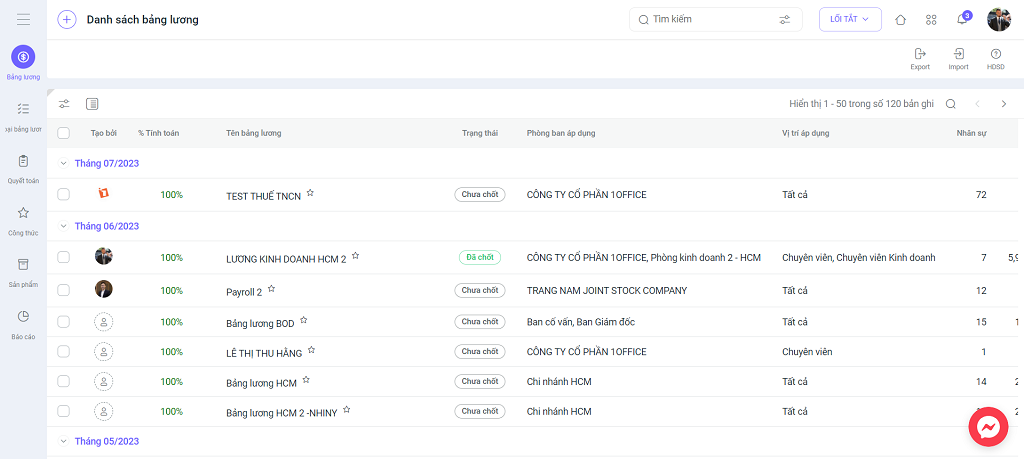
- Set up flexible payroll tables according to business needs.
- Integrate Excel timekeeping formulas into time attendance and payroll calculation.
- Assign access permissions for payroll data as desired, such as view, edit, delete permissions, etc.
- Automatically generate summary payroll reports for specified periods.
- Approve and check payroll online 24/7, anytime, anywhere, with just an internet connection.
- The payroll table is connected to other modules to calculate total earnings, such as KPIs, sales revenue, etc.
- Pay salaries automatically 24/7 via an MB Bank account or export a payment order for another bank account.
VII. Frequently Asked Questions About Payment Methods
Can a business unilaterally change the payment method?
Yes, but the business must notify the employee at least 15 days in advance and must amend or supplement the labor contract or collective labor agreement.
Which payment method is most beneficial for employees?
There is no single “most beneficial” method; it depends on individual strengths: Time-based pay offers stability; Product/revenue-based pay provides breakthrough income for those with high productivity or strong sales skills.
How is 3P salary different from a typical base salary?
A base salary is usually based only on the position, whereas 3P salary adds two important factors: individual competency (Person) and job results (Performance), helping to accurately reflect the employee’s actual value.
When paying piece-rate wages, do businesses have to contribute to social insurance?
Yes. If a piece-rate contract is essentially a labor contract (involving management, supervision, and payment) and has a term of 01 month or more, the business must still contribute to social insurance as required by law.
How can you accurately calculate commission-based salaries for multiple collaborators?
Businesses should use management software like 1Office CRM to automate sales recording and apply discount rates, helping to avoid errors and ensure income transparency for the sales team.
VIII. Conclusion
Above are the 7 most common payment methods today, compiled by 1Office. Depending on the nature of the work and the company’s needs, businesses can choose different payment methods. Additionally, businesses should also integrate automated timekeeping and payroll software to ensure accuracy and convenience for timekeeping operations!
















