


 10/05/2026
  176 views
A reward decision template is a document used to recognize achievements and motivate individuals or teams within a business, agency, or organization. This article provides legally compliant reward decision templates with complete content, available for immediate download and use, helping organizations issue them quickly and in accordance with regulations.
Mục lục
- I. General Introduction to Reward Decision Templates
- II. Legal Regulations Related to Rewards
- III. Basic Structure of a Commendation Decision
- IV. Free Download: Latest Commendation Decision Templates 2026 (Ready to Use)
- V. Guide to Drafting & Issuing Effective Bonus Decisions
- VI. Benefits of Recognition and Rewards
I. General Introduction to Reward Decision Templates
A reward decision template is an administrative document issued by an agency, organization, or business to recognize and honor the outstanding achievements, contributions, or efforts of individuals or teams during their studies, work, and labor. This document not only holds spiritual value but also serves as a legal basis for implementing specific forms of rewards such as cash bonuses, in-kind rewards, titles, certificates of merit, and commendations…
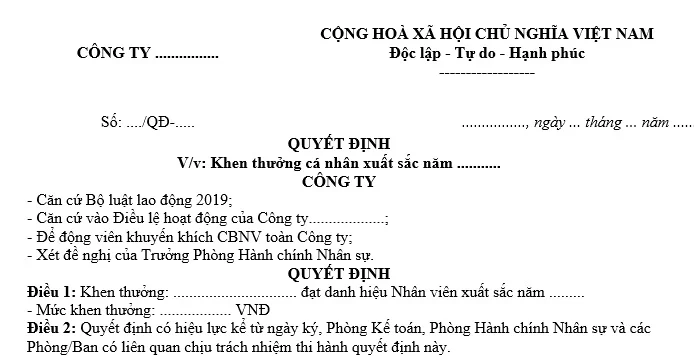
In modern human resource management, a reward decision template plays the following roles:
- Motivating employees and encouraging a spirit of dedication
- Formally and transparently recognizing contributions
- Contributing to building a culture of recognition and fairness within the organization
Rewards must be given to the right person, for the right achievement, at the right time, avoiding formalism, egalitarianism, or delays, as this can diminish their motivational impact and even be counterproductive.
Common forms of rewards today include:
- Certificates of merit, commendations
- Cash bonuses, in-kind rewards
- Emulation titles (e.g., outstanding employee, exemplary team…)
- Ad-hoc rewards, periodic rewards, year-end rewards
Rewarding in a business, agency, or organization not only has a motivational meaning but must also be carried out on a clear legal basis. A valid reward decision needs a solid legal foundation, ensuring transparency, fairness, and avoiding legal risks that may arise during implementation.

1. General Legal Basis
Emulation and reward activities in Vietnam are governed by numerous legal documents, the most important of which include:
- Law on Emulation and Commendation:
This is the foundational legal document that stipulates the principles of rewards, forms of rewards, eligible recipients, and the authority to decide on rewards. The law emphasizes that rewards must be based on actual achievements, given to the correct recipients in HR reports, and be timely and public. - Labor Code 2019:
The Labor Code allows employers to use rewards as a human resource management tool to encourage employees to improve their work efficiency. Rewards can take many forms, such as cash bonuses, in-kind rewards, or titles, as long as they are clearly defined in the company’s internal rules and regulations. - Guiding Decrees and Circulars:
Depending on the specific sector, such as public administration, education, business, or public service units, there are decrees and circulars that provide detailed guidance on organizing emulation and rewards, helping to ensure consistency in application.
Citing the correct and complete legal bases in a reward decision not only gives the document legal validity but also demonstrates professionalism in management.
2. Internal Corporate Reward Regulations
For businesses, the internal reward policy is the most direct and important basis for issuing a reward decision. This policy acts as a “guiding star” for all personnel recognition and motivation activities.
An effective reward policy needs to clearly define:
- Reward criteria: the basis for evaluating achievements, work results, and contribution levels.
- Approval authority: who has the right to propose and who has the right to decide on rewards.
- Form and level of reward: cash bonuses, in-kind rewards, commendations, titles; principles for determining the reward amount.
- Proposal – review – payment process: ensuring transparency, consistency, and complete record-keeping.
In addition, businesses should take special note of the following:
- Bonuses are considered income subject to personal income tax as stipulated by tax laws.
- Bonus payments must be made publicly and transparently, with complete and valid documentation for accounting, auditing, and inspection purposes when necessary.
> See more: LATEST STANDARD NEW EMPLOYEE EVALUATION FORM 2026
III. Basic Structure of a Commendation Decision
A properly drafted commendation decision must have a strict format and clear content, fully reflecting the basis, recipients, and implementation responsibilities.
Typically, a commendation decision will include the following main parts:
- Heading Section
- National emblem and motto, following the standard format for administrative documents.
- Name of the issuing agency or organization.
- Number, Symbol, and Date of Issuance
- Helps determine the effective date and facilitates record management and storage.
- Summary of Content
- Briefly states the purpose of the document, usually:
“Decision on the commendation of…”
- Basis Section
Includes:
- Internal commendation regulations.
- Meeting minutes, commendation proposals from relevant departments.
- Relevant legal regulations (if necessary).
- Decision Section
- Article 1: Clearly state the commended recipients (individual/collective), the achievements, and the specific form and amount of the reward.
- Article 2: Define the responsibilities of relevant departments (Administration – Human Resources, Accounting, etc.).
- Article 3: Effective date and recipients of the decision.
- Signature and Seal
The decision is only legally valid when signed by an authorized person and stamped according to regulations.
IV. Free Download: Latest Commendation Decision Templates 2026 (Ready to Use)
We have prepared detailed Word (.docx) templates with complete clauses and standard administrative document margins. Just download, edit the information, and you can issue them immediately:
1. Individual Commendation Decision Template
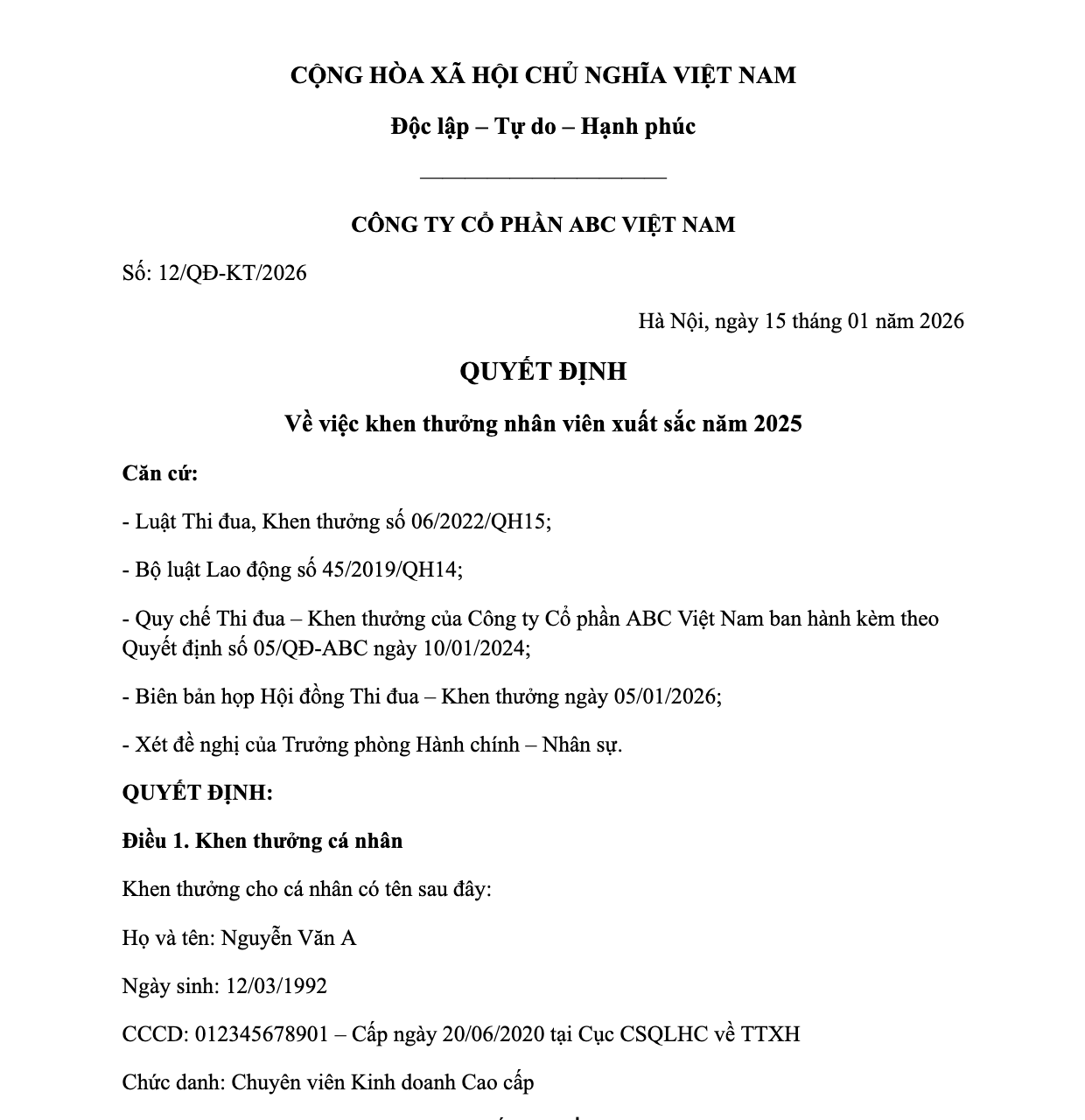
Applicable for:
- Outstanding employee of the month/quarter/year
- Exceptional achievements, improvement initiatives
- Excellent project completion
2. Team / Department Commendation Decision Template
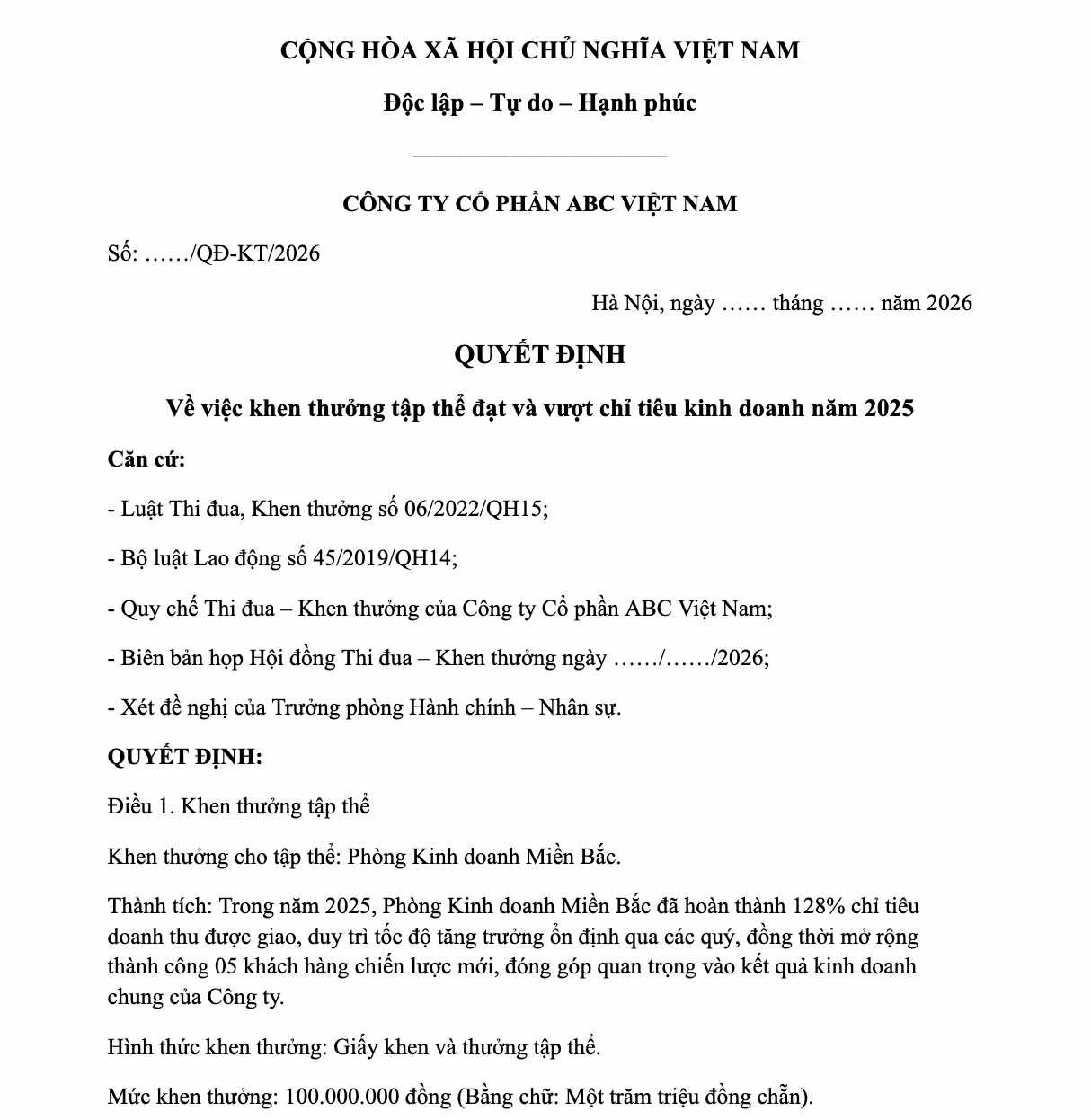
Applicable for:
- Departments exceeding targets
- Successful project teams
- Teams with special contributions
3. Commendation for a department with special contributions
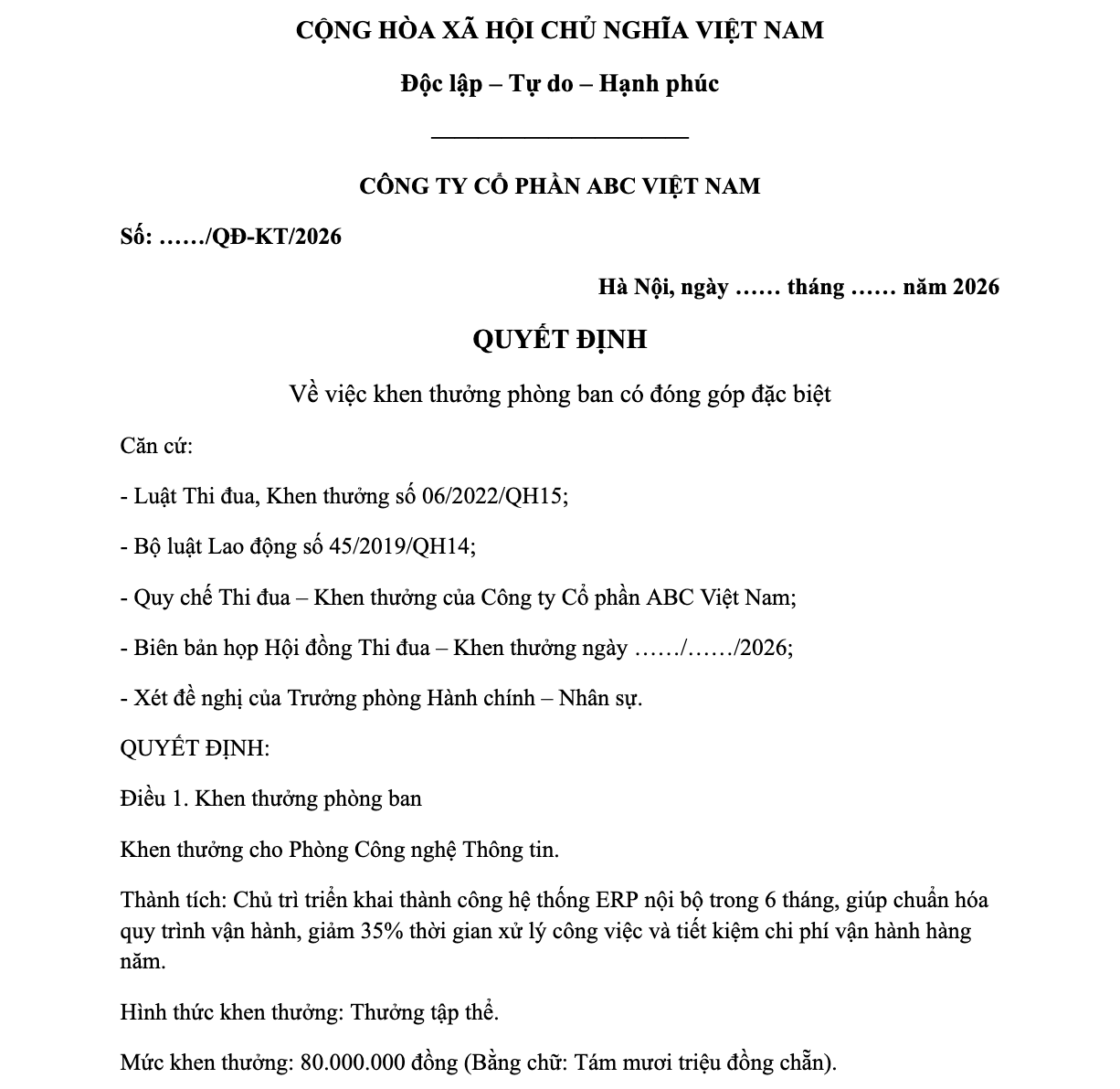
Applicable to:
- Teams that meet & exceed business targets
- Departments with special contributions
- Project teams with outstanding performance
4. Tet / Year-End Bonus Decision Template
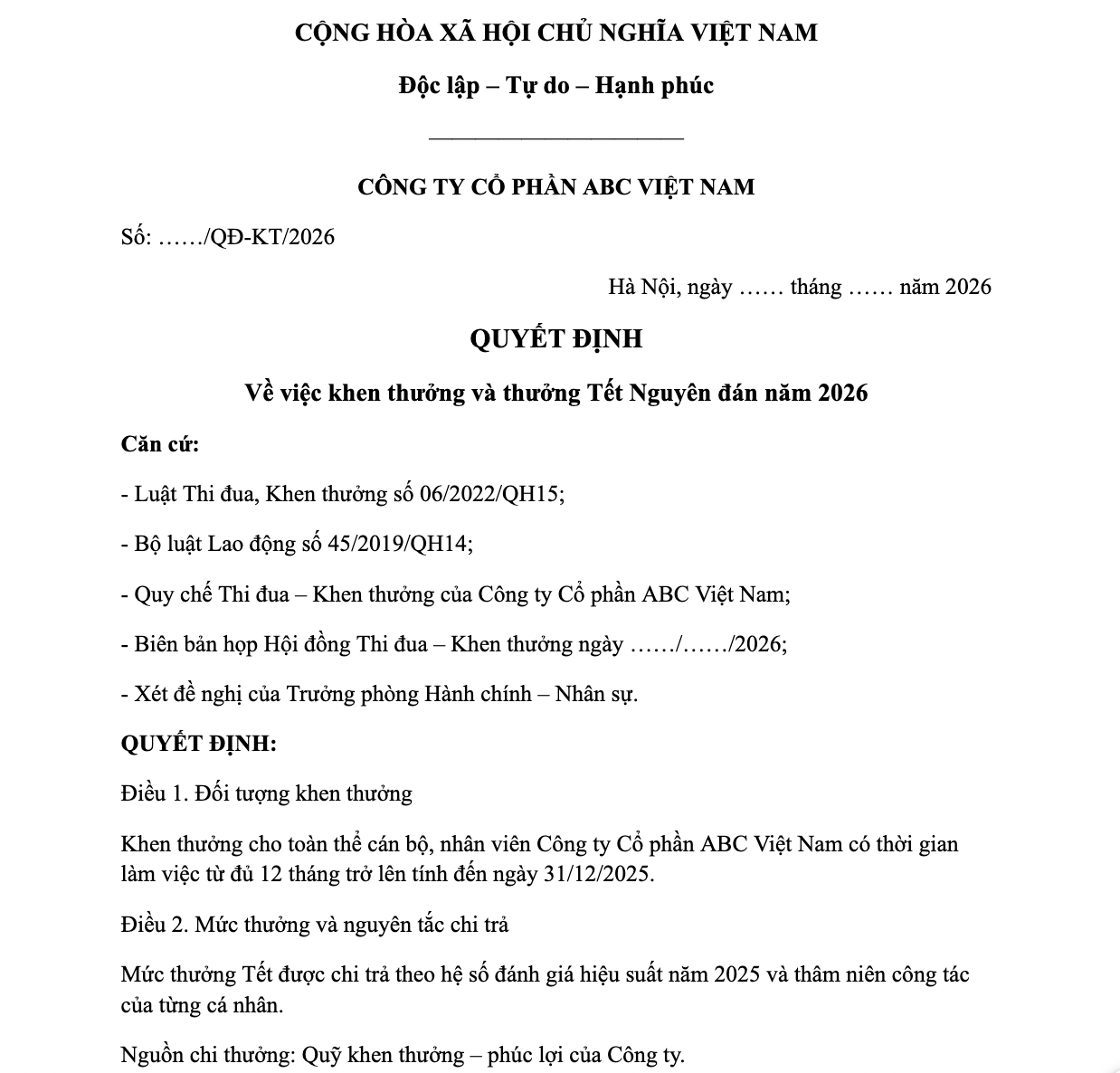
Applicable to:
- Lunar New Year (Tet) bonus
- Year-end performance bonus
- Summarizing and recognizing annual contributions
V. Guide to Drafting & Issuing Effective Bonus Decisions
For bonus activities to be truly motivating and to avoid legal risks, businesses need to build a methodical, transparent, and consistent bonus process. Issuing a bonus decision is not just an administrative procedure; it also reflects the quality of human resource management and corporate culture.
>> See more: EASY-TO-USE EXCEL EMPLOYEE LIST TEMPLATE [LATEST 2026]
1. Identify Subjects and Basis for Bonuses
The first and most important step is to correctly identify the subjects and their achievements. Businesses should base this on:
- Bonus criteria specified in the internal emulation and commendation regulations
- Performance evaluation results, work reports, KPI targets
- The actual contribution level of the individual or team
Clearly defining the basis for bonuses helps ensure fairness and objectivity, avoiding subjective or across-the-board rewards – one of the reasons that reduce motivational effectiveness in an organization.
2. Prepare Proposal Dossiers and Approval Minutes
After identifying the subjects, the responsible department (usually HR & Admin) needs to prepare a complete bonus dossier, including:
- Bonus proposal from the department head or direct manager
- Reports or evidence of the achievements
- Minutes of the Emulation and Commendation Council meeting (if any)
The more complete and clear the dossier, the more legally sound the bonus decision will be, while also creating internal transparency.
3. Draft the Bonus Decision
The bonus decision should be drafted in standard, formal, and precise administrative language, ensuring:
- The information of the rewarded individual/team is completely accurate
- A specific description of the achievement, linked to actual results
- Clearly state the form and amount of the bonus
Careful drafting not only gives the decision legal validity but also shows respect for the recipient.
A bonus decision is only valid when it is:
- Signed by an authorized person (Director, General Director, Principal, Head of Unit, etc.)
- Stamped according to regulations
Businesses must adhere to the approval authority specified in internal regulations to prevent the decision from being considered invalid.
5. Implement the Bonus and Archive the Dossier
After being issued, the bonus decision needs to be:
- Publicly announced through appropriate channels (meetings, internal emails, bulletin boards, etc.)
- Paid out or awarded in kind on time
- Archived completely to serve future inspections, audits, or cross-references
Timely recognition helps increase motivational value, avoiding situations where praise is just “on paper” without creating any real impact.
VI. Benefits of Recognition and Rewards
Recognition and rewards, when implemented correctly, bring long-term value to both the organization and its employees.
1. Benefits for the Business
Timely and fair recognition helps businesses:
- Boost morale and productivity, encouraging employees to strive to exceed goals in the workplace
- Retain talented personnel, reduce turnover rates, and lower recruitment costs
- Build a positive corporate culture where contributions are recognized and respected
- Create a foundation for transparent and professional human resource management
2. Benefits for Recognized Individuals/Teams
For employees and teams, recognition and rewards provide:
- Official acknowledgment for their efforts and achievements
- Motivation for development, fostering a spirit of continuous learning and improvement
- Increased engagement and loyalty to the organization
- A sense of pride and respect in the workplace

Conclusion
Recognition and rewards are not merely about giving money or titles; they are a strategic human resource management tool. When implemented systematically, transparently, and according to proper procedures, recognition becomes a powerful driver that helps businesses achieve sustainable growth and build a long-term, committed workforce.
















