


 12/05/2026
  338 views
For a business to survive and develop sustainably in the market, it must first have a solid foundation demonstrated through optimized and systematic business management processes. How to build an accurate and effective business management process system is a major challenge for many organizations. To help businesses resolve difficulties in standardizing management processes, 1Office introduces to readers the steps to build business management processes along with a set of standard process templates to standardize operations for all businesses.
Mục lục
- 1. Understanding what a business management process is
- 2. The role of business management processes in operations
- 3. Effective business management process
- Step 1. Design – Designing the business management process
- Step 2. Modeling – Modeling the business management process
- Step 3. Execution – Implementing the process
- Step 4. Monitoring – Tracking and evaluating the process’s effectiveness
- Step 5. Optimization – Making adjustments and optimizing the management process
- 4. The Most Accurate Standard Business Management Process Templates for 2022
- 5. 1Office – The Best Automated Business Process Management Solution on the Market
1. Understanding what a business management process is
A business management process is the process of organizing and coordinating activities within a business in a specific order to achieve set business goals.
In a business, many management processes operate in parallel, each undertaking different roles. In terms of functional areas, management processes within a business can be divided into the following groups:
- Human resource management process: includes recruitment management process, training process, performance management process, etc.
- Work & project management process: project resource management process, progress management process, task assignment, etc.
- Production management process: production stage management process, quality management process, etc.
- Business management process: process for operating and developing business activities, customer relations, etc.
- Administrative – accounting process: payroll calculation and payment process, procedure and document approval process, etc.
Regardless of its purpose or function, every management process must meet the most basic standard: it must be aligned with the company’s strategic vision and allow the business to expand and advance in the future.
See also: Review of the TOP 10 Best Business Operations Process Management Software in 2023
2. The role of business management processes in operations
It can be affirmed that a business cannot survive and develop sustainably without a systematic management process system. The business management process is the solid framework that helps the business machinery operate smoothly, rhythmically, and in coordination between departments.
A standardized management process system will create a professional, standard working environment with an optimized operational workflow, thereby bringing great benefits to the business, such as:
- Improving the operational efficiency of the entire organization by clearly defining the responsibilities and tasks for each individual and department, ensuring every employee understands their specific role.
- Minimizing issues that arise during management, helping to avoid unnecessary errors and confusion as the entire process is standardized and operates in an orderly manner.
- Creating a foundation for the business to improve its management activities, leverage internal strengths, enhance competitiveness, and achieve breakthrough growth.
The benefits mentioned above are the goals that every business aims for. Therefore, regardless of the industry, every business needs to focus on building and standardizing its business management processes from the very beginning.
Read more: 6 steps to build a risk management process for businesses
3. Effective business management process
Step 1. Design – Designing the business management process
- Determine the needs, scope, and purpose of the work
First, the business needs to list the grounds for building the management process. The factors that need to be identified before designing the process include the need (what is it for), the scope of application (for which individuals, departments), and the final goal (what result to achieve).
- Standardize the process into descriptions
A standardized process set needs to be “shaped” through visual descriptions in the form of text, images, flowcharts, etc. This is considered a reference framework for all individuals to apply the process in practice and perform work according to the specified guidelines and standards.
A standard description must adhere to the 5W – 1H – 5M formula:
5W:
- Why: Determine the objective, job requirements (the result to be achieved)
- What: Determine the content of the work (including the steps to be taken)
- Where, When, Who: Determine the context for performing the work (location, time, and personnel in charge)
1H: Choose the method to carry out the work
5M: Prepare the necessary resources for the management process
- Man: Personnel with the necessary skills, qualities, and qualifications
- Money: The budget required to operate the process
- Material: The input raw materials and supply system that need to be prepared
- Machine: The machinery and technology standards that need to be met
- Method: The methods and ways to organize management and carry out work effectively
- Classify the groups of participants in the process
One of the most important factors in the business management process is clarifying the authority and responsibilities of the participating parties. Typically, a process will have 3 main groups of participants:
- Executor: The personnel directly responsible for carrying out the assigned tasks.
- Supervisor: Has the role of monitoring and controlling the work execution process, while also providing feedback and comments to improve performance and work quality. This person will be responsible for the work results.
- Supporter: Individuals who do not directly participate in the process execution but will support the executor with suggestions and insights based on practical experience and professional expertise.
- Monitor the business management process
For a management process to ensure operational quality, it must be continuously checked and evaluated to identify outstanding issues for improvement. In this step, the manager needs to:
- Decide on the metrics and tools to measure work performance
- Identify control points and critical control points in the process
- Clarify the stages and steps where checks are needed
- Decide on the frequency of checks and the person responsible for conducting them
- Finalize business management documentation
To complete the process design phase, the business needs to create a system of instructional documents that clearly defines the methods and standards for executing the process. The documentation set must provide all the necessary information and resources to operate the process, presented through documents, forms, and circulated internally within the business.
Step 2. Modeling – Modeling the business management process
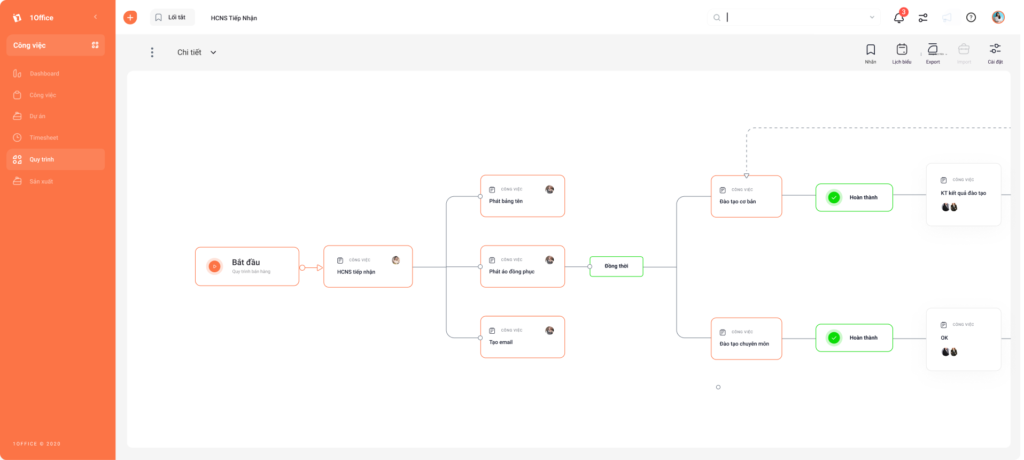
In the next step, all the theories and information prepared in the first phase will be visualized into a system of specific models and images. The purpose of this process is to help managers and participating employees easily and quickly grasp the sequence of tasks and clearly understand how the business automation process will operate once it is built.
Step 3. Execution – Implementing the process
After all necessary elements for operation have been prepared, the management process will be put into practical application in the business’s production and business activities. At this stage, the business can choose to implement the process using two different methods:
- Manual process operation using human labor, with a system of regulations and procedures stored and transmitted between departments primarily through paper documents.
- Process operation using technology with modern enterprise resource planning software capable of digitizing and automating manual, repetitive tasks. It also provides tools to optimize the process workflow, capable of handling even the most complex processes with unlimited capacity.
As can be seen, the method of operating a business management process with the support of technology is much more optimal and achieves higher efficiency compared to the manual approach.
Step 4. Monitoring – Tracking and evaluating the process’s effectiveness
During the process implementation and operation, the business must continuously track and evaluate its operational effectiveness using the methods and tools identified in step 1. This work helps the business measure the effectiveness of process standardization, while also identifying shortcomings and limitations to serve as a basis for improvement and correction, thereby minimizing potential losses.
Step 5. Optimization – Making adjustments and optimizing the management process
Based on the outstanding issues identified above, the business needs to implement necessary adjustments to optimize the process, aiming for the highest operational efficiency, helping the organization increase productivity, and creating opportunities for potential development.
| >> Read more: A Methodical ERP Implementation Process to Optimize Costs for Businesses |
4. The Most Accurate Standard Business Management Process Templates for 2022
To help businesses solve the problem of operating their business management processes optimally and effectively, 1Office has developed a set of standard business management process templates. These templates help standardize every operational step within the business, focusing on the most core functions. The standardized business operations process set includes:
- A collection of over 50 template process sets for each department’s functions: Human Resources, Finance – Accounting, and Sales.
- Bonus material: 5 essential tips to consider when building business workflows.

Download Link for the Most Optimized Business Management Process Templates 2022
5. 1Office – The Best Automated Business Process Management Solution on the Market
In reality, businesses often have many different management processes, but most are operated manually, leading to reduced productivity and wasted time on repetitive tasks. Studies have shown that, on average, each business spends nearly 2,000 hours per year on manual work, with productivity at only 50%. This is too high a price to pay when business processes are not automated.
Today, the 4.0 revolution has created a breakthrough in business administration. Every organization can now fully master its business management processes with the support of technology and intelligent management software solutions.
As the market-leading all-in-one business management software, 1Office is confident in providing organizations and businesses with the most superior automated process management solution, featuring the ability to:
- Establish standard processes based on departmental structures and specific stages or tasks
- Diagram processes and data on the software system
- Manage processes tightly, visually track progress, and control each step of the process in real-time
- Measure efficiency and improve processes using automated reports from the software
- Integrate digital signatures directly into the process, with the ability to synchronize certified digital signatures for regulatory documents, which are not only valid internally but also legally binding for administrative documents and actual revenue/expenditure records.
In the article above, 1Office has introduced readers to the most systematic strategy for building and a set of business management processes for 2022. 1Office is the most superior business management solution on the market today, helping businesses optimize their process management. For a consultation and software trial, please contact us using the information below:
- Hotline: 083 483 8888
- Fanpage 1Office: https://www.facebook.com/1officevn
- Youtube Channel: https://www.youtube.com/c/1OfficeNềntảngquảnlýtổngthểDoanhNghiệp
















