


TOP 9 Factors Affecting Employee Work Performance and How to Improve Them


Work efficiency depends not only on individual capabilities but is also influenced by the environment, processes, tools, and work organization. If you’re looking to clearly identify the reasons for low performance, this article will help you systematize the factors affecting work efficiency.
Factors Affecting Work Efficiency
1 – Work Environment
The work environment is one of the leading factors affecting work efficiency. The environment can strongly impact the morale, motivation, and productivity of the workforce. Because the workplace is a “safe zone” for employees to express themselves and develop their abilities.
Typically, when discussing the work environment, people often focus on tangible factors such as lighting quality, ventilation systems, furniture, and office equipment. Examples of factors affecting the work environment include: chairs that are too hard can cause back and neck pain and fatigue, leading to poor overall performance; loud noise disrupts employees’ concentration on their work.
One factor that is often overlooked but has the strongest impact on employee morale is the workplace atmosphere. If the work atmosphere is built on principles of cooperation, healthy competition, and empathy, employees will be in a good mood and motivated to perform to their full potential. Conversely, working in a toxic environment, constantly being scrutinized by the boss, or having conflicts with colleagues will put employees in a state of extreme stress and tension. As a result, work efficiency will inevitably decline.
Improvement Solutions
The key to creating a healthy environment that enhances employee performance is to establish work principles that uphold values such as transparency, cooperation, teamwork, and a results-oriented approach. Additionally, organizing and arranging a scientific and comfortable workspace is also essential for the physical and mental well-being of employees. Ensure that you are providing a work environment that offers maximum support for your team, both physically and mentally.
For example, Facebook—the tech giant voted the best place to work in 2018—has offices with snack and salad bars, open work areas, and relaxation rooms.
2 – Workflow Process
Among the factors affecting work efficiency, the operational process plays a significant role in employee productivity. A process defines the steps that employees must follow in a scientific sequence to achieve a goal. If the workflow is loose and does not clearly define tasks, it can easily lead to employees being confused, not knowing where to start, and departments being unable to coordinate smoothly and effectively. Therefore, a poor process is a major cause of delays and reduced labor productivity.
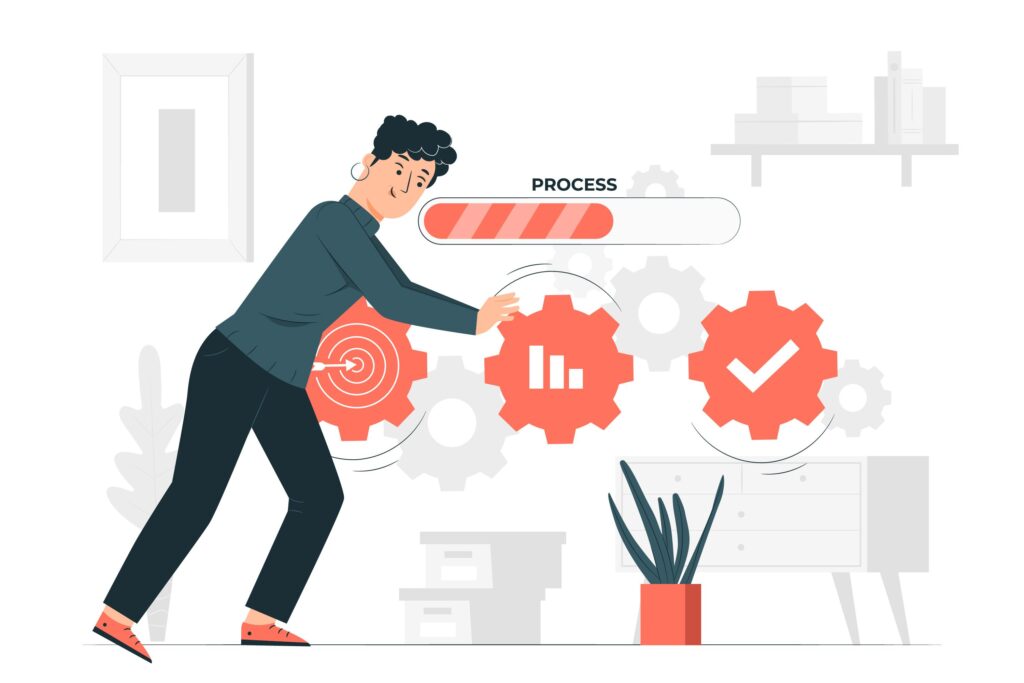
Process Improvement Solutions
Managers and executives need to establish scientific, well-structured workflows to serve as a guideline for activities within the organization. The most optimal processes are developed after numerous trials and continuous improvements. Therefore, they are the most streamlined and effective methods for completing tasks.
During the process improvement journey, to accurately assess effectiveness and identify the right improvement directions, businesses can apply the Kaizen method or the PDCA cycle. When a standard work process is in place, employees do not have to spend time planning what to do; they simply need to perform tasks according to the available instructions.
The most productive companies build processes for almost all of their recurring tasks and projects. For example: The HR department will have an employee onboarding process, a training process, and a payroll process.
See more: Multitask – Is Multitasking the Solution to the Productivity Puzzle?
3 – Facilities and Support Tools
A lack of support resources can significantly affect other performance factors such as ability, motivation, and morale. Even the most outstanding employee cannot complete their tasks well if they are not provided with the necessary tools to do the job. Outdated equipment, inadequate tools, and limited supplies directly impact an employee’s ability to perform their job functions effectively, leading to decreased productivity and suboptimal output quality.
Improvement Solutions
To equip employees with the best conditions to reach their full potential, managers need to ensure:
- Utilities and office supplies are always available
- Physical tools and machinery are in good working condition
- A fast Internet connection
- Software systems are regularly updated and upgraded
4 – Employee Engagement Level
Job engagement and performance are closely linked. According to Gallup, organizations with an engaged workforce have:
- 41% lower absenteeism
- 40% reduction in quality defects
- 10% higher customer satisfaction ratings
- 21% higher revenue
- 17% higher productivity
Internal factors stemming from the employees themselves greatly influence how they perform their work to achieve goals. Employees who are engaged and loyal to the organization and their job will care more about work outcomes. They also desire to learn and develop to become more professional and demonstrate a long-term commitment to the organization.
Improvement Solutions
As a manager, you can foster employee engagement to boost productivity by:
- Praising and recognizing employee achievements
- Providing constructive feedback and showing that you care about their needs
- Rewarding and motivating high-performing employees
- If you notice something is wrong, communicate with and support your team to find a solution
5 – Employee Skills and Competencies
If employees lack the necessary professional skills for their job, they will face obstacles in performing their tasks and may not meet their targets. Conversely, a well-trained and capable employee will work effectively, yield higher productivity, and create more value for the business.
Improvement Solutions
Do not underestimate the value of human resource training and development. Companies that prioritize this aspect often generate up to 24% higher profits than those that do not focus on investing in their workforce.
Ensure your workforce is fully equipped with knowledge about the company’s culture, products, services, and processes by implementing regular training activities. A comprehensive training program can increase employee engagement and satisfaction, reduce turnover rates, and provide a competitive advantage for your business.
Learn more: 6 Methods to Increase Business Productivity – 95% of Businesses Have Successfully Applied Them
6 – Care and Compensation Policies
It’s no coincidence that employers always mention the perks future employees will enjoy in the Job Description (JD) to attract talent. Care and compensation policies are factors that affect employee performance. Employees always look at the benefits and value they receive to determine how much they will dedicate to their work.
A Google-standard office, an 8-figure allowance, or various forms of relaxation and entertainment are motivators for employees to be more dedicated and enthusiastic about their work. Conversely, a rigid organization that does not care for the mental well-being of its staff will reduce their engagement with work, and productivity will remain average.
Improvement Solutions
As a manager, you need to create all favorable conditions for employees to feel comfortable and enthusiastic about their work. Start by providing amenities that meet all the relaxation and learning needs of your employees.
For example, Google provides a unique work environment for its employees with a range of amenities such as free bicycle repair services, free dry cleaning, free massages, a mobile library, and other perks. As a result, over 86% of the company’s employees say they are satisfied with their jobs, and the productivity of this tech giant is consistently among the top in the world.
7 – Personal Financial Issues
Personal financial issues can also be factors affecting employee performance. If your employees are constantly worried about their financial situation, they cannot focus on their work. They will spend work time thinking about due bills and debts to be paid. They will also feel less motivated to complete tasks and meet the organization’s expectations.
According to a 2016 survey conducted by Lockton, financial issues are the main cause of stress for 1 in 5 employees. Among them, 48% have difficulty covering basic living expenses. This seriously affects their job performance, productivity, and engagement with the organization.
Improvement Solutions
A fair salary and compensation can be a good method to increase employee satisfaction, helping them stabilize their lives to fully focus on work. Consider offering bonuses such as commissions, discounts, and other incentives to your staff.
Another option for small businesses with tight budgets is to offer a financial education program. Courses, webinars, and free consulting services can help your employees make smarter financial decisions and avoid falling into debt traps.
8 – Psychological Factors
Work-life imbalance, a sense of job insecurity, relationship conflicts, and heavy workloads are all common causes affecting employees’ psychology and performance at work. Employees facing these issues often get sick more frequently, perform worse, and feel less motivated.
According to a McKinsey survey, about 73% of workers experience psychological symptoms due to stress, while 77% report that their physical health is affected by stress, with symptoms such as insomnia, eating disorders, etc.

Improvement Solutions
As a business owner, you are directly responsible for employee satisfaction. Simple things, such as allowing remote work and flexible hours, can help employees feel more comfortable. Remote workers are more productive than those in the office – according to a study published by Stanford University.
Additionally, provide employees with the tools and resources they need to succeed in their roles, set realistic job expectations, and treat everyone fairly.
9 – Not Applying Technology in Operations
Technology has a huge impact on work efficiency and productivity. 75% of global organizations are projected to increase their use of technology productivity tools because they save a lot of time and money.
With the desire to help businesses solve the productivity problem, 1Office has launched WORKPLACE – a feature set that provides superior tools to address factors affecting employee work efficiency:
- Supports specific, clear work planning, assigns tasks to the right people, and automatically updates personal schedules
- Closely tracks work progress, with automatic alerts and smart reminders to help employees proactively meet deadlines
- Provides visual reports and evaluations of work efficiency in the form of Dashboards and dynamic reports, thereby accurately assessing employee performance
- Digitizes all work processes, from simple to complex, helping to closely monitor implementation progress and define responsibilities for each individual and department.
Register for a free feature Demo!
Process for Improving Business Work Efficiency
Improving work efficiency cannot be done based on feelings or temporary solutions. Businesses need a systematic process that both helps to accurately identify problems and ensures that implemented solutions deliver real, long-term results. This process consists of 4 main steps:
1. Identify the Problem – Find the “Bottleneck”
Before implementing any improvements, businesses must clearly understand the root causes of low performance. This is like “diagnosing an illness” before treatment: if the diagnosis is wrong, the results will be ineffective, no matter how many resources are invested. Businesses often classify the causes into 4 groups:
-
Issues from individual employees:
Employees may lack professional skills, have unclear job objectives, lack motivation, or feel disengaged from the organization. An inappropriate work attitude also reduces productivity. -
Issues from processes:
Complex, overlapping, or non-standardized processes (SOPs) waste time and effort. Unoptimized workflows between departments also lead to missed deadlines and errors. -
Issues from management:
When tasks are assigned unclearly or without evaluation criteria, employees can easily become confused and lose direction. Managing based on feelings or excessive micromanagement also reduces work efficiency. -
Issues from the organization and policies:
A lack of support tools, a non-transparent culture, and unmotivating compensation policies will make employees less enthusiastic, affecting overall productivity.
Objective: Correctly identifying the “bottleneck” helps the business create an accurate and effective plan to improve work efficiency.
2. Measure – Confirm the Problem with Data
After identifying the problem, businesses need to turn subjective feelings and observations into concrete data. Measurement will help confirm the correct problem and quantify the impact of each factor.
-
Performance evaluation systems:
-
KPI (Key Performance Indicator) measures work results.
-
OKR (Objectives and Key Results) helps define priority objectives.
-
Balanced Scorecard (BSC) provides a comprehensive assessment of various aspects: financial, customer, internal processes, and learning and growth.
-
-
Data collection tools:
-
Periodic work reports.
-
360-degree feedback from colleagues, managers, and customers.
-
Employee satisfaction and engagement surveys.
-
-
Quantitative and qualitative metrics:
-
Number of completed tasks, error rate, missed deadline rate.
-
Output quality according to ISO or internal standards.
-
Employee Engagement Score helps assess enthusiasm and proactivity.
-
Objective: Turn feelings and observations into data, avoid subjective assessments, and create a basis for practical solutions.
3. Develop Solutions – Build a Suitable Improvement Model
Once data is available, businesses need to build a comprehensive system of solutions to improve work efficiency, often categorized into the following groups:
-
Solutions for people:
-
Training in professional and soft skills.
-
Direct mentoring and coaching to help employees enhance their capabilities.
-
Reassigning tasks according to abilities and strengths.
-
Setting clear and transparent goals so employees understand expectations.
-
-
Solutions for processes:
-
Standardizing processes (SOP) for everyone to follow and for easy control.
-
Redesigning workflows to reduce waiting times and duplication.
-
Creating checklists and detailed guides to help employees work correctly and faster.
-
-
Solutions for technology:
-
Using work management software like 1Office, Trello, Asana.
-
Automating reports, reminders, and data storage.
-
Digitizing data to reduce the risk of loss and errors.
-
-
Solutions for management and culture:
-
A culture of recognition and two-way feedback.
-
Creating motivation with transparent salary and bonus policies.
-
Building a positive work environment that encourages innovation and creativity.
-
Objective: Select solutions based on impact and cost, prioritizing those that deliver quick yet sustainable results.
4. Monitor Continuous Improvement – Maintain Long-Term Results
Improving performance is a continuous process, not a one-time solution. Businesses need to establish a mechanism for monitoring and adjustment:
-
Regular monitoring:
-
Hold 1:1 meetings with employees to assess progress and difficulties.
-
Review KPIs/OKRs weekly, monthly, and quarterly.
-
Check the completion level compared to the time before implementing the solution.
-
-
Adjust if ineffective:
-
Adjust goals to align with reality.
-
Optimize processes if there are overlaps or obstacles.
-
Provide additional training or coaching if needed.
-
-
Apply the PDCA model (Plan – Do – Check – Act):
-
Plan – Create a detailed plan.
-
Do – Implement the solution.
-
Check – Evaluate the results.
-
Act – Adjust, improve, and refine the process.
-
-
Build a high-performance culture:
-
Each employee clearly understands their role, goals, and standards.
-
Communicate transparently and provide regular feedback.
-
Recognize efforts and achievements to create motivation.
-
Encourage innovation, creativity, and continuous improvement.
-

Through this article, 1Office helps readers gain more knowledge about the factors affecting work efficiency and provides improvement solutions to help businesses operate effectively and scientifically. For a free consultation and to experience a trial of the leading business management software today, please contact us using the following information:
- Hotline: 083 483 8888
- Fanpage: https://www.facebook.com/1officevn/
- Youtube: https://www.youtube.com/channel/UCeTIRNqxaTwk0_kcTw6SxmA




