


 13/05/2026
  313 views
Along with the market’s shift towards 4.0, the term 4C in Marketing emerged with a customer-centric marketing philosophy, helping businesses bridge the gap with their customers. So, what is 4C in Marketing? What makes this model superior to the traditional 4P model? How is 4C applied in Marketing? Let’s find the answers to these questions together.
Mục lục
1. What is the 4C Marketing Model?
The 4P in the Marketing mix has long been considered a timeless model applied by businesses when implementing marketing strategies. However, in the context of the market’s shift towards 4.0 and the digital transformation revolution in marketing, this model has revealed many shortcomings due to its excessive focus on the product.
This is understandable as the 4P concept was developed during the era of “push” marketing, where products were created by businesses and then pushed to the market for consumers—who had to be convinced that they wanted and needed them.
In today’s customer-oriented environment, businesses are beginning to adopt a “pull” approach, with products created to fit customer needs. This was the motivation for Robert F. Lauterborn to develop the 4C model in 1990 after he declared the traditional 4P method obsolete.
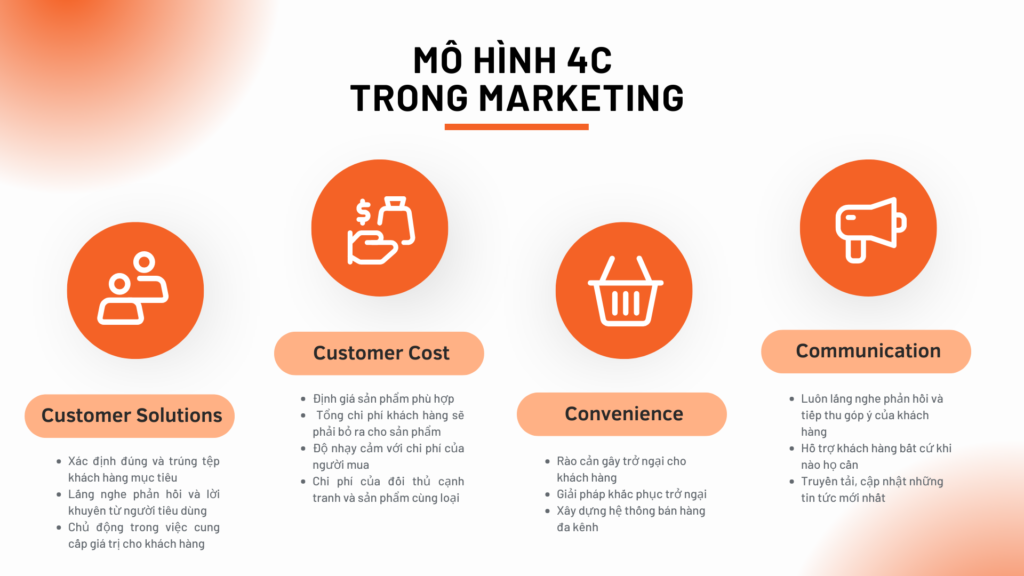
4C in Marketing includes 4 elements: Customer, Cost, Convenience, and Communication. Lauterborn’s 4C model, with its customer-centric orientation, has shifted the marketing paradigm from mass media marketing to niche marketing. When implementing a niche market strategy, businesses can precisely identify who their target customers are and focus on addressing the needs of that specific audience.
| Read more: 4Ps in Marketing and effective marketing strategies for businesses |
2. The 4 Elements of the 4C Model
2.1. Customer Solutions
First, the 4C strategy focuses on Customer Solutions. This means that every product launched to the market must be an effective solution that helps customers solve their problems and meet their needs, not just a tool for the business to make a profit. This element requires businesses to deeply understand their target customers, listen to their needs, and address their pain points to focus on solving customer problems.
To fulfill Customer Solutions, businesses need to ensure the following:
- Correctly identify the target customer segment
- Listen to feedback and advice from consumers
- Be proactive in providing value to customers
2.2. Customer Cost
The second C in Lauterborn’s model is Customer Cost, which refers to the cost the customer has to pay for the product. This cost is not limited to the product price, but includes all costs incurred for usage, shipping, maintenance, etc., and opportunity costs. Setting a cost that both optimizes profit for the business and ensures benefits for the customer is crucial.
To solve the cost problem, businesses need to:
- Choose a suitable product pricing method
- Research the total cost the customer will have to pay for the product
- Determine the buyer’s price sensitivity
- Research the costs of competitors and similar products
2.3. Convenience
Convenience for the customer is the third element in the 4C Marketing model. This is a key factor in the customer’s decision-making process. The business’s task is to eliminate all barriers that hinder customers when they access the product.
This process includes:
- Identifying barriers that hinder customers from learning about and purchasing the product
- Finding solutions to overcome these barriers
- Building a multi-channel sales system so customers can easily find the product on any distribution channel
2.4. Communication
The final element, Communication, is key to maintaining relationships and retaining customers. Communication requires two-way interaction between the seller and the buyer. This is an ongoing process that occurs before, during, and after the customer’s purchase. With the development of the Internet, businesses can now easily communicate with and provide customer care on online platforms.
The Communication element requires businesses to:
- Always listen to and incorporate customer feedback and suggestions
- Support customers whenever they need it
- Promptly convey and update the latest news about the product and the company to customers
| Read more: What are B2B and B2C Models? Comparing the Differences Between the B2B and B2C Models |
3. The combination of 4C and 4P in marketing
Although the 4C and 4P models approach the market from two different perspectives, they are not contradictory. On the contrary, if a business knows how to intelligently combine these two models, it will gain a comprehensive overview of its products and customers, thereby optimizing effective Marketing strategies.
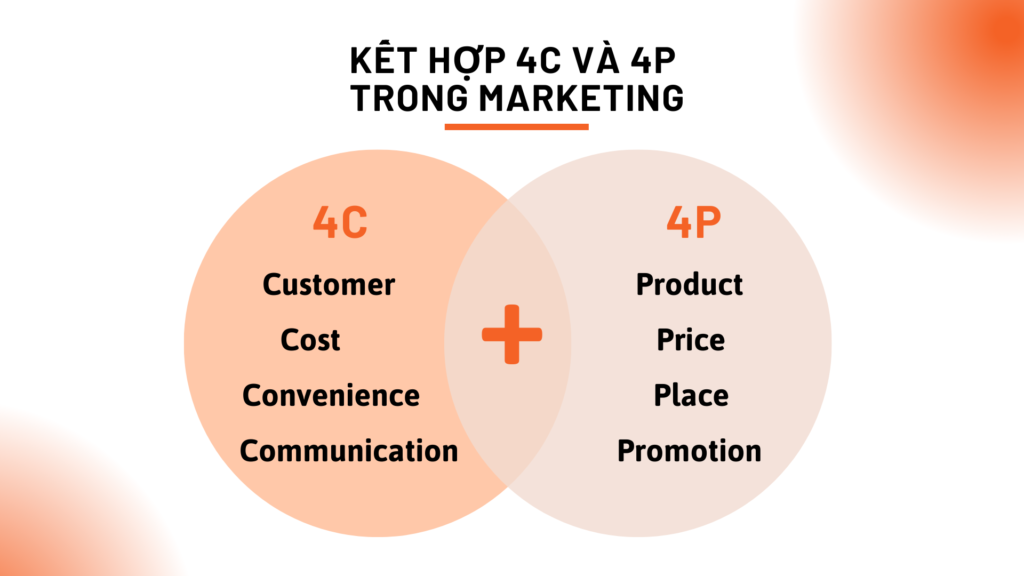
3.1. Customer – Product
This combination means that any product created must be a solution to the customer’s needs. The product’s utility must thoroughly solve the customer’s problem. To achieve this, businesses need to conduct thorough customer research to create products and services that closely align with their needs.
3.2. Cost – Price
The price set by the business must be commensurate with the cost that the customer incurs for the product. The cost invested by the customer must be worthy of the value they receive when using the product.
3.3. Convenience – Place
The product distribution location must support a smooth process for customers to access the product. Businesses need to focus on optimizing distribution channels by considering the shopping locations that customers access most frequently.
3.4. Communication – Promotion
Marketing communication is the shortest path for a business to “dialogue” with its customers. Communication channels and advertising provide businesses with the resources and means to interact with customers through promotional campaigns, advertisements, discounts, etc. These interactions help the business and customers understand each other better, strengthening the business-customer relationship and enhancing the company’s brand reputation.
=> The combination of the 4C and 4P models will create a strong product- and customer-oriented vision, helping to increase customer satisfaction, brand recognition, revenue, and profit for the business.
| Read more: What is Data-Driven Marketing? 5 Newest Data-Driven Marketing Trends in 2022 |
4. Applying the 4Cs in marketing and real-world examples
In practice, the 4C model is considered a set of criteria used by many businesses to plan and evaluate the effectiveness of their Marketing campaigns. Business managers and marketers use the 4Cs to test and optimize the strategy for a product or a company’s Marketing campaign.
Zara’s Marketing strategy is a prominent example of the 4C model, with a customer-centric philosophy that has made Zara one of the world’s leading fashion brands.

4.1. Meeting customer needs by following fashion trends
To meet the needs of its target customers who follow fashion trends, ZARA chooses to imitate the designs of international brands. At the same time, they learn about consumer preferences through customer feedback and sales data, thereby improving their products. This strategy allows ZARA to quickly design and produce clothing that meets consumer demands to keep up with fashion trends by closely following the trends of major brands.
4.2. Affordable prices, affordable fashion
ZARA’s main target customers are young consumers who are interested in fashion but have limited spending power and insufficient income to buy luxury brands. They are willing to pay for fashion but are relatively price-sensitive.
To meet customer needs, ZARA adheres to an “affordable fashion” pricing strategy. ZARA’s product prices range from $8 to $100, allowing consumers to wear designer-style clothing for a tenth of the price of luxury brands.
4.3. Developing online channels
Although physical stores are ZARA’s main sales channel, with the rise of online shopping, ZARA has also developed online channels. ZARA uses online platforms to display the latest fashion styles to consumers, while also providing professional online consulting, virtual try-ons, and other services for consumers, thus saving customers the time of going to physical stores to choose.
4.4. Improving communication channels
ZARA collects customer feedback through phone calls and emails to produce products that meet customer needs. Meanwhile, all ZARA stores must report daily sales and inventory levels, and the headquarters will replenish goods according to the actual situation of each store. This timely feedback on consumer needs and preferences to the headquarters helps ZARA’s products quickly respond to market changes.
5. Applying the 4C model in Marketing effectively with 1Office software
Helping businesses adapt to the 4.0 marketing trend, 1Office’s Marketing campaign management system is a powerful assistant that supports businesses in applying the 4C model in Marketing. The CRM solution helps businesses address the Communication element of the 4Cs by communicating and interacting with customers, providing automated customer care across multiple platforms, and tracking customer interaction and purchasing processes to devise appropriate response plans.
For all inquiries, please contact:
- Hotline: 083 483 8888
- Fanpage: https://www.facebook.com/1officevn/
- Youtube: https://www.youtube.com/channel/UCeTIRNqxaTwk0_kcTw6SxmA
















