10/05/2026
  18201 views
Financial reports are an important tool for assessing the financial health and business performance of an enterprise. However, many investors and managers do not know how to effectively analyze and utilize the information in financial reports. In this article, 1Office will provide you with the knowledge and experience to analyze indicators, helping you understand financial reports professionally and make smart business decisions.
Mục lục
- 1. What is financial report analysis?
- 2. The significance of financial report analysis
- 3. Key considerations when analyzing corporate financial indicators
- 4. The 6 most common methods of financial report analysis
- 5. 6 Basic Steps to Reading a Financial Statement
- 6. Detailed guide to analyzing financial statements
- 7. Key Financial Indicators to Monitor Periodically
- 8. Conclusion
1. What is financial report analysis?
A financial report is a compilation of various documents that provide direct information about a company’s financial activities, including information on owner’s equity, assets, liabilities, revenue, profit, and cash flow.
Financial report analysis is the process of evaluating a company’s current financial situation, identifying its strengths and weaknesses by calculating and analyzing indicators from financial reports. Understanding the relationship between these ratios is essential for drawing accurate conclusions about the company’s financial situation and business performance.
There is no specific criterion for analyzing each ratio, and a few calculated indicators are not enough to comprehensively assess the company’s condition. Therefore, the ultimate goal of financial analysis is to clearly understand the relationships between the ratios to make accurate and comprehensive assessments of the company.

2. The significance of financial report analysis
Financial report analysis holds significant importance for various stakeholders in evaluating and understanding a company’s financial situation:
- For the business: It provides an overview of the financial situation and operational efficiency, allowing managers to make accurate decisions and support the company’s sustainable development.
- For banks: Banks can assess the company’s operational situation and debt repayment capacity, thereby accurately deciding on the loan amount and term.
- For investors: It helps investors get a clear view of the company’s health and future prospects, supporting their decision on whether to invest in the business.
- For suppliers: Suppliers use the company’s financial reports to assess its payment ability and decide whether to sell goods on credit.
3. Key considerations when analyzing corporate financial indicators
3.1. Comparison with the previous evaluation period
Comparing with the previous evaluation period is an important method for a business to assess its horizontal growth. By examining financial reports and comparing them with the previous period, the business can identify changes and its development trends. This helps managers formulate development strategies and adjust business plans flexibly and effectively.
3.2. Comparison with other businesses in the same industry or with the industry average
Comparing with other businesses in the same industry or with the industry average is a crucial step in identifying a company’s strengths and weaknesses. By comparing with competitors, the business can assess its market position and identify areas for improvement or optimization. Additionally, comparing with the industry average helps determine whether the business is performing more stably or less effectively than its industry peers.
During the process of calculating and analyzing indicators, it is important to note whether the figures reflect a specific point in time or a period, in order to make the most accurate assessment of the company’s situation.
Specifically: Financial indicators in the “Balance Sheet” are typically figures that represent the situation at a specific point in time; whereas, indicators in the “Income Statement” usually reflect performance over a specific period.
4. The 6 most common methods of financial report analysis

4.1. Comparison method
In corporate financial analysis, the comparison method is used to evaluate the fluctuations of items/indicators by examining financial statements from consecutive years:
- Analyze fluctuations over time, within a period of 2 to 3 years, including both the absolute and relative values of the indicators in the financial statements.
- Analyze long-term trends by comparing data from subsequent years with a base year. This allows for assessments of the direction, speed, and trends of items/indicators over the years compared to the base year.
The advantage of this method is its simplicity, ease of implementation, and ability to reflect the trends of indicators. However, its disadvantage is the inability to assess the quality of the information used for analysis.
4.2. Ratio Method
This is a method that uses ratios to perform analysis. It involves constructing ratios by comparing one indicator with another. The advantage of this method is its high practicality, especially when improved and supplemented with increasingly refined application conditions.
4.3. Decomposition Analysis Method
The Dupont model is an analytical tool used to assess a company’s profitability by combining traditional performance management tools. This model integrates various elements from the Income Statement and the Balance Sheet.
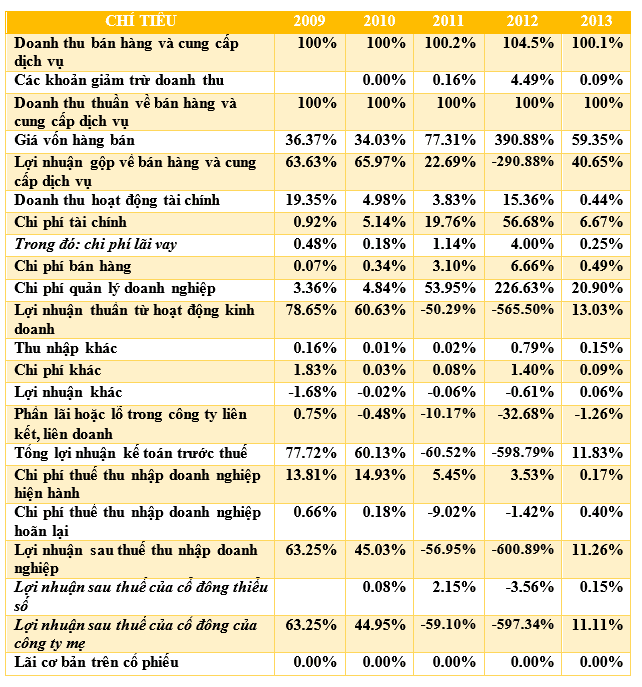
This method helps analysts identify the causes of positive and negative fluctuations in the company’s operations.
4.4. Breakdown Method
The breakdown method involves dividing a total process and result into specific components based on certain criteria, aiming to better understand that process and result from different perspectives.
4.5. Cross-Referencing Method
The cross-referencing method is used to study and evaluate the economic relationships between economic events and phenomena within the same period, while also checking the balance of economic indicators during operations.
4.6. Factor Analysis Method
This method is applied to study and examine the economic relationship between the analyzed indicator and influencing factors through two main steps:
Step 1: Determine the level of influence of the factors.
Step 2: Analyze the influence of the factors on the analyzed indicator, where the influencing factors include:
- The directional impact of the factor, whether it increases or decreases the indicators being analyzed (e.g., whether fluctuations in production volume or selling price increase or decrease revenue).
- The subjective and objective causes of the factor.
- Provide a basis for evaluation.
- Conclude the significance of studying those factors.
For example, in the case of revenue, we can apply this method to determine that an increase in revenue might be due to “increased production volume and decreased selling price.” This way, analysts can better understand which factors are affecting the indicator they are studying and the impact level of each factor, helping them to better understand the real reasons behind the indicator’s fluctuation.
5. 6 Basic Steps to Reading a Financial Statement
Reading an actual financial statement is not as complicated as many people think. You can still read and analyze a financial statement even without deep expertise in accounting and finance, as long as you understand the basic concepts and the method and process of reading & analysis.

When studying a company’s financial statements, you should read the entire set of complete financial reporting documents, including:
- Director’s report
- Independent auditor’s report
- Balance sheet
- Income statement
- Cash flow statement
- Notes to the financial statements
You should read financial statements according to the standard process below to avoid missing any information or signs related to analyzing the financial health of the business:
- Step 1: Clearly define the time frame of the financial statement
- Step 2: Review the auditor’s opinion
- Step 3: Read the balance sheet
- Step 4: Review the income statement
- Step 5: Read the cash flow statement
- Step 6: Review the notes to the financial statements
>>> See more: 6 steps to effectively read financial statements
6. Detailed guide to analyzing financial statements
6.1. Analyzing liquidity
To maintain continuous production and business operations, a company needs to maintain an appropriate level of working capital to pay short-term debts and maintain inventory levels. This is particularly important because failing to meet payment obligations in a timely manner can disrupt the company’s business operations. To assess liquidity, we use liquidity ratios.
6.1.1. Current Ratio
The current ratio is an important indicator for assessing a company’s liquidity. It reflects the ability to convert short-term assets into cash to pay short-term liabilities.
The formula for the current ratio is:
Current Ratio = Current Assets / Current Liabilities
If the ratio is low, especially below 1, the company may have difficulty meeting its obligations and face payment risks. If this ratio is high, it indicates that the company is capable of paying its due debts.
6.1.2. Interest Coverage Ratio
The interest coverage ratio is a useful tool for assessing a company’s ability to pay interest on its debt. If a company borrows heavily but its profits are insufficient to cover interest expenses, its ability to pay interest will be affected.
The formula is:
Interest Coverage Ratio = Earnings Before Interest and Taxes (EBIT) / Interest Expense
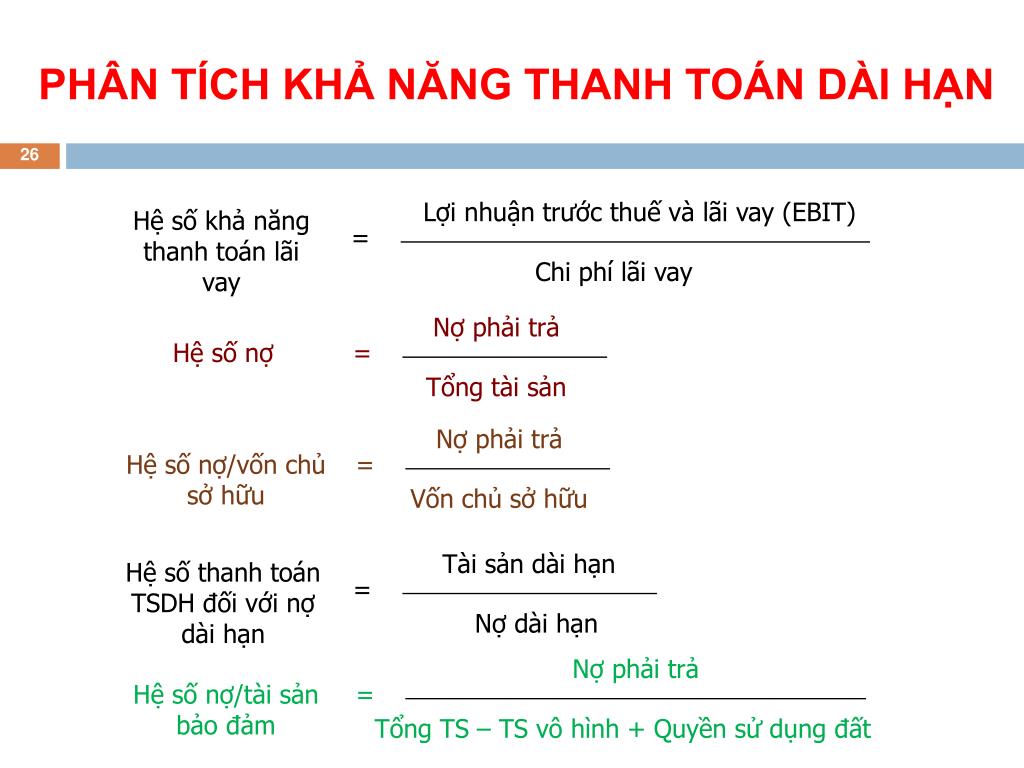
Note: If a company has too much debt, but its business operations are inefficient, and the return on invested capital is low (or even negative), ensuring timely interest payments becomes extremely difficult.
6.1.3. Analysis of Accounts Receivable Turnover Ratio
To assess the speed of debt collection, we use the accounts receivable turnover ratio, calculated by dividing sales revenue by average accounts receivable. This ratio indicates how quickly a company can collect cash from its customers.
To assess the speed of debt collection, i.e., the company’s receivables, you can calculate the accounts receivable turnover ratio using the following formula:
Accounts Receivable Turnover = Sales Revenue / Average Accounts Receivable
You can also calculate the average time required to collect receivables using the following formula:
Average Collection Period (days) = 360 / Accounts Receivable Turnover
This ratio helps us understand how long it takes for a company to collect cash from sales. Note that this ratio will depend on the company’s credit and payment policies.
6.1.4. Analysis of Inventory Turnover Ratio
The inventory turnover ratio measures how often inventory is sold during a period. A higher ratio generally indicates that the company manages its inventory efficiently and its products are selling quickly.
The formula is:
Inventory Turnover = Cost of Goods Sold / Average Inventory
However, to conclude whether a high inventory turnover ratio is positive or negative, we need to consider the specific characteristics of the industry and the company’s inventory management policy.
For example, if a manufacturing company notices a decrease in raw material prices, it might decide to increase its raw material reserves. This would lead to an increase in inventory levels, thereby reducing the inventory turnover ratio.
Additionally, by purchasing raw materials at a lower price, the company can reduce its production costs, increasing profitability. This is an example of how the positive impact of inventory management can contribute to increased profits.
6.2. Analyzing financial leverage in the report
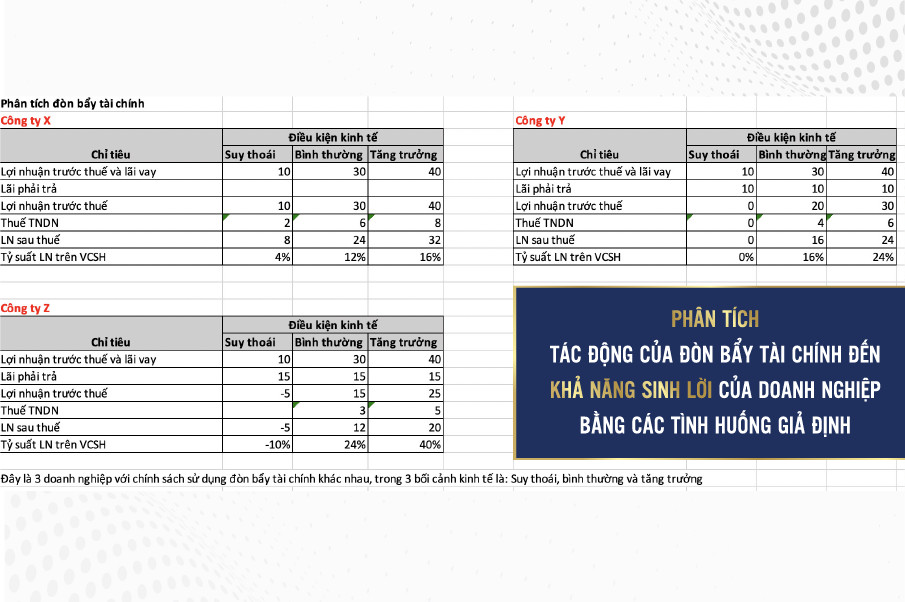
You can use the Debt Ratio to assess the proportion of debt in a company’s total capital. The formula is as follows:
Debt Ratio = Liabilities / Total Capital
However, there is no specific number to determine what debt ratio is appropriate for a particular business. This depends on many factors such as the type of business, company size, and the purpose of the loan. Typically, a low debt ratio indicates a high level of safety for the business, with less financial risk. Conversely, a high debt ratio suggests that the business has more potential risks.
6.3. Profitability Analysis
Profit is the primary goal of business operations, and it plays a crucial role in evaluating the effectiveness of the entire company’s investment, production, and business processes.
6.3.1. Calculating Return on Sales (ROS)
Return on Sales (ROS) is calculated by dividing after-tax profit by net revenue. This ratio helps assess the efficiency of a company’s cost management and its ability to generate profit from each dollar of net revenue. A business with a stable and higher ROS ratio than its competitors often has a competitive advantage and effective cost management.
>>> See more: ROS Ratio: Formula and Meaning in Financial Statements
6.3.2. Gross Profit Margin Analysis
The gross profit margin is calculated by dividing gross profit by net revenue. This ratio reflects the efficiency of managing production costs, raw material costs, and labor, as well as the ability to generate profit and compete in the market.
6.3.3. Return on Assets (ROA) Analysis
Return on Assets (ROA) is calculated by dividing after-tax profit by average total assets. ROA evaluates the efficiency of a company’s asset utilization, indicating how much after-tax profit is generated for each dollar of assets.
6.3.4. Return on Equity (ROE) Analysis
Return on Equity (ROE) is calculated by dividing after-tax profit by average equity. ROE reflects the level of financial, cost, asset, and capital management, and is a crucial factor for investors.
However, it should be noted that not only the growth of this ratio but also many other factors need to be considered to comprehensively assess the business situation and investment potential of the company.
>>> Reference: What is Profit Margin? Formula, Meaning, and Role
6.3.5. Earnings Per Share (EPS) Analysis
The EPS (Earnings Per Share) ratio indicates the amount of profit each common shareholder can earn in a year. The EPS formula is calculated by taking the after-tax profit, subtracting dividends for preferred shareholders, and then dividing by the number of common shares outstanding. The Dupont model is applied to analyze financial ratios and identify factors affecting the overall indicators.
Formula:
Earnings Per Share (EPS) = [After-tax Profit – Dividends for Preferred Shareholders] / Number of Common Shares Outstanding
6.4. Cash Flow Analysis

6.4.1. Net Cash Flow from Operating Activities / Net Revenue
Net cash flow from operating activities/net revenue is an analytical ratio used to evaluate the efficiency of generating profit from each dollar of a company’s net revenue. Although there is no specific benchmark, the higher the value of this ratio, the better. However, you need to compare current data with past data to get a comprehensive view, quickly detecting changes and developments in the business.
6.4.2. Free Cash Flow Ratio
The free cash flow ratio assesses the quality of the cash that a company owns and uses for its business activities. It is calculated as the ratio of free cash flow to net cash flow from operating activities.
A high free cash flow ratio often indicates that the company has a larger amount of surplus cash, enabling it to invest in new activities, pay dividends to shareholders, or pay off debt. This is considered a positive indicator of the company’s financial health.
6.4.3. Cash Flow Trends
Analyzing cash flow trends is a crucial task that helps investors and financial institutions assess a company’s financial situation. To analyze cash flow trends, it is necessary to collect and synthesize cash flow data from the company’s activities over a long period. This helps eliminate short-term fluctuations in cash flow and identify the stage of the business cycle the company is in. The results of cash flow trend analysis can support investors and financial institutions in making reasonable investment or financing decisions.
Some notes when analyzing cash flow trends include: Comparing the company’s cash flow with that of other companies in the same industry, considering other factors such as the economic situation, business sector, etc., and using statistical analysis tools.
7. Key Financial Indicators to Monitor Periodically
To assess a company’s financial health, regularly monitoring financial ratios is an essential step. These ratios reflect operational efficiency, profitability, risk levels, and the sustainability of the financial structure. Below are the key groups of ratios that every business should pay attention to:
7.1. Profitability Ratios
These ratios help businesses determine whether they are using their resources effectively and assess their ability to generate profits from invested capital or assets.
-
ROA (Return on Assets): indicates how much net profit is generated for every dollar of assets.
-
ROE (Return on Equity): shows the level of return for shareholders, reflecting the efficiency of using equity.
-
Gross Margin: Indicates the efficiency of production operations after deducting the cost of raw materials.
-
Net Margin: Measures the actual profit remaining after deducting all expenses and taxes.
Monitoring this group of ratios helps businesses promptly detect declining profit trends, optimize costs, and adjust pricing strategies.
7.2. Liquidity Ratios
Reflects a company’s ability to meet its short-term debt obligations, ensuring financial stability.
-
Current Ratio: Compares current assets to current liabilities, assessing the ability to pay off debts within 12 months.
-
Quick Ratio: Similar to the Current Ratio but excludes inventory, reflecting the company’s “immediate” payment capacity.
A ratio that is too low can warn of cash flow imbalance risks, while a ratio that is too high may indicate that capital is being “tied up” in current assets.
7.3. Capital Structure and Financial Leverage Ratios
Assesses the level of financial risk and the company’s ability to maintain operations while carrying debt.
-
Debt/Equity Ratio: Indicates the extent to which a company is dependent on borrowed funds.
-
Interest Coverage Ratio: Measures the ability to pay interest from operating profits, helping to assess the risk of default.
Monitoring this group helps management balance leveraging debt for expansion with maintaining financial security.
Summary: Regularly monitoring the above ratios not only helps businesses promptly identify operational issues but also serves as a basis for strategic decisions such as capital restructuring, business model adjustments, or future investment planning.
8. Conclusion
Analyzing financial statements is a crucial process for understanding and evaluating a company’s financial situation. We hope this article provides your business with enough knowledge to read and analyze a complete financial report. We wish you success.