


A solution to promote the application of information technology and digital transformation


Along with the growth prospects of the current digital economy, information technology and digital transformation have become “hot” topics of interest for every business. However, many managers still confuse the two terms “information technology” and “digital transformation,” leading to ambiguity in implementing digital technology for their businesses. To help managers effectively apply information technology and digital transformation, 1Office will provide the necessary knowledge in the following article.
Mục lục
- 1. Understanding the Concepts of Information Technology and Digital Transformation
- 2. The Differences Between Information Technology and Digital Transformation
- 3. Solutions to promote the application of information technology and digital transformation
- 4. What businesses need to do to effectively apply information technology and digital transformation
- 5. 1Office – The pioneering business management platform in digital transformation
1. Understanding the Concepts of Information Technology and Digital Transformation
1.1. Information Technology
Information Technology (IT) is the field related to the use of tools, techniques, methods, and processes to collect, process, store, transmit, and manage information via computers and computer networks. IT has a major impact on all aspects of the economy and daily social life. IT has changed the way we communicate, work, entertain, and access information.
Furthermore, IT plays a particularly important role in developing applications, services, products, and solutions based on digital technology, helping to usher the world into the digital era. At the same time, the rapid development of IT also brings new challenges and opportunities, creating a fiercely competitive environment among businesses in the market.
1.2. Digital Transformation
Digital transformation is the process of converting activities, processes, services, products, and information from traditional forms to a digital format. Digital transformation often involves using digital technology to automate and improve business operations, management, production, communication, and customer interaction. Typical examples in the digital transformation process include the use of technologies such as artificial intelligence (AI), cloud computing, the Internet of Things (IoT), and blockchain to leverage data, enhance operational efficiency, improve customer experience, create new value, and achieve certain socio-economic benefits.
Digital transformation is not just a technical process; it also requires a comprehensive change in organization, corporate culture, management, and information technology, while also posing challenges regarding data security and safety.
>> Read more: The process of building effective and flexible human resource management software for businesses to meet management needs as they grow
2. The Differences Between Information Technology and Digital Transformation
| Criteria | Information Technology | Digital Transformation |
| Scope | A specialized field related to the use of computer technology and computer networks to collect, process, store, transmit, and manage information. | A more comprehensive process that involves applying digital technology to improve business operations, management, production, communication, and customer interaction. |
| Application Area | Focuses on specific technologies and fields such as programming, networking, databases, information security, computer graphics, and many other areas within information technology. | Applies digital technology to many different industries and fields, from business, government, education, healthcare, finance, retail, manufacturing, and services to non-profit organizations. |
| Role | One of the fundamental elements in digital transformation, providing the basic technologies to support digitization. | Aims for a more comprehensive vision, requiring organizational and corporate culture changes along with the application of digital technology to business and management activities to create new value and enhance organizational productivity. |
| Objective | To provide information technology solutions to solve specific problems and needs within an organization. | To comprehensively change the organization, business processes, operating models, and methods of communication and customer interaction to achieve continuous transformation and improvement. |
| Role of People | Focuses mainly on technologies and technological solutions. | Requires a change in the way people work, think, and behave within the organization. People are a crucial factor in the digital transformation process, and they also guide and define the digital values within the organization. |
In summary, IT is a part of the digital transformation process, providing the foundational technologies, while digital transformation requires a comprehensive change in organization, business processes, corporate culture, and human involvement in the implementation process.
>> See more: Digital Transformation Roadmap – Understand the Digital Transformation process for SMEs
3. Solutions to promote the application of information technology and digital transformation
3.1. Building an intelligent data management system
Data is a valuable resource in the digital age. Therefore, businesses need to build and implement an intelligent data management system to optimally exploit this resource, helping managers make decisions based on accurate and timely data. An intelligent data management system should include the following core functions:
- Automatically aggregate data from multiple sources: An intelligent data management system needs the ability to aggregate data from various sources, including the company’s internal systems, external data sources, and data from customers and partners. The automated data collection process will help ensure the accuracy, consistency, and continuity of data, while minimizing effort and errors compared to manual data collection methods.
- Intelligent data analysis: An intelligent data management system should have the capability for in-depth data analysis to provide valuable insights for the business. Machine learning, artificial intelligence, and data science can be applied to analyze data automatically and quickly, helping leaders better understand their data and make sound decisions.
- Create automated visual reports: An intelligent data management system can automatically generate reliable data reports to help businesses better understand their business situation and provide a basis for making management decisions. Technology for automatically creating reports, charts, graphs, etc., updated in real-time, can be applied to help managers get an overview and respond quickly to “hot spots” in the operational process.
3.2. Integrate a process automation system
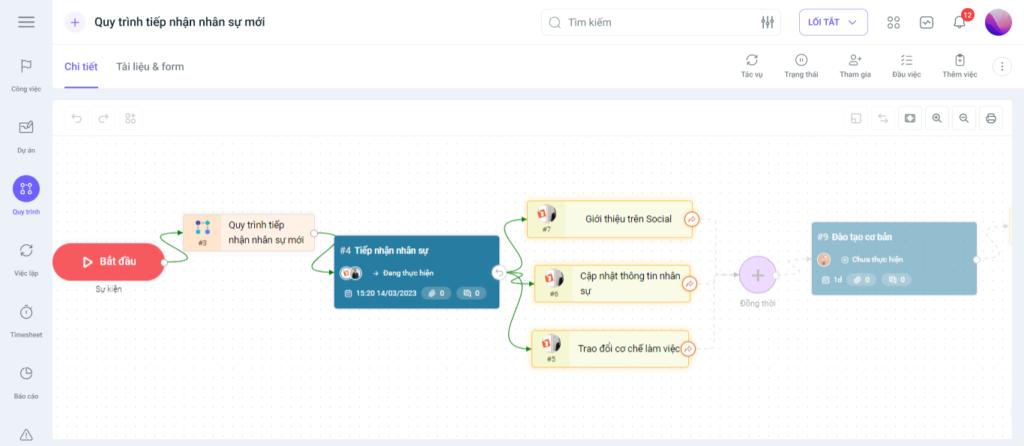
BPA (Business Process Automation) is a process automation technology capable of optimizing operational activities and streamlining business processes within a company. The implementation of BPA plays a crucial role in the process of applying information technology and digital transformation for businesses. Specifically, a process automation system helps:
- Optimize operational processes: BPA helps automate processes within the business, reducing manual, repetitive tasks, while increasing processing speed and reducing task completion time. Processes are executed quickly, accurately, and consistently, thereby optimizing operational activities for the business.
- Enhance efficiency and productivity: BPA helps reduce the effort and time employees spend on repetitive, monotonous tasks. At the same time, BPA also helps reduce dependency on human resources, allowing employees to focus on tasks that require more skill and intellect. This helps enhance the organization’s efficiency and productivity.
- Synchronize and minimize errors: Process automation technology ensures accuracy and consistency in data processing and business tasks, helping to achieve a high level of precision and minimize risks associated with errors from manual operations.
- System integration: BPA can integrate with a company’s existing systems such as HRM software (Human Resources Management), CRM (Customer Relationship Management), and many other systems. This helps strengthen the connectivity and consistency of business processes, while also enhancing the company’s comprehensive management capabilities.
3.3. Leverage cloud-based platforms
Implementing cloud solutions is one of the crucial steps in promoting the application of information technology and digital transformation for businesses. Applying digital transformation based on cloud computing platforms helps businesses save on infrastructure costs, increase flexibility, and allow for remote access and easy data sharing. To implement IT solutions on a cloud computing platform, businesses can:
- Migrate IT infrastructure to the cloud: Businesses can move their IT infrastructure, such as servers, data storage, and network systems, to a cloud computing platform. This helps businesses reduce the physical resources needed to maintain an in-house IT infrastructure, while flexibly and cost-effectively leveraging on-demand cloud services.
- Use SaaS (Software as a Service) services: SaaS is a software service solution developed on a cloud computing platform, allowing businesses to access popular software such as CRM, HRM, or project management tools without needing to deploy and manage them on an in-house server system. This solution helps businesses save significant time and resources, while ensuring updates and reducing the risk of data loss.
3.4. Building a digital culture in the organization
Organizations need to build a flexible, open, and innovative environment where information technology is seen as a supportive tool and a driving force for enhancing creativity and continuous improvement in all organizational activities. The digital culture within an organization is built on 3 core foundations:
- Leveraging information technology: Organizations need to leverage advanced information technologies to optimize work processes, improve efficiency, and reduce the time and effort required to complete tasks. This can include applying project and task management tools, customer relationship management systems, human resource management software, etc.
- Encouraging creativity: The digital culture in an organization needs to encourage creativity and innovation from its members. A digital culture can be built by creating an environment that fosters creativity, motivating employees to propose new ideas, offering suggestions and positive feedback, and creating opportunities for employees to participate in the organization’s research and development activities.
- Continuous improvement: The digital culture in an organization needs to focus on continuous improvement. Projects implemented within the organization should be periodically evaluated to draw lessons learned, which serve as a basis for process improvement, enhancing work efficiency, and improving product/service quality.
4. What businesses need to do to effectively apply information technology and digital transformation
- Develop a systematic digital transformation strategy and roadmap
This is the first and most crucial step in promoting the application of information technology. Businesses must have a clear, well-defined digital transformation strategy with a specific plan to achieve desired goals and outcomes. The IT application strategy and digital transformation roadmap need to ensure two main components:
-
- Assess and determine the current level and capacity of the business’s digital transformation
- Standardize each phase: Preparation – Consultation survey, data standardization – System setup and installation – User training and guidance – Evaluation and improvement.
- Training and enhancing digital skills
To successfully apply information technology, businesses need to invest in training and enhancing the digital skills of their staff. This includes training on new technologies, data management skills, data analysis, and other digital skills to ensure employees are competent in using information technology in their daily work.
5. 1Office – The pioneering business management platform in digital transformation
Once a solid IT foundation for digital transformation is in place, businesses will need a quality technology solution, and the all-in-one business management software 1Office is the solution chosen by over 5,000 CEOs. 1Office provides businesses with the smartest management model, offering a technology solution along with an optimal digital transformation roadmap, helping businesses continuously improve management and operational efficiency, and creating a solid foundation for breakthrough growth.
With the partnership of 5,000 customers in various fields and over 450,000 users nationwide, 1Office Joint Stock Company has overcome difficult periods and successfully guided many large enterprises such as Yody, IIG Vietnam, and others through digital transformation.
Through the article above, 1Office has shared knowledge about information technology and digital transformation with readers. For a free consultation and a trial experience of the most professional business management software available today, please contact us using the information below:
Get a free consultation & software demo
For more details, please see:
- Hotline: 083 483 8888




