I. What is a business digital transformation roadmap?
1. What is digital transformation?
Digital Transformation is the process of applying technology to the operations and processes of an organization. By adopting technologies like AI, Blockchain, etc., organizations can standardize workflows and operational processes, optimize labor costs, maximize work productivity, and more.
2. What is a Digital Transformation Roadmap?
A business’s Digital Transformation Roadmap is essentially a detailed plan and a process for applying technology to assist the business during its Digital Transformation journey.
digital transformation roadmap – helping businesses standardize processes
For large enterprises, they often have a team of IT and technology experts, which makes the Digital Transformation process easier.
3. Technology – The Backbone of a Business’s Digital Transformation Journey
The benefits that businesses gain from applying digital transformation technology include:
Process Standardization: All of the business’s operational processes will be designed and automatically set up on the system, helping employees easily understand their workload and enabling managers to easily monitor their staff’s work performance.
Automated Record Storage: All business data will be updated on the Cloud or the system. Data such as customer data, contracts, payment vouchers, personnel records, etc., will be stored on the system, and staff can search for information anywhere, anytime.
Automated Timekeeping and Payroll: Employees can track their own actual workdays/hours. Salaries will be calculated automatically and set up according to each specific business’s payroll formula.
Digital Signatures: The digital signature process can be carried out anytime, anywhere, reducing paperwork, etc.
For SMEs in the current market with limited budgets, no experienced IT experts, and insufficient funds to hire external specialists, they should refer to and follow the process outlined in the Digital Transformation Roadmap we will provide.
II. The Current State of Digital Transformation for SMEs
1. The current state of digital transformation
In the current Vietnamese market, when discussing Digital Transformation, information is often only available for large corporations considered key players in their respective fields. For SMEs, the Digital Transformation process has only been implemented in the very first and simplest steps, without truly delving deep into aspects like process standardization or maximizing productivity with support tools.
Statistics have shown that:
As many as 92% of surveyed businesses are aware of digital transformation, yet 72% don’t know where to start in their organization, and 69% don’t know which partner to choose for implementation.
Additionally, after the Covid pandemic, many SMEs have undertaken digital transformation to adapt to the current situation, but this “transformation” is still very rudimentary, such as working remotely and reporting work results via chat groups or Drive, etc.
2. The Most Common Digital Transformation Trends in 2022
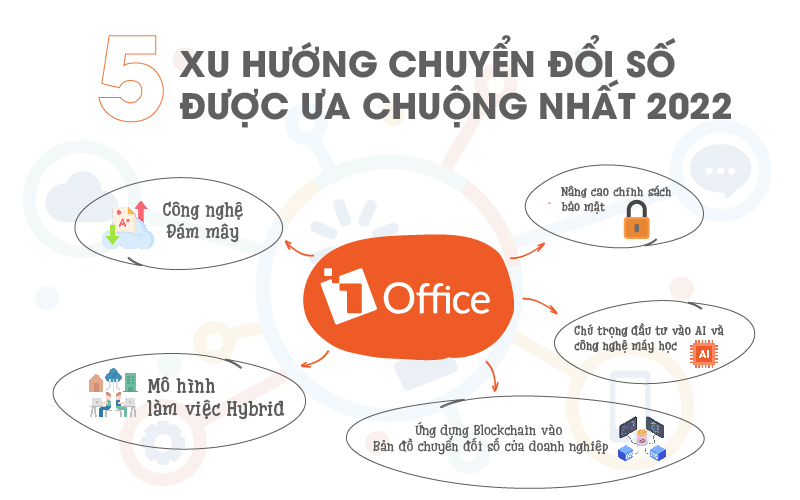
According to research by Forbes, the top 5 Digital Transformation trends for 2022 are as follows:
The 5 most commonly used digital transformation trends
II. Factors businesses need to focus on during digital transformation
It’s clear that to implement the digital transformation process, businesses will need to update or address significant gaps in both physical infrastructure and human resources.
There are five important factors that businesses need to focus on to make their operations more flexible:
The organization’s long-term strategy will change to align with the transformation process
Restructure the business to adapt to the operational model of the newly applied technology
Optimize operational processes to improve efficiency and reduce workload
Invest in technology to support the company’s development process
Among these, digitizing operations is the first and smartest strategic step for businesses to create a distinct competitive advantage, streamlining and optimizing their existing operational apparatus.
Additionally, experts believe that human resources are also a crucial factor contributing significantly to a business’s digital transformation. If personnel within the organization lack the necessary skills and expertise, digital transformation becomes futile as they cannot use these new tools to support their work. Therefore, people are the most important factor, and it is necessary to selectively invest in individuals who are adaptable, eager to learn, and flexible for the business’s digital transformation to succeed.
III. Digital transformation process for SMEs
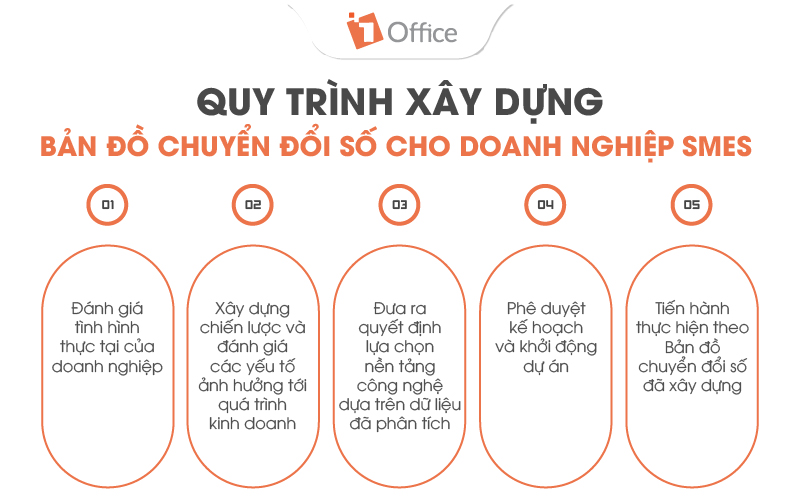
In this section, we will outline the Digital Transformation Roadmap for SMEs:
The easiest digital transformation process for businesses to implement
1. Assess the current situation of the business
Analyze market forces and trends:
By identifying and analyzing market trends, businesses can determine several factors such as: Development potential, competitors, etc.
Specific environmental factors can be analyzed using industry analysis. Factors related to the external environment directly affect the company’s strategy, short-term/long-term goals, and operations.
Some factors related to the external environment include: The bargaining power of suppliers, the bargaining power of customers, barriers to entry for new entrants, the threat of substitute products and services, and the level of competition.
Analyze suitable digital technologies to enhance the customer experience:
Researching all the digital technologies most suitable for the business is the next step. During the selection process, managers need to consider the company’s capabilities, the approved budget for digital transformation, and the needs and desires of customers.
Analyze the current operational & business model:
The business and operational model needs to be analyzed from the perspective of serving customer needs and meeting their desires. This analysis will show how resources (processes, technology, organization, people, and budget) are connected to create value for customers.
2. Build a strategy and evaluate factors affecting the business
This is one of the indispensable steps in the process of creating a Digital Transformation Roadmap for a business. The process of building a strategy and evaluating factors will be demonstrated through the following aspects:
Identify different business scenarios: By building scenarios with varying probability levels, the board of directors can view the potential future in different ways, helping to broaden their vision, list opportunities and risks, and increase the business’s ability to respond to various ongoing events.
Identify target customer segments and the technology to be used: The needs and wants of each segment are being incorporated into appropriate value streams and matched with the best technology solutions to support these value streams.
Develop a future business model: Understanding the various factors characterizing the current situation in the environment and the company, different business scenarios, and target customer segments with appropriate technologies will support meeting customer needs and wants, shaping the area where business model development should take place.
Analyze the impact of applying IT to the business’s operational processes
3. Make a decision on choosing a technology platform
As part of the strategy development process, the team empowered to select the technology for implementation must secure approval from senior management on factors such as:
The approved budget for implementing Digital Transformation
The level of compatibility with the business’s operational processes
Ease of use and suitability for the skill level of employees in the organization
Example: To proceed with selecting and using AI, a business needs to prepare internal and external resources and modify its infrastructure to accommodate the new technology. Once this information has been collected, reviewed, and approved by the appropriate managers, the team can present its findings and recommendations to senior management for approval.
4. Approve the plan and launch the project
In this step, all the resources identified in the previous steps are put into action:
The selected tool provider is arranged to begin work
IT teams are ready to coordinate with the software implementation team
Employees prepare to transition from their current processes to the new, pre-built processes.
Arguably, this is one of the most critical steps in the roadmap as it brings all the players together and moves the program forward.
5. Proceed with implementation according to the established Digital Transformation Roadmap
Many activities will take place as the business proceeds with Digital Transformation, including the following:
Install and test the new technology applied to the operational process to make adjustments and improvements based on experience.
Pilot the new technology to familiarize employees with the system and how to use it.
Develop policies, procedures, and performance measurement indicators for using the new technology.
Develop a training program for all employees on the new system, especially those who will be using it.
Conduct periodic reviews of: usage costs, and issues encountered during use.
Accept and verify the output from the new systems to ensure the results align with company requirements and make adjustments as necessary.
Measures to protect the new systems and technology
IV. Business automation helps accelerate the Digital Transformation process with 1Office
As a comprehensive business management software with a customer base of up to 5,000 businesses and over 450,000 users, 1Office enables businesses to undergo “Digital Transformation” with a host of key features, such as:
<iframe title="
Workplace
Evaluate employee work performance through a series of automatically configured charts such as Kanban, Gantt chart, etc.
Standardize processes: The company’s work processes will be standardized and updated on the system. From there, work progress is also self-updated by employees, making it easier for managers to monitor than ever before.
Create a dynamic work environment with an internal newsfeed built like a miniature social network to help connect employees.
CRM
Manage customer data, store all customer information on the system.
Send automated SMS messages, Emails, etc., designed within the system.
Manage the effectiveness of the marketing process for each specific marketing project.
Support the recruitment process: Store and classify candidate profiles for each recruitment project.
Support the employee training process, onboarding, etc.
As you can see, 1Office is a Vietnamese software, so its price is very suitable for Vietnamese businesses. The subscription price for 1Office software ranges from only 20,000 VND/user/month to 50,000 VND/user/month. The cost of setup and purchasing additional data storage space is also no more than 10 million VND.
1Office has received your consultation request. Our consultant will contact you as soon as possible. For any questions, please contact Hotline: 083 483 8888



 13/05/2026
  275 views