


 13/05/2026
  361 views
Currently, many businesses and employees are still unclear about: What is a salary scale? How are salary scales calculated to comply with the 2026 legal regulations while ensuring fairness? Let’s explore with 1Office the latest regulations on salary scales in detail and learn how to build a professional salary increase roadmap for your business.
Mục lục
- Overview of Salary Scales
- Legal Regulations on Salary Scales in 2026
- What is the difference between a salary scale, payroll, and salary step?
- Standard Salary Grade Calculation Method (With Examples)
- A Guide for Businesses on Building a Professional Salary Level System
- Smart Salary Management Solution with 1HRM
- Frequently Asked Questions about Salary Grades (FAQ)
- Conclusion
Overview of Salary Scales
What is the concept of a salary scale?
A salary scale consists of specific salary levels within the same salary grade or job title group. To fully understand the nature of a salary scale, here are its three main components:

- Number of salary levels: These are the income steps from minimum to maximum within a salary grade, creating a flexible salary range for the business.
- Salary coefficient: A specific index for each level; the higher the coefficient, the greater the actual salary received by the employee.
- Promotion criteria: Standards regarding competency, work performance (KPIs), and seniority used to review periodic salary increases.
Why are salary scales necessary?
Dividing salaries into scales is not just about classifying income; it also brings many strategic values to both employees and the business:
- Motivating career progression: Encourages employees to work hard to achieve higher income levels according to a clear roadmap.
- Recognizing seniority and competency: Clearly differentiates between newcomers and experienced individuals in the same position.
- Ensuring income fairness: Helps ensure that salaries accurately reflect the competency and contributions of each employee.
- Optimizing budget management: Makes it easier for businesses to forecast their salary fund and control annual personnel costs.
- Providing a transparent legal basis: Serves as a basis for calculating social insurance (SI) contributions and implementing periodic salary increases in accordance with regulations.
Legal Regulations on Salary Scales in 2026
For businesses
For the business sector, the Government has specific regulations to ensure the rights of employees working under contracts:
Regional minimum wage
When a business develops its salary scale and payroll, the salary for level 1 (the starting level) for the simplest job must not be lower than the regional minimum wage. Higher salary levels will be calculated based on this floor
According to Decree 293/2025/NĐ-CP, the regional minimum wage for employees working under labor contracts is stipulated as follows:
| Region | Monthly minimum wage
(Unit: VND/month) |
Hourly minimum wage
(Unit: VND/hour) |
| Region I | 5.310.000 | 25.500 |
| Region II | 4.730.000 | 22.700 |
| Region III | 4.140.000 | 20.000 |
| Region IV | 3.700.000 | 17.800 |
Build your own salary scale and payroll
A salary scale and payroll are essentially a collection of salary grades (job titles) and their corresponding salary steps. The core of building a payroll system is for the business to define how many steps are in a job title and the percentage difference between these steps.
Articles 21 and 103 of the Labor Code No. 45/2019/QH14 stipulate that the salary step and salary increase system is one of the main contents that must be included in a labor contract or agreed upon in a collective labor agreement and the company’s regulations.
Hazardous and strenuous work allowances
According to Article 5 of Decree No. 293/2025/ND-CP, for jobs in strenuous or hazardous conditions, the salary must be at least 5% or 7% higher than the salary for a job of equivalent complexity under normal conditions.
When businesses design salary steps for hazardous and strenuous positions, the salary value at each step must include this differential compared to the equivalent salary steps for positions under normal working conditions.
This ensures that the salary step reflects not only skills but also responsibility and occupational risks.
To fully comply with these complex legal regulations, 1Office offers the 1HRM module – a localized solution that deeply understands the operational realities and specific management characteristics of Vietnamese businesses. The system proactively and instantly updates with the latest decrees and circulars on salary, allowance, and insurance policies, helping businesses operate accurately.
For the Government Sector
According to Decree No. 204/2004/ND-CP, the Government applies 7 main payrolls for cadres, civil servants, public employees, and armed forces. Additionally, when appointing a grade/title, the salary is set according to the step of that grade/title.
- Regular step increase period: 2 years (Grades B, C), 3 years (Grades A0-A3), or 5 years (senior expert)
- Early step increase: Up to 12 months for outstanding achievements (rate ≤ 5%) or upon approaching retirement.
- Seniority allowance beyond the top step: After reaching the final step, an additional 5% is granted after 2-3 years, with an extra 1% for each subsequent year.
Additionally, according to Decree 07/2026/ND-CP, from January 1, 2026, the leadership position allowance coefficient for certain titles will be adjusted. This coefficient is added directly to the current salary to calculate total income.
What is the difference between a salary scale, payroll, and salary step?
A salary scale defines the framework of job positions; a payroll specifies the actual monetary amounts for those positions; and a salary step represents the income growth path based on competency and seniority within the same grade.
What is a salary scale?
A salary scale is a system of job grades and title groups arranged from low to high based on qualifications, skills, and complexity.
The salary scale acts as the “backbone,” dividing the personnel levels within the company (e.g., salary scale for workers, salary scale for specialists, salary scale for managers).
What is a payroll?
A payroll is a document that specifies the salary scale with absolute numbers (monetary amounts) or corresponding salary coefficients.
If the salary scale is the system’s management structure, the payroll is the quantification of values for each position, serving as the legal basis for paying income, deducting insurance contributions, and finalizing taxes.
See more:
- [Free Download] 13+ Standard, Easy-to-Use Employee Payroll Templates in Excel for 2026
- Restaurant Employee Payroll Template 2026 [Free Download]
Comparison table between salary scale, payroll, and salary step
| Criteria | Salary Scale | Salary Table | Salary Grade |
| Definition | A system of ranks and job titles arranged from low to high based on qualifications and complexity. | A specific document that stipulates the salary amount or salary coefficient applicable to each group of employees. | The levels of salary progression within the same civil servant rank, professional title, or job group. |
| Structure | Includes salary ranks/groups (e.g., Civil Servant Class A, B, C). | Consists of columns (salary grades) and rows (ranks/titles) forming a grid of salary information. | Includes various levels (typically from 1 to 12 grades depending on the rank). |
| Associated Value | Reflects the hierarchy of professional expertise and skills. | Shows the actual salary amount or salary coefficient (e.g., 1.86, 2.34…). | Each grade corresponds to a specific coefficient or monetary amount; the higher the grade, the higher the salary. |
| Purpose | Serves as a basis for classifying labor and establishing a compensation system. | Serves as a basis for salary negotiation, recruitment, and payment to employees. | Reflects the employee’s level of task completion, skills, and seniority. |
| Example | A company builds a salary scale with 3 groups: general labor, technicians, and management. | The 2026 salary table for Region I stipulates the salary for an accountant position from grade 1 to grade 5, with a starting salary of 5,310,000 VND/month or more. | A technician at grade 1 receives a salary of 7 million VND and is promoted to grade 2 with a salary of 8 million VND after 2 years of good performance. |
Standard Salary Grade Calculation Method (With Examples)
After clearly defining what a salary grade is and how to distinguish it from salary scales and salary schedules, applying an accurate calculation method is a key step to building a transparent income system. The 3-step process below helps businesses digitize the salary grade progression path scientifically and accurately:
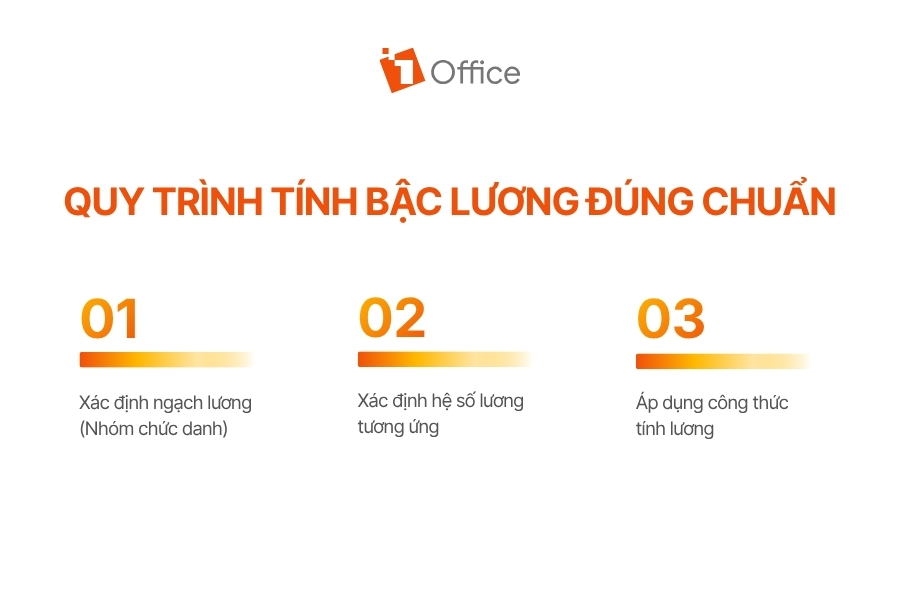
Step 1: Determine the Salary Rank (Job Title Group)
Each job position will belong to a specific salary rank based on its nature and professional requirements (e.g., Administrative staff rank, Engineer rank, Manager rank). Within each rank, the business will divide it into different salary grades.
Step 2: Determine the Corresponding Salary Coefficient
The salary coefficient is a quantitative index of the income difference between grades. This coefficient is either developed by the business in its salary scale or applied according to state regulations.
Step 3: Apply the Salary Formula
The employee’s basic salary is determined by the formula:
| Salary by Grade = Base Salary x Salary Coefficient |
Where:
- Base salary: The lowest starting salary (usually based on the regional minimum wage as stipulated for 2026).
- Salary coefficient: The index corresponding to each level n (typically, a subsequent level is higher than the preceding one).
Illustrative example:
Suppose a business sets up the salary scale for the Marketing Specialist position in 2026 as follows:
| Base salary (Level 1) | 6,000,000 VND |
| Salary coefficient level 2 | 1.1 |
| Salary coefficient level 3 | 1.21 |
Calculation:
- Level 2 Salary = 6.000.000 x 1.1 = 6.600.000 VNĐ.
- Level 3 Salary = 6.000.000 x 1.21 = 7.260.000 VNĐ.
To have their salary adjusted from a lower level to a higher one, employees typically need to meet 3 core conditions:
- Work Performance (KPI): Successfully complete tasks and meet or exceed assigned targets.
- Length of Service (Seniority): Meet the required length of service as stipulated by the company.
- Work Discipline: No violations of company rules and not currently under disciplinary action.
You might be interested in: Top 15 Best Payroll Software Today [Latest 2026]
A Guide for Businesses on Building a Professional Salary Level System

Step 1: Analyze Jobs and Classify Positions
Businesses need to review the entire organizational chart and job descriptions (JDs) for each position. Based on difficulty, responsibility, and qualification requirements, group positions of equivalent value into the same Salary Grade.
Example: The specialist group (Accountant, HR, Marketing) can be in the same grade; the management group (Department Head, Director) is in a higher grade.
Step 2: Determine the Minimum and Maximum Salary for Each Grade
After establishing salary grades, the business needs to define the Salary Range for each grade:
- Floor (Min): The lowest salary for a newcomer in that grade (must be higher than the regional minimum wage).
- Ceiling (Max): The highest salary an employee in that grade can receive.
This should be based on the company’s ability to pay and market salary survey results to ensure competitiveness.
Step 3: Design Salary Levels and the Gaps Between Them
The salary scale and payroll are essentially a collection of salary levels associated with job titles. Depending on the size and culture, the business will divide the salary range from Min to Max into several smaller steps (salary levels). The number of levels usually ranges from 1 to 6, 9, or 12.
Current law encourages businesses to negotiate this gap themselves (usually from 5% to 10%) to motivate skill improvement.
Step 4: Establish a Salary Level Promotion Policy
To ensure the process of promoting from level n to n+1 is accurate, businesses need to apply clear metrics for performance and seniority.
- Seniority: Minimum length of service (e.g., reviewed every 1 or 2 years).
- KPI Results: Must achieve “task completion” or “excellent” status in the evaluation period.
- Competency/Certifications: Complete internal training courses or obtain new professional certifications relevant to job requirements.
Additionally, businesses should specify promotion types, such as regular promotions or early promotions for employees with outstanding achievements.
See also:
- 6+ Employee KPI Evaluation Forms to Optimize Performance 2026
- A-Z Guide to Building a KPI System for Businesses
- TOP 12+ Best Employee KPI Evaluation Software 2026
Step 5: Announce and Officially Implement
To make the salary level system legally and practically effective:
- Consultation: Get feedback from the employee representative organization (Trade Union).
- Public Announcement: Post the salary scale at the workplace or send a notification through the internal management system.
- Legal Documentation: Keep records as a basis for signing labor contract addendums and for deducting insurance and tax payments as required by law.
Smart Salary Management Solution with 1HRM
Instead of manual tracking in Excel, 1HRM automates the entire process of managing salary scales and grade promotions based on actual data:
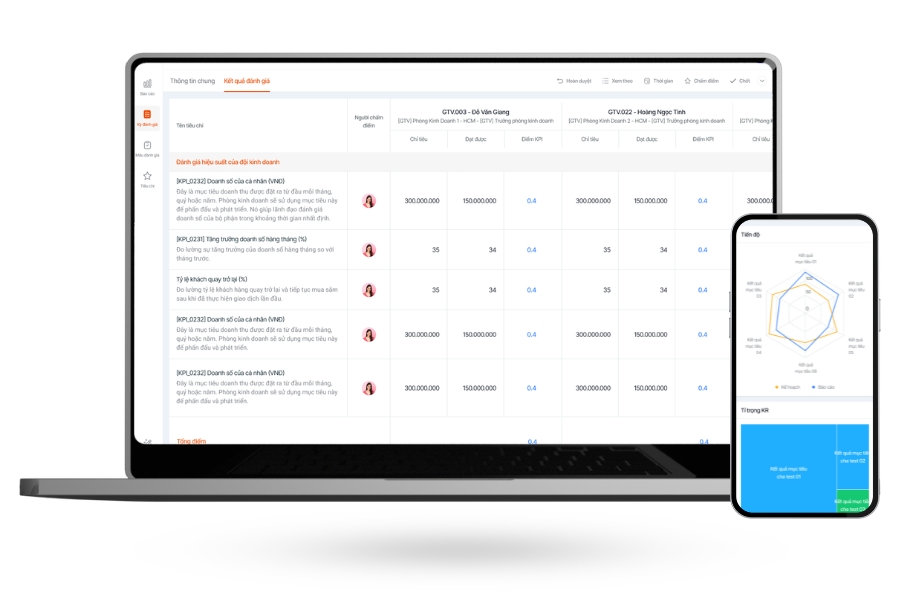
Performance Data-Based Promotion Criteria
- Connects data from the KPI Performance Management and OKR Goal Management modules to serve as a basis for salary grade promotions based on actual results.
- Updates work completion progress in real-time, creating a set of authentic evidence to make the review process transparent and eliminate subjectivity.
Automated Competency Assessment
- Establishes a detailed competency framework for each job position and automatically scores based on multi-dimensional assessment data.
- The system automatically provides suggestions or triggers the grade promotion process as soon as an employee meets the required competency score.
Flexible Salary Formulas by Grade
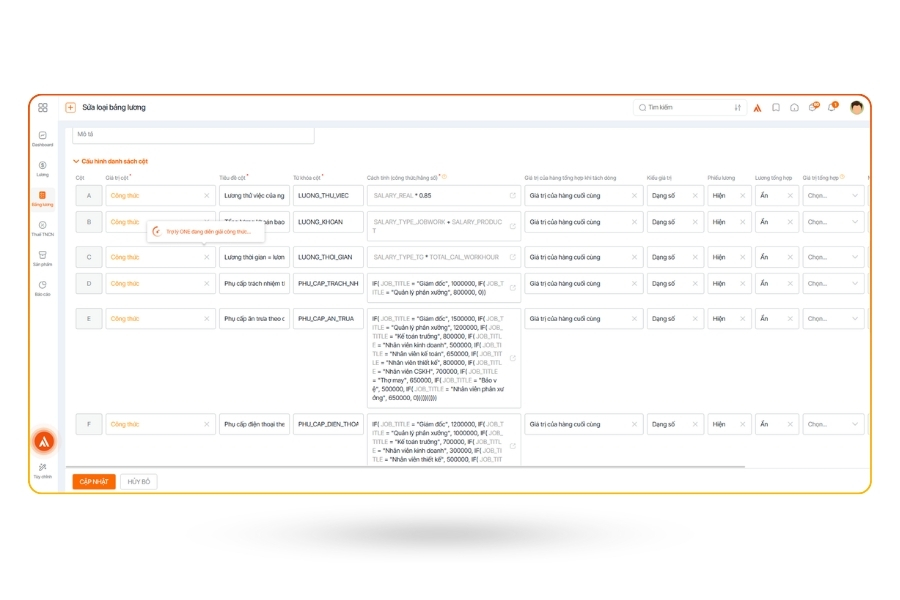
- 1HRM allows setting up variable calculation functions for each salary grade, scale, and accompanying allowance.
- When a promotion decision is made, the new salary level is automatically applied to the monthly payroll without requiring re-entry.
Automated Payslips and History
- Centrally stores the entire history of salary changes in employee profiles, facilitating quick data lookup and reconciliation.
- Employees can proactively track their payslips and personal promotion roadmap directly on the mobile app.
Digitized Approval Process
Salary grade promotion proposals are routed and approved online directly on the system, shortening processing time and ensuring accuracy for the C&B department when finalizing the monthly payroll.
Frequently Asked Questions about Salary Grades (FAQ)
What is a salary scale?
A salary scale is a concept used to classify jobs based on qualifications, skills, and complexity. Each salary scale includes a group of job positions with equivalent value within the organization.
What is salary grade 1?
Salary grade 1 is the lowest starting income level within a specific salary scale. This is typically the salary applied to newly hired employees, those on probation, or individuals who have just met the minimum standards for the position. By regulation, salary grade 1 cannot be lower than the regional minimum wage for 2026.
What is salary grade 2?
Salary grade 2 is the next income level after grade 1 within the same salary scale. Employees are typically promoted to salary grade 2 after completing a certain period of service (usually 1-3 years) and meeting the performance standards set by the company’s regulations.
Is it mandatory for businesses to increase salary grades annually?
Current labor laws do not require businesses to increase salary grades annually for all employees. Grade promotions depend on:
- The company’s internal salary and bonus regulations.
- The collective labor agreement.
- Commitments in the labor contract.
However, businesses are responsible for establishing clear promotion standards to ensure employee rights and maintain motivation.
What is the maximum salary grade?
The law does not specify a maximum number of salary grades within a scale for the private sector. The number of grades is entirely decided by the business based on its size and HR strategy (typically from 5 to 12 grades). For the public sector, the number of grades is specifically regulated for each civil servant and public employee category according to government decrees.
How do salary grades affect social insurance contributions?
The salary grade is the direct basis for determining the contribution amount for compulsory insurance (Social Insurance, Health Insurance, Unemployment Insurance). When an employee is promoted, the salary stated in the contract increases, leading to a corresponding increase in the monthly insurance contributions for both the company and the employee.
However, contributing insurance based on a higher salary provides long-term benefits for the employee, increasing the value of maternity, sickness, and unemployment benefits, and especially the future pension amount.
Conclusion
Understanding what a salary scale is and staying updated on the latest regulations for 2026 is not only a legal responsibility but also a key factor in building trust between employees and the business. A transparent and fair salary scale system is the clearest career progression path, helping to boost work performance and retain talent sustainably.
In the context of salary policies undergoing many market-aligned changes, maintaining manual salary management with Excel can lead to unnecessary errors. Therefore, digitizing the salary scale management process through solutions like 1HRM is a strategic move, helping businesses automate the calculation process, ensuring accuracy, and ensuring absolute compliance with current legal regulations.
















