


 11/05/2026
  420 views
SaaS is an increasingly popular software model because it helps businesses deploy quickly, scale easily, and reduce infrastructure pressure. If you want to understand what SaaS is and why this model is so popular, this article will help you quickly grasp the core points.
Mục lục
- 1. What is SaaS?
- 2. The History of SaaS
- 3. How the SaaS model works
- 4. What are the advantages of applying the SaaS model?
- 5. What are the challenges and risks of the SaaS platform?
- 6. Global development trends for SaaS software
- 7. How is the SaaS model applied and priced in Vietnam?
- 8. Frequently Asked Questions about SaaS
- 9. Conclusion
1. What is SaaS?
SaaS (Software as a Service) is a software delivery service. SaaS provides a complete software solution that you purchase on a subscription basis from a cloud service provider.
You will rent the right to use this software for your business, and your employees will connect to it via the Internet. This application is typically used through a web browser, though some providers also offer a mobile app.
The service provider’s data center provides all the necessary infrastructure, middleware, application software, and data. The service provider manages the hardware and software and, with an appropriate service agreement, will ensure the availability and security of your application and data.
2. The History of SaaS
SaaS was developed in the late 1950s and early 1960s. In the following years, SaaS was researched and developed on computer hardware, allowing for individual use. The cost of SaaS during this time was also less expensive. However, the SaaS system was still inefficient on a large scale as businesses required high levels of continuous software and hardware maintenance.
In the mid-1990s, the Internet reached new heights in e-commerce transactions. The growth of the Internet then spurred the birth of the “online cloud,” allowing organizations to access software from anywhere.
In 1999, Salesforce perfected SaaS by launching its own customer management software. Thanks to a strong start, Salesforce quickly became the first superstar in the SaaS space. It remains one of the largest pure-play SaaS companies in the US. As a result, companies of all shapes and sizes, from young startups to industry giants including Microsoft, Oracle, and SAP, were eager to focus on building and developing in this direction.
Today, SaaS is ubiquitous. With pure-play companies like Adobe, Salesforce, Shopify, and Intuit leading the way, the SaaS market is expected to reach $145 billion by 2022. In the Vietnamese market, well-known names are also gradually growing in technology with effective SaaS models.
3. How the SaaS model works
SaaS operates through a cloud delivery model. The software provider will host all related data by using servers, network resources, and computer systems to store the application in their data center. Therefore, the SaaS software application can be accessed on any device with a network connection.
-

SaaS is a software service for businesses
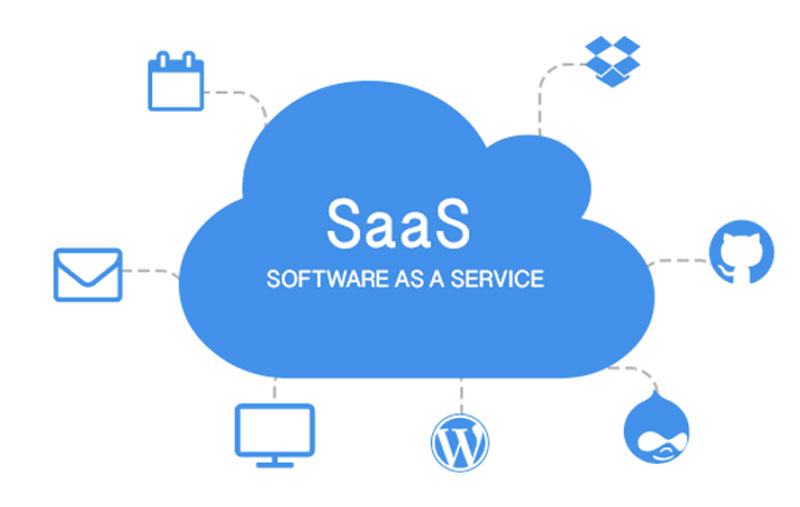
Additionally, your business will not be tasked with setting up and maintaining the software when applying this model. Instead, you pay a subscription fee to gain access. This is because it is a ready-made solution for people in the business to use.
In this SaaS model for businesses, the provider gives you network-based access to a copy of the application they have created. Of course, the source code is the same for all customers, and when new features or functionalities are released, they are rolled out to all business or user customers.
Furthermore, businesses can integrate the SaaS model with other software using an application programming interface (API). For example, a business can completely rewrite its own software and use the SaaS platform provider’s APIs to integrate with it. However, you will need to pay a higher cost than the contracted subscription price.
As a leading business management platform today, 1Office software possesses a full range of features that allow for the management of all aspects of a business, from HR and sales to the internal network, along with easy integration capabilities. 1Office software service is an excellent choice for business management operations.
4. What are the advantages of applying the SaaS model?
The SaaS platform enables organizations using this model to avoid having to directly install and run applications on their computer operating systems. This helps you eliminate the costs of purchasing and maintaining hardware, as well as software licensing fees and other costs related to software installation and support.
The SaaS (Software as a Service) model offers many benefits to businesses and users, including:
- Cost savings – No need to invest in expensive infrastructure, servers, or hardware; just pay a subscription fee based on usage needs.
- Easy access – Users can use the software from anywhere, as long as they have an internet connection.
- Automatic updates – The SaaS provider is responsible for updating the software, ensuring new features and security without user intervention.
- Flexible scalability – Easily upgrade or downgrade services according to the business’s needs without worrying about infrastructure.
- Easy integration – Many SaaS solutions support integration with other software via APIs, helping to connect and synchronize data quickly.
- Enhanced security – SaaS providers often have advanced security measures, including data encryption, regular backups, and multi-factor authentication.
- Supports remote work – Employees can work from anywhere without being limited by specific hardware or software.
- Quick deployment – No complex installation is required; users can start using the service immediately after subscribing.
However, every model has its own challenges and risks. So, what are the disadvantages of operating a SaaS (Software as a Service) model?
5. What are the challenges and risks of the SaaS platform?
Besides the outstanding advantages that the Software as a Service platform offers, SaaS also poses some potential risks for businesses. Because you have to rely on external vendors to use this software, it is they who keep the software running, monitored, and reported on. Therefore, this leads to the following issues:
-

The SaaS model can also present many obstacles for businesses if the wrong service is chosen
5.1. Issues beyond your control
Issues can arise when the software provider experiences service disruptions. They might impose unwanted changes to these services or there could be a security breach. All of these issues can have a significant impact on the SaaS software application under your control. To prevent these problems, you should thoroughly understand the SaaS provider’s SLA and ensure it is enforced.
| Read more: What is an SLA? SLAs are essential for sustainable businesses! |
5.2. Customers lose control over versioning
If the software developer updates to a new version of the SaaS application, it will be deployed across the entire system and the customer’s shared source code. Whether you want the new version or not, you have to accept it. This may require your business to spend time and resources on training.
5.3. Difficulty in switching providers
As with any cloud service provider, switching vendors can be difficult. To switch, you must move a very large amount of data from one management system to another. Furthermore, many software developers use proprietary technologies and data types, and they do not allow you to integrate with third parties. Therefore, this difficulty can further complicate data transfers between different parties.
5.4. Information security
Information security is always the biggest concern for all businesses. It is also a significant challenge for SaaS applications today. Therefore, security is the responsibility of the business management software provider when offering this SaaS service. Reliability is a 50/50 proposition if the provider is not reputable and has no standing in the market.
6. Global development trends for SaaS software
One thing is certain: businesses today use at least one software as a service provided by a SaaS developer. With products dominating the technology market such as Oracle, Google, ServiceNow, Microsoft, IBM, etc., it’s clear that Software as a Service holds a leading position in the tech software market.
According to a new report by BCC Research on the software as a service market, the SaaS software model was valued at $44.4 billion in 2017 and is projected to increase to $94.9 billion by 2022, equivalent to a growth rate of 16.4%. This figure demonstrates the great potential and opportunity for the development of the SaaS service model.
SaaS has caught up with global technology trends by offering software services from a wide range of providers. The diversity of products, along with the smooth and effective compatibility between SaaS applications, creates strength and comprehensiveness in applying technology to manage business operations. This explains why SaaS software is increasingly being used in businesses. According to BCC Research, the average was 16 applications per business (in 2017).
7. How is the SaaS model applied and priced in Vietnam?
Products from the SaaS model are also very diverse and are distributed by many providers in the B2B and B2C markets. For example: Microsoft 365, Hubspot, Trello, Netflix, Slack, Mailchimp, etc.
SaaS applications from global providers offer many general advantages and conveniences. However, there are many limitations for Vietnamese businesses that have to use foreign versions that have not been localized, making them difficult to use. This, in turn, hinders a company’s operational and development processes.
In the Vietnamese market today, there are also quite a few providers of SaaS software. These providers may only offer individual components or features within the SaaS structure, rather than a comprehensive SaaS solution. In this context, 1Office is the best choice.
- What is B2B? Characteristics and popular B2B business models
- What is B2C? Today’s leading B2C business models
-

1Office software integrates all the necessary tools for your business
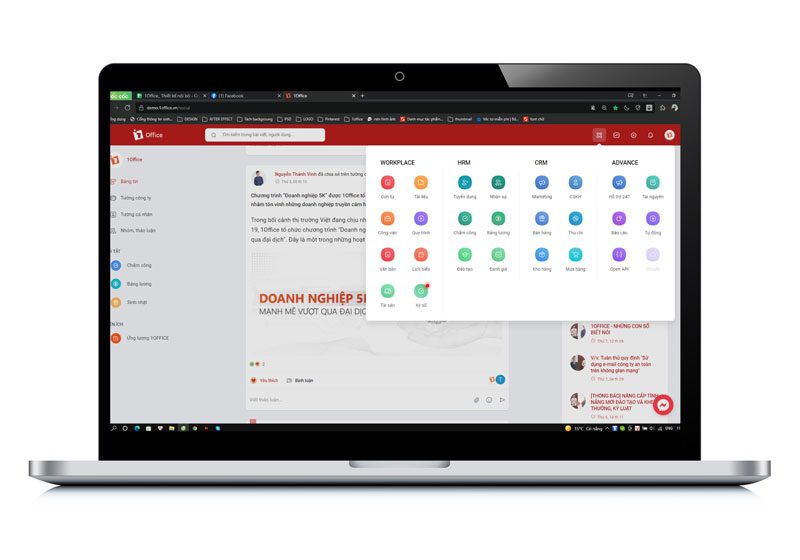
1Office is a total business management solution, providing the most complete SaaS application software on the market with the following 3 toolsets:
- Workplace: A tool for managing work resources and internal communication.
- HRM: A tool for managing human resources for companies of all sizes, from small to large, with few or many branches.
- CRM: A tool for managing all business activities from marketing to customer care, from tracking to evaluation and data reporting.
- Advanced: Allows you to connect and integrate with third parties.
Regarding SaaS pricing on the 1Office solution, it is calculated flexibly based on the requirements and operational scale of your business. For example, it can be based on each user, meaning the subscription cost is determined by the size of your company’s workforce. Costs are also calculated based on the features enabled or disabled for each registered account.
1Office’s software packages are divided into different types: Basic, Advanced, and Premium.
For a detailed price quote for our business management software, please refer here.
8. Frequently Asked Questions about SaaS
The information above provides a basic understanding of SaaS theory. However, for a deeper understanding, let’s look at some frequently asked questions:
8.1. What is SaaS marketing?
SaaS marketing uses standard marketing methods to promote and attract potential customers for cloud-based software applications and information services.
8.2. What is B2B SaaS?
B2B SaaS simply refers to companies that sell software services to other businesses. These products help organizations optimize various functions including marketing, sales, and customer service.
8.3. How is MRR calculated for a SaaS business?
Monthly Recurring Revenue (MRR) is a critical metric for SaaS businesses that use a monthly subscription pricing model. The MRR calculation is simple: multiply the average revenue per customer by the total number of accounts for that specific month.
8.4. What is the difference between the SaaS, IaaS, and PaaS models?
SaaS is just one of three main cloud service models, along with IaaS and PaaS. All three models involve cloud providers offering their own hosted data center resources to customers over the Internet.
-

SaaS operating model
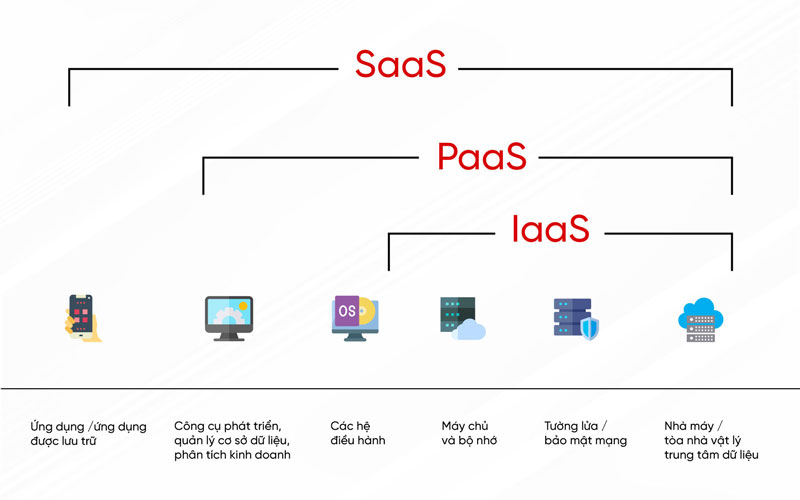
The completeness of SaaS compared to other models
The difference between the models lies in the completeness of the product. SaaS software are complete and more fully managed applications that include: internal communication tools, work resource management tools, human resource management tools, customer management, and third-party utilities,…
IaaS is largely the outsourcing of data center resources. PaaS provides a development platform and other tools hosted by the provider’s data center.
Differences in software and resource repositories of SaaS, IaaS, and PaaS
SaaS Platform application users do not have to download software, manage any existing infrastructure, or handle any technical aspects. The providers handle maintenance, upgrades, support, security, and all other aspects of managing the software.
IaaS is used by companies that want to outsource their data center and computing resources to a cloud provider. IaaS providers host infrastructure components such as servers, storage, networking hardware, and virtualization resources. Customer organizations using IaaS services still have to manage their data usage, applications, and operating systems.
PaaS provides a resource framework for an organization’s in-house developers. This hosted platform allows developers to create custom applications. The provider manages the data center resources that support the tools. Customer organizations using PaaS services do not have to manage their Operating System, but they must manage their applications and data usage.
9. Conclusion
Vietnamese businesses are currently developing on integrated SaaS Platforms to build a complete system and operate their businesses smoothly. We call SaaS the “new wave” in the market today. Therefore, to understand in more detail what an all-in-one management software applying the SaaS model is, please contact us via hotline 083 483 8888.
For more detailed information, please contact us via:
- Hotline: 083 483 8888
- Fanpage 1Office: https://www.facebook.com/1officevn
- Youtube: https://www.youtube.com/c/1OfficeNềntảngquảnlýtổngthểDoanhNghiệp
















