


 12/05/2026
  365 views
Six sigma is a renowned quality improvement method behind the success of many businesses, both large and small. However, not everyone fully and correctly understands what 6 sigma is, or how to effectively implement Six Sigma in a business.
Mục lục
- 1. What is Six Sigma?
- 2. What is the significance of the Six Sigma method?
- 3. What is Lean Six Sigma? A Lean Improvement Model Variant of 6 Sigma
- 4. What are the outstanding benefits of Six Sigma in quality management?
- 5. Principles for effective Six Sigma application
- 6. The Process of Applying the Six Sigma Method Using the DMAIC Model
- 7. Case Study: Ford Vietnam Applies 6 Sigma for Breakthrough Growth
1. What is Six Sigma?
Six Sigma (or 6 Sigma) is a standard for measuring quality and performance in quality management and production process improvement. In this context, sigma (σ) is a symbol in statistical theory that denotes the standard deviation of a set. Sigma, in this case, is used as a measure of the level of variation or deviation of a process or product from the initially set standard.
According to the 6 Sigma standard, there are only about 3.4 errors or defects per one million products produced or processes performed. In other words, 6 Sigma is equivalent to an error or defect rate of only ~0.00034% of the total products or production processes.
6 Sigma is divided into the following 6 levels:
- 1 Sigma: 690,000 defects/1 million products, equivalent to 69%
- 2 Sigma: 380,000 defects/1 million products, equivalent to 30.8%
- 3 Sigma: 66,800 defects/1 million products, equivalent to 6.68%
- 4 Sigma: 6,210 defects/1 million products, equivalent to 0.621%
- 5 Sigma: 230 defects/1 million products, equivalent to 0.023%
- 6 Sigma: 3.4 defects/1 million products, equivalent to 0.00034%
2. What is the significance of the Six Sigma method?
Six Sigma is a quality management and production process improvement method aimed at minimizing variations in production. This method is used to measure and analyze data on product quality and production processes to identify the causes of defects and find solutions to correct them. The hallmark of 6 Sigma is its high precision, with a “standard deviation” of only about 3.4 defects per one million products.
6 Sigma focuses on optimizing the production process and continuous improvement, aiming to achieve the highest level of precision to prevent defects from occurring in the process. This ensures product quality from the very beginning rather than focusing on fixing defective products.
See more related articles:
3. What is Lean Six Sigma? A Lean Improvement Model Variant of 6 Sigma

Lean Six Sigma is a combination of the Lean Manufacturing method and the 6 Sigma method. The Lean Manufacturing method focuses on minimizing waste in the production process by optimizing production flow, increasing efficiency, and reducing production costs. Meanwhile, the Six Sigma method focuses on minimizing errors in the production process by using statistical techniques, helping to optimize the production process and ensure product quality.
By combining both methods, Lean 6 Sigma creates a comprehensive solution for managing and improving the production process, helping to enhance production efficiency, minimize waste and errors, and improve product quality.
| Read more: What is Kaizen? How to Effectively Apply Kaizen in Your Business |
4. What are the outstanding benefits of Six Sigma in quality management?
The Six Sigma method is a quality management tool that businesses and corporations, from small to large, focus on investing in and implementing due to the sustainable benefits it brings. So, what value do organizations receive when applying 6 Sigma?
- Reduce production costs: By minimizing defective products, shortening waiting times, and eliminating waste in the production process, Six Sigma helps save costs and raw materials, thereby reducing the cost per unit and increasing profits.
- Improve product quality: The 6 Sigma method helps businesses enhance product quality by minimizing the volume of defects and optimizing the production process. Tightly controlled product quality that meets quality standards and customer expectations is the key to retaining customers and increasing brand credibility.
- Enhance competitiveness: The 6 Sigma method in quality management helps strengthen a company’s competitive power by improving production processes, optimizing performance, and enhancing the quality of products and services. This allows the organization to build a competitive advantage and achieve sustainable development in the market.
5. Principles for effective Six Sigma application
After understanding what Six Sigma is, we need to grasp the basic principles to apply the 6 Sigma method effectively in quality management:
- Focus on customer needs: The customer is always the most important factor and the ultimate goal of the 6 Sigma method. Therefore, to succeed in applying the Six Sigma method, businesses must place the customer at the center of all decisions.
- Data-driven approach: Data is a core element in the 6 Sigma implementation process. Therefore, the figures and data used must be collected, processed, and analyzed completely and accurately.
- Continuous improvement: Six Sigma is not a standalone project but a business philosophy, a continuous process. Therefore, it is necessary to maintain a quality management system to monitor and improve business processes to meet market changes and customer needs.
- Accepting imperfections: Just as the 6 Sigma standard is 3.4 defects per million opportunities, no process can achieve absolute perfection. Therefore, managers must always be ready to address problems if errors occur. Minor errors or defects are also seen as opportunities to improve processes, enhance quality control, and boost the organization’s capabilities.
| >> Discover how to: Increase Work Efficiency by 200% with Work Improvement Ideas |
6. The Process of Applying the Six Sigma Method Using the DMAIC Model
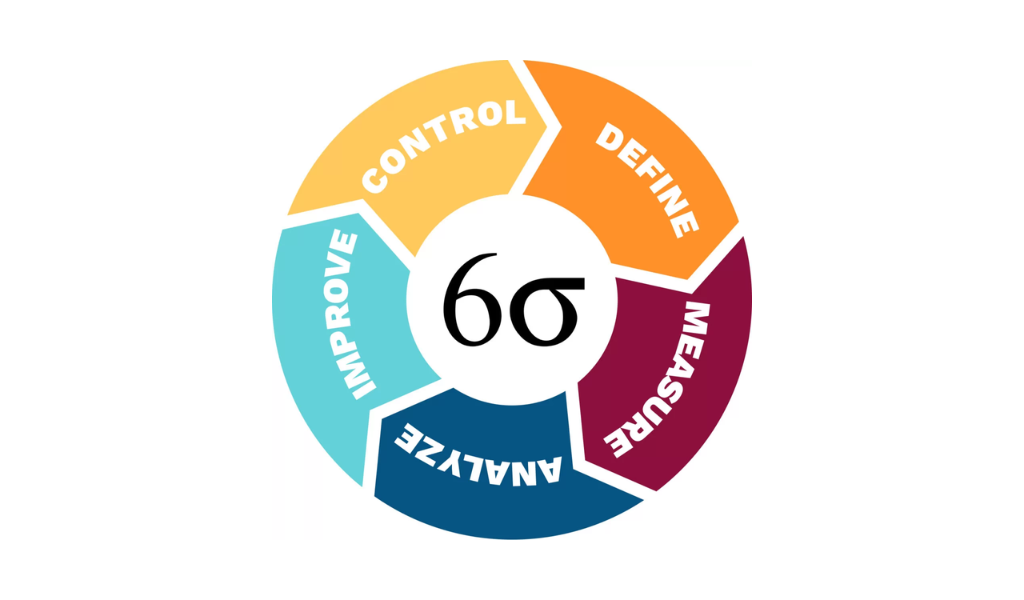
A common process widely used to apply Six Sigma most effectively in most businesses is DMAIC. The DMAIC process consists of 5 steps: Define, Measure, Analyze, Improve, and Control.
Step 1. Define
Define is the first step in the Six Sigma improvement process, serving as a foundational step that helps the organization identify the basic data needed to implement 6 Sigma for quality management and improve business processes.
The key aspects to focus on during the Define step include:
- Define the problem: Clearly define the problem to be solved using Six Sigma and investigate its root cause. The problem can appear in various aspects of the operational process, from production to customer service.
- Define the goals: Set specific, clear goals for the improvement project. The goals must be measurable by specific quality metrics. Some metrics that can be used include:
- Process Performance metrics: Measure the process’s ability to produce products or services that meet customer requirements.
- Process Variation metrics: Measure the degree of fluctuation in the production process, represented by standard deviation or process variation.
- Product Reliability metrics: Measure the product’s ability to function correctly and meet customer requirements over a specific period.
- Identify the customers: Identify who the end customers of the process to be improved are and understand their requirements that can be addressed through 6 Sigma.
- Determine the data to be collected: Determine the types of data needed to assess the current state of the process and make decisions about the improvements to be made. Typically, data related to quality characteristics is expressed in numerical form, with two common types: data on the results of quality characteristics and process data that indicates the cause of the quality characteristics.
- Define the scope: Analyze the current operational process to find “gaps” that need improvement. From this, the team will determine the areas to focus on for implementing Six Sigma quality management, including which activities are within the scope of the process and which are not.
| >> Learn more: What is BPMS? The role and core functions of Business Process Management Software |
Step 2. Measure
The second step of the 6 Sigma DMAIC application process is Measure, which involves measuring data from the production process and collecting the necessary parameters to assess the current state of the process and its sigma level.
Here are some tasks to be performed in the Measure step of the DMAIC process:
- Collect data: Collect data on the current process using measurement tools and techniques. The data must be collected according to predefined standards and its accuracy and completeness must be ensured.
- Measure performance: Measure the performance indicators of the current process, including processing time, error rate, number of completed products, and production costs.
- Identify influencing variables: Identify the variables that affect the process, including input and output variables, operations performed within the process, and environmental factors.
- Determine the gap between the current process and quality standards: After collecting and evaluating the data, the 6 Sigma team needs to determine the gap between the current process and the quality standard. This gap will help the Six Sigma team assess the level of improvement the process needs to achieve the 6 Sigma quality standard.
Step 3. Analyze
After completing the Define and Measure steps, the Six Sigma implementation team will proceed with analysis to identify the root causes of problems or defects in the production process.
The tasks to be performed in the Analyze step include:
- Analyze collected data: Analyze the data collected from the Measure step to understand its characteristics and distribution using statistical tools.
- Identify root causes: After analyzing the collected data, it is necessary to identify the root causes of the problem. The Six Sigma team can use various methods such as the Pareto principle, Ishikawa fishbone diagrams, scatter plots, regression analysis, etc.
- Summarize analysis results: Summarize the analysis results and draw conclusions about the root causes of the gap between the current process and quality standards, as well as proposed improvement solutions for the process. These results will be used to proceed to the next step, Improve.
Step 4. Improve
The Improve step is a crucial stage in the Six Sigma DMAIC process. In this step, the team will focus on implementing improvement solutions to minimize defects and enhance product quality. The tasks that need to be performed to ensure the effectiveness and sustainability of the improvement process include:
- Propose improvement solutions: Based on the analysis results from the Analyze step, propose improvement solutions to minimize the gap between the current process and quality standards. These solutions may include changing the work process, updating systems or new technologies, training employees, etc.
- Evaluate solution feasibility: Conduct experiments to test the feasibility and effectiveness of the proposed improvement solutions. Simultaneously, verify data and information to ensure the accuracy of the results.
- Implement changes and improvements: If the solutions are accepted and proven effective, the Six Sigma team will proceed to implement the changes and improvements in the process. The team will ensure that the changes are implemented on time, within scope, and achieve the improvement objectives.
Step 5. Control
Control is the final step in the Six Sigma DMAIC process. In this step, the 6 Sigma implementation team for the business will establish control mechanisms to ensure stability and meet the objectives set after the improvement process.
The tasks to be performed in the Control step include:
- Establish a control system: Establish a control system to monitor the process and ensure that it is operating stably and meeting the established 6 Sigma quality standards. This control system includes quality control processes, performance evaluation, and monitoring systems to detect and address any issues that arise.
- Establish measurement metrics: The measurement metrics established in the Measure step will be used to monitor the process in the Control step. The Six Sigma team needs to ensure that these metrics are regularly measured and monitored to ensure the process operates stably and meets the established quality standards.
- Establish a feedback system: Establish a feedback system to detect and address arising issues, while also helping the process operate stably in the future.
- Evaluate effectiveness: Evaluate the effectiveness of the improved process by comparing quality and performance indicators before and after implementing the DMAIC process. This evaluation should be performed periodically to ensure that the process is operating stably and meeting the set quality objectives.
7. Case Study: Ford Vietnam Applies 6 Sigma for Breakthrough Growth
The success of millions of businesses worldwide in implementing the 6 Sigma method for quality management in their operations has affirmed the stature and optimization of this lean improvement method. Among them, Ford Vietnam is a typical success story.
Ford Vietnam is a joint venture between Ford Motor Company, headquartered in Michigan, USA, and Song Cong Diesel Company, focusing mainly on car assembly, manufacturing, marketing, sales, and customer care. Before applying 6 Sigma, Ford Vietnam’s business production process had quite a few “loopholes” in its operations, leading to:
- High error rate
- High production costs
- Slow delivery process
- Long product creation time
Since 2000, Ford has initiated the implementation of Six Sigma with 200 improvement projects across all areas. So, what were the results that Ford Vietnam achieved by applying 6 Sigma?
The implementation of the Six Sigma method in operational quality management created a remarkable breakthrough, helping Ford Vietnam save $1.2 million and achieve a customer satisfaction index score of over 90% for many consecutive years. Notably, in 2016, the defect rate for Ford vehicles manufactured in Vietnam decreased from 250 PPM to below 50 PPM.
In the article above, 1Office has introduced readers to what 6 Sigma is and how to apply Six Sigma in a business for optimal results.
For an operational system to achieve the best efficiency, the key is not only to understand what 6 Sigma is and grasp its application principles but also to depend heavily on the management technology the business is using. For a consultation and a trial of our business management software that helps streamline processes and triple operational efficiency, please contact us using the information below:
- Hotline: 083 483 8888
- 1Office Fanpage: https://www.facebook.com/1officevn
- Youtube Channel: https://www.youtube.com/c/1OfficeNềntảngquảnlýtổngthểDoanhNghiệp
















