


9 Roles of Corporate Culture in Business Development


A good corporate culture cannot be replaced by any other benefit because it has a huge impact on the engagement, productivity, and overall success of a business. The role of corporate culture is undeniable in building a healthy work culture and sustainable business development, however, not every business is aware of the value and importance of corporate culture. Join 1Office to explore the 9 roles of corporate culture that every CEO needs to understand in the following article.
Mục lục
- 1. Understanding the nature of corporate culture
- 2. 9 roles of corporate culture in business development
- 2.1 Guiding employee behavior and awareness
- 2.2 Promoting, maintaining, and developing core values
- 2.3 Shaping the employer brand and retaining talent
- 2.4 Building a unique brand identity
- 2.5 Establish operational consistency
- 2.6 Enhance performance and work quality
- 2.7 Minimize unnecessary conflicts
- 2.8 Increase brand credibility
- 2.9 Effective onboarding
- 3. 1Office – The platform for effectively building a 4.0 corporate culture
- 4. Conclusion
1. Understanding the nature of corporate culture
Corporate culture is the collection of values, beliefs, attitudes, norms, and shared behaviors of an organization. It shapes the way employees interact with each other, with customers, with partners, etc. Corporate culture not only affects the work environment but also directs the development, efficiency, and success of the business.

The 5 elements that make up a corporate culture include:
- Core Values: These are the principles and standards that the business values and strives for. Core values can include honesty, innovation, respect, social responsibility, and customer-centricity.
- Vision and Mission: Vision is the long-term goal the business wants to achieve, while the mission is the reason for the business’s existence. Both of these elements help to guide and inspire employees.
- Attitudes and Beliefs: The attitudes and beliefs of leaders and employees towards their work, customers, and business partners play a crucial role in shaping corporate culture.
- Leadership Style: The way leaders manage and interact with employees also affects corporate culture. Democratic, open, and creativity-encouraging leadership often creates a positive and dynamic culture.
- Rules and Processes: Specific work rules and processes, decision-making methods, and problem-solving approaches are also an important part of corporate culture.
>>> See more: The elements that constitute a positive and solid corporate culture
2. 9 roles of corporate culture in business development

2.1 Guiding employee behavior and awareness
Corporate culture helps define the principles, rules, and behaviors that employees need to follow. It creates a common framework for the work process, while also guiding how to communicate, interact, and treat each other, customers, and partners.
By establishing a healthy corporate culture, a company can promote proper and ethical behavior within the organization. Corporate culture also guides behavior by defining the goals, roles, and responsibilities of each individual in the organization.
2.2 Promoting, maintaining, and developing core values
Core values such as honesty, respect, creativity, teamwork, and customer-centricity are defined when establishing a corporate culture. By creating an environment where these values are respected and practiced, corporate culture supports the building of a unified and cohesive team.
A work environment with a corporate culture driven by clear purpose and values helps inspire employees to actively engage in their work and interact with colleagues. It also leads to a high level of workforce engagement, thereby boosting productivity.
2.3 Shaping the employer brand and retaining talent
The role of corporate culture not only affects the attitude and way employees perform their work but also impacts the shaping of the company’s employer brand. Candidates can immediately recognize a part of the culture from various sources and decide whether to apply based on it.

A strong corporate culture always prioritizes employees and their relationship with the company and its organizational goals, creating a positive employee experience. These employees are often engaged and passionate about their work, two traits that job seekers can easily notice. A strong corporate culture will attract similarly motivated candidates.
2.4 Building a unique brand identity
Corporate culture helps a business create a distinct identity, standing out in a sea of brands, making it easy for customers, partners, and employees to recognize the company. A strong corporate culture also conveys the company’s core values to stakeholders, helping to build a solid reputation and brand.
Corporate culture represents the company’s image and reputation. People often make assumptions about a business based on their interactions both inside and outside the company. If a business lacks an organizational culture or has a weak image, customers may hesitate to do business with them. Conversely, businesses with a strong brand identity tend to attract more partners and candidates who share similar values and support their mission.
2.5 Establish operational consistency
Corporate culture shapes how work is done, how people communicate, and how problems are solved within the organization, creating a synchronized environment that ensures everyone views and approaches work uniformly. When all employees share the same mindset and work methods, this consistency leads to higher performance, increased efficiency, and helps the organization achieve its goals.
Additionally, corporate culture fosters a sense of consensus and positive interaction among team members. When everyone shares the same vision, goals, and values, they feel more connected and work together more effectively, contributing to a spirit of unity and cohesion, and promoting collaboration within the organization.
2.6 Enhance performance and work quality
A healthy corporate culture includes attractive perks for employees, from the workspace to benefits packages. These perks directly affect employee happiness, which in turn impacts their engagement and productivity. Gallup research shows that businesses with more engaged employees have higher productivity—up to 18% higher.

When employees are provided with the necessary resources and tools to do their jobs, overall productivity and performance increase. Corporate culture also influences the workplace structure by bringing together people with similar skills. Individuals with common backgrounds and skills can work together more effectively when tackling complex projects.
2.7 Minimize unnecessary conflicts
By establishing clear rules and standards of conduct, businesses can prevent unnecessary conflicts. When everyone adheres to common rules of conduct, values, beliefs, attitudes, and behaviors, an environment of mutual support, sharing, and focus on common goals is created, helping to resolve issues in the most agreeable manner.
However, factors such as individual differences, personal goals and interests, internal competition, and work pressure can lead to unwanted conflicts. Although corporate culture provides a foundation for resolving conflicts constructively, appropriate processes, policies, and tools are still needed to handle specific disputes.
>>> Read more: Keep corporate culture “alive” in 5 simple steps
2.8 Increase brand credibility
A business with a good culture and friendly, competent employees will build a positive image in the eyes of customers, partners, and the community. This helps customers feel more comfortable when using the company’s products. By making a good impression on customers, the business has the opportunity to attract more potential clients, increase its competitiveness in the market, and work towards sustainable development.
2.9 Effective onboarding
More and more businesses are building their culture around effective onboarding methods to train new employees. Onboarding activities include orientation programs, training, and performance management, helping new hires access the right resources and easily integrate into their roles. This not only promotes employee longevity and loyalty but also reduces frustration when they lack the necessary information to work effectively. Onboarding is an excellent way for companies to ensure new employees clearly understand and share the company’s core values.
>>> Read more: 3 outstanding examples of corporate culture today
3. 1Office – The platform for effectively building a 4.0 corporate culture
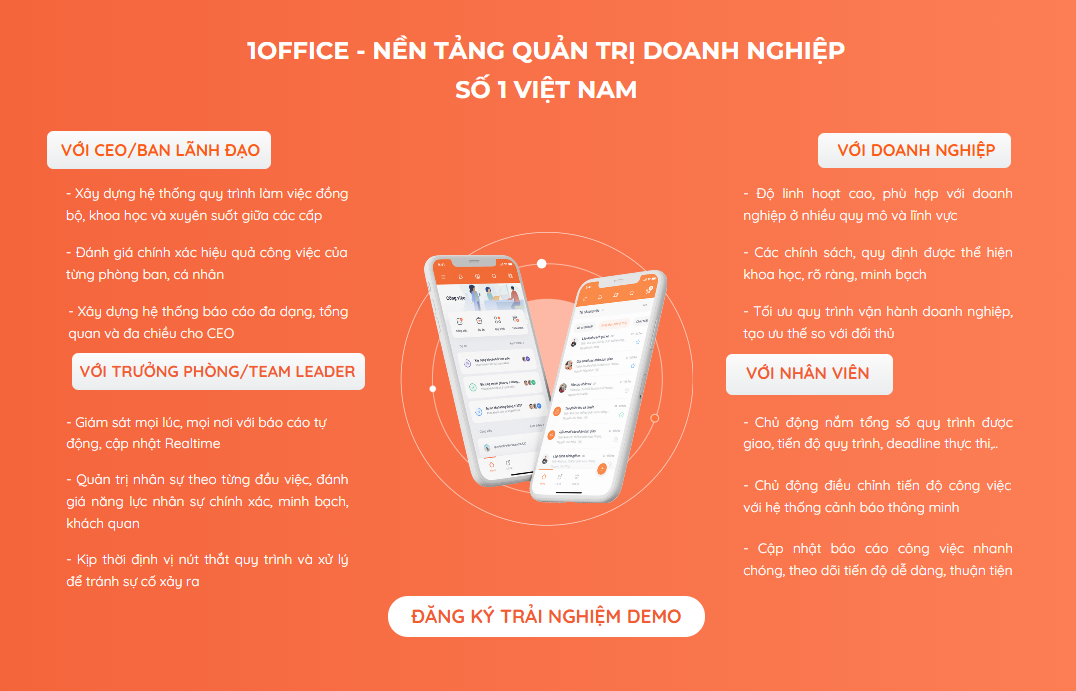
Develop an effective corporate culture with 1Office!
Corporate culture is a solid foundation that inspires and motivates employees. It is the most powerful resource for attracting and recruiting talent. With the goal of helping businesses build a distinctive, modern, professional, and 4.0-digitalization-oriented corporate culture, 1Office software was created to provide a comprehensive solution, helping businesses innovate and change, and enabling employees to connect better with each other:
- Build a professional work environment, enhancing interaction and connection between departments within the company through an internal network system, without having to wait for face-to-face meetings as before.
- Give managers the opportunity to be closer to, listen to, understand, and contribute their opinions. This, in turn, helps motivate employees, making them love their jobs more and stay with the company long-term.
- Build a high-level, tightly-integrated management system with superior features such as personnel management, schedule management, and document management.
With special features that support cultural development and establishment, 1Office contributes significantly to helping businesses find a sustainable work and development culture:
- Easy internal communication environment: With 1Office, businesses can clearly delegate communication management permissions. With an attractive interface, the person in charge can easily draft internal topics with various post types such as announcements, polls, event creation, etc. Additionally, internal communication with 1Work emphasizes interactivity, allowing every individual to comment and share their feelings on posts.
- Build independent communication channels right on the software: Helps create and categorize chat groups by individual, department, and team.
- Embodying the spirit that “Every employee is a crucial nucleus of the organization”: Through 1Office, each individual and their direct manager can track that person’s career progression, creating motivation for effort and recognition. Furthermore, the business can monitor the work process at the company in real-time. This allows for the implementation of appropriate reward and penalty policies for employees.
4. Conclusion
Above are the details of the 9 roles of corporate culture in business development that every manager needs to understand clearly, in order to build a healthy work culture and sustainable business development. If you are looking for a solution that can help your business build a digital 4.0 work culture, learn about 1Office software – Vietnam’s leading all-in-one business management solution!




