


 10/05/2026
  9987 views
Restaurant employee salary is more than just a number – it’s how an organization demonstrates transparency, motivates staff, and controls operational costs. With the unique nature of multiple shift positions, tips, overtime, and more, creating a standard payroll is vital for smooth restaurant operations and retaining talented employees. In this article, 1Office will help you understand how to build an effective restaurant employee payroll for every position, from head chef and servers to managers – along with important notes to ensure fairness and legal compliance. Let’s explore popular and updated payroll templates specifically for the F&B industry in the content below.
Mục lục
- 1. What Information Should Be Included in a Hotel and Restaurant Employee Payroll
- 2. What Factors Determine How Restaurant Employee Payroll is Calculated?
- 3. What percentage of restaurant revenue should labor costs account for?
- 4. Free Restaurant Employee Payroll Template
- 5. Common Salary Calculation Methods in the Restaurant Industry
- 6. Common Salary Ranges for Each Restaurant Department
- 7. Benefits of Calculating Salaries Using a Restaurant Employee Payroll Sheet
- 8. Tips for Storing and Tracking Employee Payroll Sheets
- 9. Standard Employee Payroll Templates for Businesses
- 10. Automate Restaurant Employee Payroll with AI – 1AI Salary
1. What Information Should Be Included in a Hotel and Restaurant Employee Payroll
Basic Information
For restaurants to operate at peak productivity, many different teams and job positions are required, which leads to certain salary discrepancies between roles. However, all restaurant employee payrolls share a common structure:
- Employee Information: Employee name, employee ID (if any), position, contact phone number, address, start date, job role, and other personal information.
- Basic Salary Information: The employee’s basic salary based on working time (e.g., hourly, daily, or monthly)
- Allowances and Subsidies: These include meal allowances, parking subsidies, seniority allowances, and any other allowances and benefits the employee is entitled to.
- Deductions: Includes personal income tax, social insurance, and any other deductions the employee must pay.
- Total Earnings: The total amount the employee receives after calculating the basic salary, allowances, welfare benefits, and after subtracting deductions.
- Signatures: Signatures of the employee and manager to confirm agreement with the information on the payslip.
Allowances and Income Beyond Fixed Salary in a Restaurant
When creating a payroll for restaurant employees, you can’t stop at just the basic salary. In reality, F&B staff often receive various other supplements – which contribute significantly to their actual monthly take-home pay.
Below are common items that managers should note when creating a restaurant employee payroll:
Common Allowances
- Night shift/split shift allowance: usually 20,000 – 50,000 VND/shift depending on policy.
- Meal allowance: if meals are not provided on-site, the restaurant usually pays 20,000 – 30,000 VND/day.
- Travel/gasoline allowance: support for employees who work far away.
- Attendance allowance: for staff who do not take any leave during the month.
Bonuses and Variable Income
- Tips: especially important for service staff and baristas; some places divide them by shift, others by a percentage of the bill.
- Sales/KPI bonus: applied to cashiers, managers, head chefs – linking salary to operational results.
- Spot bonus/team competition bonus: encourages teamwork during peak hours.
- Overtime (OT): calculated at 150%–200% according to legal regulations.
Note: When including allowances in the payroll, they should be clearly itemized to increase transparency and avoid unnecessary conflicts with employees.
Overall, fully reflecting these income sources in the payroll helps employees see the fairness and builds trust in the organization – a key factor in long-term staff retention.
2. What Factors Determine How Restaurant Employee Payroll is Calculated?
Depending on the Labor Contract signed between the restaurant and the employee, parameters such as working hours, work completion levels, and regulations on bonuses and penalties will be determined. The timesheet is an important tool for recording this information, helping to ensure accuracy and transparency in personnel management.

Creating a payroll also requires compliance with legal regulations, especially regarding the regional minimum wage. Based on Decree 90/2019/ND-CP, the minimum wage is determined by region as follows:
- Region I: 4,420,000 VND/month
- Region II: 3,920,000 VND/month
- Region III: 3,430,000 VND/month
- Region IV: 3,070,000 VND/month
This ensures that the payroll is calculated at no less than the minimum wage stipulated for the region where the restaurant operates. This not only complies with legal regulations but also ensures fair benefits for restaurant employees.
3. What percentage of restaurant revenue should labor costs account for?
Labor cost is one of the largest expenses in a restaurant’s operational structure. Determining a reasonable labor cost ratio will help the business balance its budget, ensure profitability, and avoid uncontrolled payroll inflation.
According to surveys from iPOS and major F&B chains in Vietnam, the labor cost ratio should account for about 25% – 35% of total monthly revenue. This figure can fluctuate depending on the restaurant’s scale, service type, and level of operational automation.
Example: If a restaurant’s average monthly revenue is 300 million VND, the reasonable payroll should range from 75 to 105 million VND.
Some notes on optimizing labor costs in a restaurant:
-
Should not exceed 40% of revenue – otherwise, it will affect profitability.
-
Increase employee efficiency instead of just cutting wages – through KPIs, training, and clear processes.
-
Use human resource management software to control work hours, costs, and productivity in real-time.
Balancing a reasonable restaurant employee salary with business efficiency not only helps the organization develop sustainably but also contributes to retaining talent in the competitive F&B industry.
4. Free Restaurant Employee Payroll Template
This is a salary payment file in Word format, showing all the necessary content for an individual employee’s salary slip.
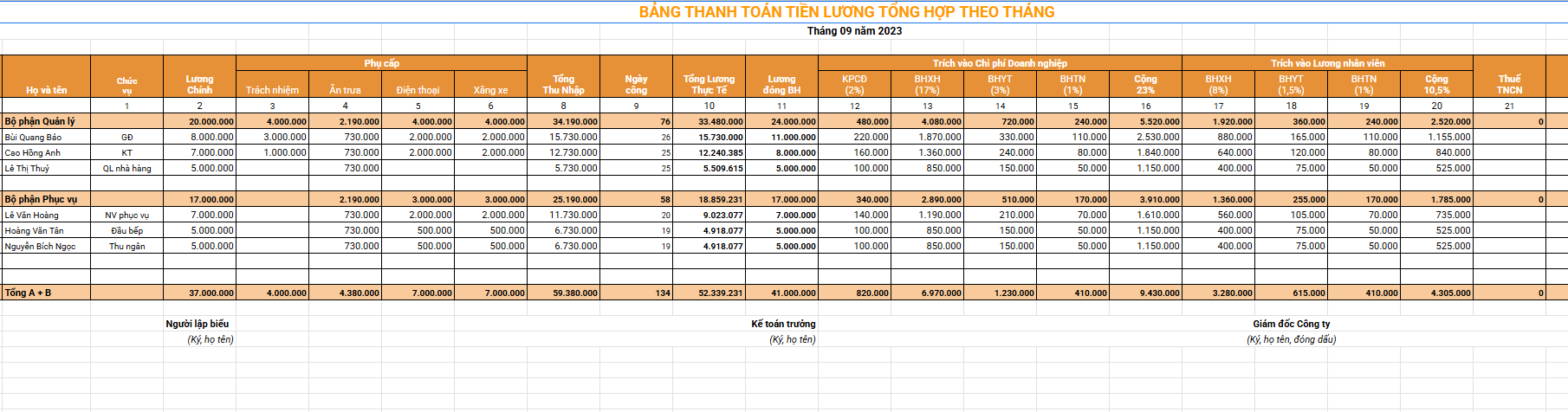
Free download:
General Employee Payroll Template [Latest 2026]
5. Common Salary Calculation Methods in the Restaurant Industry
Depending on the operating model and type of restaurant (buffet, à la carte, coffee shop, take-away…), choosing the appropriate payroll structure will help managers easily control costs and evaluate staff performance. Below are the 3 most common salary calculation methods in the F&B industry today:
| Method | Advantages | Suitable for models |
|---|---|---|
| Hourly/Shift-based salary | Flexible, easy to schedule, suitable for part-time staff | Coffee shops, bubble tea shops, fast food |
| Commission/KPI-based salary | Encourages accountability, motivates performance improvement | À la carte restaurants, specialized service models |
| Fixed salary + bonus | Stable, easy payroll processing, suitable for full-time staff | Buffet restaurants, fine dining restaurants |
Some advice for choosing a payment method:
-
If you have a large staff with frequently changing shifts → you should choose per-shift pay for flexibility.
-
If the goal is to increase revenue/manage service quality → you should add KPI bonuses to create motivation.
-
For management and head chefs → you should apply a fixed salary with bonuses to retain talent and evaluate performance.
Understanding each method helps businesses build a restaurant employee payroll template that fits their actual situation, ensuring both operational efficiency and fairness for employees.
6. Common Salary Ranges for Each Restaurant Department
If your business is budgeting to open a restaurant, employee salaries are a fixed cost. Below are the salary ranges for different positions in a restaurant:
6.1 Kitchen Staff Payroll
To ensure the efficient operation of the restaurant, the kitchen department plays a crucial role in creating unique and high-quality dishes. Led by a team of talented and skilled chefs, the Kitchen Department not only prepares food but also contributes significantly to the restaurant’s appeal.

The professionalism and creativity of the chefs not only determine the quality of each meal but also create a lasting impression on customers. This means that the ability to recruit and retain talented chefs is crucial for attracting and keeping repeat customers.
Example of a kitchen staff payroll:
- Kitchen Department – Executive Chef: Income ~ 26 million VND/month
- Executive Sous Chef: Income ~ 20 – 25 million VND/month
- Head Chef: Income from 15 – 20 million VND/month
- Sous Chef: Income from 9 – 15 million VND/month
- Cook: Income from 5 – 7 million VND/month
- Kitchen Assistant: Income from 3.5 – 5 million VND/month
Note: The restaurant employee payroll table above is for reference only; specific salaries depend on the benefits offered by each restaurant.
6.2 Front of House Staff Payroll
Salaries for front of house staff are often much higher than in other departments, reflecting the significant responsibilities of these positions and the high degree of care required to prevent errors.
Example of a Front of House Staff Payroll:
- Food and Beverage Manager: Salary ~ 22 million VND/month
- Assistant Department Supervisor: Salary from 16 – 20 million VND/month
- Restaurant Manager: Salary from 15 – 17 million VND/month
- Assistant Restaurant Manager: Salary from 10 – 12 million VND/month
- Waiter/Waitress: Salary from 4.5 – 6 million VND/month
- Food Runner: Salary from 3.5 – 5 million VND/month
Note: The salary for hotel and restaurant management staff will be higher than the payroll for regular restaurant staff.
6.3 Payroll for Receptionist/Switchboard/Customer Service Positions
Salaries for Receptionist, Switchboard, and Customer Service positions are often highly valued in the service and hospitality industry. Employees in these roles must not only have excellent communication skills but also handle diverse customer situations professionally. The salary for these positions often reflects professionalism, enthusiasm, and strong management skills in creating a positive customer experience.

Example Payroll for Receptionist/Switchboard/Customer Service Positions:
- Assistant Head of Reception: Salary from 6 – 12+ million/month
- Lobby Manager: Salary from 8 – 15 million/month
- Receptionist: Salary from 5 – 8 million/month
- Customer Service Staff: Salary from 5 – 8 million/month
- Shift Manager: Salary from 8 – 15 million/month
- Switchboard Operator: Salary from 5 – 8 million/month
- Night Auditor: Salary from 5 – 8 million/month
- Guest Relations Officer: Salary from 5 – 8 million/month
- Gift Shop Attendant: Salary from 4 – 6 million/month
6.4 Salary for Restaurant Operations Manager Position
The salary for an operations manager position in the restaurant and hotel industry is often higher as it is a crucial role that demands numerous skills and significant responsibilities. The operations manager is responsible for managing the daily activities of the restaurant or hotel, ensuring smoothness and efficiency in all aspects.
The salary for this position typically reflects professionalism, management experience, the ability to make flexible decisions, and the capacity to create a positive work environment for the team. This helps attract and retain talented management professionals to maintain and grow the business.
Example Salary Table for Restaurant Operations Management:
- General Director: Salary from 25 – 50 million/month
- Deputy General Director: Salary from 15 – 50 million/month
- Rooms Division Director: Salary from 15 – 30 million/month
- Front Office Director: Salary from 15 – 30 million/month
- Housekeeping Director: Salary from 15 – 30 million/month
- Food and Beverage Director: Salary from 15 – 30 million/month
- Executive Chef: Salary from 15 – 30 million/month
- Sales and Marketing Director: Salary from 15 – 30 million/month
- Finance and Accounting Director: Salary from 15 – 30 million/month
- Human Resources and Administration Director: Salary from 15 – 30 million/month
- Engineering Department Director: Salary from 15 – 30 million/month
- Security Department Director: Salary from 12 – 20 million/month
>> See more: BEST Human Resource Management Software Pricing 2026
7. Benefits of Calculating Salaries Using a Restaurant Employee Payroll Sheet
Calculating employee salaries in businesses and restaurants is often a challenge. To address this, using a payroll sheet has brought significant convenience. This way, accountants can handle employee salary-related issues more effectively and easily.
7.1. Employees Can Easily Track the Restaurant’s Payroll
Utilizing modern calculation and sales management software on the market is an effective solution for processing payroll for the staff, especially in the restaurant industry with its diverse workforce. This helps restaurant employees easily track bonuses, overtime hours, allowances, and other information without spending too much time searching.
With a smartphone, you can access and view online payroll & HR policies from company announcement pages. This makes the process easier and significantly reduces the error rate compared to the traditional manual method of writing on paper.

7.2 HR Can Easily Reconcile and Identify Payroll Errors
The payroll sheet not only helps to clearly record the income, expenses, and payments for each employee during their employment, but also details bonuses for overtime, performance-based rewards, etc. This makes it easy to check and reconcile with HR information to detect and correct errors when necessary.
7.3. Using a Restaurant Employee Payroll Sheet Helps Control Finances More Transparently
In the course of business operations, especially in the restaurant sector, managing revenue and expenditures, particularly recurring fees, often faces “unforeseen” transactions. By using a restaurant and hotel employee payroll sheet, managers can better understand expenses, which helps balance the budget to maintain operations effectively. Additionally, this also helps prevent confusion and fraud in the process of recording and managing funds.
8. Tips for Storing and Tracking Employee Payroll Sheets
In many businesses, calculating payroll is just the first step. Equally important is how these payroll sheets are stored and tracked to ensure they meet both legal requirements and serve long-term administrative purposes. If not stored correctly, businesses can face risks of data loss, sensitive information leaks, or difficulties during audits and reconciliations.
8.1 Why is it necessary to store payrolls?
Storing payrolls is a mandatory part of human resources and financial management. This is not only legal evidence in case of disputes with employees, but also a basis for accountants, HR, and management to quickly look up information when needed to reconcile costs or analyze resource fluctuations. In other words, properly stored payrolls help businesses operate more transparently and securely.
8.2 How long should payrolls be stored?
According to Vietnam’s Law on Accounting and Labor Code, payroll records must be stored for a minimum of 05 years. However, many businesses tend to extend this period to 10 years for added security, especially in cases of audits or complex dispute resolutions. Long-term data retention also helps HR easily analyze personnel cost trends and management efficiency.
8.3 How should payrolls be stored?
There are two common ways to store payrolls: traditional and modern.
- With the traditional method (Excel or paper records), the cost is low, but the risk of data loss, errors, or leaks is quite high. Searching and cross-referencing when needed is also time-consuming.
- With the modern method, businesses use human resource management software or cloud storage systems. This method helps centralize data, makes it easy to assign access permissions, is more secure, and especially allows for quick retrieval when reporting to auditors or management.
Simply put, if the payroll is the “heart” of the compensation system, then storing payroll is the armor that protects transparency and security for both the business and its employees.
9. Standard Employee Payroll Templates for Businesses
In addition to specific payroll templates for the restaurant and hotel industry, there are also templates for other specific industries, or standard payroll templates for all businesses. The benefit of a standard payroll template is that it can be used by most businesses today, except for industries with unique characteristics. Download the latest employee payroll templates suitable for your business here.
10. Automate Restaurant Employee Payroll with AI – 1AI Salary
To solve that problem, 1Office introduces the 1AI Salary feature – an intelligent AI assistant that helps businesses automatically create restaurant employee payrolls from any available data format.
With 1AI Salary, managers can:
- Automatically read, understand, and build payrolls from internal template files, Excel, or data from timekeeping software.
- Auto-generate salary calculation formulas for each position such as kitchen staff, servers, cashiers, shift managers, etc., based on actual data.
- Suggest separating income components (base salary, KPIs, tips, allowances, etc.) to ensure transparency and optimize tax calculations.
- Automatically apply formulas for social insurance and personal income tax deductions, accurately calculating the “net pay” for each employee.
- Alert for unusual discrepancies, such as allowances exceeding limits, missing shifts, incorrect employee IDs, etc.
- Clearly separate bank transfer and cash salaries, supporting effective cash flow management for the restaurant.
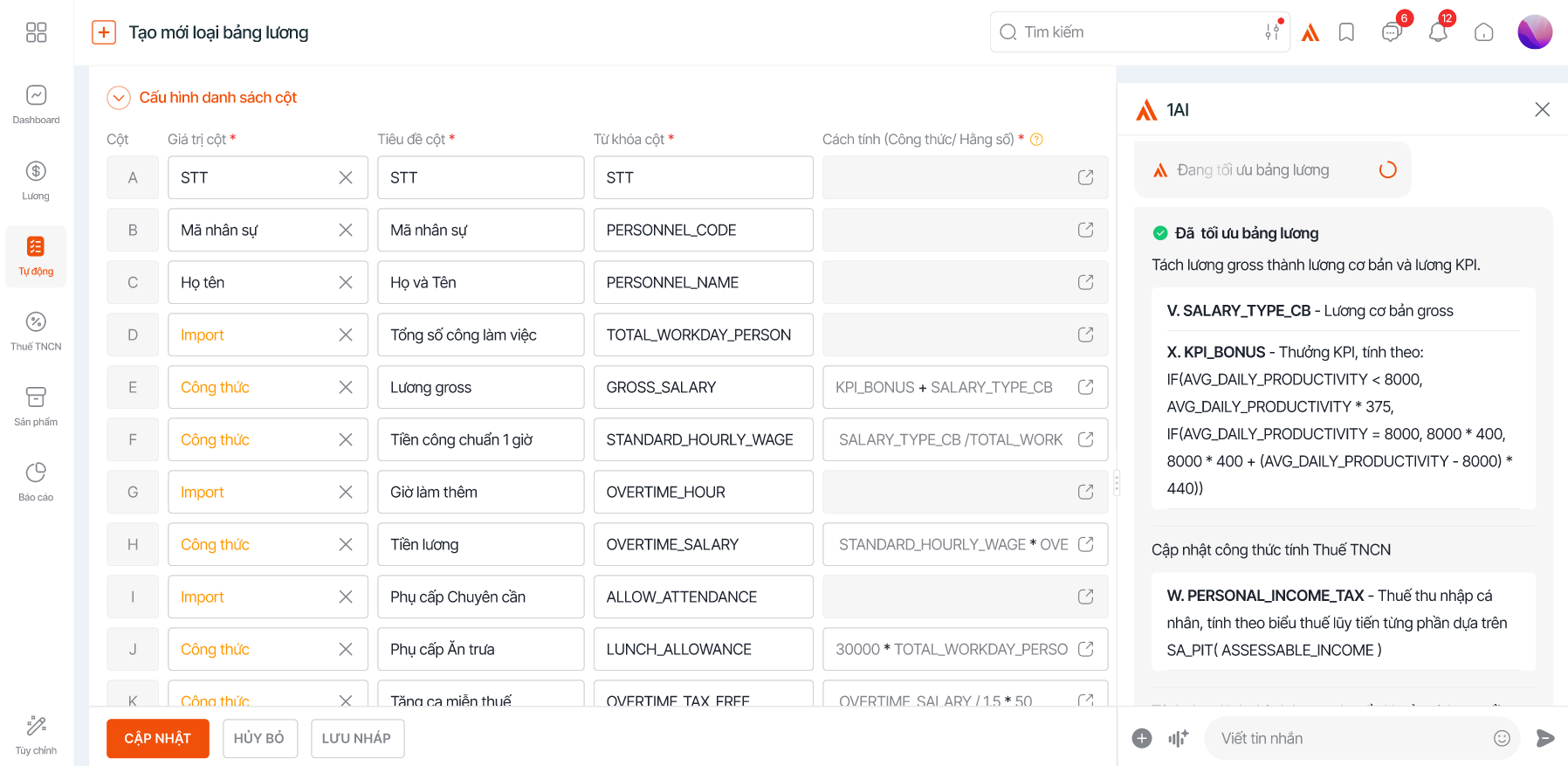
By integrating AI into the payroll process, restaurants can:
- Reduce the time spent processing restaurant employee payrolls by up to 80% each period.
- Minimize errors, complaints, and data discrepancies.
- Increase transparency, strengthening internal trust.
- Control the salary fund more effectively, especially in models with multiple shifts and many part-time employees.
With 1AI Salary, creating restaurant employee payrolls is no longer a worry each payday. From timekeeping to payroll calculation – everything is automated and controlled by intelligent AI.
————————————
We hope this article from 1Office has helped your business choose the simplest, most applicable, and most suitable restaurant and hotel employee payroll template. To experience our automated HR payroll management software, please contact us via:
- Hotline: 083 483 8888
- Facebook: https://www.facebook.com/1officevn/
- Youtube: https://www.youtube.com/@1office-chuyendoisodn
















