


 13/05/2026
  332 views
Employee salary advance is currently a topic of interest for businesses looking to improve the quality of life for their employees. However, implementing a salary advance policy still faces many obstacles due to a lack of understanding of the processes and procedures, leading to implementation challenges. To help businesses better understand the salary advance process and regulations, 1Office will provide the necessary information in the following article.
Mục lục
- 1. Why should businesses have an employee salary advance policy?
- 2. Regulations on salary advances for employees
- 3. The latest salary advance process for employees in 2026
- Step 1: The employee fills out a Salary Advance Request form (+template)
- Step 2: Submit the request to the Department Head for advance approval
- Step 3: Submit the request to the Director for advance approval
- Step 4: Forward to the payment accountant to create a payment voucher (+payment voucher template)
- Step 5: The Chief Accountant reviews the payment voucher
- Step 6: The Director signs and approves the payment voucher
- Step 7: The cashier disburses the advance payment to the employee
- Step 8: Record and archive salary advance documents
- Step 9: Settle the advance payment
- 4. Who is responsible for employee salary advances?
- 5. Issues that arise during the employee salary advance process
- 6. 1Office – The Best Automated Payroll Management Solution in Vietnam
1. Why should businesses have an employee salary advance policy?
Solves personal financial challenges for employees
For employees, a salary advance is an urgent need to cover living expenses, especially for those with low wages who haven’t accumulated savings and often face unexpected expenses. Providing a salary advance for employees will help them solve personal financial problems such as:
- Paying rent, electricity, and water bills.
- Funerals and weddings of relatives and friends.
- Paying for children’s tuition.
- Making credit card payments.
- Covering unexpected medical expenses.

Implementing a salary advance policy helps businesses build a humane welfare policy for employees, giving them more autonomy in managing their personal finances and stabilizing their income and expenses. This, in turn, increases job satisfaction and strengthens their commitment to the company.
Encourages employees, improves productivity
According to information from the Vietnam Labor Market, the average employee spends more than 4 hours a day worrying about finances. This disrupts their work process and directly affects their job performance.
Therefore, the purpose of a salary advance policy is to solve the “bread and butter” issues for employees, helping to reduce their financial burden so they can focus more on their work. This is an effective form of employee encouragement aimed at improving business productivity.
Minimizes risks to the corporate image
Experience has shown that when their financial needs are not met, employees tend to turn to loan sharks or personal financial services. This creates many risks for both the employee and the business. If payments are not made on time, employees can be harassed and threatened. The business’s image is consequently affected, and it may even be slandered by third parties, leading to a loss of trust among employees and customers.
Therefore, a salary advance policy not only helps minimize risks to the corporate image but also contributes to enhancing brand quality and building trust with employees.
Creates a competitive advantage in the labor market
Beyond benefiting employees, a salary advance policy also helps businesses enhance their position in the labor market. By offering a humane and attractive welfare policy, a salary advance solution can reduce turnover rates and retain talent, securing a quality workforce for the company.
Additionally, this is an effective method for building an employer brand and attracting young talent—especially Gen Z, a workforce known for its liberal spending, low savings, and a tendency towards “buy now, pay later” habits.
| Read more: The Best Salary Increase Proposal Template for Businesses |
2. Regulations on salary advances for employees
In which cases are employees entitled to a salary advance?
Typically, cases for salary advances are based on conditions agreed upon by the employee and the employer (Article 101 of the 2019 Labor Code). Other specific cases are regulated as follows:
- Cases where employees are paid by product or piecework for jobs that last for several months (Article 97 of the 2019 Labor Code)
- During the period when the employee is performing civic duties (Article 101 of the 2019 Labor Code)
- For annual leave (Article 101 of the 2019 Labor Code)
- During the period when the employee is temporarily suspended from work (Article 128 of the 2019 Labor Code)
How much salary can an employee receive as an advance?
In principle, the amount of the salary advance for an employee is agreed upon by both parties (Article 101 of the 2019 Labor Code). Some special cases are regulated as follows:
- Based on the volume of work completed during the month in cases of payment by product or piecework (Article 97 of the 2019 Labor Code)
- Not exceeding one month’s salary for employees performing civic duties (Article 101 of the 2019 Labor Code)
- At least equal to the salary for the days of leave in the case of annual leave (Article 101 of the 2019 Labor Code)
- 50% of the salary before the work suspension in the case of temporary work suspension (Article 128 of the 2019 Labor Code)
How many times can an employee receive a salary advance?
The number of salary advances will depend on the conditions discussed and agreed upon by the employee and the employer when signing the contract or as stipulated in the company’s salary advance policy. Some businesses may limit the frequency of employee salary advances per month or per year to ensure operational cash flow.
What are the penalties if an employer does not grant a salary advance?
According to the provisions of the 2019 Labor Code, employers are required to provide a salary advance to employees when it has been previously agreed upon by both parties and in the 04 cases where employees are entitled to a salary advance as mentioned above.
In cases where the employer does not provide an advance or provides an insufficient advance to an employee during a period of temporary work suspension as prescribed by law, according to Article 17 of Decree 12/2022/ND-CP, they will be subject to an administrative fine ranging from 5,000,000 VND to 50,000,000 VND, depending on the number of employees.
On the other hand, if the situation does not fall into the specified cases and there is no agreement between the two parties, the employer’s refusal to grant a salary advance is not contrary to the law and will not be penalized.
Read more: 6 steps to standardize the process of building a transparent and fair salary payment regulation
3. The latest salary advance process for employees in 2026
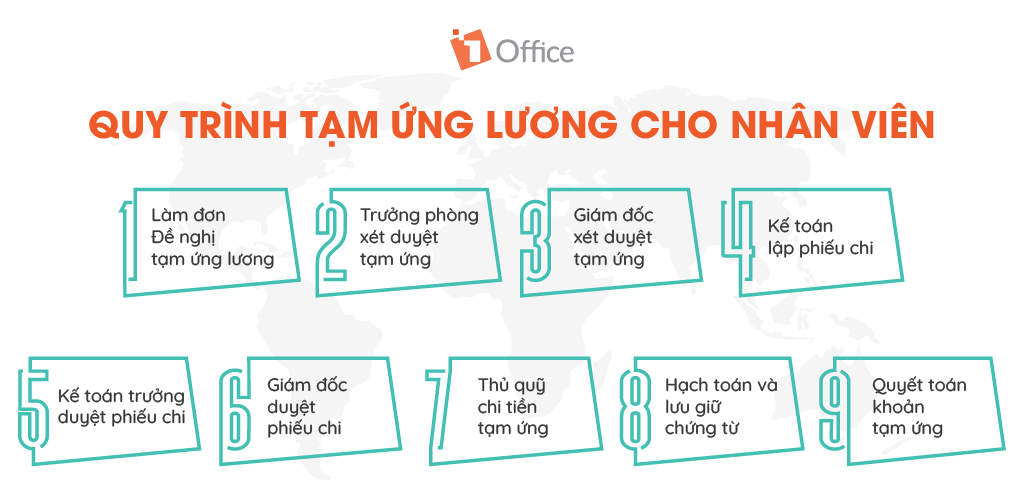
Step 1: The employee fills out a Salary Advance Request form (+template)
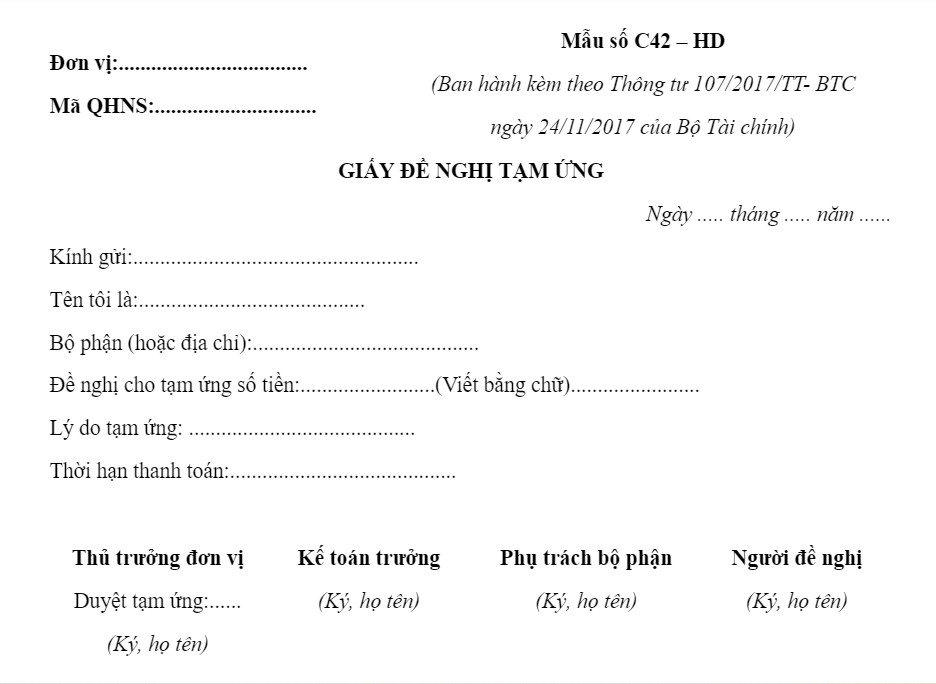
When the need for a salary advance arises, the employee must first fill out a Salary Advance Request form. The form must clearly state the following information:
- Employee information
- Reason for the salary advance
- Advance amount
- Repayment deadline
1Office provides a salary advance template for employees, compliant with Circular No. 133/2016/TT-BTC of the Ministry of Finance, at this LINK
Step 2: Submit the request to the Department Head for advance approval
After completing the Advance Request form, the employee must submit it to their Department Head for review and approval. If approved, the Department Head will sign the salary advance approval form for the employee.
Step 3: Submit the request to the Director for advance approval
After receiving the Department Head’s approval, the employee continues to submit the request to the Director for review and final approval.
Step 4: Forward to the payment accountant to create a payment voucher (+payment voucher template)
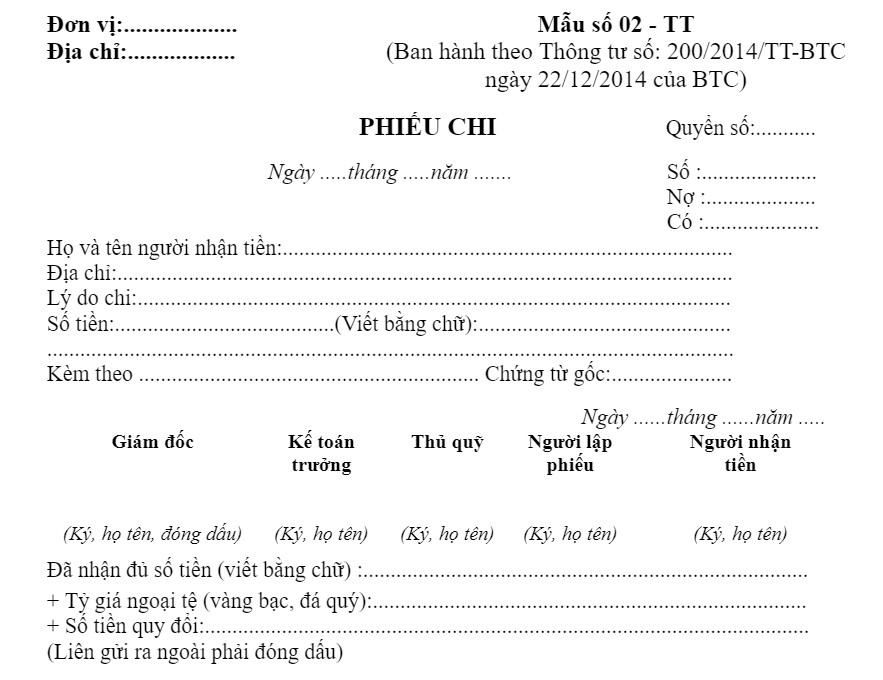
Once the Director has approved the request with the proposed advance amount, the Advance Request form will be forwarded to the accounting department for verification. After confirming the accuracy of the information declared in the form, the accountant will proceed to create a salary advance payment voucher for the employee.
The payment voucher must be created according to the template specified in Circular 200/2014/TT-BTC, which readers can download at this LINK.
Step 5: The Chief Accountant reviews the payment voucher
In the next step, the Chief Accountant will be responsible for re-checking and approving the salary payment voucher for the employee.
Step 6: The Director signs and approves the payment voucher
After the Chief Accountant’s approval, the accountant will submit it to the Director to finalize the advance payment voucher for the employee.
Step 7: The cashier disburses the advance payment to the employee
After receiving the Director’s approval, the cashier will, based on the payment voucher with all the required signatures (employee, accountant, chief accountant, and director), disburse the salary advance from the company’s funds to the employee.
Step 8: Record and archive salary advance documents
In this step, the accountant will archive all relevant documents, including the advance request form and the advance payment voucher, to serve as the basis for recording the salary advance for the employee.
The salary advance amount for the employee will be recorded in Account 334 – Payables to employees.
Step 9: Settle the advance payment
After the salary advance process is completed, when the monthly payday arrives, the company will deduct an amount corresponding to the advanced sum from the employee’s payslip.
Currently, using automatic employee payroll software is favored by many businesses. Applying software solutions not only helps reduce the time spent on payroll and advance processing and eliminates unnecessary procedures, but also minimizes potential errors that can occur during manual calculations.
4. Who is responsible for employee salary advances?
The salary advance process requires the coordinated participation of several departments within the company, including:
- Employer: Managers, Department Heads, and Directors are directly responsible for employee salary advances. Their duty is to review and approve employees’ requests for salary advances.
- Human Resources Department: As the department responsible for managing and caring for the workforce, HR staff/managers are tasked with providing necessary information for the advance process, such as employee payslips, number of working days, etc. Additionally, HR will address any issues and provide support to help employees receive their desired advance amount.
- Accounting Department: This department handles the administrative procedures and paperwork in the salary advance process. The roles involved in this process include the payment accountant, chief accountant, and cashier.
DOWNLOAD NOW: 5+ Most Common Employee Payslip Templates for 2026
5. Issues that arise during the employee salary advance process
Employee salary advance is a complex process that depends on many factors. In reality, many businesses, despite having a clear understanding of the salary advance process, still encounter numerous issues during implementation, such as:
- The company’s cash flow is affected, making it unable to arrange funds for employee salary advances
- Complex administrative procedures and processes, causing HR and accounting to waste time handling individual cases
- Lack of supporting tools means that controlling and reconciling advances must be done manually, which can easily lead to errors
A survey conducted by 1Office with over 5,000 businesses and corporations using 1Office has revealed some noteworthy figures regarding the salary payment situation in businesses:
- 80% of surveyed businesses are interested in salary advances but lack the supporting capital
- 60% of accountants are hesitant to process salary advances or pay salaries twice a month due to being busy with other tasks
- 50% of businesses face difficulties in implementing employee salary advances due to complex procedures and processes
Therefore, solving the financial problem for employees requires businesses to have a clear understanding of the procedures and sufficient resources to optimize their salary advance policy.
6. 1Office – The Best Automated Payroll Management Solution in Vietnam
With 7 years of partnership with over 5,000 businesses and more than 450,000 employees, 1Office understands better than anyone the needs of employees and the barriers businesses face with salary advance policies. With the desire to solve the financial challenges for businesses, 1Office offers a flexible payroll management solution within the HRM module.
1Office is a solution built with the mission to accompany businesses in improving the quality of life for employees, promoting digital transformation in HR, and enhancing the employer brand.
The 1Office payroll management toolkit offers businesses special benefits such as:
- Optimize the salary advance process on 1Office, with disbursement in just 1 minute
- The process of approving advance requests, creating payment vouchers, and signing for approval is fully digitized on the software
- Synchronize data and automatically calculate payroll, with convenient salary transfers through bank account integration
- Free human resource management software system
This article from 1Office has provided readers with necessary information about the employee salary advance process and a flexible salary advance solution. For a free consultation and to experience a trial of the 1Office sales management software, please contact us using the information below.
For more detailed information, please see:
- Hotline: 083 483 8888
- Fanpage: https://www.facebook.com/1officevn/
- Youtube: https://www.youtube.com/channel/UCeTIRNqxaTwk0_kcTw6SxmA
















