


 09/05/2026
  51160 views
A labor contract template helps businesses clearly establish the rights, obligations, salary, working hours, and other important terms with their employees. Depending on the situation, HR may need a definite-term contract, an indefinite-term contract, a contract with a probationary period, an appendix, or a bilingual template. The section below compiles the latest labor contract templates that are easy to download and convenient to edit according to your needs.
Mục lục
- I. What is a labor contract?
- II. Types of Labor Contracts
- III. What content should a labor contract template include?
- IV. Collection of Labor Contract Templates Updated According to the Latest Regulations
- VI. Rights and Obligations in an Employment Contract
- XI. How does a business household employment contract differ from a regular employment contract?
- XII. FAQ – Frequently Asked Questions
- XIII. Conclusion
I. What is a labor contract?
A labor contract is a written agreement between an employee and an employer, clearly defining the rights, obligations, working conditions, salary, and related benefits. It serves as the legal basis binding both parties throughout the employment period and protects the legitimate rights of the employee as stipulated by the Labor Code.
Article 13 of the 2019 Labor Code also describes the definition as follows:
A labor contract is an agreement between an employee and an employer regarding the performance of a job with compensation, salary, working conditions, and the rights and obligations of each party in the labor relationship. In cases where the two parties reach an agreement under a different name but it still reflects the performance of a job with compensation, salary, and the management, direction, and supervision of one party, it will be considered a labor contract.
II. Types of Labor Contracts
According to the 2019 Labor Code, effective from 2021, the regulations on entering into a labor contract are as follows:
Since 2021, when entering into a labor contract, employees can only choose between two types of contracts, including:
- Indefinite-term labor contract: a contract in which the term and conditions for termination are not clearly defined.
- Definite-term labor contract: a contract in which the term and conditions for termination are specifically defined, not exceeding 36 months from the effective date.
The employee and employer will decide on the type of contract that suits the specific situation. In cases where the employee works for less than 03 years, a definite-term contract is preferred.
* Note: From 2021 onwards, seasonal contracts and contracts for a specific job with a term of less than 12 months are no longer used. In cases where a short-term labor contract is desired, the parties will use a definite-term contract.
Additionally, labor contracts are also classified by their signing format:
- Paper-based labor contract: A hard-copy contract, usually drafted on paper and signed by hand with a red seal.
- Digitally signed labor contract (Electronic contract): A type of contract stored using cloud computing technology. The condition for entering into this type of contract is that both parties must possess a digital signature.
>>> See more: What is a digital signature? Why businesses should use digital signatures
III. What content should a labor contract template include?
According to Article 21 of the 2019 Labor Code, a legal labor contract must include the following <strong data-start="401" data-end="4
IV. Collection of Labor Contract Templates Updated According to the Latest Regulations
Depending on the specific field and industry, employers need to consult, amend, and draft a suitable contract template. Below are some common templates that managers can refer to.
1. The Most Common Labor Contract Template Today
The common labor contract template is a type of contract that can be used for most cases, across different business fields and industries. The content of this contract ensures the full basic rights and obligations of both parties.
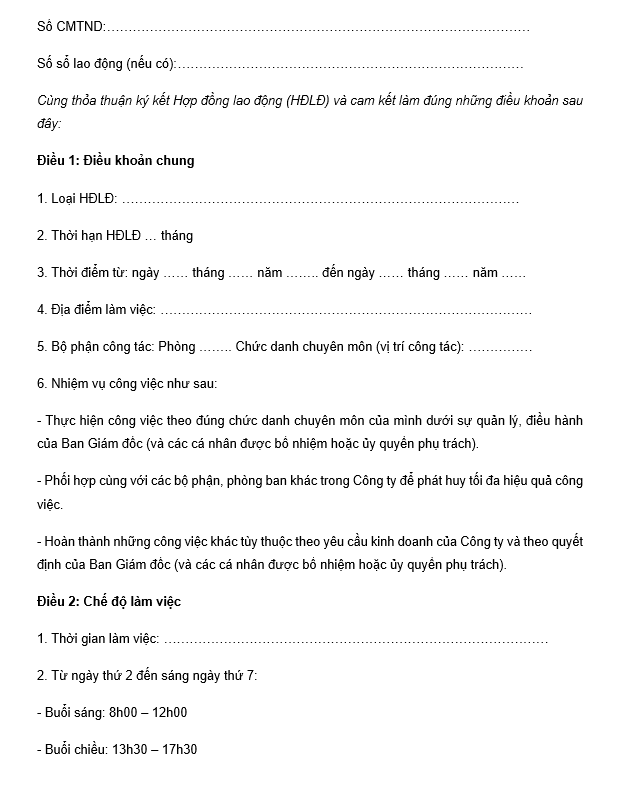
Download the common labor contract template (.docx)
2. Fixed-Term Labor Contract Template
A fixed-term labor contract is a type of contract in which the specific duration and termination conditions are set from the beginning. Typically, this contract has a specific duration, not exceeding 36 months, from the effective date of the contract.
Fixed-term labor contracts are often used when there is a need for work for a fixed period or when there are special factors, such as a specific project or a temporary job.
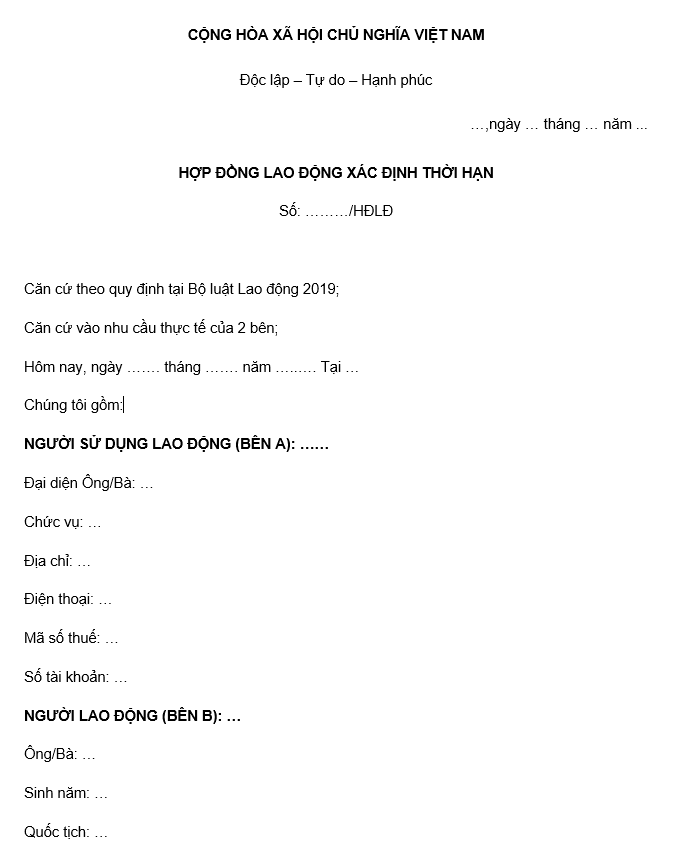
Download the fixed-term labor contract template (.docx)
3. Indefinite-Term Labor Contract Template
An indefinite-term labor contract is a type of contract in which the working
Download accountant employment contract template (.docx)
VI. Rights and Obligations in an Employment Contract
In any employment contract, the rights and obligations are always clearly defined for both the employee and the employer. This is a core element to ensure fairness, transparency, and provide a legal basis in case of disputes. Clearly understanding the rights and obligations of both parties not only helps mitigate legal risks but also builds a healthy work environment, contributing to improving business operational efficiency and fostering long-term employee engagement with the organization.
1. Rights and Obligations of the Employee in an Employment Contract
In an employment contract, the employee’s rights are clearly stated, including:
- Salary, allowances, and payment method: The employee has the right to be paid on time and at the agreed-upon rate (according to Article 90 of the 2019 Labor Code).
- Leave policy and working/rest hours: The employee is entitled to annual leave, public holidays, and paid personal leave as regulated.
- Insurance benefits: The employee is entitled to participate in Social Insurance (BHXH), Health Insurance (BHYT), and Unemployment Insurance (BHTN) as per the signed contract.
- Working conditions: The right to work in a safe environment that ensures health, with adequate protective equipment (if applicable).
In addition to rights, the contract also clearly states obligations such as: performing work as described, complying with internal labor regulations, maintaining confidentiality, and protecting company assets.
Throughout the duration of the contract, the employee is guaranteed:
- To receive full salary, bonuses, and other benefits as agreed.
- To receive training and professional development to enhance skills if the company has a human resource development policy.
- To have their legal rights protected in case of disputes, through the intervention of a trade union or the law.
- The right to unilaterally terminate the contract for legitimate reasons as stipulated in Article 35 of the 2019 Labor Code (e.g., not being paid on time, mistreatment, unsafe working environment…).
Upon termination of the employment contract, the employee has the following rights:
- In case of legal resignation (with proper notice): The employee is entitled to full payment of salary, any allowances (if applicable), the social insurance book, and related documents.
- In case of termination due to structural changes, technology, or economic reasons: The employee is entitled to a job loss allowance, typically equal to one month’s salary for each year of service, but at least two months’ salary (Article 47 of the 2019 Labor Code).
- In case of unlawful termination: The employee has the right to demand compensation, reinstatement to their position, or receive additional compensation corresponding to the period of unemployment.
Thus, the employee’s rights in an employment contract are not only specified upon signing but also apply throughout the employment period and upon termination. This helps ensure fairness and reduces the risk of labor disputes.
2. Rights and Obligations of the Employer in an Employment Contract
When signing an employment contract, the employer’s rights are also protected by law. Some basic rights include:
- To require the employee to perform the work as agreed in the contract, ensuring quality and deadlines.
- The right to manage, supervise, and evaluate work performance, as well as to enforce labor regulations and take disciplinary action for violations.
- The right to protect business secrets and company assets, requiring the employee to commit to not disclosing information or causing damage.
- The right to recruit, transfer, or assign work according to production and business needs, provided it complies with the law.
While the contract is in effect, the employer has important rights:
- To utilize labor as committed: The employee must work the full hours, capacity, and responsibility as stated in the contract.
- To demand compensation when the employee causes damage: If an employee damages equipment,For businesses with hundreds or thousands of employees, manual contract management can lead to many issues such as errors, lost information, and difficulties in searching and retrieving documents. With 1Office’s online Contract Management and Digital Signature Solution, users can easily create, edit, and track labor contracts, ensuring accuracy and transparency in the process. In particular, the digital signature feature allows contracts to be signed and approved anytime, anywhere, optimizing time and enhancing work efficiency. All operations are performed online, ensuring safety, security, and compliance with legal regulations:
- Manage, classify, and store documents and materials centrally on a single platform
- Integrated digital signatures directly on the system, saving printing and storage costs
- Track and receive reminders for document processing workflows, progress, and contract status on the system
- Smart permission delegation by department, position, etc., to ensure security
See more:
XI. How does a business household employment contract differ from a regular employment contract?
When hiring employees, both individual business households and corporations need to sign employment contracts to ensure the rights and obligations of both parties. However, due to differences in legal status, scale, and management obligations, the business household employment contract template has some differences compared to a standard employment contract in a corporation.
1. What is a regular employment contract?
A regular employment contract (typically used by corporations and organizations with legal entity status) is a mandatory legal document when recruiting employees.
The content of the contract is clearly stipulated in Article 21 of the 2019 Labor Code, including:- Information of the employee and the employer.
- Job description, location, and contract term.
- Salary, allowances, bonus schemes, and payment method.
- Regulations on working hours, leave, insurance, contract termination, compensation, etc.
These contracts usually bear the company’s round seal or digital signature and are stored electronically or in hard copy for inspection purposes.
2. What is a business household employment contract?
An individual business household does not have legal entity status like a corporation, so the employment contract is signed under the name of the individual household owner.
-
The contract may not require a round seal; the signatures of both parties are sufficient for it to be valid.
-
The household owner must still ensure minimum wage, working hours, rest periods, social insurance, and health insurance if employing regular workers.
-
The contract format is flexible: it can be a written document, an email, or electronically signed if fully confirmed.
3. Detailed comparison table between a business household contract and a corporate contract
Criteria Labor Contract for Business Households Standard Corporate Labor Contract Legal status of the employer Individual, no legal entity status Enterprise with legal entity status Seal & valid confirmation No round seal required, only the signature of the household head Corporate seal or electronic digital signature is mandatory Tax code Personal tax code of the household head Corporate tax code Number of employees Usually < 10 people Unlimited Regulations on SI, HI, UI Contributions required for regular employees working ≥ 1 month Full contributions are mandatory for all contracted employees Salary scale and internal regulations Not required to establish internal labor regulations Mandatory to have a salary scale, payment regulations, and internal rules Contract form Flexible (written or electronic) Must be in writing and stored according to regulations Dispute resolution Through a labor mediator or local court According to the formal labor dispute process Scale and professionalism Small-scale, manual Strict processes, use of management software Digitization and storage capabilities Limited, usually stored manually Can be managed, digitally signed, and stored online on a digital platform like 1Office XII. FAQ – Frequently Asked Questions
When are labor contract disputes likely to arise?
Labor contract disputes often arise when the agreed-upon terms are unclear regarding the job, salary, duration, place of work, and the rights and obligations of the parties, or when a business uses a different contract name but the nature of the relationship is still one of employment with management, supervision, and remuneration.
What is the difference between a labor contract and a service contract?
A labor contract is associated with an employment relationship that involves a salary and is subject to the management, direction, and supervision of the employer. In contrast, a service contract typically focuses on an agreement to complete a specific job or achieve a particular result, and does not involve the same level of labor management as a labor contract.
What is the difference between a fixed-term and an indefinite-term labor contract?
A fixed-term labor contract is a contract with a specific end date, not exceeding 36 months. An indefinite-term labor contract does not specify an expiration date. The 2019 Labor Code only recognizes these two types of contracts.
Do probationary employees need to sign a labor contract?
It is not mandatory to sign a separate labor contract if both parties agree to a probationary contract. However, the law also allows for the probationary terms to be included directly in the labor contract. In other words, businesses can choose either method, depending on their recruitment practices.
Is there any software that helps businesses manage labor contracts more centrally?
Yes. If a business wants to manage labor contracts, addendums, employee records, and the digital signing process on a single system, they can consider 1Office’s employee records management software.
See more:
- What is an Electronic Labor Contract? Features & Signing Regulations
- Effective Contract Management Software | Free Trial
- Seasonal Work Contract Template with Full Clauses [Free Download]
XIII. Conclusion
The above is a summary of the latest information on labor contracts, along with specific contract templates for special cases and important notes to consider when entering into a contract. We hope that the insights shared in this article will provide managers with the most useful knowledge for drafting labor contracts for their own businesses.
















