12/05/2026
  379 views
You may be familiar with the term Kaizen – Continuous Improvement, but you might be unsure about its benefits and process. Is the Kaizen Standard a workplace process? If you are interested in improving efficiency, succeeding in competition, and increasing profits, this is a method that businesses cannot afford to ignore. In this article, 1Office will help you answer the question What is Kaizen and the most effective steps to apply Kaizen in your business.
Mục lục
- 1. What is Kaizen?
- 2. Benefits of Applying Kaizen for Businesses
- 3. 10 Important Kaizen Principles for Effective Continuous Improvement
- 4. 6 Steps to Implement the Kaizen Continuous Improvement Method in Your Business
- 5. When should an organization implement the Kaizen method?
- 6. Examples of practical Kaizen applications in business
- 7. Technology Application – A Key Factor in a Business’s Improvement Process
1. What is Kaizen?

Kaizen is a term that means ongoing improvement or continuous improvement for the better. The Kaizen method comes from the combination of two Japanese words: Kai (change) & zen (good).
The father of this method is Mr. Masaaki Imai, a famous Japanese management master. He has dedicated almost his entire life to popularizing and developing Kaizen for businesses not only in the land of the rising sun but also around the world.
The application of Kaizen can be implemented in all aspects of life and is especially effective for business development.
When it comes to Kaizen, we immediately think of Japanese manufacturing companies like Honda, Yamaha, Canon, etc., and Toyota, the pioneer company that applied this method to its business 50 years ago.
Kaizen is about statistical process control that will improve quality in every aspect of the business. Employees are empowered to propose ideas to solve common problems so they do not recur.
Although this method often brings only small improvements, maintaining it regularly and incrementally over time will create impressive results. This is one of the secrets to the success of the Japanese.
Because it leverages small improvements without the need for high-tech intervention, Kaizen is also an extremely cost-effective method.
| See more: A comprehensive A-Z process for standardizing operations for SMEs and startups |
2. Benefits of Applying Kaizen for Businesses
Continuous improvement is the driving force that promotes problem-solving, collaboration, and communication skills, as well as allowing employees to demonstrate their abilities, reducing the pressure on leaders. In general, Kaizen is a way to strengthen a strong culture of continuous work improvement in your organization. Ultimately, it is the best way to maintain the principles you want to guide your company to apply in practice.
- Continuous Improvement for Products and Services
Following the Kaizen process of continuous improvement in work helps you solve problems, from large to small, that affect the quality of products and services. As a result of quality improvement, customer satisfaction increases because they encounter fewer negative issues. It also helps identify the reasons why customers refuse to use your products or services. This enhances brand reputation and brings communication efficiency, leading to increased sales and revenue.
- Provides a Competitive Advantage
Continuous improvement creates a competitive advantage by differentiating you from others in the industry. It helps establish your business as a leader, moving faster and being more innovative. That is, the Kaizen model helps organizations continuously improve in quality management, productivity, and practical efficiency. This mindset also creates a highly skilled workforce, generating long-term value for your company.
- Encourages Grassroots Thinking
The Kaizen method is not a process that only affects and impacts managers. It has an influence regardless of anyone’s role in the company. Over time, employees begin to think, reason, and act on their approach to their daily work. Improvement has the benefit of encouraging employees to be more proactive in their work. Typically, grassroots-level employees understand problems more clearly than management because they deal with these issues daily. This tends to reduce the pressure on managers and allows them to continue implementing plans that benefit the company.
- A Culture of Continuous Improvement
Businesses that implement Kaizen often have a highly engaged workforce. Improving processes and products also means improving the culture. Your employees are empowered to make changes. They will understand that their contributions can create real benefits. This fosters dedication among employees, leading to a positive culture and an organized and engaging workplace.
- Strengthens Collaboration and Internal Cohesion
One thing that often hinders a business’s workflow is the process of communicating information between departments and levels. A breakdown in communication can have costly consequences, both financially and in terms of morale.

When applying Kaizen, all personnel are actively encouraged to share their perspectives, opinions, and propose any ideas. It promotes greater collaboration and increases trust between departments.
- Increases Work Productivity
Meeting deadlines can feel like an incredibly tense battle between managers and employees. It creates a constant daily pressure. But continuous improvement is a method to increase productivity in business by enhancing work efficiency through a scientific and intelligent workflow.
- Enhances Creativity
The nature of creativity is that there are no rules to follow. Therefore, fostering creativity in the workplace is very difficult. The Kaizen method offers solutions to unexpected problems as they arise and teaches them how to think outside the box. Employees are empowered to come up with new ideas and create a work plan according to their abilities.
- Improves Teamwork
Employees will tend to communicate and collaborate more with colleagues as they strive to improve work quality and personal benefits. The Kaizen implementation process can harness the power of collaboration across positions, functions, and individual roles.
| >> Read more: TOP 9 factors affecting work performance and how to improve them |
3. 10 Important Kaizen Principles for Effective Continuous Improvement
Before applying Kaizen in your business, you need to understand its principles. This serves the overall interests of the business and helps managers develop their roles more effectively.
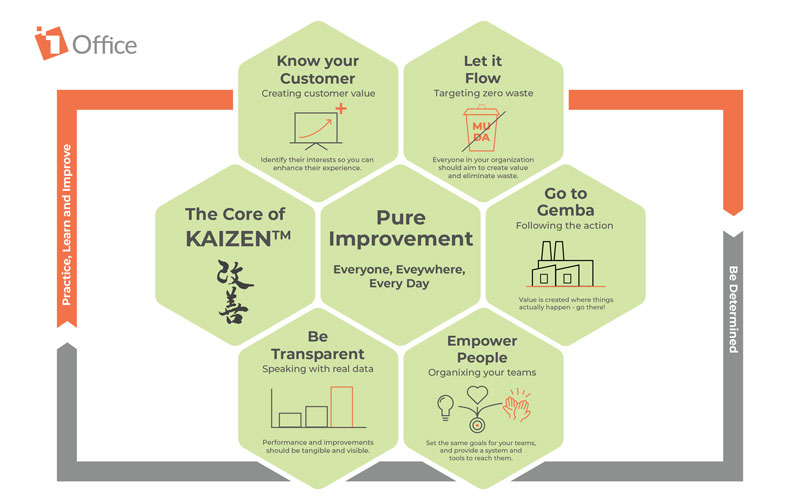
Regardless of your business’s development stage, you must pay special attention to the following principles when implementing Kaizen:
1. Focus on Customer Benefits
The principle in most business activities is that products and services must meet market demands. The market, in this case, always revolves around consumers. This means your business must always focus on customer benefits and improve its products and services accordingly.
2. Continuously Improve
It is basic human nature to get used to performing tasks in a certain way. People repeat the same ideas and follow long-established protocols. So, what is the Kaizen principle for improvement? It is to let go of this fear and embrace new ideas.
Therefore, under this principle, you need to closely monitor Marketing tasks such as customer research and outreach, telesales, and regular customer care. These activities help you improve product quality, optimize service MRR (Monthly Recurring Revenue), identify flaws, save time and costs, and achieve greater efficiency.
3. Be Accountable and Avoid the Blame Cycle
Accountability eliminates the time and effort spent on distracting activities and inefficient behaviors. Instead of blaming team or department members when something goes wrong, coach them and hold them accountable for their tasks so they do not repeat the same mistakes.
4. Promote an Open Corporate Culture

Building a corporate culture is one of the key principles for achieving the most effective work improvements. It’s important to stop hesitating over potential obstacles the business anticipates, move forward towards goals, and continuously improve.
Employees need to face mistakes directly, accept weaknesses, and ask for help and support from colleagues or superiors. Having an internal social network for the business to engage and connect with its workforce is a plus for implementing Kaizen.
5. Empower All Employees to Speak Up
Everyone involved in the company’s success, from the CEO to frontline employees, should be encouraged to offer suggestions and solutions for problems that can be fixed or improvements that can be made. While you don’t have employees to solve your personal life, you can still encourage friends and family to make suggestions if they see things you could improve.
Talk to different people about your goals and get their feedback. Encourage your family and friends to offer input if they see things you could do.
6. Don’t Stop
Never assume a job/project is finished once it’s completed. Improvement has no limits and can be practiced infinitely. Manage your MBO (Management by Objectives) goals intelligently by never stopping, but continuously moving forward and beyond. This way, everyone in the business has the opportunity to develop more skills in life for continuous improvement.
7. Always Correct and Don’t Neglect
Some parts of the standard process that are being executed incorrectly or are not aligned with business operations must be continuously corrected throughout this improvement process. Observe competitors and businesses in the same field to find different and more optimal implementation methods.
8. Practice the 5 Whys Method
Before making any final decision, get to the root of the problem by asking “Why?” five times. By continuously asking yourself why, you can find the true purpose behind an issue. Often, the reason given by a superior for a problem, or by a customer, will actually lead to more questions and a deeper dive into the current situation. You might think you don’t have the time or the capability, but that will be the reason your business declines.
9. Be Economical
Financial control throughout the entire improvement process in the business is essential. Find ways to save money while implementing small improvements, then allocate the savings to subsequent improvements. The overall goal of improvement is to save money or stop overspending on unused things.
10. Source Ideas from the Community
Learn from other businesses or management levels and get new opinions on things you can add to your processes to create continuous improvement. Learning is what helps a business implement Kaizen better. Having multiple opinions can not only add to an improvement but can also provide a new perspective, a new initiative, or a new, effective solution.
4. 6 Steps to Implement the Kaizen Continuous Improvement Method in Your Business
How is the continuous improvement process implemented effectively? Currently, there are many different steps to implement Kaizen. However, ultimately, the most scientific way to conduct Kaizen is condensed into 6 steps. Below are the steps to apply the continuous improvement process to help businesses enhance their operational efficiency.
Step 1: Identify Problems and Objectives
In this step, you first need to determine the state of the business. This means identifying whether the business is in a crisis period or a stage of stable development. From there, a unified objective can be established.
Your objective is the overall objective of the business. The objective must be achievable and greater than the current results. Applying Kaizen does not require a large financial investment from the business, but it does demand commitment and effort for long-term change. Ensure that both employees and leadership are ready and willing to participate in this plan.
Step 2: Measure the Data
To achieve the objective, you also need to measure the types of data required for analysis and evaluation, which will help in formulating a suitable solution.
- First, what is the root cause of the problem your business is facing? For example, is it related to personnel quality, convoluted processes, or unreasonable business policies, etc.
- Second is external data. For instance, customer data, competitor data, campaigns, new trends, social policies, and government policies that have some impact on the business’s problem.
Step 3: Analyze the Data
You can analyze all the above data using an Ishikawa diagram, also known as a fishbone diagram.
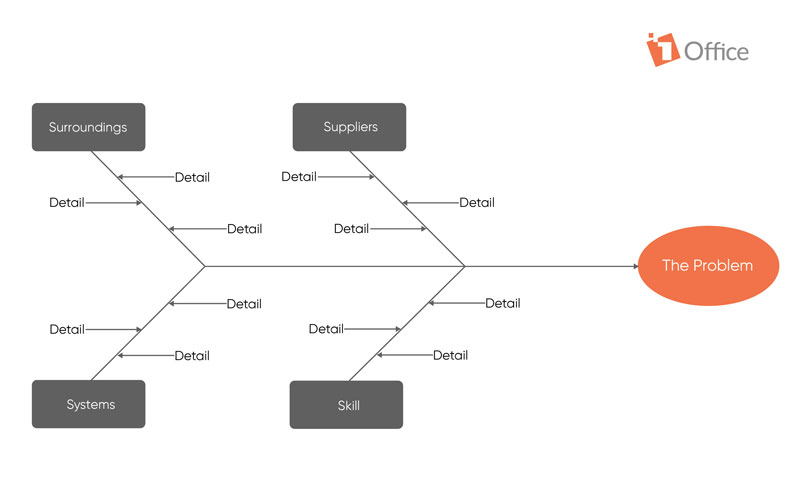
This fishbone diagram allows us to analyze the main groups of causes originating from:
- People – manpower
- Machinery/Equipment – machine
- Materials – material
- Work Methods – method
- Finance, Environment
The fishbone diagram is a commonly used tool for identifying the root causes of problems and for quality management. To achieve optimal results, you should combine it with modern technologies to implement Kaizen.
Step 4: Find Solutions
If you have a clear understanding of all the problems and have explored every aspect of the data, you can easily find solutions to start implementing Kaizen effectively. This step includes: creating, classifying, and prioritizing the improvements you have identified. This means selecting solutions based on a matrix of impact or influence and opportunity.
Step 5: Implement Kaizen Improvements
Agreeing on a suitable solution for the business makes it easier to implement changes and track progress. The business should apply a pilot program in the initial phase, then proceed step-by-step, rather than making comprehensive changes immediately.
This means you need to take small steps for initial testing. For example, apply Kaizen to the Marketing department first, then to the Sales, Customer Care departments, etc. During implementation, management must regularly collect information and conduct checks and supervision. This allows for the detection of any shortcomings and timely resolution.
Step 6: Check and Standardize
This step requires standardizing and optimizing the solutions that have been, are being, and will be implemented. While implementing continuous improvement in quality management, your business may have aspects that are not suitable, and certainly some that are particularly suitable. You need to quickly eliminate the weaknesses and promote the strengths.
At the same time, repeat the cycle step-by-step. This makes it easier to identify emerging problems and continuously innovate solutions that align with current trends. This is significant for the core value of the Kaizen method, which is “continuous improvement”.
>> Read more: INCREASE WORK EFFICIENCY BY 200% WITH WORK IMPROVEMENT IDEAS
5. When should an organization implement the Kaizen method?
According to the concept and principles of the Kaizen method, or continuous improvement, a business can apply it at any time. Additionally, a business can apply the Kaizen of one department to other departments, ensuring that core values are still maintained. For example: A business implements Kaizen for sales costs while maintaining product quality.
A business can implement Kaizen at various times:
- During a crisis:
When a business faces major problems originating internally or from environmental impacts, implementing Kaizen is necessary for the organization to overcome those issues.
- During difficult periods:
During business operations, there will certainly be times when the organization faces difficulties (often stemming from external environmental impacts). For example, the (COVID-19 pandemic) caused businesses to face major challenges in their operational and business activities. At this time, applying Kaizen aims to limit disruptions, develop suitable remote operational solutions, and prepare for post-pandemic recovery.
- During normal operations:
At this stage, a business applying Kaizen focuses on solving problems in human resource management, process management, work, etc., to save time and build a foundation for future development.
6. Examples of practical Kaizen applications in business
1. Identify problems using the 5W – 1H method
This method involves questions that define the problem and analyze each aspect. 5W – 1H includes:
- Who: Who did this, who is doing this, who should do this, who else can do this, who else should do this.
- What: What needs to be done, what should be done, what must be completed, what needs to be prioritized.
- Where: Where to do the work, where to complete it, can it be done elsewhere, where is the best place to do it.
- When: When does this need to be done, for how long, during what period should it be prioritized.
- Why: Why should it be done, why must this person do it, why should it be done now, why should it be done this way.
- How: What is the most optimal process to do it.
2. Manage and organize the workplace with the 5S Method
The 5S method consists of principles that promote self-discipline. This is because this continuous improvement method can yield visually intuitive results and measure positive effectiveness.
The 5S framework provides several principles to achieve its goals:
- Seiri (Sort): Separate and identify useful tasks, items, and tools, and eliminate unnecessary ones.
- Seiton (Set in Order): Everything must always be placed in order, in the correct position for easy searching and checking.
- Seiso (Shine): It is necessary to clean and maintain a clean workplace to minimize factors that hinder the work process or cause equipment damage.
- Seiketsu (Standardize): This means standardizing activities from Sorting to being orderly and clean.
- Shitsuke (Sustain): This means maintaining self-discipline to form habits and a professional work style.
7. Technology Application – A Key Factor in a Business’s Improvement Process
The ultimate goal of the Kaizen method is to achieve work results that are better today than yesterday, and better tomorrow than today. Therefore, you need a method to improve your way of working to be effective, fast, and optimal. To do this, many managers have implemented comprehensive business management software.
Why do they use business management software? Because there are two most important factors: First, business management software integrates all management modules, from human resources to small and large work processes. Second, this software helps every individual and all levels to grasp their own work processes, as well as those of their department/division, to monitor and boost efficiency.
Additionally, the main reason many businesses are abandoning traditional tools for digital software is that old tools create many difficulties and obstacles to business development. For example, assigning tasks via chat tools, email, Zalo, etc., can easily cause you and your employees to miss information, forget tasks, and fall behind schedule.
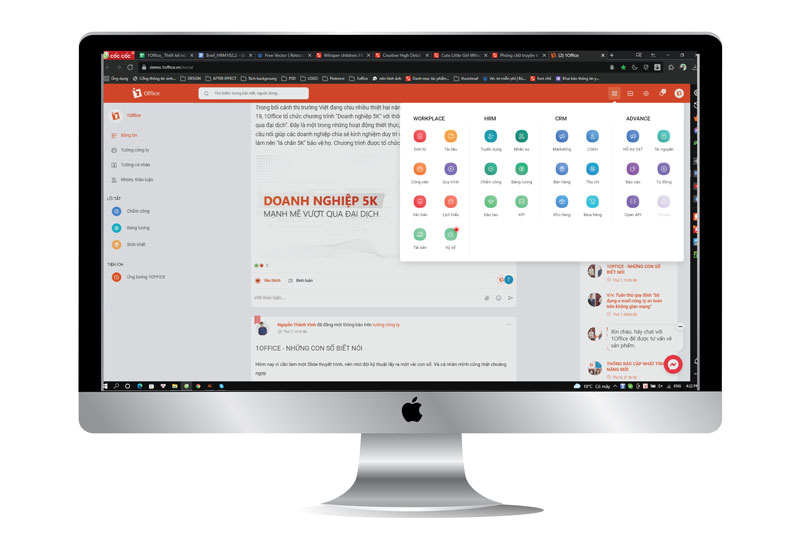
Those are the reasons why 5,000 businesses are now using 1Office’s operational process management software to manage work effectively. So, what is Kaizen’s role and how is it related to this software? In essence, 1Office software acts as a Kaizen method to help your business, managers, and all levels of personnel optimize the business management process from A to Z.
- Regarding time:
The intelligent 1Office management software automatically sends alerts for approaching and overdue deadlines for tasks you need to complete. You can also view the entire time history of how employees have worked and the estimated completion time.
- Regarding processes:
The entire process of carrying out every task is mapped out more scientifically and intelligently on 1Office. For example, with a sales process, you can assign the person responsible, the manager, and the follower, and divide each step with its corresponding person. This allows you to view, check, and evaluate work quality effectively. It also fosters habits of discipline, responsibility, and transparency in the work process.
Thus, to make a breakthrough in your business’s field of operation and to grow more sustainably, you need to make the right transformational decisions. Above is detailed information explaining the Kaizen method and its benefits for businesses. The “Kaizen” effect is becoming popular and widespread among “young businesses” today. So why haven’t you applied this work improvement model with the comprehensive business management software 1Office?
Contact and reference information at:
- Hotline: 083 483 8888
- Fanpage 1Office: https://www.facebook.com/1officevn
- Youtube: https://www.youtube.com/c/1OfficeNềntảngquảnlýtổngthểDoanhNghiệp