12/05/2026
  65 views
Human resources are always the core force, the pillar of development for the manufacturing industry. Therefore, human resource management in manufacturing is a top priority investment aimed at building a sustainable, high-quality workforce. However, the overall picture of the labor market and the fluctuations in the manufacturing sector require businesses to always be ready to adapt to new demands and retain their workforce. So how can manufacturing businesses flexibly transform to effectively solve the human resource management challenge in the digital age? 1Office will provide the answer in the following article.
Mục lục
- 1. The Overall Picture of Human Resources in the Manufacturing Sector 2022
- 2. The Human Resource Management Challenge in the Manufacturing Sector – Difficulties and Challenges
- 3. The Best Human Resource Management Solutions in the Manufacturing Industry Today
- 4. 1Office HRM – The superior HR management solution for the manufacturing industry
1. The Overall Picture of Human Resources in the Manufacturing Sector 2022
2022 marked a milestone in the resurgence of the manufacturing industry since the pandemic. The production capacity of businesses has recovered, along with positive signs from the economy with strong market demand in key sub-sectors, helping the manufacturing industry stabilize its operations after a period of being frozen by the pandemic, and signaling growth prospects for 2023.
The promising signals of the overall industry trend also have a positive impact on human resource management in manufacturing. With the advantage of being a key industry invested in and prioritized for development by the state, manufacturing remains a sector with a competitive edge, creating many jobs for a large number of domestic and foreign workers.
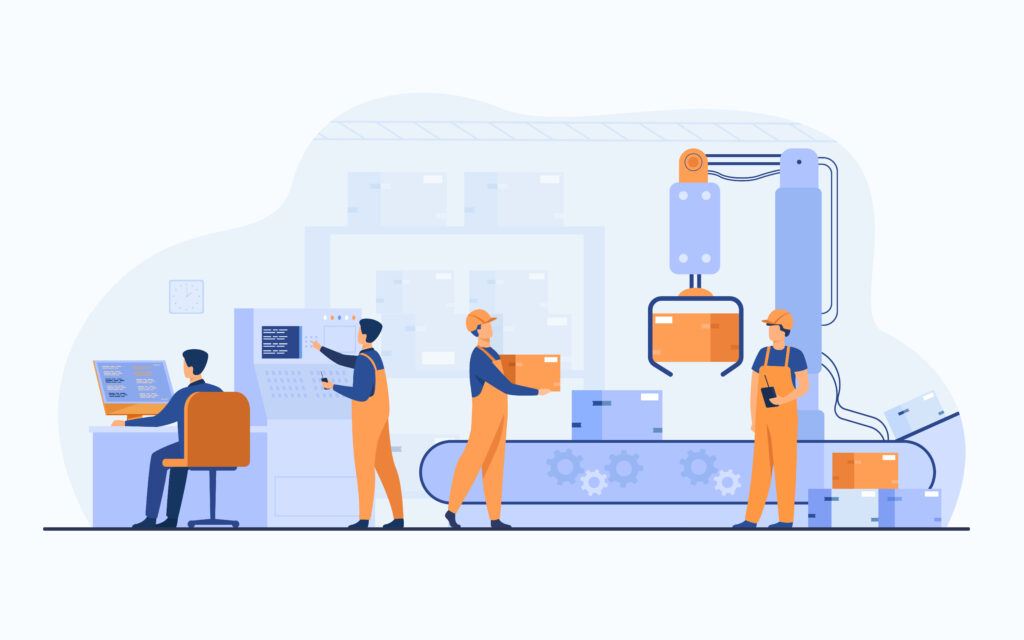
Additionally, the 4.0 revolution, along with the emergence of “cobots” (a form of collaborative robot designed to work with humans), artificial intelligence, and automation replacing human labor, has created a leap in performance for manufacturing businesses.
Guaranteed operational capacity and optimized labor productivity allow businesses to focus on investing in human resources, developing effective human resource management methods, and training to improve skills and labor quality. Besides, international human resource management is also well-developed in the manufacturing sector as the demand for foreign resources is increasing.
Alongside the positive signs in the general human resources landscape of the manufacturing sector in 2022, businesses also face a “thirst” for talent. The Vietnamese labor market was estimated to be short of 120,000 workers by the end of 2022, with a particular scarcity in positions requiring degrees and high skill levels. The shortage of senior personnel has left many businesses in a “dire” state, lacking the necessary resources to meet operational demands.
Try the professional 1Office HRM software for free
2. The Human Resource Management Challenge in the Manufacturing Sector – Difficulties and Challenges
Large and constantly fluctuating workforce
The biggest bottleneck in the human resource management challenge in the manufacturing sector is the large number of personnel, which leads to difficulties in management and causes constant workforce fluctuations. In manufacturing businesses, the number of workers can reach hundreds or even thousands, making it very difficult to capture the information and personal records of each individual and to monitor compliance with regulations during work.
Furthermore, the majority of the workforce in manufacturing businesses consists of general laborers who often rotate jobs frequently and have a low level of commitment, leading to an unstable personnel structure. Many companies find themselves in trouble due to the lack of effective employee retention strategies, resulting in a labor shortage.
| Read more: 5 effective human resource management methods in the new normal |
Challenges in Human Resource Recruitment
Recruitment challenges are also a difficult problem that manufacturing businesses are facing. The manufacturing industry always has a high demand for human resources. Specifically, in 2022, the recruitment demand of businesses fluctuated, increasing from 29% (Q1) to 37% (Q4). This figure is quite high compared to the average of other sectors such as consumer/retail, finance/banking, IT, etc.
However, the labor market supply has a large disparity compared to the demand. The number of workers with vocational qualifications from elementary to college level only accounts for 38%, while this is the core workforce in the operational apparatus of a manufacturing enterprise. A survey by Navigos Group indicated that up to 43% of businesses expressed difficulty in finding candidates with suitable experience, skills, and professional knowledge to meet job requirements.
The core reason for the difficulty in attracting and retaining talent in the manufacturing industry is the lack of suitable welfare and reward policies to encourage and motivate employees. The working environment and job stability are also factors that profoundly affect job choices and personnel commitment.
Difficulties in Timekeeping and Payroll Calculation
The complexity of the work is also one of the “obstacles” that HR professionals face in manufacturing human resource management. Complex working hours, multiple shifts per day, and constantly changing work schedules lead to overlapping timekeeping data, consuming a lot of time for shift allocation to departments/individuals, calculating payroll, and balancing overtime for personnel.
Personnel Competency and Qualifications
With the rapid development of technology, manufacturing is one of the pioneering industries embracing the digital transformation wave to modernize production lines and improve operational efficiency. However, technological development also poses a significant challenge to human resource management in manufacturing, as the workforce has weak skills and has not kept up with scientific and technological changes.
The process of employees learning and applying machinery and software in production is slow, limited, and inefficient. This not only wastes the budget invested in improvements but also leads to operational stagnation as personnel have to change and adapt to new working methods.
Read more: 4 steps to create an effective and resource-saving project human resource management plan
3. The Best Human Resource Management Solutions in the Manufacturing Industry Today
Attracting and Retaining Talent with a Digital Work Experience
Changes in employee needs, along with the development of digital technology, have motivated businesses to be more creative in human resource management. Technology is predicted to play a key role in attracting and retaining talented employees for every business. Therefore, to build a stable and sustainable workforce, manufacturing businesses need to pay more attention to creating a digital work experience for their employees.
The digital work experience is founded on a healthy and happy work environment, accompanied by a cohesive culture that attracts collective participation, and finally, flexible welfare policies that closely follow employee needs. All of these are built and developed with the support of digital data. By mining, analyzing, and measuring personnel information, businesses can develop effective and practical management strategies, optimizing the work experience for employees at every touchpoint.
| Read more: 7 steps to standardize the human resource management process according to ISO standards |
Developing a digital workforce to keep up with Industry 4.0 trends
The context of the digital economy and the 4.0 revolution forces manufacturing businesses to transform if they don’t want to be left behind. In this, a digital workforce is the main, key driving force for digital transformation in production. Therefore, the challenge for human resource management is how to develop a digital workforce capable of mastering technological devices and applying them effectively in the production process.

Developing a digital workforce is also the solution to compensate for personnel shortages by reducing manual workloads and increasing labor productivity through automation. Therefore, businesses need to focus on enhancing the training and development of their digital workforce, improving labor quality by placing highly qualified talent in key positions, sending personnel to training courses, and especially optimizing the recruitment process to find truly suitable candidates.
Applying technology in human resource management
The wave of technology has been deeply affecting all aspects of the economy, especially creating breakthroughs in human resource management. With the potential to create a competitive edge and meet the demands of the digital economy, there is no reason for HR managers to ignore digital technology.
Today, with 4.0 human resource management solutions, all personnel information is managed centrally, clearly, transparently, and is easily searchable on a system with massive storage capacity. Furthermore, the greatest strength of applying technology to HR management in manufacturing is its automation capability and strong connectivity, helping to reduce resources for data consolidation by up to 80%.
With timekeeping and payroll software, all data on attendance, salary, KPIs, and sales are synchronized and updated in real-time. Additionally, the automation feature can automatically calculate and generate monthly payrolls for employees with pre-set formulas without human intervention. This helps reduce the workload and frees up labor for the HR department, allowing HR professionals to focus on human resource development strategies.
4. 1Office HRM – The superior HR management solution for the manufacturing industry
To overcome the barriers in HR management and meet the new demands of the industry in the digital era, manufacturing businesses must take decisive action to become digital enterprises. Applying software technology to HR management in manufacturing is the prerequisite for optimizing the human resource management process.
1Office HRM is a superior HR management solution for the manufacturing industry. With experience in accompanying and successfully implementing digital transformation solutions for over 5,000 businesses of all sizes, including major names in the manufacturing sector like Dong Tam Group, BMB Steel, Hong Ha Beton, etc., 1Office has affirmed its position as a leading HR management solution pioneering digital transformation.
With a powerful and superior toolset, the 1Office HRM module can solve all problems in HR management, helping manufacturing businesses remove barriers to build a sustainable workforce and create a solid foundation for future growth.
Manage & measure personnel data
- Standardize and centrally store all personnel data (profiles, insurance, contracts, leave, etc.) on a single platform, making it easy to filter, search, and retrieve information
- Easily track personnel fluctuations through automatic, visual, and instantly updated statistical reports
Timekeeping & payroll management
- Thoroughly handle the challenges of shifts, shift registration, and shift changes for personnel
- Flexibly define and assign work shifts in various forms: rotating shifts, administrative hours, and individual shifts.
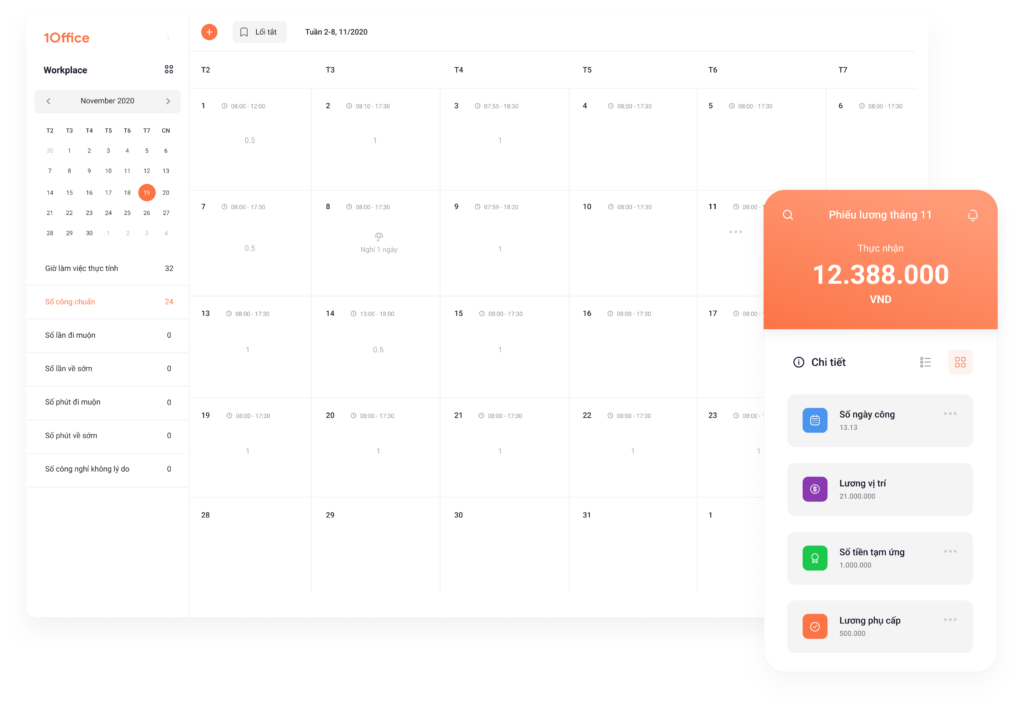
- Automatically connect with time clocks or support timekeeping through methods like GPS, FaceID, etc.
- Automatically consolidate data and generate transparent, clear timesheets
- Automatically calculate and send payslips to employees, making the payroll process transparent
Support training & personnel development
- Managers can grasp the quality of personnel through a systematic evaluation criteria system
- Allows for planning and designing skills training courses, digital technical expertise training, and closely monitoring the competency development process of personnel
- Build a clear career path for each position and title
Optimize recruitment
- Comprehensive management of the company’s recruitment process, improving recruitment efficiency and quality
- Allows you to set up evaluation criteria to screen candidates and find the most potential applicants who meet the requirements for qualities, skills, and qualifications
- Build a systematic and seamless recruitment process, from sourcing candidates and screening resumes to interviewing and sending job offers
In the article above, 1Office has provided readers with an overview of human resource management in the manufacturing industry, as well as introduced effective human resource management solutions in manufacturing to help improve the efficiency of HR management activities within the business. 1Office is the leading business management solution on the market today, helping businesses optimize their process management. For a consultation and a free trial of the software, please contact us using the information below:
- Hotline: 083 483 8888
- 1Office Fanpage: https://www.facebook.com/1officevn
- YouTube Channel: https://www.youtube.com/c/1OfficeNềntảngquảnlýtổngthểDoanhNghiệp