


 12/05/2026
  241 views
In line with the development of digital technology, HR management software has gradually become an important and indispensable tool for every business. More and more businesses are investing in building HR management software to optimize and enhance the efficiency of human resource management. However, in reality, not every business succeeds in implementing HR management software due to a lack of understanding of the development process and failure to identify the core factors during implementation. So, what steps are included in an effective process for building employee management software? Let’s find out with 1Office in the following article.
Mục lục
- 1. Essential criteria for good HR management software
- 2. The process of building effective HR management software for businesses
- Step 1: Define the goals and needs of HR management
- Step 2: Design the organizational structure chart
- Step 3: Prepare input data for the software
- Step 4: Design the human resource management software
- Step 5: Implement the human resource management software
- Step 6: Monitor, evaluate, and adjust the software
- 3. Conditions for successfully building and applying human resource management software
- 4. 1Office HRM – The leading comprehensive human resource management software in Vietnam
1. Essential criteria for good HR management software
HR management software is a technological solution that provides tools to handle human resource management tasks. By systematically digitizing and storing HR-related information and tasks, the software helps optimize HR management processes such as employee information management, benefits management, timekeeping and payroll management, etc.

HR management software aims to meet the needs of three main user groups within a business: senior management, middle management, and employees. To do this well, good HR management software needs to meet the following criteria:
- A user-friendly interface that everyone from management to employees can easily get used to and use.
- The software must accurately and fully reflect the nature of human resource management tasks, and its features must be developed in close alignment with practical HR management practices.
- Update information throughout the employee lifecycle on a single, centralized platform, helping managers grasp all information related to the personnel situation.
- Ability to analyze data and generate reports to support managers in making accurate personnel decisions.
- Strict and precise permission settings for each individual and department, ensuring the security and confidentiality of HR data.
- Automate manual operations and processes, especially in timekeeping and payroll tasks.
See more: 7 steps to standardize the HR management process according to ISO standards
2. The process of building effective HR management software for businesses
Step 1: Define the goals and needs of HR management
Before starting to build employee management software, businesses need to clearly define the goals and needs of their HR management. This will help determine the necessary functions for the software.
It should be noted that the goals and needs of human resource management must be carefully analyzed based on the actual problems that the business in general, and the HR department in particular, are facing. For example, if a company has a high turnover rate and a short employee lifecycle, building HR management software will need to focus on improving recruitment quality and optimizing the onboarding process.
Additionally, the goals of the HR management system must align with the company’s development strategy at each specific stage. For instance, for young, developing businesses, the requirements for HR management software will be at a basic level to match their current resources and capabilities, with the primary needs focused on managing employee profile information and timekeeping/payroll.
As for businesses that are growing and expanding, building a high-quality, strong workforce will be a top priority. Therefore, the HR management software will focus on developing training and evaluation features.
EXPERIENCE THE FEATURES OF 1OFFICE HRM SOFTWARE
Step 2: Design the organizational structure chart
Designing the organizational structure chart is a crucial step in the process of building HR management software. The organizational chart will help define the relationships between departments and positions within the company, and it also serves as a reference frame for developing the hierarchy system in the HR management software.
Furthermore, the organizational structure also provides a basis for setting permissions within the software, clearly defining the authority and responsibilities of relevant parties in internal request-approval processes.
Step 3: Prepare input data for the software
To digitize HR data and import it into the system, businesses first need to standardize the input information source by completing detailed descriptions of job titles, job information, and clear, specific descriptions of the operational methods and roles of the HR management functions within the software.

This is a crucial step that directly affects the operational efficiency of the HRM software and subsequent human resource management tasks. Therefore, the input data must be accurate and transparent.
Step 4: Design the human resource management software
After preparing all necessary resources, the business will proceed to build the human resource management software based on data coding and programming on a technology platform.
At this stage, the business can directly undertake the software implementation. It is important to note that developing human resource management software is a complex project that requires a detailed plan, reasonable resource allocation, and close coordination between the HR and IT departments.
Currently, most businesses – including technology leaders – tend to choose professional HR software providers. These providers not only have a technology platform specifically developed for human resource management but also offer consulting services for HR management solutions tailored to each business’s specific characteristics. Therefore, this is the optimal choice, helping businesses design and build employee management software while saving time and costs.
Step 5: Implement the human resource management software
After the design phase is complete, the human resource management software will be implemented and applied in practice to human resource management tasks. During this process, the business needs to widely inform the entire staff and conduct training sessions to guide them on using the software.
For employees, training will cover basic features in the software such as creating requests, tracking workdays, updating profiles, etc. For managers, training will focus on the process of managing employee records and requests on the software, as well as data analysis and report generation.
Step 6: Monitor, evaluate, and adjust the software
During the software application process, the business needs to closely monitor and measure the effectiveness of human resource management to assess the software’s implementation feasibility.
Furthermore, businesses are constantly changing and developing, which brings new needs in operational management. Therefore, the HRM software must be continuously improved and adjusted to promptly meet the organization’s strategic goals.
3. Conditions for successfully building and applying human resource management software
To successfully design and build human resource management software for a business, in addition to a methodical process, many other factors are involved. Many businesses, despite having completed their human resource management system, fail to achieve the desired results upon implementation. Therefore, to successfully implement HRM software, a business needs to ensure the following conditions:
- Close guidance and direction from the leadership throughout the process of applying the HR system in the business
- The technology application skills of the management team need to be focused on, developed, and enhanced to keep up with system features
- The human resource management software needs to be integrated with other functional management software and modules of the business to create a synchronized and seamless operational system
- The investment cost for the human resource management software must be commensurate with the value it brings
4. 1Office HRM – The leading comprehensive human resource management software in Vietnam
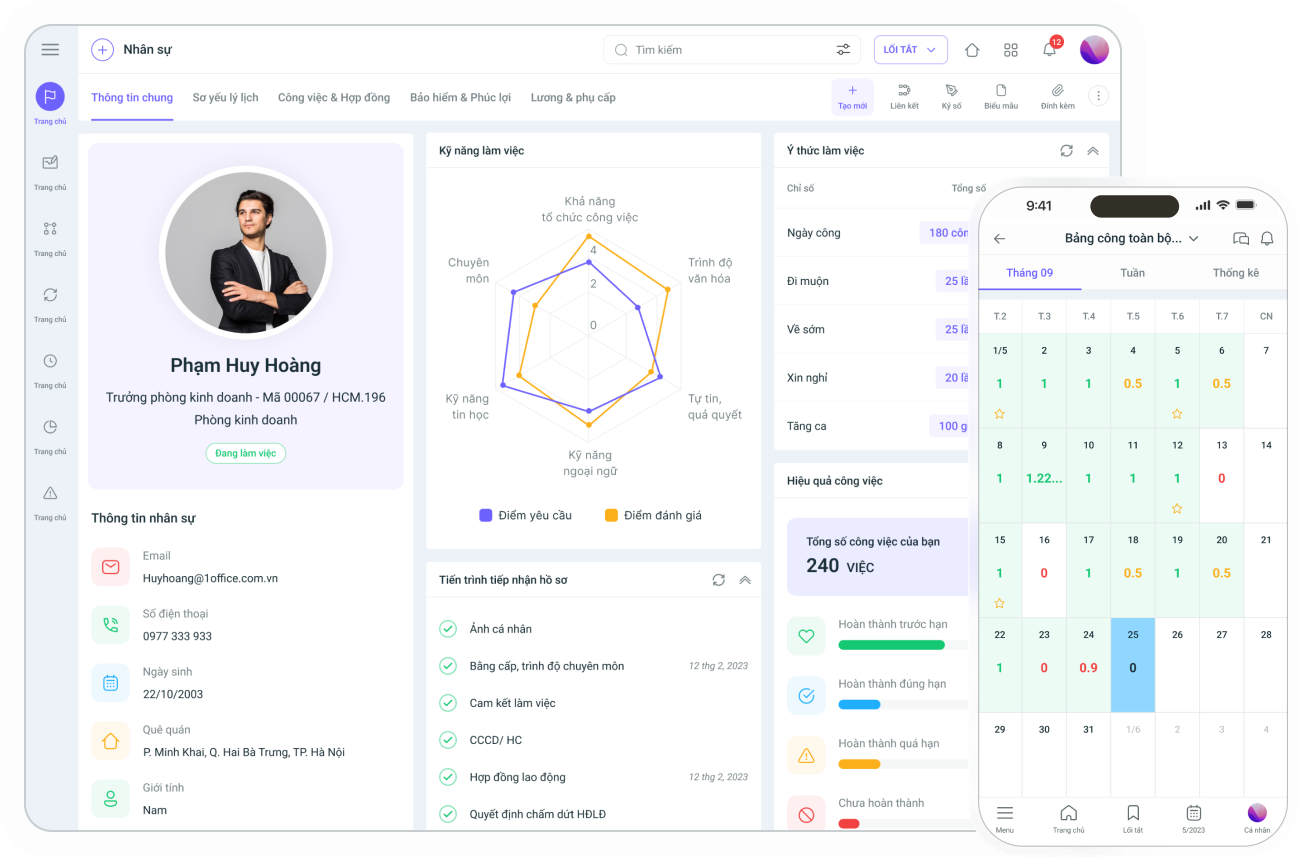
1OFFICE HRM provides a toolset to optimize human resource management within a business, ensuring the provision of a quality workforce that meets the company’s development requirements accurately, sufficiently, and in a timely manner:
- Recruitment management, allowing for synchronized CV integration from recruitment sites
- Manage interview schedule information and candidate evaluation results
- Manage and store all personnel information, work history, contracts, salary, insurance, etc.
- Manage and store all labor contract information, supporting integration with eContract for digital signing
- Simple and flexible work shift scheduling
- Integrate various timekeeping methods: time clock, GPS, FaceID, etc.
- 100% automatically calculated timesheets
- 24/7 automatic payroll calculation,
- Online leave request system, automatic management of leave and compensatory time-off information
- Integration for payroll processing through MB Bank
- Evaluate work performance through KPIs and OKRs
In the article above, 1Office has provided readers with an overview of the most effective process for building human resource management software for businesses, while also introducing a comprehensive HR management software that helps optimize business resources. For a consultation and a trial of the market-leading human resource management software, please contact us using the information below:
- Hotline: 083 483 8888
- 1Office Fanpage: https://www.facebook.com/1officevn
- Youtube Channel: https://www.youtube.com/c/1OfficeNềntảngquảnlýtổngthểDoanhNghiệp
















