What are KPI Evaluation Criteria? Building Effective KPIs for Departments


What is a KPI? How can you build an effective and suitable KPI scale for each job position? Let’s find out with 1Office in the article below!
Mục lục
- 1. What is a KPI?
- 2. Why do businesses need to establish KPI metrics?
- 3. Method for Determining KPIs
- 4. 5 Steps to Building an Effective KPI Strategy for Your Business
- 5. Examples of KPI templates for departments in a business
- 6. Some reasons why businesses fail to achieve their KPI targets
- 7. How to build the most suitable KPI targets?
- 8. Manage and evaluate employee KPIs effectively with 1Office software
1. What is a KPI?
For any business to survive and grow, it needs to have a goal to achieve (e.g., revenue, profit, etc.). To achieve these goals, CEOs and managers often have to outline various plans and strategies, including both large and small tactics, to get closer to those objectives.
In the process of implementing a plan, whether it’s a tactic or a strategy, it often goes through many steps and takes time to see the results of that work. After obtaining the results, it is crucial to have a certain standard to evaluate the effectiveness of the process and the outcome of the work performed.
This is where KPIs come in.
A KPI is an indicator used to measure and evaluate the work performance of each employee, individual, and the entire enterprise. KPI is an acronym for Key Performance Indicator.
2. Why do businesses need to establish KPI metrics?
Organizations and businesses often use Key Performance Indicators (KPIs) at various levels to evaluate their success in achieving set goals.
High-level KPIs can focus on the overall performance of the business, while low-level KPIs focus on the performance of processes or employees in departments such as sales and marketing. When a business sets KPIs for company activities and for each employee, it helps motivate the entire team or individuals to strive harder in their work.
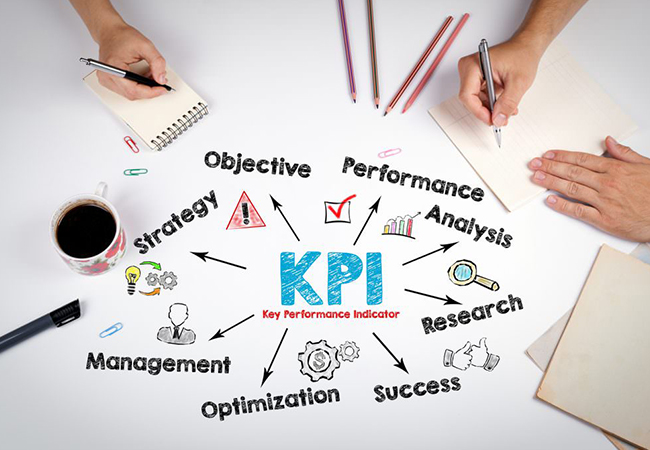
KPIs are a modern tool that helps managers turn strategies into management objectives for each department and division in various fields such as human resources (recruitment, training, salary, performance evaluation, etc.), finance, sales, advertising, and for each individual.
KPIs are applied for various purposes, such as managing the work system of a team or organization, and self-managing the work of each individual. Typically, each position has a job description or a monthly work plan, which managers use to evaluate the performance results for that position. Based on each employee’s KPI level, managers can determine:
- Reward levels
- Basis for determining training content
- Improving corporate culture
- Company resources
- Basis for scaling
- Development direction
- …
Read more: What is an SLA? Understand SLA and KPI to guide development
3. Method for Determining KPIs
Defining what a KPI is is very important because if it is not set up correctly, the business cannot successfully operate its KPI system.
CEOs and managers should start with the basics, understanding the organization’s goals, how to plan to achieve them, and who will be involved in implementing these plans before starting to build suitable KPIs for the company’s business operations as well as employee activities.
This is a process that requires analysts, department heads, and managers to constantly monitor and closely follow the company’s processes to understand them clearly and devise appropriate KPIs, and to determine who is responsible for these KPIs.

KPIs in sales are different from KPIs in HR or business, so determining KPIs must be based on important or core business objectives:
- What is the desired outcome?
- Why is this outcome important?
- Who is responsible for the work results?
- How will you know you have achieved the goal?
- How often will you evaluate progress, and how will you do it?
Based on a few common questions, you can define KPIs in the simplest way, and this also serves as a scale to help you evaluate the level of work completion, motivating you to try and strive harder in your work.
See more: TOP 12 Leading KPI Software Solutions Used by Many Businesses Today
4. 5 Steps to Building an Effective KPI Strategy for Your Business
Building KPIs for a business or organization is very important. Sometimes, setting inappropriate KPIs can make employees feel uncomfortable, tired, and under a lot of pressure at work, which will directly affect the company’s overall goals.
An organization can approach the KPI building method in the following 5 steps:
Step 1: Identify the department or manager responsible for building KPIs
Usually, functional departments or divisions will build KPIs for themselves. The manager will be responsible for ensuring or adjusting the KPIs to suit the available resources. Alternatively, KPIs can be developed by senior management and passed down to departments for implementation.
Step 2: Define KPI metrics
Building KPIs depends on the following factors:
Departmental KPIs: Built based on the functions and responsibilities of that department. The manager will set general KIP metrics, which serve as the basis for developing KPIs for each employee.
Individual KPIs: Based on each person’s job description. The SMART model is often used when building employee KPIs to ensure feasibility and ease of evaluation.
Step 3: Evaluate KPI completion level
After establishing appropriate KPI metrics, the next step is to apply them to the operations of each department/division/function within the organization.
Since the KPI metrics are clearly defined before being applied, management becomes much simpler. You can group KPIs to evaluate their performance as follows:
- Group A: Time-consuming to implement – impacts overall operations
- Group B: Time-consuming to implement, significantly affects the overall goal/or time-consuming to implement and has little impact on overall operations.
- Group C: Less time-consuming and has little impact on overall operations.
Step 4: Evaluate KPIs and determine compensation
For each level of completion, employees will receive a corresponding bonus to encourage them to put more effort into their work.
Step 5: Adjust KPIs
KPIs are monitored and adjusted over time to ensure the metrics are met.

How to build a KPI scale?
| Read more: OKR and KPI: The difference between the 2 solutions and how to apply OKR and KPI effectively |
5. Examples of KPI templates for departments in a business
Below are some KPI templates for departments in a business:
- KPI template for the Head of Human Resources and Administration position: VIEW HERE
- How to build KPIs for the Digital Marketing department?: VIEW HERE
- KPI template for customer service staff: VIEW HERE
- The most detailed KPI template for a Content Marketing staff position: VIEW HERE
- The most detailed KPI template for a Sales Team Leader position: VIEW HERE
- The most accurate KPI template for a Marketing Manager position: VIEW HERE
- KPI template for an accountant position in a business: VIEW HERE
- The most accurate KPI template for an IT System staff position: VIEW HERE
- KPI template for a Branch Manager position in a business: VIEW HERE
See more KPI templates for other departments: HERE
6. Some reasons why businesses fail to achieve their KPI targets
When it comes to employee performance appraisal methods, people immediately think of developing evaluation metrics, but KPI is still a relatively new concept for businesses.
However, not every business that applies KPIs is successful. Some reasons why businesses fail to achieve their desired KPIs include:
- Setting unclear objectives in the KPI evaluation system; evaluation criteria are unsuitable and do not align with SMART principles.
- Incorrect perception of KPIs due to insufficient communication and lack of consensus from staff when implementing KPI evaluations. Some employees work merely to meet the metrics, creating negative consequences for the entire system.
- Some businesses build a KPI system just for the sake of it, making it mechanical and disconnected from the company’s strategic goals.
- There is no dedicated individual or team with sufficient competence to monitor, synthesize, and provide timely warnings during KPI implementation.
- Building KPI targets with too many processes without focusing on establishing the objective system for those processes.
- The staff’s capabilities are weak, lacking the ability to achieve the set KPI targets.
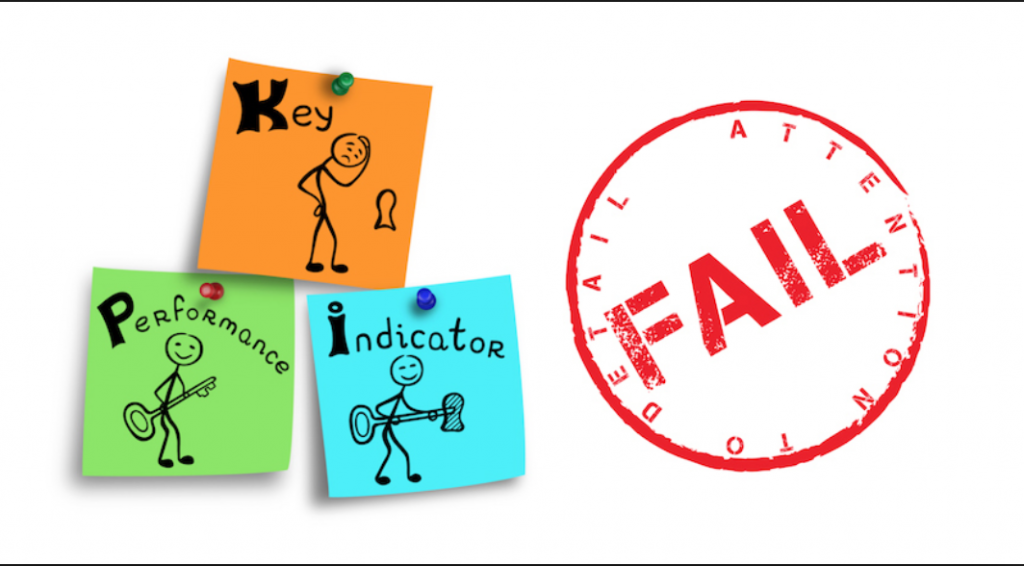
Therefore, we can see that KPIs set for others to execute must be truly suitable and closely aligned with the established objective system. When completed and achieved, KPIs must have a positive impact on the business and organization.
7. How to build the most suitable KPI targets?
When setting a KPI for an activity or job, we need to evaluate and consider whether our KPI has all the following characteristics according to the SMART principles mentioned above:
- Specific, clear:
KPIs need to be clearly defined and should target a specific area/element for improvement. A KPI is worthless if it is not specific and clear, and does not contribute to improving work efficiency
- Measurable:
If a KPI cannot be measured or lacks an effective standard or benchmark for evaluation, it is worthless. Therefore, it must be measurable and evaluable through data and reports.
- Achievable, executable:
KPIs should be assigned to employees who can achieve them and be held accountable. If you cannot find an employee to be responsible for a job with a KPI, should you even build a KPI system?
- Realistic:
Most importantly, KPIs need to be realistic. We should not set KPIs for employees based on beliefs or hypotheses.
- Has a specific and definite deadline:
A specific timeline must be set to know when the work will be completed, making it easy to assess the level of completion. You should not assign a KPI or any task if your employee cannot determine a deadline for its completion.
8. Manage and evaluate employee KPIs effectively with 1Office software
Building KPI indicators is becoming increasingly important for businesses. However, for many businesses, this task still faces some obstacles from users, such as not having a suitable management tool. Recognizing the importance of a KPI evaluation solution, 1Office has developed the KPI management software as a separate module in its comprehensive business management solution suite.
This is a software that helps managers create KPI frameworks for each department, track KPI indicators, evaluate work performance, manage execution time, and more. With over 3500 businesses currently using it, it can integrate with the sales, customer care, recruitment, human resources, and Marketing modules. This is a powerful automated support tool that helps managers get a comprehensive overview of progress management and employee performance evaluation.
Above are all the insights from 1Office, hoping to provide you with a deeper and clearer perspective on what a KPI is and how to create suitable KPI indicators. Additionally, if you need more detailed advice on how to build KPIs for each department and how to monitor and measure them, you can leave your information for a consultation via the button below.
Related keywords: kpis, what are kpis, what is kpi
Connect with us:
- Hotline: 083 483 8888
- Website: https://1office.vn/
- Facebook: https://www.facebook.com/1officevn