


 13/05/2026
  211 views
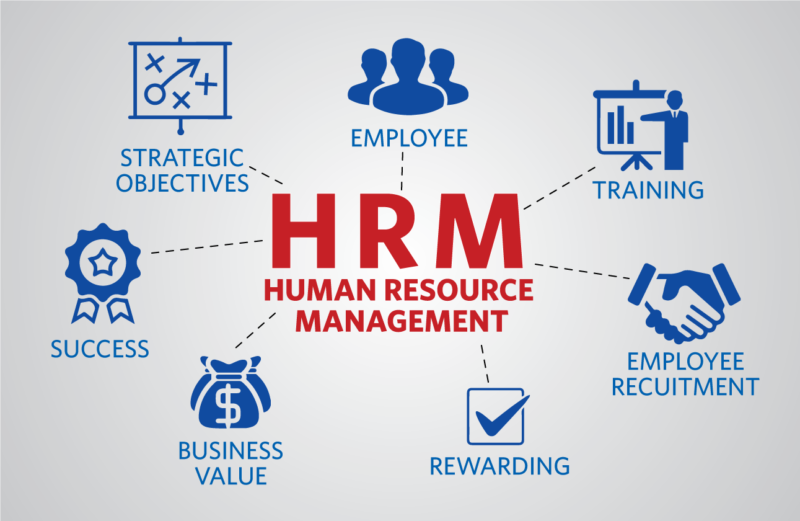
Historically, human resources have always played a crucial role and directly influenced the development of any organization. However, effectively managing human resources is a difficult challenge that most businesses face. So, what is a human resource management system, and what are its functions and roles? Let’s explore the article below to find the answers.

Mục lục
- 1. What is a human resource management system?
- 2. Benefits of an HRMS for businesses
- 3. Functions of an HRMS
- 3.1 Job Design and Job Analysis
- 3.2 Employee Recruitment and Selection
- Clearly, HRM plays a crucial role in preparing employees for greater tasks and responsibilities, leading to their overall development at work. An organization that provides ample development and growth opportunities for its employees is considered a healthy one.
- 3.4 Managing and evaluating employee performance
- 3.5 Accurate Timekeeping and Payroll Management
- 4. Criteria for choosing the right HRMS for your business
- 5. Common types of HRMS
- 6. Frequently asked questions about HRMS software
- 7. 1Office – A comprehensive human resource management system for businesses
1. What is a human resource management system?
A Human Resource Management System (HRMS) refers to a suite of software that organizations use to manage internal HR functions. From recruitment, timekeeping and payroll management, benefits, to employee training… The software helps HR professionals manage the workforce intelligently and conveniently. This saves time and effort for HR staff and allows managers to focus on personnel strategies.
2. Benefits of an HRMS for businesses
When discussing HR management software, we must mention the convenience and automation capabilities that help increase efficiency and manage HR tasks quickly and effectively. Therefore, in the digital age, implementing an HRMS is a comprehensive solution that helps businesses save costs, time, and brings many significant benefits, such as:
2.1 Retain your best employees
A human resource management system helps engage employees by providing a way for them to continue learning with training and development programs. Many HRMS options feature e-learning with courses that employees can complete at their own pace. Since training and development opportunities often rank higher in employee satisfaction surveys than monetary benefits, allowing your employees to grow and learn with the company is likely to keep them longer. Plus, better training means more skilled employees—so it’s a win-win.
| Read more: How to build an effective, optimized HR Department model for businesses |
2.2 Automate repetitive HR tasks
If you’re always spending a lot of time on repetitive tasks and routine administrative work, you certainly won’t have much time to focus on more in-depth projects like improving your work environment. An HRMS can help automate repetitive and time-consuming tasks. Automating these types of tasks will help improve record accuracy, prevent duplicate records, and lead to fewer errors overall.

2.3 Accelerate your recruitment process
Right now, it’s a candidate’s market, and recruiting for your business can be very challenging. Not only do HR professionals and hiring managers have to create job listings, answer questions, and search for suitable candidates to interview; they then have to interview candidates, process their paperwork, and oversee the entire onboarding process.
An HRMS can help you create job listings and source top talent by analyzing resumes for keywords, and it can also assist by automating some of the paperwork to make it easier for you and your team to onboard if that employee is hired. This feature is amplified if you integrate your HRMS with an applicant tracking system, which can really help you delve deeper into employee analytics, resolve bottlenecks in your recruitment plan, and discover who needs hiring assistance in your company.
2.4 Improve employee performance
An HRMS allows employees to easily track their progress right within the human resource management system. Managers can use this data to develop goals, and make adjustments and improvements to their work. This allows managers to access the system, provide more accurate recommendations and feedback, and assist employees in goal planning. This helps employees get recognized for their achievements during meetings and be rewarded for good work—which is essential for achieving better performance and productivity.
2.5 Secure employee data and maintain compliance
With so many labor laws, regulations, and tax codes in place, it’s difficult to stay on top of everything. An HRMS is responsible for tracking new regulations, changing laws, data privacy, and anything else that could affect your company’s compliance.
Employers are responsible for ensuring that employee data is protected and not misused. An HRMS also helps protect against external threats by encrypting the data it stores, making it inaccessible to unauthorized users.
2.6 Save on office supply costs
Today, many companies are “going green” to help reduce waste, but they also have the potential to save money in the process. Reducing the amount of paper your business uses can go a long way in cutting supply costs. But how can an HRMS help you go paperless?
- Signing and approving contracts can be done right within the HRMS.
- Records are securely maintained by the HRMS provider on their servers.
- Payrolls can be sent via direct deposit instead of paper checks.
Going paperless with your HRMS can help reduce office clutter and may even help eliminate bulky storage, leaving more space for employees.
From the benefits mentioned above, it is clear that a human resource management system plays an important role and is an indispensable assistant in helping businesses increase work efficiency and effectively improve the quality of their personnel. So, what are the main functions of an HRMS? Let’s find out in the content below.
3. Functions of an HRMS
3.1 Job Design and Job Analysis
One of the most important human resource management functions of HRM is job design and job analysis. Job design involves the process of describing the tasks, responsibilities, and activities of a job. This can be done by describing the skills and personality traits of your most effective employees. Doing so will help you identify the type of candidate you want for the job. You will be able to determine your key minimum requirements for a candidate to qualify for the job.
3.2 Employee Recruitment and Selection
Recruitment is one of the arts of personnel management that managers need to know. HRM functions to attract and retain competent and effective employees to achieve the company’s goals and objectives. This all starts with recruiting the right employees from a pool of applicants. HRM helps find and identify ideal candidates for interviewing and selection. Candidates will then go through a comprehensive screening process to filter out the most suitable candidates from the applicant pool. The screened candidates will then go through various interview rounds to test and analyze their skills, knowledge, and work experience for the job position.

Clearly, HRM plays a crucial role in preparing employees for greater tasks and responsibilities, leading to their overall development at work. An organization that provides ample development and growth opportunities for its employees is considered a healthy one.
The role of HR is to ensure that new employees acquire the company-specific knowledge and skills to perform their tasks effectively. This contributes to improving the overall efficiency and productivity of the workforce, which ultimately leads to better business results for the company. Ultimately, the success of the human resource management model will depend on how well employees are trained for their jobs and their development opportunities.
3.4 Managing and evaluating employee performance
The next activity on the list of HR functions is managing employee performance. Effective performance management ensures that employee output meets the organization’s goals and objectives. Performance management focuses not only on individual employee performance but also on the performance of teams, departments, and the organization as a whole. Employee performance evaluation helps HR understand each individual’s capabilities and devise suitable training plans for personnel.
3.5 Accurate Timekeeping and Payroll Management
Instead of spending a lot of time manually calculating employee work hours, a human resource management system helps resolve all related issues with ease. HRM systems will automatically sync timekeeping data on the system, quickly calculate salaries, and automatically deduct for leave days, late arrivals, and process salary advances for employees. This helps save maximum time for HR in timekeeping and payroll, allowing them to focus on optimizing the business’s operational processes.
|
4. Criteria for choosing the right HRMS for your business
Finding the right HRMS for you is both a challenge and an important task. The HRMS platform you choose will shape how your HR team and the entire employee ecosystem will operate. Here are a few things to keep in mind when looking for the right HRMS for your organization:
- Find out if the HRMS can solve the exact problems you are facing.
- Determine if it is easy to integrate.
- Understand the cost and if it fits your budget.
- Ensure the HRMS will guarantee employee satisfaction.
- Determine the ease of use and the level of customization possible.
- Find out if the HRMS is scalable enough.
See now: The best HR management software pricing for 2026 – A cost-effective solution for businesses
5. Common types of HRMS
Which simple, easy-to-use HRMS software to choose is a question many people are still wondering about. Currently, there are 3 common types of HRMS on the market that many people choose
- Cloud: As part of the cloud, the system and data are stored on a third-party server. This basically leverages the power of the Internet.
- On-Premise: In this case, the system is installed and set up on the company’s own hardware and servers. The organization does not store or use the internet.
- Hosted: This is similar to the on-premise deployment method with the only difference being that the company pays a third-party server to store their data.
6. Frequently asked questions about HRMS software
What is most important to you when choosing a provider?
This will reveal how much attention you should pay to their references. If what they are after is the cheapest option and you are after the best option, then what you hear from this reference will be of limited value.
Would you describe the solution as good value?
A cheap product can be poor value, while an expensive product can represent superior value. So, instead of asking purely about price, find out if it is a good value solution.
How long does the software take to implement?
Providers often promise that the software will be delivered in the most perfect timeframe for you. Rarely is this actually achieved. This will give you a sense of the provider’s track record for timeliness and keeping promises.
7. 1Office – A comprehensive human resource management system for businesses
The HRM human resource management system is a perfect solution that helps businesses manage all HR processes from recruitment, timekeeping, payroll, and personnel records… quickly and conveniently. Possessing many smart features, the HRM software helps businesses solve all HR-related problems on a single platform. Here are some of the software’s outstanding features:
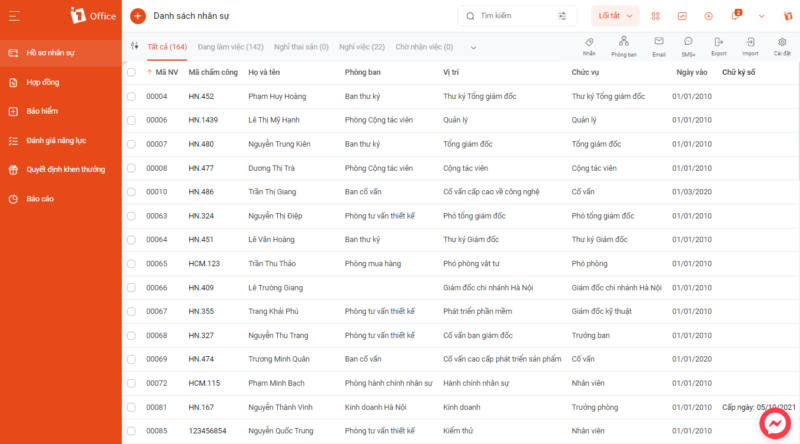
– Allows for the quick creation of new recruitment proposals on the software, helping HR receive notifications and approve requests with just one click
– Updates reports to help managers evaluate the effectiveness of recruitment channels, thereby helping managers focus on the most effective channels
– Digitizes employee information and data on the software, making it easy for managers to search, look up, and retrieve information directly on the software
– Tracks employee timekeeping and allows viewing of payslips directly on the software, helping HR save time and office supply costs
– Captures the work situation of personnel, allowing managers to get an overall picture of personnel fluctuations to devise the best methods
– Assesses employee capabilities accurately and fairly through performance review periods
– Employee timekeeping software via GPS positioning; just set the check-in location and you’re done.
– Automatically synchronizes timekeeping data, saving maximum time for HR payroll processing; accountants can transfer salaries to employees 24/7, including holidays.
Thus, the content above has introduced users to the role and function of a human resource management system in the digital age. It can be seen that applying HRMS software is an effective solution that helps businesses digitize all HR management processes quickly and easily. And 1Office is one of the best HR management tools that helps optimize all processes and issues related to human resource management. For consultation and support regarding the 1Office HRM software, please leave your information for 1Office experts to contact and advise you.
For more details, please visit:
Fanpage: https://www.facebook.com/1officevn/
Youtube: https://www.youtube.com/channel/UCeTIRNqxaTwk0_kcTw6SxmA
















