


What is a Differentiation Strategy? 4 Strategies to Create Differentiation


An effective business strategy is a key factor when a business starts its operations. It acts as a guiding compass, directing the business’s activities to achieve its set goals. To stand out from competitors in a volatile and competitive market, building a differentiation strategy is essential. In this article, 1Office provides you with information on the topic of differentiation strategy, methods to build this strategy effectively, and specific examples.
Mục lục
1. What is a differentiation strategy?
A differentiation strategy (Differentiation Strategy) is a general strategy used to guide business strategy, brand strategy, and marketing strategies with the goal of becoming the most prominent brand in the field where the business operates.

A differentiation strategy is about leveraging the brand’s unique strengths to create special value that no other business has. From superior product quality and excellent customer service to unique shopping experiences – each element has the power to shape differentiation. This is the key that helps a business not only survive but also thrive.
2. The importance of a differentiation strategy in business
In an era of technological development and fierce market competition, building a differentiation strategy for a business is not just important but also creates a unique advantage to stand out from the crowd. An effective differentiation strategy will help a business not only attract a large number of customers but also retain them for the long term. So, let’s explore with 1Office how important building a differentiation strategy is.
To avoid getting ‘lost’ in an increasingly crowded sea of businesses, building and executing an effective differentiation strategy will be a lifesaver, helping the business not only outperform competitors but also leave a lasting impression in customers’ minds. It is the first and most fundamental step in building a strong and sustainable brand.
2.1 Minimize price competition

This strategy allows a business to increase its competitiveness in the market through various factors other than price. For example: A travel company stands out from other businesses in the market due to factors such as the thoughtfulness and warmth of its professional staff, the uniqueness of its pre-planned itineraries, or the diversity of services it provides.
It’s clear that although competitors may offer cheaper tours, they cannot compete on the quality of service aimed at creating the best customer experience. This is a lifesaver that helps a business not only outperform competitors but also leave a lasting impression in customers’ minds. It is the first and most fundamental step in building a strong and sustainable brand.
2.2 Unique products
Building a differentiation strategy based on the uniqueness of a product/service brings a significant advantage to the business. To achieve this, company personnel must truly understand the features and USP (Unique Selling Point). The business can also create a comparison chart of the outstanding features that its product/service possesses, which competitors do not have. This is a golden opportunity for the business to advertise and communicate to potential customers through effective marketing campaigns.
2.3 Better profit margins
A differentiated product is not just about creating unique features but also about successfully communicating that uniqueness to customers. When customers perceive the superior value of the product, they will remember it and prioritize choosing it, thereby increasing the business’s chances of achieving higher profits.

If the business’s target market is willing to pay a higher price for better quality or value, they can generate more revenue with fewer sales. It is clear that a product differentiation strategy is the key to helping a business enhance value, reduce competition, increase loyalty, and expand its market. When the product successfully showcases its unique point, profits will soar, leading the business to success.
2.4 Customer brand loyalty
A business can survive and stand firm in the marketplace thanks to customer loyalty. Customers always prioritize using products/services that have left a good impression on them from past experiences. If the unique, superior point of the product/service ‘resonates’ with customers, they may develop a stronger attachment to the brand. From there, the business can increase its competitive advantage over rivals in the market.
2.5 Unique, irreplaceable products
In a fiercely competitive business environment, building customer trust that a company’s product/service is unique and irreplaceable is a key strategy. To achieve this, businesses must constantly stay updated on trends to capture customer needs. This involves investing in research and development to create products with superior features and impressive designs, ensuring consumers have the best experiences. When customers believe that a company’s product is unique and irreplaceable, they are willing to pay a higher price and remain loyal to the brand long-term. Businesses need to continuously strive to improve products, enhance service quality, and strengthen customer trust to achieve sustainable success in the competitive market.
3. 4 Common Types of Differentiation Strategies
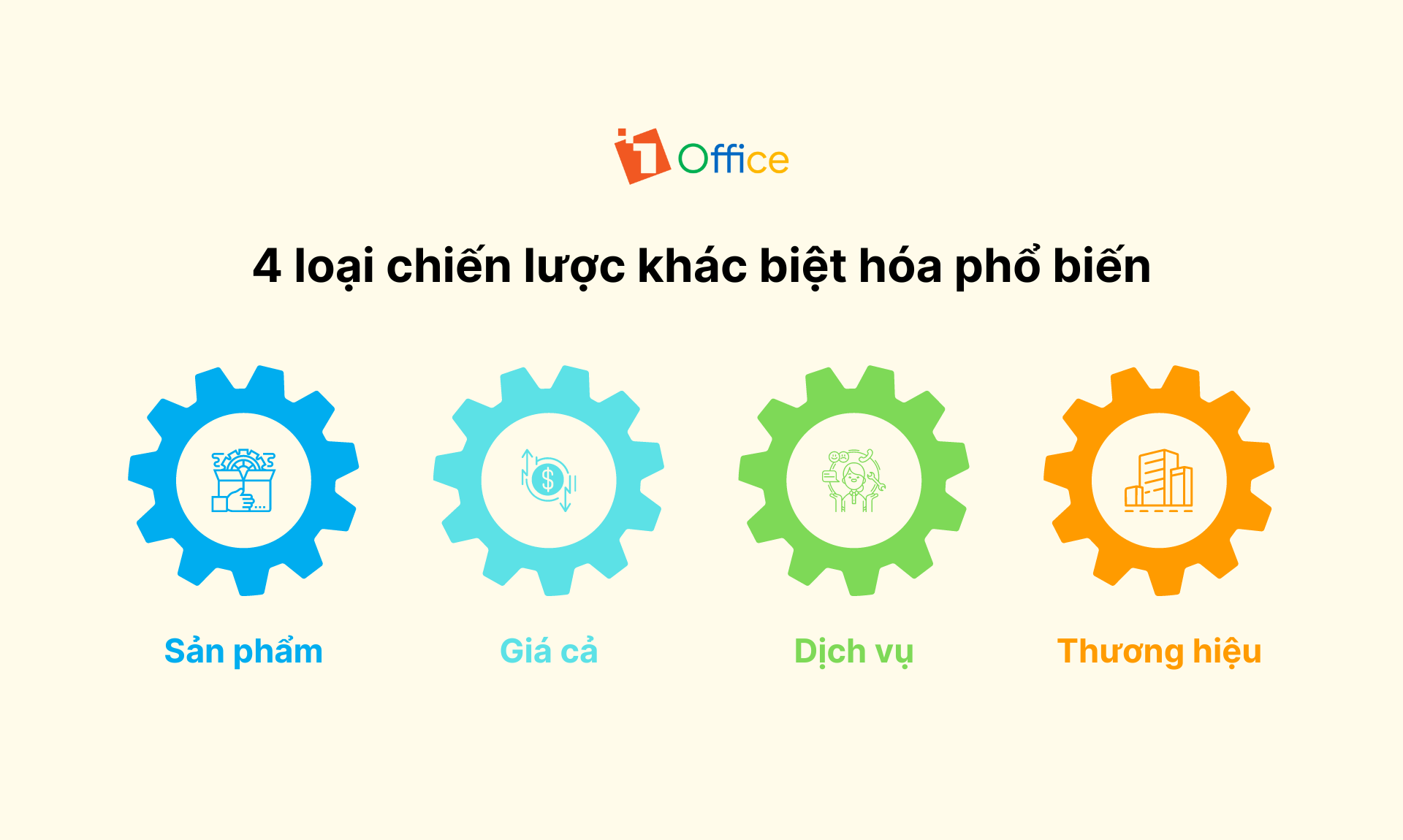
There are many different ways to build an effective differentiation strategy for a business. The approach to building and implementing it depends on the industry’s characteristics, the product/service’s features, and the company’s target customers. Below, 1Office has compiled 4 common types of differentiation strategies.
3.1 Product Differentiation
As its name suggests, this differentiation strategy focuses on creating a product with superior features and unique benefits compared to competing products on the market. Moreover, this strategy requires the business to have a firm grasp of customer needs and expectations for the product. It also requires conducting market research and clearly understanding its competitive advantages to create a unique and appealing product.
3.2 Price Differentiation
In this strategy, the business focuses more on price. By optimizing the production process, reducing operational costs, or finding cheaper supply sources, a business can offer its product/service at a lower price than competitors. Some businesses choose to sell at a higher price while providing better quality products/services with more value and benefits.
3.3 Service Differentiation
Building a service differentiation strategy aims to enhance the quality perception in the eyes of customers. To do this, the business must first train and develop a skilled and knowledgeable staff. This helps create a seamless workflow with customers and provide them with the best experiences when interacting with the product/service.
3.4 Brand Differentiation
A brand differentiation strategy is built by a business with the desire to create a brand image that is deeply ingrained in the customer’s mind through advertising campaigns and media channels. A brand strategy often expresses its difference through imagery, the brand’s origin story, its mission, vision, and the core values the business wants to convey. Through this, the business creates an emotional connection with customers that goes beyond just the product’s function.
4. Pros and Cons of Building a Differentiation Strategy

Every business strategy has its benefits, advantages, and downsides. Let’s delve into the pros and cons of this strategy to apply it most effectively to your business.
4.1 Advantages
- Increased market competitiveness: A business can increase its competitiveness against rivals in the marketplace by communicating the unique and superior points of its product/service to potential customers.
- Increased business profits: With the unique advantages of the product/service, a business can set a higher price for its product compared to the market average. This boosts the company’s profits and drives strong revenue growth.
- Builds customer loyalty: Besides the diversity and superiority of the product in terms of quality or price, the company’s brand story is also one of the important factors in retaining customers. When they perceive a positive difference in the product compared to other businesses, they will remain loyal to your company’s product.
- Reduced dependence on price: Perceiving superior product quality with unique features makes customers less sensitive to price. This makes it easier to persuade customers to make a purchase.
4.2 Disadvantages of a Differentiation Strategy
- Higher costs: To create a point of differentiation and uniqueness for products/services, businesses need to dedicate time to market research, product research, and testing. Additionally, businesses also require a significant cost to cover research and the production of test products. This can increase production costs and result in higher prices for some items.
- High risk from customers: Although uniqueness and differentiation demonstrate creativity and specialty, not every customer thinks this way. Some customers who prefer to preserve a pure aesthetic may not accept that difference, and may even condemn it.
- Difficult to maintain differentiation: With the rapid development of modern technology today, it is inevitable that rival companies can research your business’s products and solutions and learn from them. Competitors in the market can quickly catch up with new trends. The challenge for businesses is to constantly innovate and be creative to maintain differentiation from products already on the market.
5. Case studies on business strategy
With the diversity of differentiation strategies, businesses can implement them in many ways. To better visualize how this strategy works, and to help you compare it with the dry theory outlined above, we have compiled case studies of 3 major enterprises: Apple, Starbucks, and Vingroup.
Learn more
- Vinamilk’s Business Strategy: Vietnam’s No. 1 Milk Brand
- Shopee’s Business Strategy: The “Leader” of the E-commerce Industry
- Apple’s Business Strategy 2024: Decoding Success
5.1 Apple
Apple Inc. is an American multinational technology corporation headquartered in Cupertino, California. The corporation specializes in designing, developing, and selling consumer electronics, computer software, and online services. We often know and use this company’s products such as the iPhone, iPad, AirPods, etc.
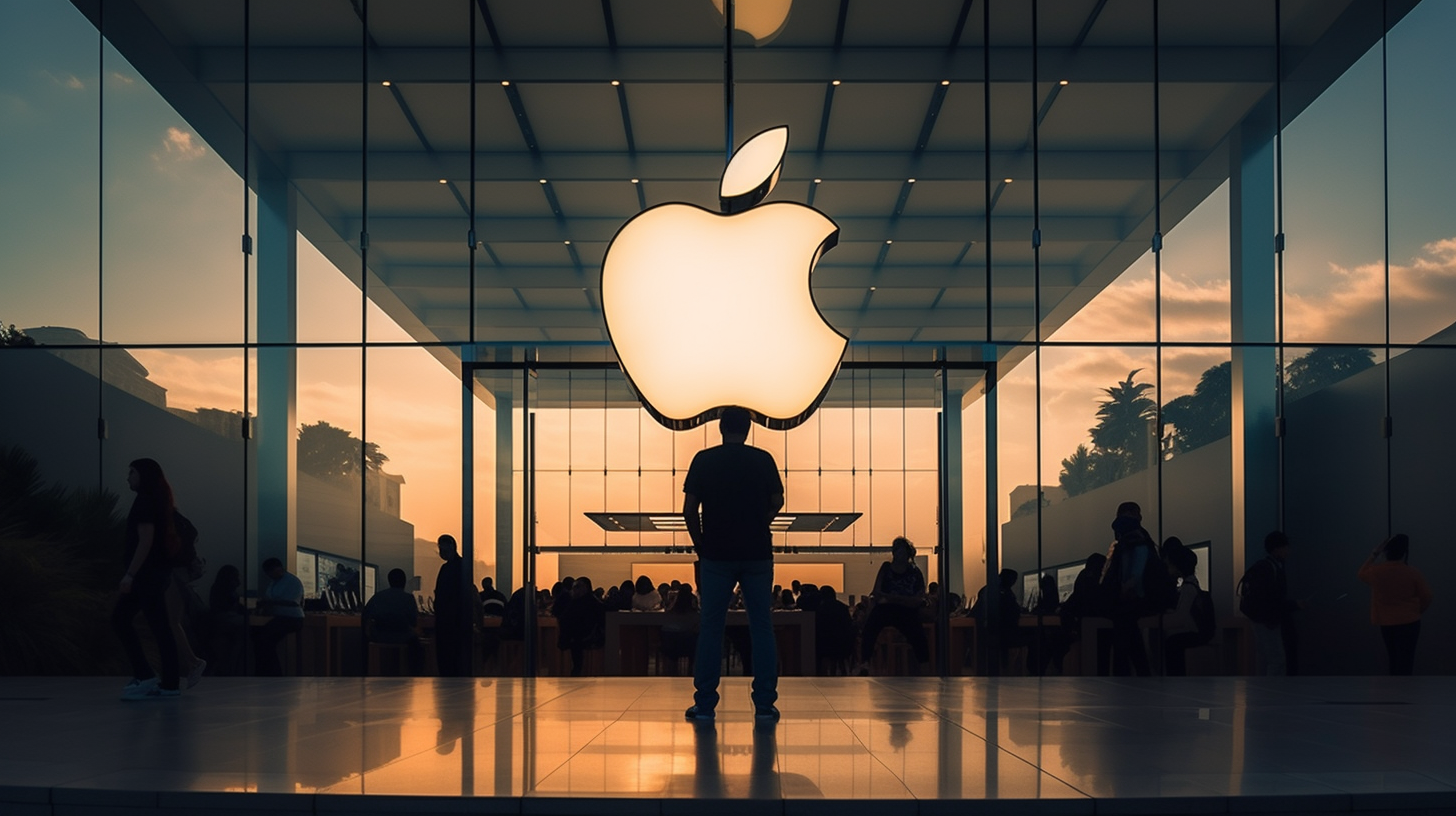
The differentiation strategy is used by Apple to position its products uniquely, lead trends, and “crush” competitors. Some strategic activities that Apple has used to outperform its rivals are demonstrated through:
- Breakthrough product design: With a unique design that changes with each new product launch, Apple has successfully attracted the public with its “premium” product design. Above all, the products of this “tech giant” always prioritize the user experience. This was also the key factor in the success of the iPod – one of the products that helped Apple achieve its current status. Read the detailed case study here: Systems Thinking – The Key to Success in Every Field
- Creating a unique path with a separate operating system: Instead of using the Windows or Android operating systems like other electronics companies, Apple created iOS – its own operating system. With high security, ease of use, and stability, Apple’s products are always highly regarded and sought after by users. Notably, Apple also built a connection between devices using iCloud, helping users control their personal information when changing phones or computers. It even allows linking different devices with just one simple step: logging into an iCloud account.
- Price differentiation strategy: Steve Jobs, co-founder of Apple, pursued a bold philosophy: create high-quality products with a corresponding price, while ensuring high profits. This strategy, contrary to the general market trend, has shaped Apple’s unique position in the technology industry. Apple’s products, even in the lowest price segment, are always aimed at the mid-range. However, customers are willing to pay a higher price because they receive corresponding value with a superior user experience. Apple is steadfast in its premium pricing strategy. They believe that product quality and user experience are the keys to building customer loyalty and affection, leading to sustainable long-term profits.
- Special product PR method: In a fiercely competitive technology market where all forms of communication are used for new products, Apple’s simplified communication has become a highlight. Apple only holds one product launch event to inform the media and customers about the new product’s design, features, and its differences from previously launched products. This not only piques customers’ curiosity through information published by the press but also makes them ready to pre-order products to experience them.
Read more:
5.2 Starbucks
Starbucks is a world-famous coffee brand. The Starbucks coffee company is headquartered in Seattle, Washington, USA; additionally, it has over 23,000 stores in 64 countries. This famous coffee brand has been mentioned as a case study on differentiation strategy in the book “Marketing Management” by Philip Kotler and Kevin Keller.
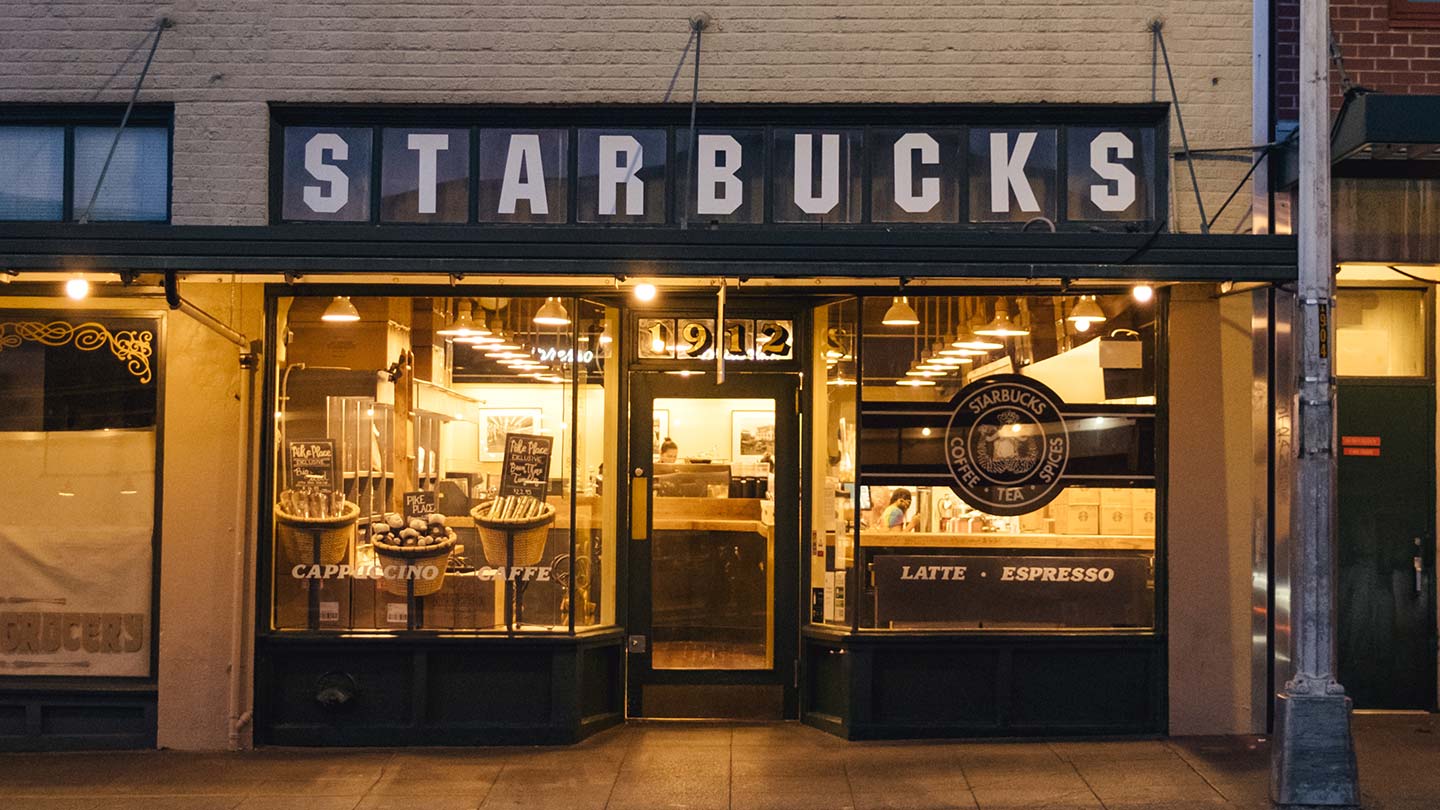
Operating as a single store in Seattle for 40 years, the coffee shop at Pike Place Market has become one of the largest brands in the global beverage industry thanks to its product differentiation strategy.
Coffee is always present in our daily lives. It is a common beverage that can be found in every store, and can even be brewed at home. Starbucks has made its products stand out through:
- Diverse beverage sizes: Starbucks has offered beverages in many different cup sizes, catering to the needs and preferences of all customers. The 5 cup sizes include: Short, Tall, Grande, Venti, and Trenta. The 3 most common sizes in Vietnam are Tall, Grande, and Venti.
- Rich menu: Like any other beverage shop, Starbucks sells all kinds of drinks, with or without coffee. Specifically: Espresso, Cappuccino, Iced Tea, etc. Offering many choices is one of the factors that attract customers to this “mermaid” coffee brand. Because in addition to the products mentioned above, Starbucks also offers organic-rich products and non-fat nut milks, tapping into the health-conscious trend of today’s youth.
- Drink customization: Starbucks has built an image as a brand that is very accommodating to its customers. To meet customers’ preferences, Starbucks allows them to request personalized flavors to be added to their drinks, such as caramel, extra coffee, or fresh cream.
- Price differentiation: Starbucks’ differentiation strategy is not limited to its products but also includes its pricing strategy. Instead of competing on low prices with other coffee shops, Starbucks in Vietnam is even sold at a higher price than in the US. They have used a premium price point to create differentiation and reinforce the image of a large, luxurious, and expensive brand.
- Enhancing the customer experience: “Starbucks doesn’t just sell coffee, it sells coffee culture.” Starbucks was the first brand to bring the self-service culture to Vietnam. This encourages young people to come and experience a different culture. From the modern, luxurious designed space to the cups with customers’ names written on them. Everything is aimed at imprinting in the customer’s mind the feeling of holding a cup of coffee from an expensive brand that expresses their own personality.
5.3 VinFast – Vingroup
VinFast is a Vietnamese automobile brand belonging to Vingroup Corporation. VinFast’s vision is to become a global smart electric vehicle company. This brand has laid the foundation for the electric car and motorcycle manufacturing industry in Vietnam, while also striving to contribute to promoting the electric vehicle revolution worldwide.

Leading the trend by applying a differentiation strategy to create a competitive advantage, VinFast is growing remarkably and securing its position in the market. To develop as it has today, VinFast has focused on demonstrating its differentiation through:
- Leading the green energy trend: VinFast pioneers the production of vehicles that use electric energy instead of fossil fuels, including electric motorbikes, electric cars, and electric buses. This is a groundbreaking strategy that contributes to environmental protection and aims for sustainable development.
- Impressive design: Possessing a luxurious and high-class design, VinFast vehicles are also integrated with an AI virtual assistant, providing a modern and convenient driving experience. This is a unique differentiating point compared to other competitors in the market.
- Perfect customer experience: VinFast focuses on providing thoughtful warranty and after-sales services, ensuring customer satisfaction. Additionally, the VinFast taxi service also creates opportunities for customers to directly experience the product quality.
- Reasonable pricing: Despite having a unique design and high quality, VinFast vehicles are still listed at competitive prices, suitable for the financial capacity of many customer segments. Thanks to this, VinFast is gradually affirming its position as a reputable and reliable car brand in Vietnam.
Vinfast has been making a difference with its green products, impressive designs, a perfect customer experience, and reasonable prices. This smart development strategy promises to take Vinfast even further in the future, affirming the Vietnamese brand’s position in the international market.
See more:
To build an effective differentiation strategy for a business, in addition to having a firm grasp of business administration knowledge, managers need to clearly understand the market in which the business operates, its competitors, their strategies, etc. Above all, creativity is essential to devise a unique strategy that stands out in a highly competitive market.
6. Conclusion
In this article, 1Office has shared specific information about differentiation strategy. Through definitions, classifications, and concrete case studies, we hope readers will gain a deeper understanding of this business strategy and successfully apply it to their businesses. To learn more about 1Office – the all-in-one business management platform, contact us today!




